Key takeaways
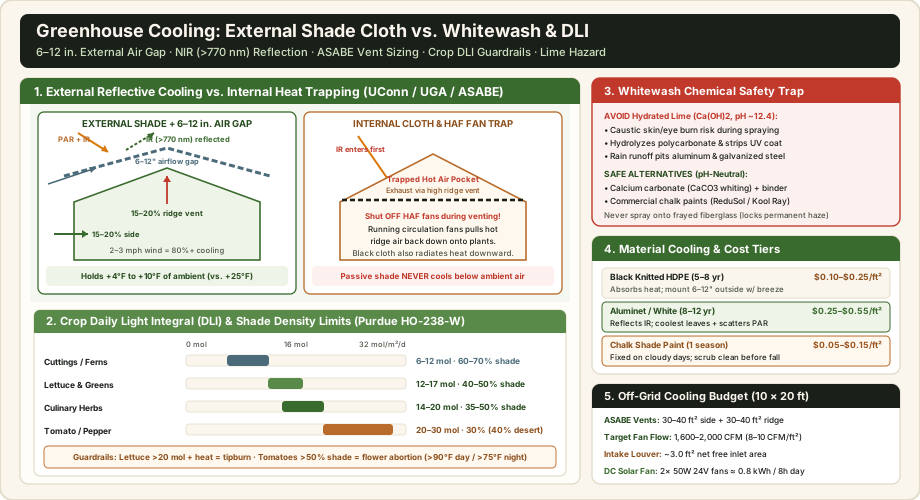
- Passive shading drops interior heat 10–20°F relative to an unshaded greenhouse (not below outdoor ambient air): pair shading with 15%–20% sidewall plus 15%–20% ridge vent area or 8–10 CFM/sq ft exhaust fans.
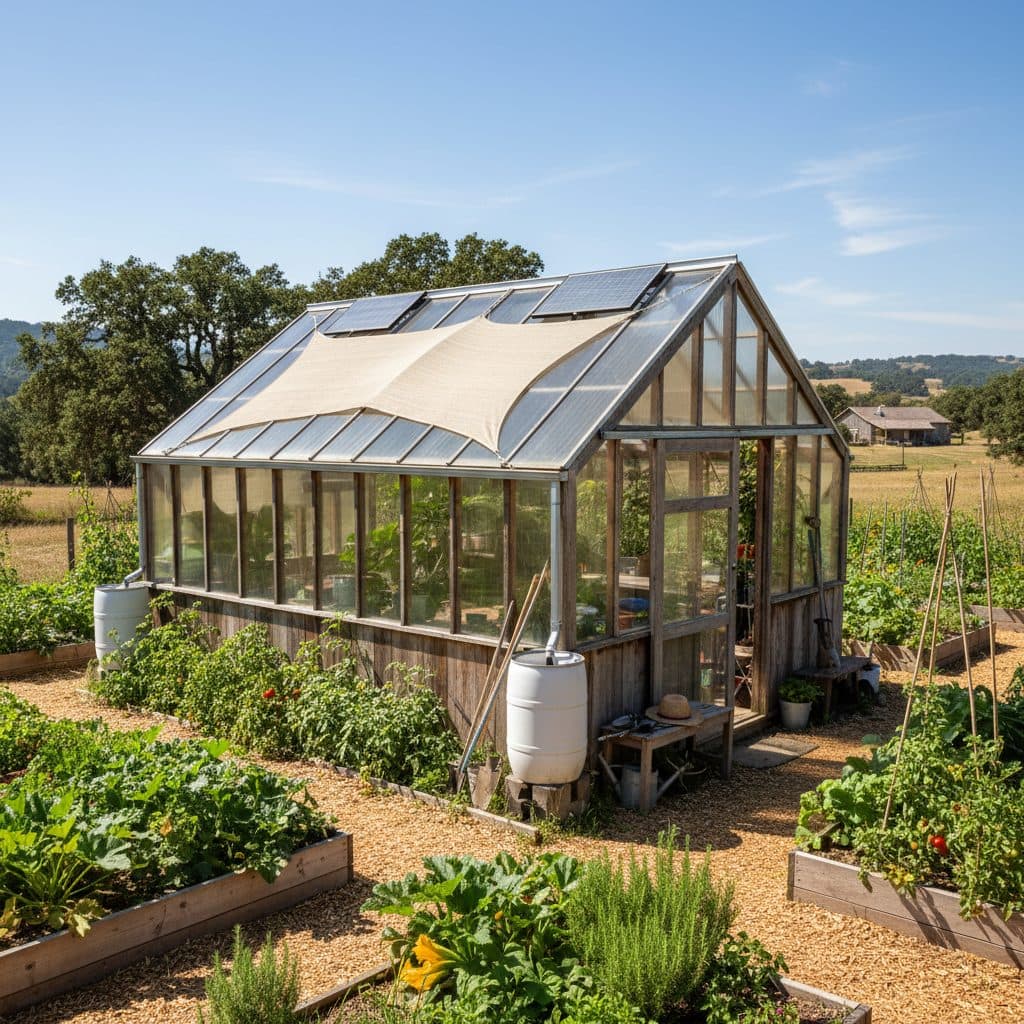
- Mount shade cloth externally on a 6–12 in. air gap rather than inside the glazing; reflective Aluminet or white cloth bounces near-infrared heat (>770 nm) off the roof while black cloth absorbs heat and radiates warmth downward.
- Never confuse calcium carbonate (CaCO3 whiting / chalk paint) with hydrated lime (Ca(OH)2, pH ~12.4): caustic hydrated lime causes skin/eye burns, pits aluminum framing, and hydrolyzes UV coatings on polycarbonate.
- Protect crop DLI targets instead of guessing shade density: fruiting tomatoes need 20–30 mol/m²/d (cap at 30%–40% shade), whereas lettuce thrives at 12–17 mol/m²/d and develops tipburn above 20 mol in heat.
- Shut off horizontal airflow (HAF) circulation fans during peak summer ridge venting so you do not stir hot trapped attic air back down onto plant canopies.
Quick answer: External shade cloth mounted 6 to 12 in. above glazing and pH-neutral greenhouse whitewash both cut incoming near-infrared solar heat before it converts to trapped interior air warmth, typically lowering peak greenhouse temperatures by 10 to 20°F compared with an unshaded house. Passive shading cannot cool air below outdoor ambient temperature—it limits heat buildup above outside air when paired with ASABE-sized vents (15%–20% of floor area on sidewalls plus 15%–20% at the ridge). Match shade density to crop Daily Light Integral (DLI) needs (30%–40% for tomatoes, 40%–50% for greens), choose reflective Aluminet or white cloth over heat-absorbing black HDPE when cooling matters most, and never spray caustic hydrated lime (calcium hydroxide) onto polycarbonate or aluminum frames.
Why Unshaded Greenhouses Overheat and What Passive Cooling Can Realistically Do
A greenhouse earns its keep in winter by trapping long-wave thermal radiation under glazing, letting less than 4% pass back out through glass or rigid plastic per University of Georgia (UGA) Extension Bulletin 792. On a bright July afternoon, however, solar radiation hits roughly 300 Btu per hour per square foot. Without heavy air exchange or shading, closed hobby greenhouses spike 20 to 30°F above outside air within an hour, pushing interior canopies past 110°F.
One physics boundary separates real greenhouse engineering from catalog hype: passive shade cloth and whitewash cannot cool indoor air below outdoor ambient dry-bulb temperature. Even a fan system exchanging one full house volume per minute holds an unshaded greenhouse about 8°F above outside air (UGA B792). Cutting solar heat gain by 40% to 50% with exterior shade drops an unshaded house by 10 to 20°F, bringing indoor temperatures within 4 to 10°F of outdoor shade air—without burning off-grid battery banks. Only wet evaporative cooling pads or high-pressure fogging in arid air drop temperatures below outdoor ambient.
Crop failure begins well before leaves scorch brown. Purdue Extension trials show tomatoes and peppers suffer pollen sterility and blossom drop once daytime air exceeds 90°F or nighttime air stays above 75°F, while fruit exposed above 93°F develops uneven yellow shoulders. Cool-season lettuce, spinach, and cilantro bolt bitter within days once root zones warm past 75–80°F. Before modifying your roof, check seasonal crop timing with local frost dates, heat pollen sterility triggers, and our greenhouse climate control guide.
Shade Cloth vs. Aluminet vs. Whitewash: Physics, Costs & Lifespan
Plants use Photosynthetically Active Radiation (PAR, 380–700 nm) for growth, while near-infrared wavelengths (>770 nm) contribute almost pure heat load (UConn IPM). Choosing a shading strategy means picking how you reflect or absorb that infrared energy before it warms pots, benches, and leaves.
Passive Greenhouse Shading Materials: Heat Rejection, Glazing Safety & Cost (UConn / Cornell / Industry Benchmarks)
Shading Option | How It Handles Solar Heat | Glazing & Frame Safety | Temp Drop vs. Unshaded House | Cost ($/sq ft) & Lifespan |
|---|---|---|---|---|
Black Knitted HDPE Cloth | Absorbs radiation; conducts warmth into air unless mounted outside with breeze | Safe on all glazings (pad sharp frame corners to stop abrasion) | 8–12°F outside (only 3–6°F inside without strong ridge exhaust) | $0.10–$0.25/sq ft · 5–8 yrs |
White Knitted HDPE Cloth | Reflects ~60%+ of intercepted solar load and diffuses light deeper into canopy | Safe on glass, poly, and polycarbonate; stays noticeably cooler than black | 10–16°F external with 6–12 in. air gap | $0.15–$0.35/sq ft · 5–8 yrs |
Aluminet (Metalized Reflective Screen) | Reflects both UV and NIR (>770 nm) outward; acts as winter night thermal blanket if hung inside | Safe on all frames; lightweight tension avoids stressing polycarbonate ridges | 12–18°F external; measurably cooler leaf temps than black HDPE | $0.25–$0.55/sq ft · 8–12 yrs |
Commercial Chalk Shade Paint (ReduSol / Kool Ray) | Reflects and scatters solar energy outside glazing before heat enters | Formulated pH-neutral for glass, poly film, and polycarbonate; avoid on frayed fiberglass | 10–18°F (static all summer, including overcast weeks) | $0.05–$0.15/sq ft · 1 season (4–6 mo) |
DIY Whiting Slurry (CaCO3 + Small Latex Binder) | Reflects 50%–70% radiation outside glazing while softening harsh shadows | Safe on glass and aluminum when using pure calcium carbonate (never hydrated lime) | 10–16°F (wears unevenly in heavy storms; needs fall scrubbing) | $0.02–$0.06/sq ft · 3–5 mo |
Why black shade cloth runs hotter than white or Aluminet
Agricultural engineering research by Dr. Dan Willits at NC State University (reported by UConn IPM) proved that while a 50% black shade cloth cuts 50% of direct light accurately, total thermal energy reduction can be closer to half that figure if heat conducts from the dark fabric straight into the glazing or interior air. Black fabric turns absorbed sunlight into hot plastic strands that radiate thermal warmth downward. White HDPE and metalized Aluminet screens reflect incoming infrared rays back into the sky before the fabric heats up, producing cooler canopy leaves and scattering diffuse light down to shaded lower tomato branches.
Whitewash chemical warning: calcium carbonate vs. caustic hydrated lime
Never spray hydrated lime onto polycarbonate or aluminum: Old DIY blogs routinely confuse whiting (calcium carbonate, CaCO3, near-neutral pH) with agricultural hydrated lime (calcium hydroxide, Ca(OH)2, pH ~12.4). Hydrated lime is strongly caustic: overhead spray drift burns eyes and skin, rainwater runoff pits bare aluminum glazing bars and galvanized fasteners, and high alkalinity chemically hydrolyzes polycarbonate, clouding panels, stripping their UV protective film, and triggering stress crazing. Oklahoma State Extension also warns against spraying liquid shade onto older frayed fiberglass, where pigment soaks into exposed fibers permanently.
If you coat glass or polycarbonate with liquid shade, use a commercial pH-neutral chalk suspension (such as ReduSol or Kool Ray) thinned to manufacturer specs—or mix 5 lb pure calcium carbonate (agricultural whiting) into 1 to 1.5 gallons warm water with at most 1 cup exterior white flat latex paint as a light rain binder. Straining through cheesecloth keeps backpack sprayer nozzles clear, and waiting for 24 dry hours prevents rain wash-off. Test a discreet bottom corner first on any plastic panel, and plan to scrub residues off with warm water and a soft brush before autumn low-light months arrive. Compare material choices against structural designs in our greenhouse styles and builds guide.
Daily Light Integral (DLI) & Shade Percentage by Crop
Shade cloth and whitewash reduce both heat and photosynthetically active light together. Purdue Extension (HO-238-W) and Cornell Controlled Environment Agriculture (CEA) research emphasize managing Daily Light Integral (DLI)—measured in moles of PAR photons per square meter per day (mol/m²/d)—instead of throwing a heavy 60% tarp over every bench by habit.
Target DLI, Thermal Cutoffs & Shade Density by Greenhouse Crop Group (Purdue / Cornell / UGA)
Crop Group | Target DLI (mol/m²/d) | Heat Stress Threshold | Ideal Shade % (Temperate vs. Intense Sun) | Over-Shading & Over-Light Traps |
|---|---|---|---|---|
Cuttings, Seedlings & Shade Ornamentals | 6–12 mol/m²/d | >85°F leaf scorch / rapid wilt | 60%–70% shade (higher during first 7 days of propagation) | Uncovered high sun desiccates unrooted stems within hours |
12–17 mol/m²/d | >75–80°F bolting & bitterness | 40%–50% shade (50%–60% in arid southern summer sun) | Exceeding 20 mol/m²/d under summer heat triggers calcium tipburn in lettuce heads | |
Culinary Herbs (Sweet Basil, Parsley, Cilantro) | 14–20 mol/m²/d | >85–90°F premature bolting (cilantro >75°F) | 35%–50% shade | Over-shading past 60% stretches basil internodes and drops essential-oil flavor |
20–30+ mol/m²/d | >90°F day / >75°F night pollen drop | 30% moderate summers; 35%–40% high-UV arid regions | Applying >= 50% permanent shade cuts DLI below 18 mol on cloudy weeks, aborting flowers |
Unshaded mid-summer outdoor sunlight routinely tops 45 to 60 mol/m²/d across clear US regions, so a 30% shade cloth still leaves 25–35 mol/m²/d inside a clean glazing roof—plenty for heavy fruiting tomatoes and cucumbers while dropping peak midday tunnel temperatures roughly 10°F (from 119°F down to 109°F in Purdue high-tunnel trials). In foggy coastal or northern cloud belts, static whitewash becomes a liability during multi-day overcast streaks where natural DLI dips under 15 mol; retractable cloths let you pull shade open on gray days and save autumn light. See specific outdoor/tunnel crop strategies in shade cloth density by crop, shade cloth percentage installation, preventing tomato blossom drop, pepper blossom drop fixes, and stopping lettuce and spinach bolting.
Installing External Shade Cloth Without Wind Tearing or Condensation Traps
Where you place the cloth changes performance as much as the weave itself. Always mount shade fabric outside the glazing whenever structure height allows, suspending it 6 to 12 in. above the roof on PVC/steel standoffs, timber battens, or tensioned ridge cables. Wind moving through that 6–12 in. convective channel strips intercepted infrared heat before it ever conducts into the greenhouse skin.
- Account for material shrinkage and cut-edge fraying: UConn Extension notes polypropylene cloth shrinks roughly 1% and fireproof saran shrinks 3% after sun exposure, so hang woven fabrics with slight slack rather than drum-tight tension. Lock-stitched knitted HDPE resists unravelling when cut around exhaust vents and lasts 5–10+ years.
- Anchor for >= 30 mph summer squalls: Attach perimeter grommets every 18–24 in. using UV-resistant bungee ball ties or wiggle-wire spring channels locked to steel purlins, never loose zip ties that snap after one UV season. Pad sharp ridge bolts and gutter corners with foam pipe insulation or old poly scraps so wind gusts do not saw holes through the mesh.
- Avoid wetting shade cloth in humid regions: Intermittent roof misting over external shade cloth drops arid desert interiors another 5–10°F via evaporation, yet backfires badly in humid climates and on hard well water—leaving chalky calcium scale permanently etched onto glass/polycarbonate while elevating indoor humidity into the Botrytis and downy-mildew danger zone.
- Store clean and dry before autumn frost: Take cloths down in late August or September once afternoon highs drop below 80°F, rinse off summer pollen and dust with a garden hose, let dry completely, and roll inside a rodent-proof bin so full winter sunlight reaches winter high-tunnel crops and strawberries.
If you must use an internal shade screen inside a tall hoop or gable house (strung on 12–14 gauge galvanized support wires per Cornell HORT 494), pick reflective Aluminet over black mesh and install high ridge vents directly above the curtain. Remember Cornell and UConn's dual-purpose tip: an interior Aluminet curtain pulled closed at sunset doubles as a winter thermal blanket, trapping up to 20%–35% more radiant heat overnight.
ASABE Ventilation Sizing & Realistic Off-Grid Solar Fan Math
Shade alone fails if trapped warm air has nowhere to exit. University of Connecticut IPM and Farm Energy Extension highlight the American Society of Agricultural and Biological Engineers (ASABE) passive ventilation rule: size combined sidewall intake vents at 15% to 20% of greenhouse floor area and combined ridge exhaust vents at 15% to 20% of floor area (30%–40% combined). Under just a gentle 2 to 3 mph outdoor breeze, wind sweeping across an open ridge vent drives 80%+ of total cooling exchange—requiring zero electricity when paired with wax-piston roof openers and roll-up sidewalls.
Turn OFF horizontal airflow (HAF) fans during peak summer venting: UConn and Farm Energy Extension warn growers against leaving horizontal mixing fans running while trying to vent a 95°F greenhouse naturally. HAF fans destratify the rising thermal column, stirring hot ceiling air straight back down onto tomato and lettuce leaves instead of letting buoyancy exhaust it cleanly out the ridge.
When buildings or trees block prevailing breezes, size mechanical exhaust fans for 8 to 10 CFM per square foot of floor area (10 CFM/sq ft if unshaded) with 1.5 sq ft of net intake louver area per 1,000 CFM of fan flow (UGA B792). Off-grid homesteaders skip massive inverters by running high-efficiency brushless 12V or 24V DC solar exhaust fans wired straight from dedicated PV panels during daylight peak sun—aligning fan power with solar gain while sparing household battery banks.
Off-Grid Passive Vent & DC Solar Fan Sizing by Backyard Greenhouse Footprint
Greenhouse Footprint | ASABE Passive Vents (Side + Ridge) | Mechanical Target (8–10 CFM/ft²) | Off-Grid 24V DC Solar Fan Setup | Daily Battery-Free Solar Draw (8 hr) |
|---|---|---|---|---|
8 × 12 ft (96 sq ft) | 15–19 ft² side + 15–19 ft² ridge (2–3 wax openers) | 770–960 CFM (1.4 ft² intake louver) | 1× 16 in. brushless 24V DC fan (45–60 W) + 100 W PV panel | 0.36–0.48 kWh/day (vs. ~2.5 kWh AC fan) |
10 × 20 ft (200 sq ft) | 30–40 ft² side + 30–40 ft² ridge (roll-up sides) | 1,600–2,000 CFM (3.0 ft² intake louver) | 2× 50 W 24V DC fans (100 W total) + 200 W PV panel | 0.80 kWh/day (zero drain on house LiFePO4 bank) |
14 × 32 ft (448 sq ft) | 68–90 ft² side + 68–90 ft² ridge (continuous ridge) | 3,600–4,500 CFM (6.5 ft² intake louver) | 2× 24 in. DC shutter fans (220–280 W total) + 400 W PV | 1.75–2.25 kWh/day (runs strongest at solar noon) |
Combine exterior shading, ASABE ventilation, and morning drip irrigation with consistent bumblebee or hand shaking via our greenhouse tomato pollination guide so warm-season blossoms still set fruit cleanly. For panel wiring, solar fan sizing, and airflow layouts across homestead outbuildings, read off-grid greenhouse summer cooling, solar greenhouse fans, passive homestead ventilation, shade structures for vegetables, cooling summer greens under shade, and off-grid solar basics alongside tiny-home solar planning and off-grid living systems.