Key takeaways
- Identify your succulents’ cold hardiness; most tender varieties cannot tolerate temperatures below 40°F.
- Thoroughly inspect and treat plants for pests like mealybugs or spider mites before bringing them indoors.
- Provide ample light, ideally 10-14 hours daily from a south-facing window or supplemental grow lights.
- Reduce watering significantly during winter dormancy, often to once every 3-4 weeks, to prevent rot.
- Maintain cool, stable indoor temperatures, ideally between 50°F and 65°F, to encourage healthy dormancy.
- Gradually reintroduce succulents to outdoor conditions in spring to prevent sunburn and shock.
Quick answer: To overwinter tender succulents in USDA Zone 6, bring them indoors before temperatures drop below 40°F. Provide 10-14 hours of supplemental light, maintain cool indoor temperatures (50-65°F), and significantly reduce watering.
For many growers across the US, especially those in colder regions like USDA zones 5 or 6, the arrival of autumn brings a familiar dilemma: how to protect beloved tender succulents from the impending freeze. While many succulents are native to arid, warm climates, some can tolerate surprisingly low temperatures. However, varieties like Echeveria, most Kalanchoe, and many Crassula species simply won’t survive outdoor temperatures consistently below 40°F. Bringing them inside isn’t just about survival; it’s about providing the right conditions to ensure they thrive and return to their outdoor glory next spring.
Successfully overwintering these plants indoors requires more than just moving them inside a warm house. It demands a deliberate approach to light, temperature, humidity, and pest management. Without careful planning, you might face issues like etiolation, rot, or pest infestations that can quickly decimate your collection. This guide will walk you through the practical steps, from preparing your plants in late summer to transitioning them back outside when the last frost has passed so they’re ready for another growing season.
Preparing your succulents for their indoor transition
The move indoors is a significant stressor for succulents, so proper preparation matters for their success. Begin this process in late summer or early fall, typically when nighttime temperatures start consistently dipping below 50°F in USDA zone 6, but before they reach 40°F. A good rule of thumb is to bring them in about two weeks before your region’s average first frost date. For example, in parts of Ohio, this might be mid-September.
pest inspection and treatment
Before any plant crosses your threshold, a thorough pest inspection is non-negotiable. Outdoor plants can harbor a variety of unwelcome guests, including mealybugs, spider mites, and scale insects. Inspect the undersides of leaves, stem joints, and the soil surface. If you find pests, treat them proactively. A common method involves using an insecticidal soap. For targeted pests like mealybugs, applying 70% isopropyl alcohol directly with a cotton swab is also effective. Repeat treatments every 5-7 days for a few weeks to break the pest life cycle. You might also consider a systemic insecticide for particularly stubborn infestations or as a preventative measure, following product instructions carefully. This step matters to prevent an indoor pest outbreak that could affect all your houseplants.
- Inspect all leaf surfaces, front and back.
- Check stem joints and crevices for hidden pests.
- Examine the soil surface and pot drainage holes.
- Treat any detected pests with appropriate solutions.
- Quarantine new or treated plants for two to three weeks.
Creating the optimal indoor environment
Once your succulents are pest-free and ready, their new indoor home needs to mimic their natural arid conditions as closely as possible. The three pillars of a successful indoor environment are light, temperature, and air circulation. Without these, even the most resilient succulents will struggle. Many succulents, like those from the southwestern US or Mexico, are accustomed to intense, direct sunlight for 10-14 hours daily. Replicating this indoors is the biggest hurdle for growers in places like upstate New York or Michigan.
light requirements and solutions
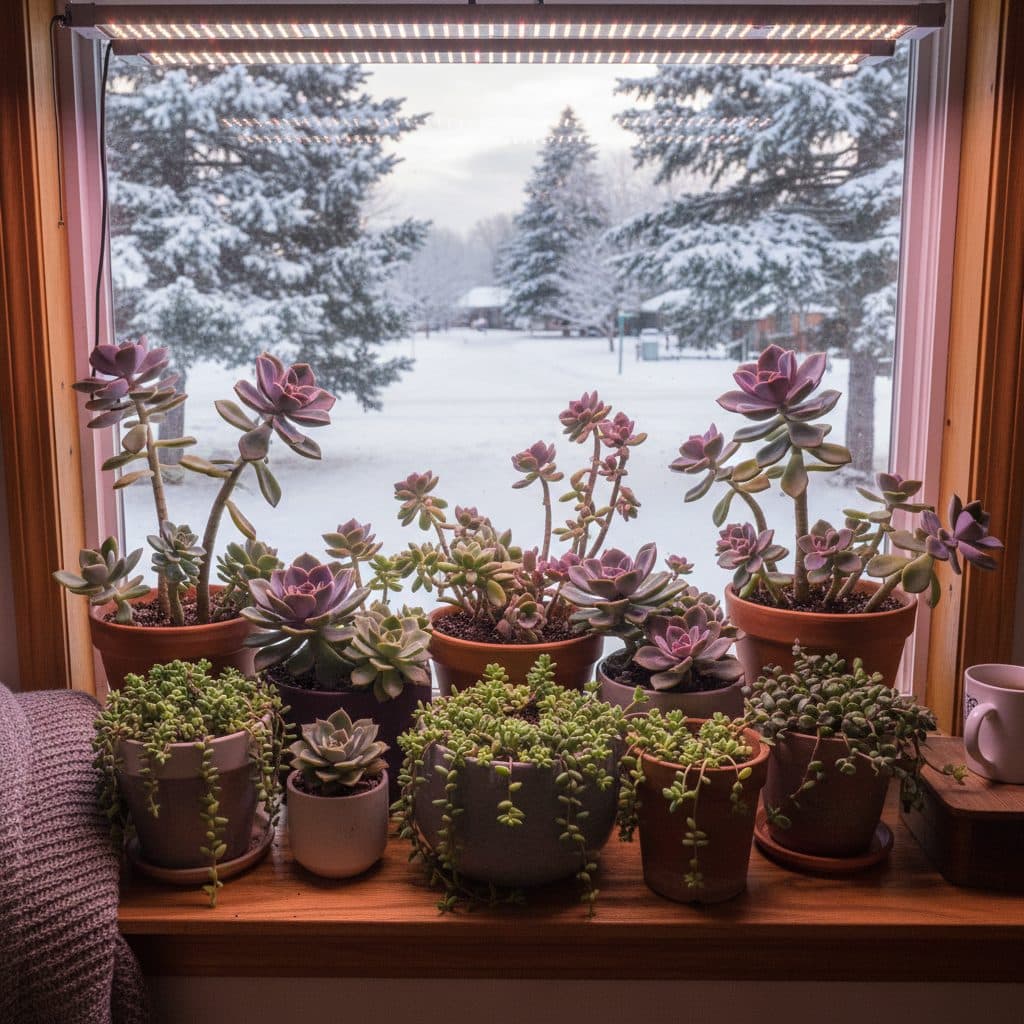
Most homes simply don’t provide enough natural light, especially during the short, cloudy days of winter. A south-facing window is often the best natural option, but even then, light intensity can be significantly lower than outdoors. To prevent etiolation (stretching and weakening due to insufficient light), supplemental grow lights are often essential. Full-spectrum LED grow lights are energy-efficient and effective, providing the necessary wavelengths for photosynthesis. Position lights 6-12 inches above the plants, ensuring they receive 10-14 hours of light per day. You can use a timer to maintain a consistent light schedule. For a small collection, a single 24-watt LED bar can make a significant difference. Consider using a reflective indoor grow tent to maximize light efficiency and maintain stable temperatures for a larger collection.
- Provide 10-14 hours of light daily.
- Use full-spectrum LED grow lights for best results.
- Position lights 6-12 inches above plant foliage.
- Utilize timers for consistent light cycles.
- Consider reflective surfaces or grow tents to amplify light.
Winter care and dormancy management
Once indoors, succulents enter a period of reduced growth, often referred to as dormancy. This metabolic slowdown is a natural response to shorter days and lower light intensity, similar to how many organisms adapt to cold conditions [2]. Your care routine must adjust significantly from their active growing season. Overwatering is the single biggest killer of indoor succulents during winter, especially in less permeable indoor potting mixes.
watering and feeding during dormancy
During dormancy, succulents require significantly less water. The frequency will depend on your home’s temperature and humidity, but a good starting point is to water thoroughly only when the soil is completely dry, typically every 3-4 weeks. For plants in terracotta pots, which promote faster drying, this might be every two weeks. For plastic pots, it could be longer. Always check the soil moisture 2-3 inches deep before watering. When you do water, soak the soil until water drains from the bottom, then empty any excess from the saucer. Avoid misting, as succulents prefer dry air. Fertilizing is generally unnecessary during winter dormancy. The plants are not actively growing, and excess nutrients can lead to weak, leggy growth or even root burn. Resume a diluted feeding schedule (e.g., a 1:4 dilution of a balanced succulent fertilizer) only when signs of active growth return in spring.
- Water only when soil is completely dry, typically every 3-4 weeks.
- Avoid misting or increasing ambient humidity.
- Do not fertilize during the dormant winter months.
- Ensure excellent drainage and empty saucers promptly.
- Monitor for signs of thirst, like slightly wrinkled leaves.
Addressing common indoor challenges
Even with the best intentions, overwintering succulents indoors can present a few common challenges. Recognizing these issues early and knowing how to address them can save your plants. These problems often stem from the artificial indoor environment and the plants’ natural adaptations to outdoor conditions. For instance, the stress of moving indoors can sometimes trigger changes in plant gene expression, similar to how other organisms respond to environmental stressors [2, 3, 4].
identifying and treating pests
Despite your best efforts during the initial inspection, pests can sometimes emerge. Mealybugs are notorious for hiding and can quickly multiply in warm, dry indoor environments. Look for white, cottony masses in leaf axils. Spider mites, though tiny, can cause stippling on leaves and fine webbing. Scale insects appear as small, immobile bumps. If you spot pests, isolate the affected plant immediately. Treat mealybugs and scale by dabbing them directly with a cotton swab dipped in 70% isopropyl alcohol. For spider mites, increase humidity slightly with a pebble tray (though avoid misting the plant itself) and use insecticidal soap. A consistent inspection schedule, perhaps once every two weeks, can help catch infestations early. Remember, persistent pest issues can be a sign of underlying plant stress, so also check light and watering conditions.
- Isolate any plant showing signs of pest infestation.
- Treat mealybugs and scale with 70% isopropyl alcohol.
- Combat spider mites with insecticidal soap and increased ambient humidity.
- Inspect plants every two weeks to catch issues early.
- Address underlying stress factors like insufficient light or improper watering.
Transitioning back outdoors in spring
As winter recedes and the threat of frost diminishes, typically around late April or early May in USDA zone 6, it’s time to prepare your succulents for their return to the great outdoors. This transition needs to be gradual to prevent shock, especially from intense sunlight. Just as you wouldn’t send a person who’s been indoors all winter directly into a summer desert, your succulents need a hardening-off period.
the hardening-off process
Start by moving your plants to a sheltered, shady spot outdoors for a few hours each day, gradually increasing their exposure to brighter light over a period of 10-14 days. A porch or under a dense tree canopy can work well. Begin with 2-3 hours of morning sun, then slowly extend the time and intensity. After a week, they can tolerate partial sun for half the day. By the end of two weeks, most tender succulents should be ready for their full sun exposure. This process helps the plants adjust their cellular structure and pigment production to handle increased UV radiation, preventing severe sunburn which can permanently scar leaves. Once hardened off, they can be repotted if necessary, perhaps into a slightly larger container with fresh, well-draining succulent mix, or refreshed with a top dressing of compost. This is also a good time to resume a regular watering and feeding schedule. For tips on companion planting, you might explore resources like A permaculture garden plan to integrate your succulents into a broader landscape design.
- Begin hardening off when nighttime temperatures consistently stay above 50°F.
- Start with 2-3 hours of morning sun in a sheltered location.
- Gradually increase sun exposure over 10-14 days.
- Monitor plants for signs of stress or sunburn.
- Repot or refresh soil as needed after hardening off.
Temperature Threshold: Most tender succulents, including many <i>Echeveria</i> and <i>Kalanchoe</i>, will suffer damage or death if exposed to temperatures below 40°F for extended periods.
Light Duration: Indoor succulents require 10-14 hours of bright, direct light daily during winter to prevent etiolation and maintain compact growth.
Winter Watering: Reduce watering frequency to once every 3-4 weeks for most dormant succulents; make sure the soil is completely dry before rewatering.
Frequently asked questions
What temperature is too cold for most tender succulents?
Most tender succulents, such as <i>Echeveria</i> and <i>Kalanchoe</i>, cannot tolerate temperatures consistently below 40°F (4°C). Prolonged exposure to these low temperatures can cause cell damage and lead to plant death, especially in regions like USDA zone 5.
How much light do succulents need indoors during winter?
Indoor succulents require a significant amount of light, ideally 10-14 hours of bright, direct light per day. A south-facing window is best, but supplemental full-spectrum LED grow lights positioned 6-12 inches above the plants are often necessary to prevent stretching and maintain compact growth.
How often should I water my succulents indoors in winter?
During their winter dormancy, succulents need much less water. You should only water them when the soil is completely dry to the touch, typically every 3-4 weeks. Overwatering is a common issue that can lead to root rot in indoor environments with reduced light and cooler temperatures.
What are common pests for indoor succulents and how do I treat them?
Common indoor succulent pests include mealybugs, spider mites, and scale insects. Mealybugs can be treated by dabbing them with a cotton swab dipped in 70% isopropyl alcohol. Spider mites often respond to insecticidal soap. Regular inspection, perhaps every two weeks, helps catch infestations early.
When is the best time to move succulents back outside in spring?
The best time to move succulents back outside is after all danger of frost has passed, and nighttime temperatures consistently remain above 50°F (10°C). This usually occurs in late April or early May for regions like USDA zone 6, followed by a 10-14 day hardening-off period.
References
- Insect cold-hardiness (1993). Insect cold-hardiness.
- Metabolism during overwintering in two species of cold-hardy goldenrod gall insects. (2023). Metabolism during overwintering in two species of cold-hardy goldenrod gall insects..
- Peer Review #3 of “Gene expression analysis of overwintering mountain pine beetle larvae suggests multiple systems involved in overwintering stress, cold hardin (2016). Peer Review #3 of “Gene expression analysis of overwintering mountain pine beetle larvae suggests multiple systems involved in overwintering stress, cold hardin.
- Peer Review #2 of “Gene expression analysis of overwintering mountain pine beetle larvae suggests multiple systems involved in overwintering stress, cold hardin (2016). Peer Review #2 of “Gene expression analysis of overwintering mountain pine beetle larvae suggests multiple systems involved in overwintering stress, cold hardin.
- Peer Review #1 of “Gene expression analysis of overwintering mountain pine beetle larvae suggests multiple systems involved in overwintering stress, cold hardin (2016). Peer Review #1 of “Gene expression analysis of overwintering mountain pine beetle larvae suggests multiple systems involved in overwintering stress, cold hardin.
- USDA Natural Resources Conservation Service (2024). USDA Natural Resources Conservation Service.