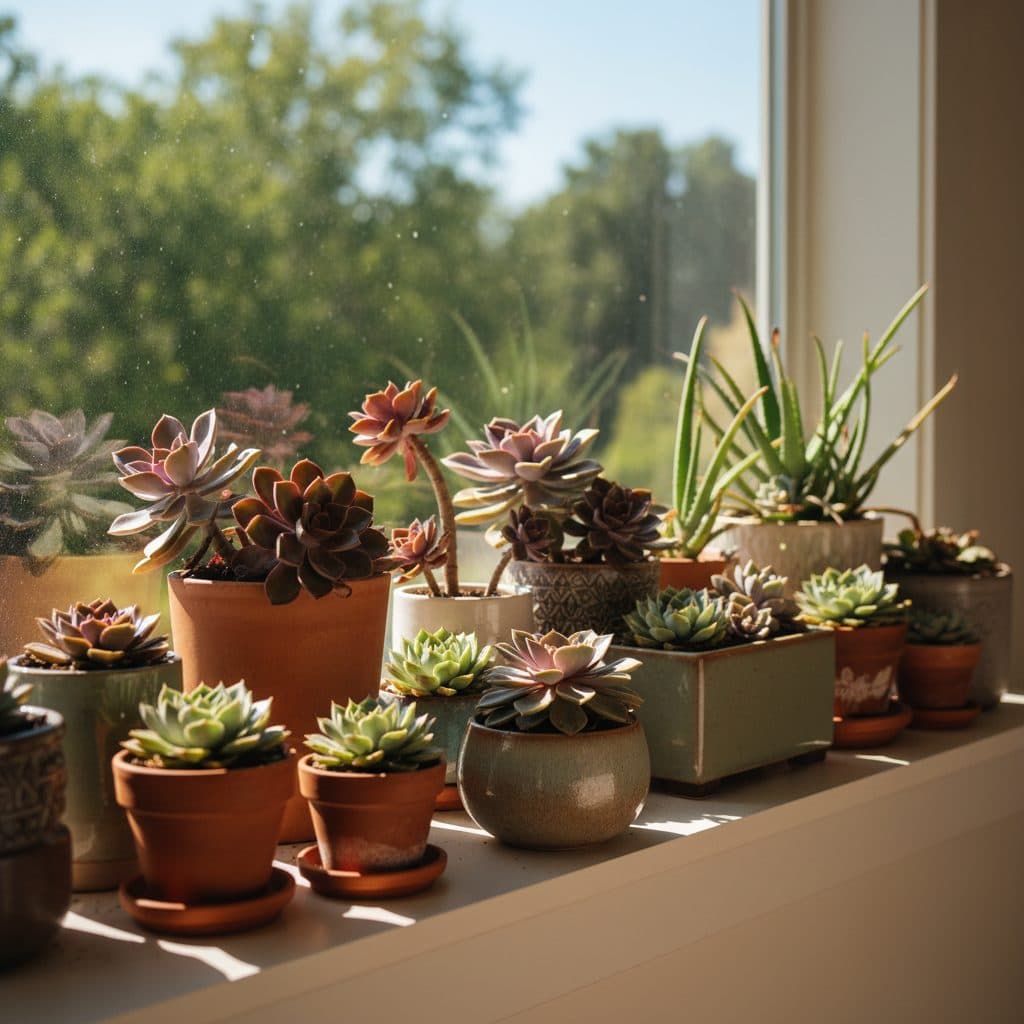
Key takeaways
- Always choose containers with at least one drainage hole for succulents to prevent waterlogging.
- Terracotta pots are often ideal for succulents due to their porous nature, which promotes faster soil drying.
- Avoid adding a drainage layer of gravel or rocks at the bottom of pots; it can create a ‘perched water table’ and hinder drainage.
- Use a fast-draining potting mix specifically formulated for succulents and cacti, typically containing 30-50% inorganic amendments.
- Water succulents thoroughly but infrequently, allowing the soil to dry completely between waterings, often every two to four weeks.
- Proper container choice and potting mix significantly reduce the risk of root rot, which causes a majority of indoor succulent failures.
Quick answer: For indoor succulents, always choose containers with drainage holes and use a fast-draining potting mix. Terracotta pots are often ideal due to their porosity, which helps prevent waterlogging and root rot.
In the diverse climates of the United States, from the arid Southwest to the humid Southeast, indoor succulents offer a touch of resilient beauty. Many US homes, from apartments in New York City to houses in rural Kansas, host these drought-tolerant plants, but success often hinges on one critical factor: proper drainage. Overwatering is the leading cause of succulent demise, accounting for a majority of plant failures in indoor settings. This guide will walk you through selecting the right containers and understanding effective drainage strategies so your succulents thrive for years.
Choosing the correct pot and understanding how water moves through soil are fundamental principles for any indoor gardener, especially when dealing with plants adapted to dry conditions. While it might seem counterintuitive, the container itself plays a significant role in managing soil moisture, influencing how often you need to water and how quickly the roots dry out. We’ll explore various materials, the absolute necessity of drainage holes, and why some common drainage “hacks” actually do more harm than good, affecting many new growers.
Understanding succulent needs for indoor growth
Succulents are remarkable plants, evolved to thrive in environments with infrequent rainfall, such as the deserts of Arizona or coastal California. Their ability to store water in their leaves, stems, or roots means they do not tolerate prolonged periods of wet soil. For instance, a typical Echeveria can store enough water to last several weeks without additional moisture. Their shallow root systems are adapted to quickly absorb surface water and then dry out. When grown indoors in a US home, these plants require specific conditions to mimic their natural habitat, particularly concerning soil moisture levels. The biggest threat to their health is excessive water around their roots, which can quickly lead to root rot within days if the soil remains saturated.
The danger of overwatering and root rot
Root rot occurs when roots are deprived of oxygen due to standing water, causing them to decay. This condition can affect many indoor succulents if drainage is inadequate. Ensuring proper oxygen exchange around the roots is as critical as providing adequate light, perhaps 6-8 hours of bright, indirect light daily. A container and potting mix that facilitate rapid water drainage and air circulation are therefore paramount. Without these, even careful watering practices may not be enough to prevent issues. Most succulents prefer indoor temperatures between 60°F and 80°F, which is typical for many US residences.
- Succulents store water in specialized leaves or stems.
- They prefer infrequent, deep watering, allowing soil to dry.
- Their roots need oxygen to function properly.
- Standing water in the pot causes root rot within days.
- Most species thrive in indoor temperatures of 60-80°F.
Selecting the right container material
The material of your succulent container plays a significant role in how quickly the potting mix dries out, directly impacting the plant’s health. For instance, a porous terracotta pot can promote faster evaporation of soil moisture compared to a glazed ceramic one. This evaporative cooling effect can be particularly beneficial in warmer climates like those in Florida or Texas, helping to prevent the soil from becoming waterlogged. Terracotta pots are generally inexpensive, often costing less than $10 for a 6 in pot, and are widely available across the US. However, they can dry out the soil more rapidly, sometimes requiring watering every two weeks in hot conditions.
Pros and cons of common pot materials
In contrast, glazed ceramic and plastic pots retain moisture for longer periods. Glazed ceramic pots, while decorative and often costing $15-$30 for a 6 in size, do not allow water to evaporate through their sides. Plastic pots, typically under $5 for a 6 in pot, are lightweight and durable, making them a practical choice for many growers, but their high water retention capacity means careful watering is even more critical. Metal containers can be aesthetically pleasing, but they can heat up quickly in direct sunlight, potentially damaging roots, and may rust over time. Wooden containers offer good insulation but can rot if constantly wet. Always consider the pot’s drainage hole design regardless of material.
- Terracotta pots promote faster soil drying due to porosity.
- Glazed ceramic and plastic containers retain more moisture.
- Plastic pots are lightweight, inexpensive, and durable.
- Metal containers can heat up rapidly in direct sun.
- Wood containers offer insulation but are prone to rot over time.
The non-negotiable drainage hole
Perhaps the single most important feature of any succulent container is the presence of at least one drainage hole. This is not merely a suggestion; it is a fundamental requirement for preventing root rot. Without a hole, excess water has no escape, creating a saturated environment at the bottom of the pot. This leads to a lack of oxygen for the roots, a condition that can kill a succulent within a few days. Even if you water carefully, a pot without drainage is a significant risk. For most indoor succulent pots up to 12 in diameter, a single drainage hole of at least 1/2 in to 3/4 in is generally sufficient, allowing for effective excess water removal.
Debunking the drainage layer myth
A common misconception, affecting many new growers, is that adding a layer of gravel, pot shards, or sand at the bottom of a container improves drainage. However, research from institutions like the University of Illinois (2013) has debunked this idea, indicating that such layers actually create a “perched water table” [4]. This phenomenon occurs because water does not easily move from a finer-textured material (potting mix) into a coarser-textured material (gravel) until the finer material is fully saturated. This means the lower portion of your potting mix remains waterlogged, effectively reducing the functional soil volume by up to 15% and increasing the risk of root rot [3]. Therefore, a direct link between the potting mix and the drainage hole matters for proper root zone aeration. For more on soil and drainage, see Choosing raised bed materials and protection.
- A single drainage hole matters for pots up to 12 in diameter.
- Drill holes in plastic pots using a 1/4 in or larger bit.
- Avoid adding gravel or pot shards at the bottom of pots.
- The “perched water table” traps water above a drainage layer.
- Water should exit the pot within 30 seconds of thorough watering.
The critical role of potting mix
Even with the perfect container and drainage hole, the wrong potting mix can quickly lead to succulent failure. Standard garden soil or general-purpose potting mix is too dense for succulents, retaining too much moisture and compacting over time. For example, typical garden soil can hold a significant portion of its volume in water, far too much for drought-adapted plants. Succulents require a gritty texture that allows water to drain rapidly and provides ample aeration properties for their roots. A good succulent mix contains a high percentage of inorganic amendments.
Crafting the ideal fast-draining soil
A fast-draining mix typically consists of less than 20% organic matter and 30-50% inorganic amendments like perlite, pumice, or coarse sand. Perlite, a lightweight volcanic rock, can improve drainage when added to soil. Pumice, another volcanic material, is also excellent for improving drainage and aeration. You can create your own mix using equal parts potting soil, coarse sand (like horticultural sand, not play sand), and perlite or pumice. Alternatively, many commercial succulent and cacti mixes are available, formulated to provide the ideal water retention capacity and drainage. Repotting every one to two years helps refresh the soil and provides fresh nutrients [6]. For more on soil, consider How to grow celery: from indoor seed to a long, tender harvest.
- A good mix contains less than 20% organic matter.
- Perlite or pumice should make up 30-50% of the mix.
- Avoid standard garden soil, which is too dense and holds too much water.
- Commercial succulent mixes are readily available at garden centers.
- Repot every one to two years to refresh the soil and nutrients.
Complementary watering and maintenance practices
Even with the best container and potting mix, proper watering techniques are essential for succulent health. The “soak and dry” method is widely recommended: water thoroughly until it drains from the bottom of the pot, then allow the soil to dry out completely before watering again. This can mean watering every two to four weeks for many indoor succulents in US homes, depending on factors like light and temperature. For example, a succulent in a sunny window in Arizona might need water every two weeks, while one in a darker corner in Washington State might only need it once a month. A soil moisture meter can help accurately gauge when the soil is dry 2-3 in deep.
Seasonal adjustments and light considerations
Succulents generally require less water during their dormant period, typically in winter months. Reducing watering frequency to once every 3-4 weeks during this time can prevent overwatering. Adequate bright indirect light also matters, as plants in low light conditions use less water and are more susceptible to rot. Consider supplemental lighting, such as a grow tent, for optimal growth in darker months or regions, as discussed in Reflective Indoor Grow Tent. Good airflow circulation around your plants also assists in drying out the soil surface and preventing fungal issues. By combining the right container, an appropriate potting mix, and mindful watering, your indoor succulents will thrive.
- Water thoroughly until water drains from the bottom.
- Allow the soil to dry completely before rewatering.
- Check soil moisture 2-3 in deep before deciding to water.
- Reduce watering frequency in winter months, often to once every 3-4 weeks.
- Ensure good air circulation around plants to aid drying.
Root Rot Risk: Overwatering causes a majority of indoor succulent failures across US homes, primarily due to inadequate drainage.
Drainage Myth: Adding a gravel layer at the bottom of a pot can reduce the usable soil volume by up to 15% and create a perched water table, hindering drainage [3].
Frequently asked questions
Can I use a container without drainage holes if I’m careful with watering?
While possible, it’s not recommended for long-term succulent health. Without a drainage hole, excess water has no escape, leading to standing water at the bottom of the pot, which can cause root rot within days. Many new succulent growers struggle with this approach.
How often should I water my indoor succulents?
Watering frequency depends on several factors like light, temperature, and pot material, but a good rule of thumb is to water thoroughly only when the soil is completely dry. In many US homes, this might mean watering every two to four weeks, but always check the soil moisture 2-3 in deep.
Is it true that a layer of gravel helps drainage?
No, this is a common misconception. Research from institutions like the University of Illinois (2013) indicates that a drainage layer of gravel or pot shards actually creates a “perched water table,” trapping water in the soil above it and increasing the risk of root rot [4].
What’s the best type of soil for indoor succulents?
The best soil for indoor succulents is a fast-draining, gritty mix designed specifically for cacti and succulents. This typically contains a high percentage of inorganic amendments like perlite, pumice, or coarse sand, often making up 30-50% of the total volume, to ensure excellent aeration and drainage.
My succulent leaves are turning yellow and mushy. What’s wrong?
Yellow, mushy leaves are a classic sign of overwatering, which is the most common issue for indoor succulents, affecting many plants. This usually indicates root rot due to insufficient drainage or too frequent watering. Check your pot for drainage holes and ensure your potting mix is fast-draining.
How large should the drainage hole be for a typical succulent pot?
For most indoor succulent pots up to 12 in diameter, a single drainage hole of at least 1/2 in to 3/4 in is generally sufficient. The key is that water can freely exit the pot, preventing accumulation at the bottom and ensuring proper moisture management for the plant’s roots.
References
- PRINCIPLES OF CHOOSING CONTAINERS FOR STEGANOGRAPHIC SYSTEMS (2020). PRINCIPLES OF CHOOSING CONTAINERS FOR STEGANOGRAPHIC SYSTEMS.
- Miracle Pots (2007). Miracle Pots.
- Effect of drainage layers on water retention of potting media in containers. (2021). Effect of drainage layers on water retention of potting media in containers..
- THE MYTH OF DRAINAGE MATERIAL IN CONTAINERS (2013). THE MYTH OF DRAINAGE MATERIAL IN CONTAINERS.
- Factors affecting the spread of radioactive aerosols into indoors: deposition on the inner walls of small containers, a new model (2023). Factors affecting the spread of radioactive aerosols into indoors: deposition on the inner walls of small containers, a new model.
- USDA Natural Resources Conservation Service (2024). USDA Natural Resources Conservation Service.