Key takeaways
- Perlite is expanded volcanic glass designed for maximum drainage, aeration, and preventing soil compaction.
- Vermiculite is an expanded silicate mineral designed for maximum moisture retention and cation nutrient buffering.
- Use perlite for drought-tolerant crops, cacti, succulents, rooting cuttings, and aroid potting mixes.
- Use vermiculite for seed starting top-dressings, moisture-loving houseplants, and outdoor raised bed water retention.
- Always moisten perlite and vermiculite before pouring from bags to suppress airborne mineral dust.
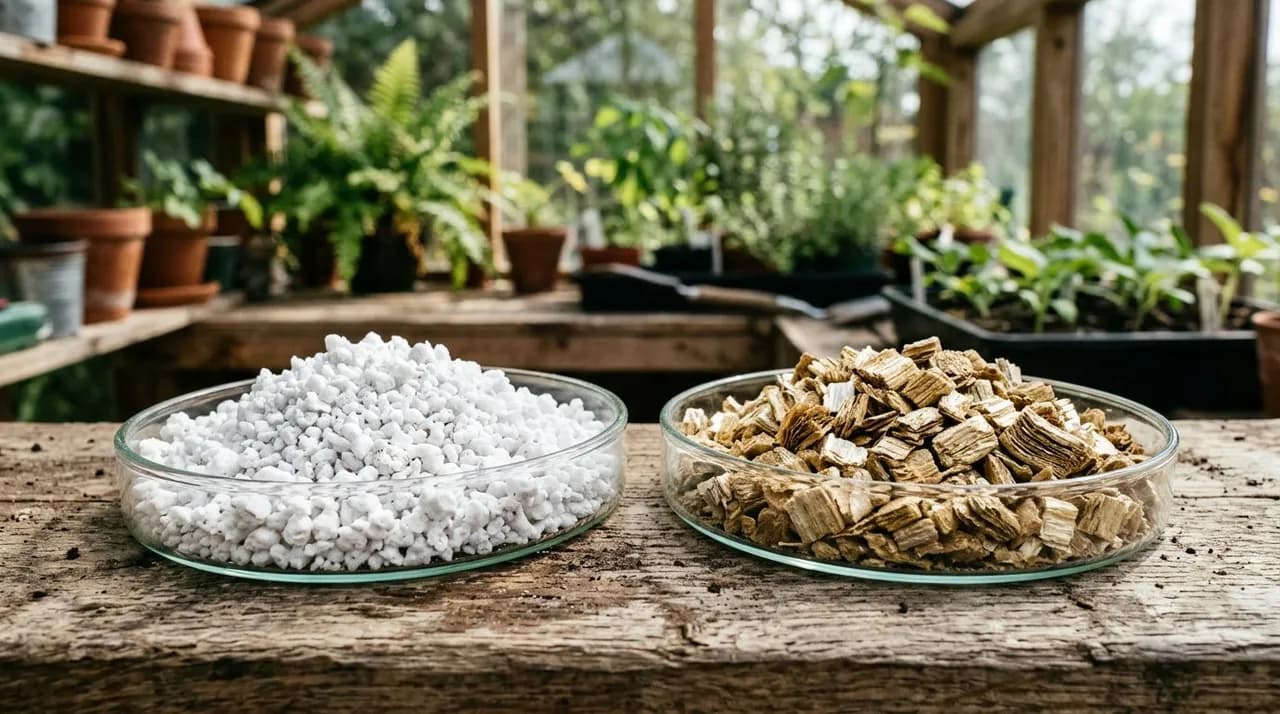
Quick answer: The primary difference between perlite and vermiculite is that perlite promotes rapid drainage and root aeration, while vermiculite retains moisture and plant nutrients. Choose white, porous perlite for plants that need fast-draining soil, and golden, spongy vermiculite for seed starting and thirsty, moisture-loving crops.
Understanding the debate between perlite vs vermiculite is one of the most practical lessons in container gardening, indoor plant care, and soil formulation. When browsing the aisles of a garden center or reading potting soil recipes, gardeners frequently encounter both of these lightweight mineral additives.
While both substances are natural, inorganic, sterile minerals expanded through industrial heat treatment, they perform opposite physical functions in the soil. Mixing up perlite and vermiculite in a potting recipe can cause serious root issues: adding vermiculite to a desert cactus blend will trap excessive moisture and induce root rot, while adding only perlite to moisture-loving ferns will cause the soil to dry out too quickly between waterings.
By understanding how each mineral is formed, how they interact with soil water and root zones, and which plant families benefit from each medium, you can formulate custom potting mixes that provide the exact balance of oxygen and moisture your plants need.
What is perlite: origin, manufacturing, and properties
Perlite is a naturally occurring volcanic glass (similar to obsidian) formed when viscous volcanic lava cools rapidly in the presence of water:
- The Popping Process: Raw perlite ore contains 2% to 5% trapped molecular water. When crushed and heated rapidly in industrial furnaces to temperatures between 1,600°F and 1,800°F (870°C to 980°C), the trapped moisture flashes into steam. The expanding vapor pops the softened glass granules just like popcorn, expanding each particle to 7 to 16 times its original volume.
- Physical Structure: The resulting product consists of snow-white, featherweight, rigid granules filled with thousands of microscopic closed air cavities.
- Water Behavior: Perlite does not absorb water into its interior. Instead, water clings exclusively to the irregular, craggy surface crevices of the granules. It holds approximately 3 to 4 times its dry weight in surface moisture, allowing excess water to drain freely away.
- Chemical Traits: Completely sterile, non-toxic, pH-neutral (7.0 to 7.5), and chemically inert.
- Durability: Because perlite is an expanded volcanic rock, it does not compress, decompose, or break down over time, providing permanent aeration channels in container mixes for years.
To see how coarse minerals integrate with organic matter and balanced soil textures, see our guide on loamy soil and soil structure.
What is vermiculite: origin, manufacturing, and properties
Vermiculite is a naturally occurring hydrous phyllosilicate laminar mineral composed of alternating layers of aluminum, iron, and magnesium silicates:
1. The exfoliation process
In its raw mineral state, vermiculite resembles dense, dark flakes of mica. When subjected to intense heat (around 1,650°F / 900°C), the moisture trapped between the microscopic mineral plates expands, forcing the layers apart into accordion-like, concertina-shaped golden-brown flakes.
- Physical Structure: Spongy, soft, and compressible, with a large internal surface area containing hundreds of open, water-holding laminations.
- Water Behavior: Highly absorbent sponge-like behavior. Vermiculite absorbs and holds roughly 3 to 4 times its dry weight in moisture within its laminar layers.
- Nutrient Retention (High CEC): Unlike inert perlite, vermiculite has a high Cation Exchange Capacity (CEC). Its charged mineral layers naturally bond with positively charged plant nutrients (including potassium, magnesium, calcium, and ammonium ions), slowly releasing them to plant roots as needed.
- Durability: Soft and spongy. Under heavy outdoor foot pressure or prolonged container cultivation, vermiculite flakes compress and break down over three to four years.
To learn how moisture-retentive minerals support delicate seedling roots without causing fungal diseases, review our advice in preventing damping off seedling failure.
Head-to-head comparison: perlite vs vermiculite
Characteristic | Horticultural Perlite | Horticultural Vermiculite |
|---|---|---|
Primary Function | Aeration and drainage | Moisture and nutrient retention |
Appearance | Bright white, popcorn-like granules | Golden-brown, soft, layered flakes |
Source Material | Volcanic glass (rhyolite) | Silicate clay mineral (mica group) |
Water Retention | Low to moderate (surface clinging) | High (absorbs inside sponge layers) |
Air Porosity | Exceptional (creates permanent air channels) | Moderate to low when fully saturated |
Nutrient Exchange (CEC) | Zero (chemically inert) | High (buffers K, Mg, Ca ions) |
Durability | Permanent (never decomposes) | Compresses and degrades over time |
Soil pH | Neutral (7.0 to 7.5) | Neutral to slightly alkaline (7.0 to 8.0) |
When to use perlite
Choose perlite whenever you need rapid drainage, good oxygenation in the root zone, and protection against soil compaction.
1. Rooting softwood and semi-hardwood cuttings
Perlite is an excellent propagation medium for rooting plant cuttings. Sticking cuttings into pure moist perlite or a 50/50 mix of perlite and peat provides a sterile, well-aerated medium that helps protect softwood and semi-ripe cuttings from damping off and basal rot.
2. Cacti, succulents, and epiphytic aroids
Desert succulents, sansevierias, and epiphytic houseplants (Monstera, Philodendron, Anthurium) demand porous, airy soil. Blend 30% to 40% coarse perlite into standard potting soil to mimic their natural well-drained habitats.
3. Amending in-ground soil vs containers
Do not try to improve heavy clay garden beds with perlite: you need vast quantities to make a difference, it is expensive, and it floats to the surface over time. Add compost, leaf mould or well-rotted manure instead; organic matter is far more effective in open ground. Save perlite for containers and propagation beds.
4. General indoor houseplant mixes
Adding 20% perlite to standard potting blends prevents the soil from turning dense and soggy after repeated indoor waterings.
For building custom propagation blends for indoor trays, see our practical formulas in diy seed mix for budget pots and seed starting for beginners.
When to use vermiculite
Choose vermiculite whenever you need to maximize soil water-holding capacity, prevent fast drying, and buffer plant nutrients.
1. Seed starting flats and fine seed coverage
Tiny seeds (such as petunias, lettuces, and carrots) often dry out before their embryonic roots can penetrate the soil. Sowing seeds in a vermiculite-rich blend and covering them with a light 1/8-inch layer of fine vermiculite keeps the seed coat continuously moist without forming a hard surface crust.
2. Thirsty and moisture-loving houseplants
Plants that require consistently moist soil (such as Boston ferns, maidenhair ferns, calatheas, marantas, African violets, and peace lilies) thrive when 25% to 30% vermiculite is incorporated into their potting mix.
3. Outdoor raised bed mixes (Mel's Mix)
In classic Square Foot Gardening, "Mel's Mix" relies on equal parts coarse vermiculite, blended compost, and peat moss (or coco coir) to create a lightweight raised bed soil that holds moisture through hot summer heatwaves without frequent daily irrigation.
4. Sub-irrigated and wicking planters
Vermiculite increases the vertical capillary draw in self-watering planters. For structural reservoir calculations, see our guide on wicking bed soil mix depth.
Safe handling practices for gardeners
Both dry perlite and dry vermiculite generate fine mineral dust when poured directly from bags:
- Moisten Before Pouring: Always cut open the top of the bag and pour 1 to 2 cups of clean water directly into the bag before scooping out the minerals. The water dampens the dust particles, preventing them from becoming airborne.
- Wear a Dust Mask: When handling large quantities or sifting dry minerals, wear an N95 or standard dust mask to prevent respiratory irritation.
- Asbestos Safety Note on Vermiculite: Modern horticultural vermiculite comes from mines with routine asbestos testing, so commercial bags are safe to use. (The historic Libby, Montana mine that caused asbestos contamination closed in 1990.) As with any dusty mineral product, dampen it before scooping or wear a dust mask to avoid breathing the fine particles.
Using perlite for aeration and drainage, and vermiculite for moisture and nutrient retention, lets you adjust potting mixes to the needs of different plants.