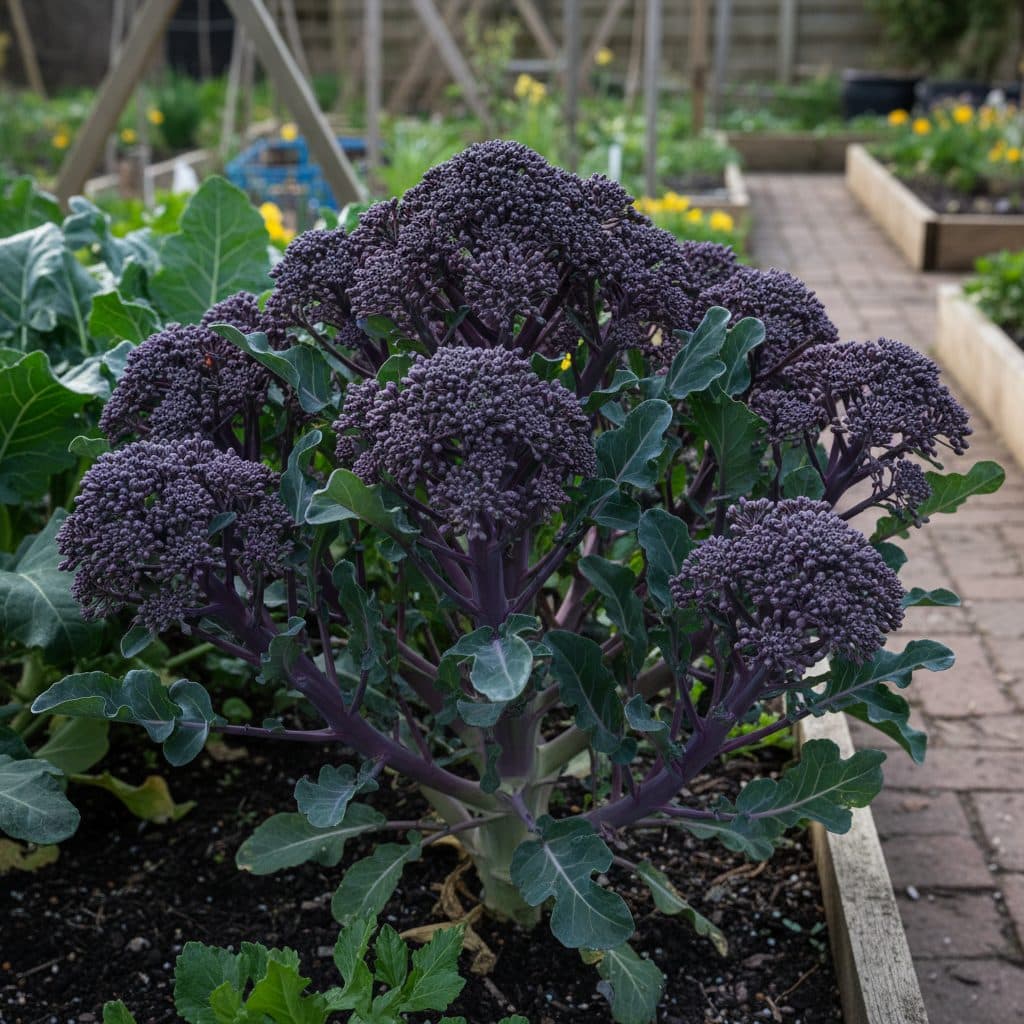
Key takeaways
- Sow seeds from late April to June in module trays to raise sturdy seedlings for summer planting.
- Transplant into firm, fertile, alkaline to neutral soil (pH 6.5 to 7.5) with wide 60–75 cm spacing.
- Net plants continuously against cabbage white butterflies in summer and pigeons throughout winter.
- Stake mature plants securely in autumn to prevent wind rock from loosening root systems during winter gales.
- Harvest the central purple spear first in early spring to stimulate heavy production of succulent side shoots.
Quick answer: Growing purple sprouting broccoli in the UK involves sowing in late spring, growing large plants over summer and autumn, and overwintering them outdoors to harvest purple spears between February and May. Providing firm, well-limed soil, wide 60–75 cm spacing, sturdy staking, and winter bird protection ensures a heavy yield during the spring hungry gap.
Purple sprouting broccoli (Brassica oleracea var. italica) is one of the crown jewels of the British allotment calendar. Unlike fast-maturing summer calabrese, which produces a single large green head, purple sprouting broccoli (often abbreviated by UK gardeners as PSB) is a biennial crop bred specifically for exceptional cold hardiness and prolonged harvesting.
Knowing the complete cycle of purple sprouting broccoli allows you to harvest tender, sweet florets precisely when other garden vegetables are scarce. It spends ten to twelve months occupying the plot, standing through frost, snow, and winter rains before bursting into flower buds as days lengthen in late winter.
Because this crop occupies garden space for nearly an entire year and grows into massive, waist-high bushes with extensive root frameworks, successful cultivation demands thoughtful site selection, proper staking, balanced nutrition, and rigorous protection against allotment pests.
Choosing varieties and sowing windows
Selecting the right cultivars ensures a continuous harvest from late winter through mid-spring:
- Early varieties (such as Rudolph, Early Purple Sprouting and Santee F1): Begin producing spears as early as December to February in mild southern regions, providing the earliest fresh brassica harvests of the year.
- Maincrop varieties (such as Red Spear): Mature reliably throughout March and April, offering exceptional cold tolerance and deep purple, nutrient-dense florets.
- Late varieties (such as Late Purple Sprouting and Claret): Yield heavily in late April and May, extending your picking season until spring-sown greens arrive.
- White sprouting varieties (such as White Star): While distinct in colour, white sprouting broccoli follows the exact same growing cycle and offers an exceptionally mild, sweet flavour profile.
Sow seeds between late April and mid-June. Sowing too early in March causes plants to grow excessively large and woody before winter, making them vulnerable to storm damage; sowing past late June results in undersized plants that yield thin, spindly spears.
Start seeds in modular cell trays using peat-free seed compost. Sow two seeds per cell, 1 cm deep, and thin to the strongest seedling once the first true leaves emerge. Module starting allows you to nurture robust, pest-free seedlings in a cold frame while summer crops still occupy your allotment beds. For foundational brassica techniques, review our guide on how to grow broccoli.
Soil preparation and summer transplanting
Purple sprouting broccoli requires firm, fertile ground that holds moisture without becoming waterlogged. Loose, freshly dug soil leads to poor anchorage, wind rock, and loose, unformed spears.
Prepare the bed several weeks before transplanting by clearing weeds using a stale seedbed weed control routine. Brassicas thrive in neutral to alkaline soil with a pH between 6.5 and 7.5. Acidic soils encourage clubroot (Plasmodiophora brassicae), a devastating soil-borne disease that deforms roots and stunts growth. If your allotment soil tests below pH 6.5, apply agricultural lime in late winter or early spring prior to planting.
Work in well-rotted garden compost or farmyard manure, and rake in a balanced organic fertiliser such as blood, fish, and bone or poultry manure pellets.
Transplant your module-grown plants in June or July once they have developed five to six true leaves:
- Space plants 60 cm to 75 cm apart in rows spaced 75 cm apart. Tighter spacing reduces spear size and limits airflow, increasing disease risks.
- Plant deeply, burying the stem up to the base of the first true leaves to encourage adventitious root formation.
- Firm the soil thoroughly around each plant with the heel of your boot. The soil should feel solid enough that a gentle tug on a leaf will tear the leaf rather than dislodge the root ball.
- Water each plant deeply after planting with 2 to 3 litres of water to settle the soil around the roots.
Year-round protection against allotment pests
Purple sprouting broccoli faces distinct pest threats across its long growing season:
In summer (June to September), the large white (Pieris brassicae) lays batches of yellow eggs on the leaf undersides, while the small white (Pieris rapae) lays its eggs singly. Erect a sturdy timber or pipe frame covered with 7 mm butterfly netting immediately upon planting out (reserve fine under-1.3 mm insect mesh for beds where flea beetle or whitefly is the specific problem). Ensure the netting remains elevated above the foliage, and implement integrated cabbage pest management practices.
In autumn and winter (October to March), woodpigeons become the primary threat. Pigeons will strip the outer leaves of unprotected brassicas down to bare leaf ribs in a matter of days. Replace fine insect mesh with wider bird netting securely pegged to the ground to keep pigeons out while allowing winter snow and rain to pass through cleanly.
In spring (March to May), watch for cabbage aphids colonising developing spear clusters. Wash small colonies away with a firm jet of clean water, squash what remains by hand, and cut out badly infested spear clusters. If you consider any product, check its current UK approval for edible crops and its harvest interval first.
Autumn staking and winter care
By November, purple sprouting broccoli plants will have grown into substantial shrubs up to 1 metre tall with heavy, sail-like foliage.
Winter gales can rock the heavy top growth, loosening the root system in wet ground. This "wind rock" tears fine feeding roots, stunting the plant and delaying spear formation.
To prevent wind rock:
- Drive a stout wooden stake (1.2 metres tall) deep into the ground beside each plant.
- Secure the main stem to the stake with soft garden twine or flexible rubber tree ties in a figure-eight loop.
- Earth up soil around the base of the main stem by 10 cm to provide additional physical support and encourage sturdy anchor roots.
Clear fallen yellowing leaves from the base of the plants throughout winter to maintain airflow and discourage fungal diseases like grey mould (Botrytis cinerea). Compare this brassica timeline with our what to plant in August in the UK sowing schedule to plan seamless bed successions across the whole growing year.
Harvesting for maximum yield
Harvesting begins in late winter or early spring as daytime temperatures gradually rise.
The Golden Rule of PSB Harvesting: Always cut the central spear first. The central head emerges at the top of the main stem. Use a sharp knife to cut this spear when it is 10 cm to 15 cm long, while the purple flower buds are tightly closed. Do not wait for the yellow flowers to open, as open flowers quickly become woody and bitter.
Removing the central spear breaks apical dominance, triggering the plant to produce dozens of succulent side shoots from the leaf axils.
Harvest the side shoots every three to four days. Regular picking forces the plant to continuously generate fresh spears over a six to eight week harvest window. Both the tender stems and small surrounding leaves are fully edible and packed with vitamins. Once warm weather arrives in May, the plants will bolt completely into flower; at this point, dig up the spent roots, chop the woody stems for the compost heap, and prepare the bed for summer-planted crops like leeks or winter squash.