
Key takeaways
- Coastal gardens face two distinct salt threats: airborne sea spray (burning leaves up to 0.5–1 mile inland) and root-zone soil or groundwater salinity (osmotic stress above 2–4 dS/m).
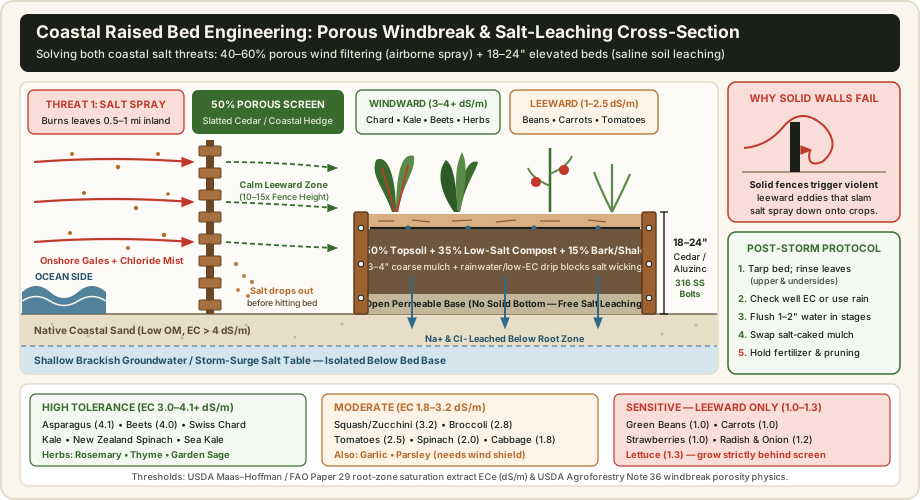
- Use a 40–60% porous windbreak perpendicular to prevailing onshore winds; solid walls create low-pressure leeward eddies that drive salt spray straight down onto beds.
- Skip standard galvanized steel and plain zinc screws within 0.5 miles of surf—marine chlorides corrode zinc fast. Build with cedar, black locust, HDPE composite, or Aluzinc panels fastened with 316 stainless steel hardware.
- Build open-bottom raised beds 18–24 inches deep so roots stay above native saline sand and periodic freshwater flushes leach sodium and chloride cleanly below the root zone.
- Place high-tolerance crops (asparagus, beets, Swiss chard, kale, New Zealand spinach, rosemary, thyme, sage) on the windward edge and shelter sensitive crops (beans, carrots, strawberries, radishes, onions) behind the screen.
- After coastal gales or storm surges, tarp the bed soil while rinsing leaves, test well water EC before flushing, apply staged 1–2 inch freshwater pulses, replace salt-caked mulch, and hold off on fertilizer.
Quick answer: Productive coastal vegetable beds solve two separate salt problems at once. Stop airborne salt spray by placing a 40–60% porous windbreak (slatted cedar, bamboo screen, or living coastal hedge—never a solid fence) on the windward side. Beat saline native sand and brackish groundwater by building 18–24 inch open-bottom raised beds from Western red cedar, black locust, HDPE composite, or Aluzinc steel fastened with 316 marine-grade stainless steel hardware. Fill beds with 50% loamy topsoil, 35% low-salt compost, and 15% coarse pine bark or expanded shale, mulch 3–4 inches deep, irrigate with rainwater or tested low-EC drip lines, and match crops to USDA Maas–Hoffman EC thresholds.
Two Separate Salt Threats in Coastal Vegetable Gardens
Most coastal gardening advice treats salt as a single problem and recommends buying tough seeds. In practice, oceanfront and barrier-island gardens from Maine and Cape Cod to the Outer Banks, Gulf Coast, and Pacific Northwest face two distinct physical mechanisms. Addressing only one still leaves vegetable beds scorched by midsummer.
Threat 1: Airborne Salt-Spray Desiccation
Breaking waves launch microscopic seawater aerosols into onshore winds. Routine 15–25 mph sea breezes deposit heavy chloride film up to 1/2 mile inland, while nor'easters and tropical storms carry salt mist several miles ashore. Once salt dries on leaves, it draws moisture straight out of plant cells by osmosis and penetrates wind-abraded cuticles. Even when raised-bed soil tests clean at 0.5 dS/m, unprotected tender greens develop brown, crispy leaf margins within 48 hours of an onshore gale.
Threat 2: Soil Salinity and Brackish Groundwater
Below grade, coastal sand often contains under 1% organic matter while sitting above shallow brackish water tables, storm-surge salt deposits, or salty coastal wells. As dissolved sodium (Na+) and chloride (Cl-) build in pore water, electrical conductivity (ECe) climbs. Above 2.0 to 4.0 dS/m, high osmotic pressure blocks roots from absorbing water even in damp soil—producing physiological drought alongside leaf-margin ion toxicity. Elevating beds 18 to 24 inches above native ground breaks capillary wicking from brackish subsoils and creates a clean, flushable root profile.
Porous Windbreak Aerodynamics: Stopping Sea Spray Without Turbulence
Building a solid privacy fence or masonry wall on the ocean side of a vegetable patch backfires reliably. Windbreak aerodynamics studies from the USDA National Agroforestry Center and the Royal Horticultural Society show why: because air cannot pass through a solid barrier, wind surges over the top and plunges downward into a low-pressure vacuum right behind the wall. Those violent leeward eddies snap trellises, shred stems, and slam concentrated salt mist straight down onto the beds.
Semi-permeable windbreaks engineered to 40–60% porosity—roughly half solid slats and half open gaps—solve the physics cleanly. Letting part of the breeze filter through eliminates the vacuum zone, slows wind velocity smoothly, and forces heavier airborne salt droplets to collide with the barrier or drop behind it. A 5-foot screen with 50% porosity calms wind across a leeward distance 8 to 15 times its height, sheltering 40 to 75 feet of garden space.
- Slatted cedar or composite screen: Space 3.5-inch boards with 2.5- to 3.5-inch uniform gaps perpendicular to prevailing onshore summer and storm winds.
- 50% HDPE windbreak netting: Fastened to cedar frames or coated steel posts with stainless ties, knitted agricultural wind cloth withstands gusts without ripping like solid tarps and works well for renters.
- Living maritime hedges: Plant tough coastal buffers—bayberry (Morella pensylvanica / M. cerifera), wax myrtle, yaupon holly, or sea buckthorn—at least 6 to 8 feet upwind so shrub roots stay out of vegetable soil. See our guide to salt-tolerant trees and shrubs for coastal windbreaks.
- Skip annual plant screens: Sunflowers or tall corn snap in 35 mph coastal gusts and leave beds exposed during spring planting and autumn nor'easters.
Leave a Salt-Drop Strip Behind the Screen: Check local NOAA wind roses or observe how nearby coastal trees lean away from the water. Leave a 3- to 5-foot gravel or native-turf buffer directly behind your 40–60% porous screen so precipitated salt droplets fall harmlessly before reaching the first raised bed.
Coastal Raised Bed Materials & Marine-Grade Hardware
Standard inland raised-bed guides recommend plain galvanized steel troughs and exterior deck screws. Within half a mile of salt surf, marine chlorides strip ordinary zinc coatings rapidly, causing white rust and red-rust failure along the wet soil line inside a few seasons. Fasteners fail faster still: zinc-plated screws and standard 304 stainless bolts pit and seize in humid salt air.
Secure every coastal frame with 316 marine-grade stainless steel bolts, brackets, and screws. The added molybdenum alloy in 316 stainless resists chloride pitting that degrades ordinary hardware. For broader material trade-offs, review metal raised garden beds and choosing raised bed materials and protection.
Coastal Raised Bed Frame Materials & Hardware Performance Under Salt Exposure
Bed Material | Salt-Spray Longevity | Soil & pH Interactions | Coastal Build Verdict |
|---|---|---|---|
Aluzinc Powder-Coated Steel | 15–25+ years (3–7x plain galvanized) | Inert; food-safe exterior coating prevents metal leaching | Top modular metal choice with 316 SS bolts. Hose off exterior salt film after gales and seal any scratched cut edges. |
Plain Galvanized Steel | 3–7 years within 0.5 mi of surf | Accelerated zinc breakdown in damp, salty air | Avoid near oceanfront or salt marsh yards; safe only several miles inland. |
Cedar or Black Locust | 10–20+ years (locust 20+ yrs) | Naturally rot-resistant; neutral soil pH | Top wood pick (2-inch nominal boards). Weathers silver-gray without rotting when joined with 316 stainless steel screws. |
HDPE Composite Lumber | 25+ years (immune to salt) | Completely inert; zero leaching | Zero-maintenance coastal frame. Add internal cross-bracing every 3–4 feet in tall beds to stop heat bowing. |
Concrete / Masonry Blocks | 30+ years (stormproof) | Fresh mortar and blocks leach lime, raising edge pH | Strong in hurricane zones. Weather new blocks first, line interior walls with heavy HDPE if coastal sand is already alkaline (pH > 7.5), and test pH. |
Following UF/IFAS Extension food-safety standards, skip creosote railroad ties and pre-2004 CCA pressure-treated lumber near vegetables. Build beds 18 to 24 inches tall and no wider than 4 feet for easy reach. Keep the bottom completely open to native sand (use 1/4-inch stainless hardware cloth only for burrowing rodents—never solid plastic or landscape fabric, which traps leached salt inside the bed).
Coastal Raised Bed Soil Mix, Mulch & Drip Leaching Setup
Many raised-bed formulas call for 30% sand or perlite. Near the coast, both backfire: extra sand reproduces the exact droughty native soil you built raised beds to avoid, while featherweight perlite floats and blows away in sea breezes. Mix a moisture-retentive, high-CEC blend that buffers minor salt pulses while draining cleanly during flushes:
- 50% screened loamy topsoil: Supplies stable mineral structure and water-holding capacity so wind-tossed plants anchor firmly.
- 35% low-salt compost: Raises organic matter and cation exchange capacity (CEC) to buffer root zones against salinity. Favor leaf mold and plant-based compost over uncomposted steer manure or biosolids, which frequently test at 5–10+ dS/m soluble salts.
- 15% pine bark or shale: Aged 1/4–3/8 inch pine bark fines or expanded shale maintain permanent drainage pores during deep salt flushes without blowing out like perlite.
Cover the finished bed with 3–4 inches of coarse mulch such as shredded hardwood bark, pine straw, or thoroughly fresh-rinsed seaweed (never unwashed surf kelp straight from the tide line). Blocking surface wind evaporation stops capillary action from wicking dissolved salts up into a white crust around shallow roots—see mulching sandy beds for drought resilience.
Water through sub-mulch drip tape or inline emitters instead of overhead sprinklers, which invite humid-air leaf blights and coat foliage with mineral salt rings. Pair drip irrigation for sandy soil with roof-fed rainwater harvesting barrels or IBC totes. Rainwater tests near 0.05–0.15 dS/m, giving coastal gardens a zero-salt reserve for seedlings and post-storm flushing whenever shallow wells drift brackish.
Salt-Tolerant Vegetable & Herb Matrix (USDA Salinity Thresholds)
Crop salinity thresholds come from the USDA Maas–Hoffman model published in FAO Irrigation and Drainage Paper 29. Each crop carries a root-zone threshold (ECe in dS/m) where yield remains 100%, plus a yield-loss slope for each 1.0 dS/m above that line. Contrary to many coastal gardening blogs, carrots, radishes, onions, green beans, and strawberries are among the most salt-sensitive crops grown and belong strictly in sheltered leeward beds.
Edible Vegetable & Culinary Herb Salinity Tolerance Matrix (USDA Maas–Hoffman / FAO Paper 29)
Tolerance Tier | Edible Crops & Herbs | Soil Threshold ECe (dS/m) | Yield Drop per +1 dS/m | Coastal Bed Placement |
|---|---|---|---|---|
High Tolerance | Asparagus (Asparagus officinalis), Beets (Beta vulgaris), Swiss Chard, Kale, New Zealand Spinach (Tetragonia tetragonioides), Sea Kale (Crambe maritima), Purslane | 3.0–4.1+ dS/m (Asparagus 4.1; Beets 4.0) | 2.3% (Asparagus) to 9.0% (Beets) | Plant along the windward bed edge or most exposed beds; waxy or fleshy leaves resist both salt spray and elevated soil EC. |
High-Tolerance Herbs | Rosemary, Thyme, Garden Sage, Lavender, Oregano | 3.0–4.5 dS/m | Low once established | Grow in fast-draining windward corners; woody Mediterranean herbs shrug off steady onshore breezes and salt mist. |
Moderate Tolerance | Zucchini & Squash (3.2), Broccoli (2.8), Tomatoes (2.5), Spinach (2.0), Cabbage (1.8), Garlic, Parsley | 1.8–3.2 dS/m | 4.7% (Squash) to 9.9% (Tomato) | Place in the middle bed zone behind a 50% porous screen. Mild soil EC (2.5–3.0 dS/m) boosts tomato sugar concentration, though foliar spray still burns leaves. |
Salt-Sensitive | Green Beans (1.0), Carrots (1.0), Strawberries (1.0), Radishes (1.2), Onions (1.2), Lettuce (1.3) | 1.0–1.3 dS/m | 13% (Radish/Lettuce) to 19% (Beans) | Restrict to sheltered leeward beds watered with rainwater or municipal water (<0.8 dS/m); flush seed furrows before sowing. |
Even high-tolerance crops like beets and Swiss chard are vulnerable during seed germination and emergence, because the top inch of soil dries fastest and concentrates salts. Start transplants indoors in clean potting mix or flush direct-sown rows with rainwater before seeding. For non-edible landscape buffers or hyper-saline subtropical shores above 4 dS/m, see salt-tolerant plants for coastal gardens and salt-tolerant halophyte plants for Gulf gardens.
Water Testing, Routine Leaching & The Gypsum Reality Check
Submit a soil and irrigation water test through your state land-grant lab—see our US Cooperative Extension soil testing guide—requesting soluble salts (EC), pH, and Sodium Adsorption Ratio (SAR). Municipal water generally stays below 0.5–0.8 dS/m, whereas shallow coastal wells can climb past 2.0–4.0 dS/m during dry late-summer drawdown or king tides.
When three weeks pass without heavy rain, run a deep leaching soak every 14 to 21 days so freshwater percolates completely below the 20-inch bed into native sand. Applying 15–25% extra freshwater depth (an FAO Paper 29 leaching fraction of 0.15–0.25) flushes accumulated fertilizer and airborne salt downward before levels cross crop thresholds.
When Gypsum Helps—and When It Backfires: UF/IFAS and NC State Extension trials confirm that agricultural gypsum (calcium sulfate) fixes sodic clay or silt soils where high sodium seals pores and ruins drainage (high SAR). In free-draining sandy coastal raised beds suffering from soluble sodium chloride (high EC, low clay), gypsum cannot remove chloride and adds extra dissolved sulfate salt. Apply gypsum only when lab results show sodic clay—see gypsum, lime, and sulfur by soil test.
Post-Storm Salt Rinse & Soil Leaching Protocol
Coastal hurricanes and dry nor'easters frequently blanket gardens in salt spray with minimal rainfall or push brackish surge across yards. Follow this five-step protocol during the first 24 to 72 hours after winds subside:
- Tarp soil before rinsing leaves: Spread a plastic drop cloth over the bed mulch, then gently hose both upper and lower leaf surfaces with clean municipal water or stored rainwater (never a pressure washer). Tarping stops salty leaf runoff from saturating your root zone.
- Check well EC first: Test shallow coastal well water with a digital EC pen before leaching. Storm surges can intrude into surficial wells temporarily, turning well flushes counterproductive.
- Leach in 1–2 inch stages: If surge water or heavy brine entered the bed, apply 1 to 2 inches of clean fresh water at a time, waiting 12 to 24 hours between pulses so roots do not suffocate. Following UF/IFAS and Clemson guidance, roughly 6 inches of staged clean water lowers root-zone EC by about 50% in well-drained loam.
- Replace salt-caked mulch: Rake off and discard heavily brined bark or straw so subsequent rains do not re-leach trapped salt, then spread 3 inches of fresh coarse mulch.
- Hold fertilizer and pruning: Never feed salt-stressed plants right after a storm—soluble fertilizer piles extra osmotic salt stress onto burned roots. Wait 2 to 3 weeks for clean green shoots before trimming brown margins or resuming gentle feeding.
Once post-storm flushing brings top-6-inch EC back below 1.5 dS/m, sheltered beds are ready for quick cool-season brassicas, spinach, or radish re-sowing. Combining porous wind screening, corrosion-proof elevated frames, high-CEC mulched soil, and realistic crop placement turns exposed coastal properties into productive kitchen gardens.