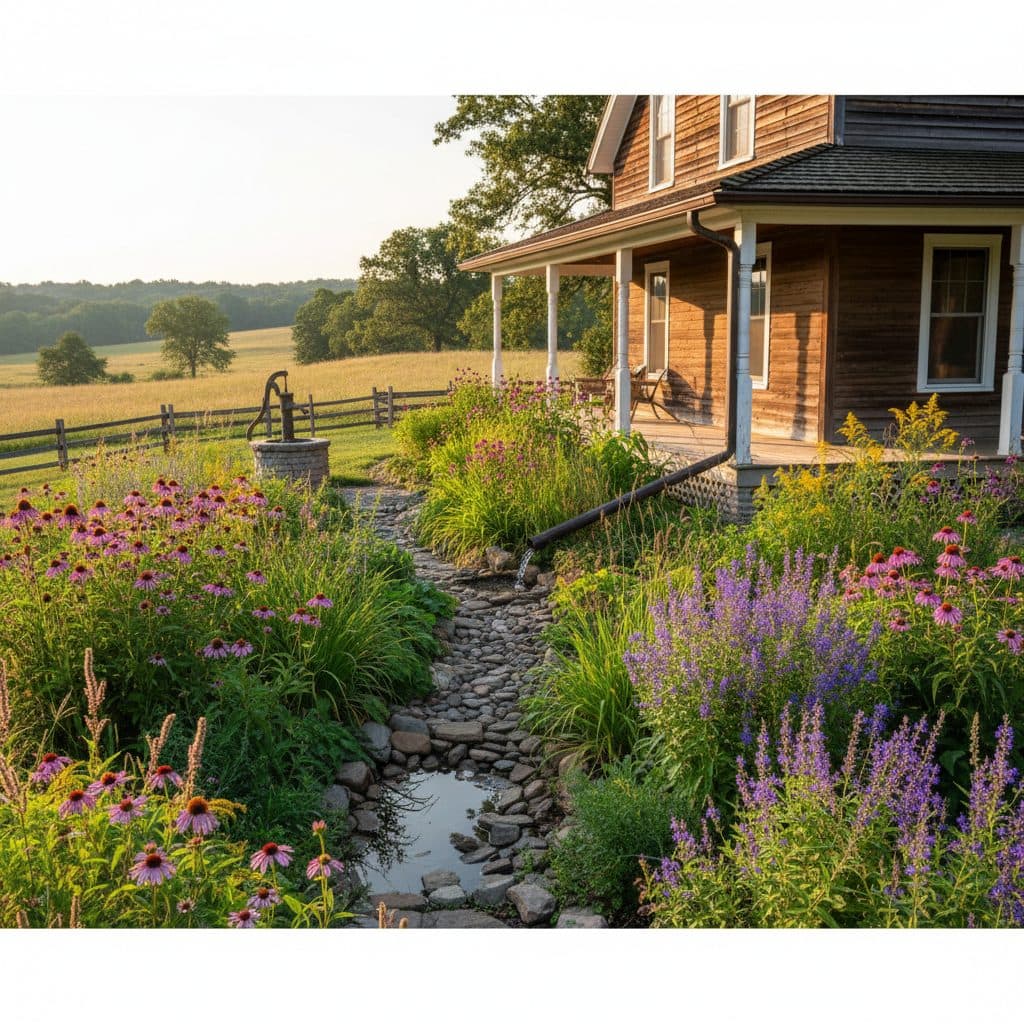
Key takeaways
- A rain garden is a shallow depression designed to capture and filter stormwater runoff, often reducing it by 30% or more.
- Proper siting requires a minimum distance of 10 feet from foundations and consideration of underground utilities.
- Sizing depends on your roof’s impervious area, soil type, and desired ponding depth, typically ranging from 5-10% of the contributing area.
- Amending native soil with 30% compost improves infiltration and supports plant growth in the rain garden basin.
- Native plants adapted to both wet and dry conditions are crucial for a rain garden’s long-term success.
- Regular maintenance, especially during the first two years, ensures the garden functions effectively.
Quick answer: A rain garden is a shallow depression planted with native vegetation, designed to capture and filter stormwater runoff. Proper siting involves placing it at least 10 feet from foundations, and sizing typically ranges from 5-10% of the impervious surface area it serves.
In many parts of the United States, like the Ohio River Valley, a single inch of rain on a 1,000 square foot roof can generate over 600 gallons of runoff. This water often flows directly into storm drains, carrying pollutants and contributing to local flooding and stream erosion. For homeowners in USDA zone 6 and across the country, managing this runoff is a practical concern.
A rain garden offers a simple, effective solution by capturing and slowly infiltrating this stormwater into the ground. These specially designed landscape features can reduce the amount of runoff leaving your property by 30% or more, protecting local waterways and recharging groundwater. With careful planning, you can create a functional and attractive rain garden that serves your home for decades.
Understanding the rain garden concept
A rain garden is a shallow depression planted with native vegetation, designed to intercept and absorb stormwater runoff from impervious surfaces like roofs, driveways, and patios. Unlike a pond, a rain garden is not meant to hold standing water for long periods; instead, it allows water to soak into the ground within 24 to 48 hours after a rain event. This process filters pollutants, recharges groundwater, and reduces the burden on municipal storm sewer systems, especially during heavy downpours that can drop over two inches of rain in a single hour in regions like the Pacific Northwest.
how rain gardens work
The garden’s design typically includes a flat bottom, gently sloping sides, and a berm on the downhill side to retain water. The soil within the garden is often amended to improve infiltration rates, allowing water to penetrate the ground more efficiently than compacted native soil. Research from 2014 on the Hyoja Drainage Basin in South Korea demonstrated that appropriately sized rain gardens could significantly reduce stormwater runoff volume, sometimes by over 30%, depending on the rainfall intensity and soil characteristics. The plants selected for a rain garden must tolerate both temporary inundation and dry periods, thriving in the fluctuating moisture levels. These gardens are part of passive irrigation strategies.
- Runoff interception: Captures water from roofs and other hard surfaces.
- Water filtration: Soil and plants remove pollutants like nitrogen and phosphorus.
- Groundwater recharge: Allows water to slowly infiltrate, replenishing aquifers.
- Habitat creation: Provides food and shelter for beneficial insects and birds.
- Reduced flooding: Decreases the volume of water entering storm drains.
Siting your rain garden effectively
Choosing the right location for your rain garden is as important as its size. A poorly sited garden can lead to foundation issues or simply fail to function as intended. The primary rule is to place the garden at least ten feet away from any building foundation to prevent water from seeping into basements or crawl spaces. This distance is a critical safety measure, especially for homes in regions with expansive clay soils like those found in parts of Texas, where soil movement can be a concern.
critical siting considerations
Before digging, identify the flow path of stormwater from your downspouts and other impervious areas. The garden should be located in a natural depression or a gently sloping area where water naturally collects or can be easily diverted. Avoid placing rain gardens over septic fields or within 25 feet of a well, as this could contaminate your drinking water supply. Also, check for underground utilities like gas lines, electrical cables, and irrigation pipes before you start any excavation; calling 811 a few days before digging is a free service that can prevent serious accidents and costly repairs. A soil percolation test, which involves digging a 6-inch hole and timing how long it takes for water to drain, will give you an idea of your soil’s infiltration rate, an important factor in sizing.
- Distance from structures: Maintain at least 10 feet from building foundations.
- Slope: Place in a gently sloping area, ideally less than a 15% grade.
- Underground utilities: Locate and mark all buried lines; call 811 before digging.
- Sun exposure: Match plant selection to the available sunlight, whether full sun (six+ hours) or partial shade (three-six hours).
- Soil type: Conduct a percolation test to understand your soil’s drainage capacity.
Sizing your rain garden accurately
The size of your rain garden directly impacts its effectiveness in managing stormwater. An undersized garden won’t capture enough runoff, while an oversized one might be unnecessarily large. The general guideline for sizing is to make the rain garden between 5% and 10% of the impervious surface area it serves. For instance, if your roof section is 500 square feet, your rain garden should ideally be 25 to 50 square feet. This calculation matters for reducing stormwater runoff, per studies on urban drainage basins [1].
calculating required dimensions
To calculate the required size, first determine the square footage of the impervious area that will drain into the garden. For a roof, multiply its length by its width. Next, consider your soil type: sandy soils drain quickly, requiring a smaller rain garden (closer to 5% of the impervious area), while clay soils drain slowly, necessitating a larger garden (closer to 10%). A typical rain garden ponding depth is six inches, but this can vary from four to eight inches depending on local rainfall patterns and soil conditions. For instance, in areas like Florida with high water tables, a shallower depth might be more appropriate. You can divert water from your downspouts using a simple expandable hose or a more permanent underground pipe system.
- Measure impervious area: Calculate the square footage of your roof section or driveway.
- Determine soil type: Perform a soil test to understand drainage rates (sandy, loamy, clay).
- Choose ponding depth: Typically 6 inches, but adjust based on climate and soil.
- Apply sizing factor: Use 5-10% of impervious area, depending on soil and depth.
- Calculate garden dimensions: Divide the required square footage by a desired length or width to get the other dimension.
Building and planting your rain garden
Once you’ve selected and sized your rain garden, the construction phase begins. Start by clearly marking the outline of your garden. Excavate the area to a depth of 12 to 18 inches, creating a flat bottom. The excavated soil can often be used to create a berm on the downhill side of the garden, which helps retain water within the basin. This berm should be 6 to 12 inches high and gently sloped to prevent erosion. In areas with heavy clay soils, like much of the Southeast, this excavation is critical for proper water infiltration.
soil preparation and plant selection
After excavation, amend the native soil in the basin to improve its drainage and fertility. A common recommendation from the USDA Natural Resources Conservation Service [6] is to mix the excavated soil with 30% compost or other organic matter. This creates a rich, well-draining medium that supports healthy plant growth and allows water to infiltrate at a rate of at least one inch per hour. For planting, choose native species adapted to your USDA zone that can tolerate both wet feet during rain events and drier conditions between storms. Examples for USDA zone 5 include coneflowers, sedges, and switchgrass, which can thrive in varying moisture levels. Consider installing a garden PE irrigation hose for supplemental watering during establishment.
- Excavate the basin: Dig to a depth of 12-18 inches with a flat bottom.
- Build the berm: Create a 6-12 inch high berm on the downhill side using excavated soil.
- Amend soil: Mix native soil with 30% compost for improved drainage and fertility.
- Select native plants: Choose species tolerant of wet and dry conditions, appropriate for your USDA zone.
- Mulch the surface: Apply 2-3 inches of shredded hardwood mulch to retain moisture and suppress weeds.
Rain Garden Sizing Factors by Soil Type
Soil Type | Infiltration Rate (inches/hour) | Recommended Sizing Factor (% of Impervious Area) | Typical Ponding Depth (inches) |
|---|---|---|---|
Sandy Soil | 2.0 – 6.0 | 5% | 6 |
Loamy Soil | 0.5 – 2.0 | 7% | 6-8 |
Clay Soil | 0.05 – 0.5 | 10% | 8-12 |
Runoff reduction: A properly sized rain garden can reduce stormwater runoff from your property by 30% to 50% during a typical rain event.
Foundation safety: Ensure your rain garden is located at least 10 feet away from any building foundation to prevent moisture issues.
Soil amendment: Mixing native soil with 30% compost can significantly improve water infiltration rates and plant health.
Frequently asked questions
How deep should a rain garden be?
A typical rain garden basin should be excavated to a depth of 12 to 18 inches, with a ponding depth of 6 to 8 inches. This allows for sufficient water storage and proper soil amendment for plant roots.
How far from my house should a rain garden be placed?
It is strongly recommended to place a rain garden at least 10 feet away from any building foundation. This distance helps prevent water from seeping into basements or causing structural damage over time.
What kind of plants are best for a rain garden?
Native plants that tolerate both wet and dry conditions are ideal for rain gardens. Examples for many US regions include coneflowers, switchgrass, sedges, and various native shrubs, which can handle temporary inundation for 24-48 hours.
How much does it cost to build a rain garden?
The cost of building a rain garden can vary widely, from a few hundred dollars for a small, DIY project to over $2,000 for larger, professionally installed gardens. The primary costs are for plants, compost, and potentially gravel or edging materials.
How often does a rain garden need maintenance?
During the first one to two years, a rain garden requires regular weeding and watering to establish plants. After establishment, maintenance typically reduces to annual weeding, mulching every two to three years, and occasional debris removal.
Can a rain garden attract mosquitoes?
No, a properly designed and functioning rain garden should not attract mosquitoes. It is designed to drain completely within 24 to 48 hours, which is insufficient time for mosquito larvae to develop, as they typically need 7 to 10 days of standing water.
References
- Sizing Rain Garden to Reduce Stormwater Runoff in Hyoja Drainage Basin – Applying Monte Carlo Simulation – (2014). Sizing Rain Garden to Reduce Stormwater Runoff in Hyoja Drainage Basin – Applying Monte Carlo Simulation –.
- Annual catalog,1932 : “everything for your garden but the rain” / (1932). Annual catalog,1932 : “everything for your garden but the rain” /.
- Catching Rain in Your Community: Effectively Marketing a Voluntary Rain Garden Program (2010). Catching Rain in Your Community: Effectively Marketing a Voluntary Rain Garden Program.
- Siting, Sizing, and Energy Management System for Future Manned Lunar Microgrids (2023). Siting, Sizing, and Energy Management System for Future Manned Lunar Microgrids.
- Multiobjective Optimization of Residential Rain Garden Siting Using ArcGIS Suitability Modeling and NSGA-II Algorithm (2026). Multiobjective Optimization of Residential Rain Garden Siting Using ArcGIS Suitability Modeling and NSGA-II Algorithm.
- USDA Natural Resources Conservation Service (2024). USDA Natural Resources Conservation Service.