Key takeaways
- Research local council zoning to verify permitted agricultural uses, dwelling rights, and animal stocking limits.
- Register for a mandatory Property Identification Code (PIC) with your state authority before acquiring any livestock.
- Comply with state water harvestable rights, stock and domestic dam rules, and groundwater bore licensing.
- Plan bushfire defence: assess your Bushfire Attack Level (BAL) and maintain a cleared Asset Protection Zone.
- Understand the Australian Taxation Office distinction between a lifestyle hobby farm and a commercial primary production business.
Quick answer: Starting a hobby farm in Australia involves purchasing 2 to 20 hectares of rural land, securing appropriate council zoning permissions, registering a Property Identification Code (PIC) for livestock, and designing water storage and bushfire protection systems. Success depends on realistic financial planning and matching agricultural enterprises to regional climate and soil.
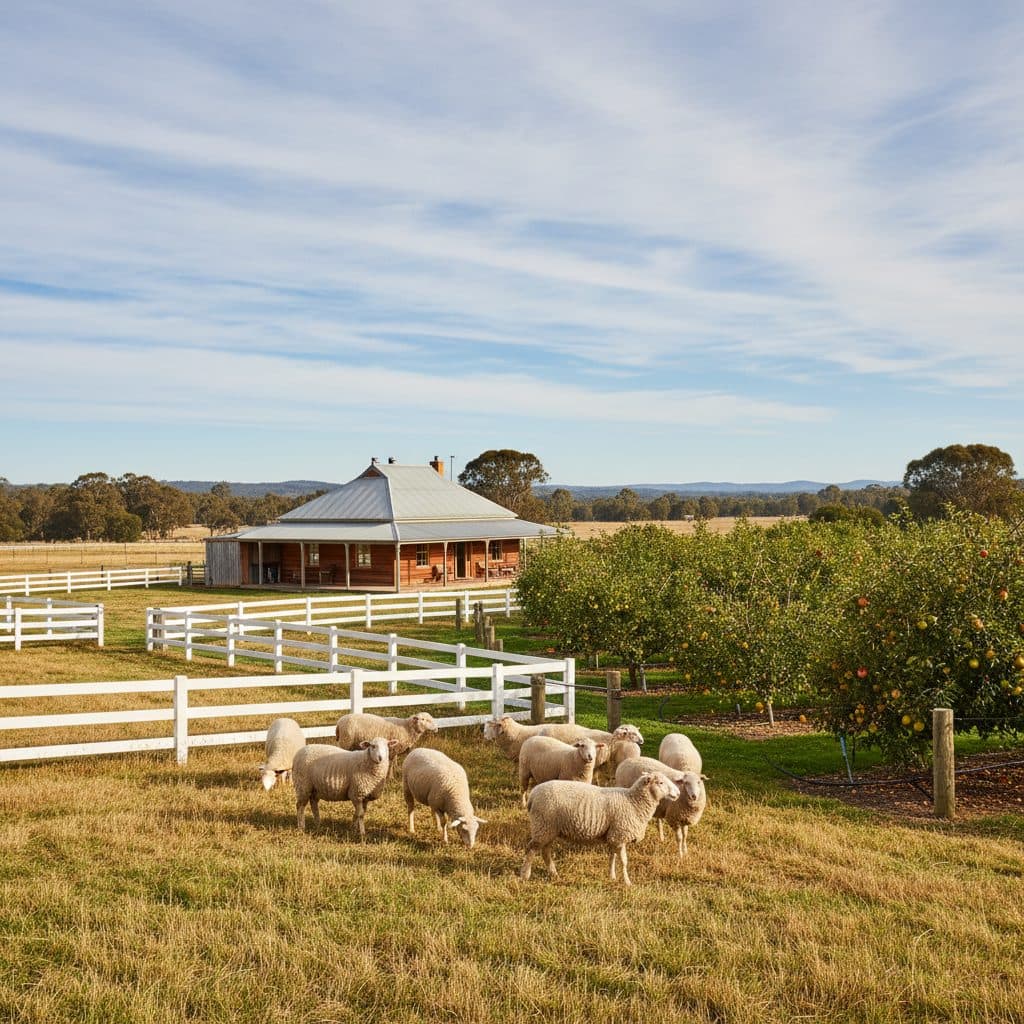
The dream of trading crowded suburban streets for a peaceful small acreage property—complete with grazing livestock, home orchards, free-ranging poultry, and productive veggie patches—resonates deeply with thousands of Australians. A hobby farm offers the ideal platform for family self-reliance, outdoor living, and rural land stewardship.
However, starting a hobby farm australia requires navigating distinct legal, regulatory, and environmental realities. From understanding local council planning schemes and state biosecurity laws to designing fire-defensible spaces and managing precious water allocations, running a successful small holding demands practical preparation.
Whether you plan to graze a small flock of heritage sheep, plant a boutique truffle orchard, or simply enjoy fresh eggs and honey, following a structured setup plan ensures your rural lifestyle remains rewarding and financially sustainable.
Buying a hobby farm in Australia: siting and zoning due diligence
When evaluating small acreage properties (typically 2 to 20 hectares or 5 to 50 acres), do not rely solely on real estate marketing brochures. Conduct thorough due diligence across key planning areas:
+-------------------------------------------------------------------------------+
|                       DUE DILIGENCE PROPERTY CHECKLIST                        |
|                                                                               |
|   1. Local Council Zoning:   Rural Living, Rural Residential, or Primary Prod.|
|   2. Dwelling Entitlement:   Confirm building rights exist on the specific lot|
|   3. Water Security:         Dam capacity, rainwater tanks, licensed bore     |
|   4. Bushfire Overlay (BAL): Check Bushfire Attack Level & fire access tracks |
|   5. Soil & Topography:      Assess erosion history, slope, and pasture weeds |
+-------------------------------------------------------------------------------+
+-------------------+---------------------------+-------------------------------------------------------+
| Planning Area | Key Governing Body | Critical Information to Verify |
+-------------------+---------------------------+-------------------------------------------------------+
| Council Zoning | Local Municipal Council | Minimum lot subdivision sizes; permitted animal types;|
| | | boundary setback requirements for outbuildings & sheds|
| Water Licensing | State Water Authority | Stock and domestic dam allowances (Harvestable Rights);|
| | (e.g. WaterNSW, DWER WA) | bore extraction licenses; annual volumetric caps |
| Biosecurity (PIC) | State Dept. of Agriculture| Mandatory registration required for ALL livestock; |
| | (e.g. NSW LLS, Biosec QLD)| NLIS compliance for cattle, sheep, goats, and pigs |
| Native Vegetation | State Environmental Agency| Land clearing restrictions; protected native tree regs|
+-------------------+---------------------------+-------------------------------------------------------+For practical guidance on assessing rural property before purchase, read our essential guide to land for homesteading.
Mandatory biosecurity and livestock laws: property identification codes
In Australia, biosecurity is taken exceptionally seriously to protect national agriculture against exotic animal diseases.
What is a property identification code (PIC)?
Under state biosecurity legislation, anyone who keeps livestock—even a single cow, sheep, goat, alpaca, horse, or pig, or more than 50 to 100 poultry birds—must register for a Property Identification Code (PIC) with their relevant state authority (such as Local Land Services in NSW, Agriculture Victoria, or Biosecurity Queensland).
- Tracing Disease Outbreaks: The PIC links livestock movements to a specific parcel of land, enabling rapid contact tracing during national disease emergencies (such as foot-and-mouth disease or avian influenza).
- National Livestock Identification System (NLIS): All cattle, sheep, and goats moving on or off your property must carry registered NLIS ear tags and be accompanied by a National Vendor Declaration (NVD) waybill.
To learn how to manage free-ranging flocks within biosecure pasture boundaries, explore our guide on raising pastured chickens.
Water rights, farm dams and catchment in Australia
Water is the lifeblood of any Australian smallholding. Rainfall is variable, and municipal mains water is rarely available in rural zones.
+-------------------------------------------------------------------------------+
|                       AUSTRALIAN WATER HARVESTING LAYERS                      |
|                                                                               |
|   1. RAINWATER ROOF CATCHMENT:  Minimum 50,000 to 100,000 litres for domestic |
|   2. SURFACE RUNOFF DAMS:       Built within state harvestable right formulas |
|   3. GROUNDWATER BORES:         Licensed through state water departments      |
|   4. DEDICATED FIRE TANK:       10,000L static reserve with Storz fittings    |
+-------------------------------------------------------------------------------+- Harvestable Water Rights: Most Australian states allow rural landowners to capture a specific percentage of rainfall runoff entering their property in farm dams without needing a special water license (for example, the 10% to 30% Harvestable Right in NSW). Any larger commercial storage requires statutory licensing.
- Stock and Domestic Rights: Riparian landowners whose property directly fronts a permanent river or creek generally possess the right to extract water for household use and stock drinking, but not for broad commercial irrigation.
- Bores: Sinking a groundwater bore requires an exploratory drilling permit and a formal water bore license from your state water agency.
Bushfire preparedness and asset protection zones
Bushfire safety is a fundamental responsibility for every Australian smallholder:
- Bushfire Attack Level (BAL): Properties in designated bushfire-prone areas will receive a BAL rating (ranging from BAL-Low to BAL-FZ Flame Zone) that dictates building materials, shutter requirements, and construction standards for new dwellings and sheds.
- Asset Protection Zone (APZ): Maintain a cleared, managed fuel-reduction zone of 20 to 50 metres around your home and main outbuildings. Keep grasses mowed low, thin tree canopies, and eliminate flammable mulch right against building foundations.
- Static Firefighting Water: Most rural fire services (such as the RFS in NSW or CFA in Victoria) require a dedicated, static water reserve (typically 10,000 to 20,000 litres in a metal or concrete tank) fitted with standard firefighting Storz valves that fire trucks can connect to during an emergency.
To design resilient perennial orchards and fire-retardant green belts around your homestead, explore our guide on subtropical food forest.
Hobby farm ideas and financial realities: ATO rules
Many aspiring smallholders hope to generate substantial income from their acreage. Approach small acreage farming with realistic economic expectations.
+-------------------+-----------------------------------+-----------------------------------------------+
| Enterprise Idea   | Capital / Infrastructure Need     | Profitability & Labour Assessment             |
+-------------------+-----------------------------------+-----------------------------------------------+
| Pastured Eggs     | Mobile coops, fox fencing, feed   | Reliable cash flow; high daily labour demand  |
| Garlic & Herbs    | Drip lines, drying shed, tiller   | High value per m²; seasonal harvest rush      |
| Heritage Sheep    | Secure dog-proof fencing, yards   | Low daily labour; modest wool / meat returns  |
| Micro-Orchard     | Irrigation, netting, tree stock   | 3-5 year lag before meaningful commercial crop|
| Agro-Tourism / Stay| Council development approval (DA)| High capital; income depends on DA & occupancy|
+-------------------+-----------------------------------+-----------------------------------------------+
The ATO distinction: hobby vs primary producer
The Australian Taxation Office (ATO) strictly differentiates between a lifestyle hobby and a commercial primary production business:
- Hobby Farm: If your farm is operated for personal recreation, family food production, or small-scale surplus trading, farm losses cannot be written off against your off-farm employment income.
- Primary Production Business: To qualify for primary producer tax status, you must prove commercial intent, substantial operational scale, a realistic business plan, and a genuine prospect of making an ongoing commercial profit.
- Even as a Business, Losses May Be Quarantined: The ATO's non-commercial loss rules (Division 35) defer farm losses unless you meet the income requirement and one of the four tests, or you are a primary producer with off-farm assessable income under $40,000. Confirm your position with a registered tax agent — thresholds and tests change.
For an overarching introduction to homesteading skills and self-sufficient living, read our foundational guide on what is homesteading.