Key takeaways
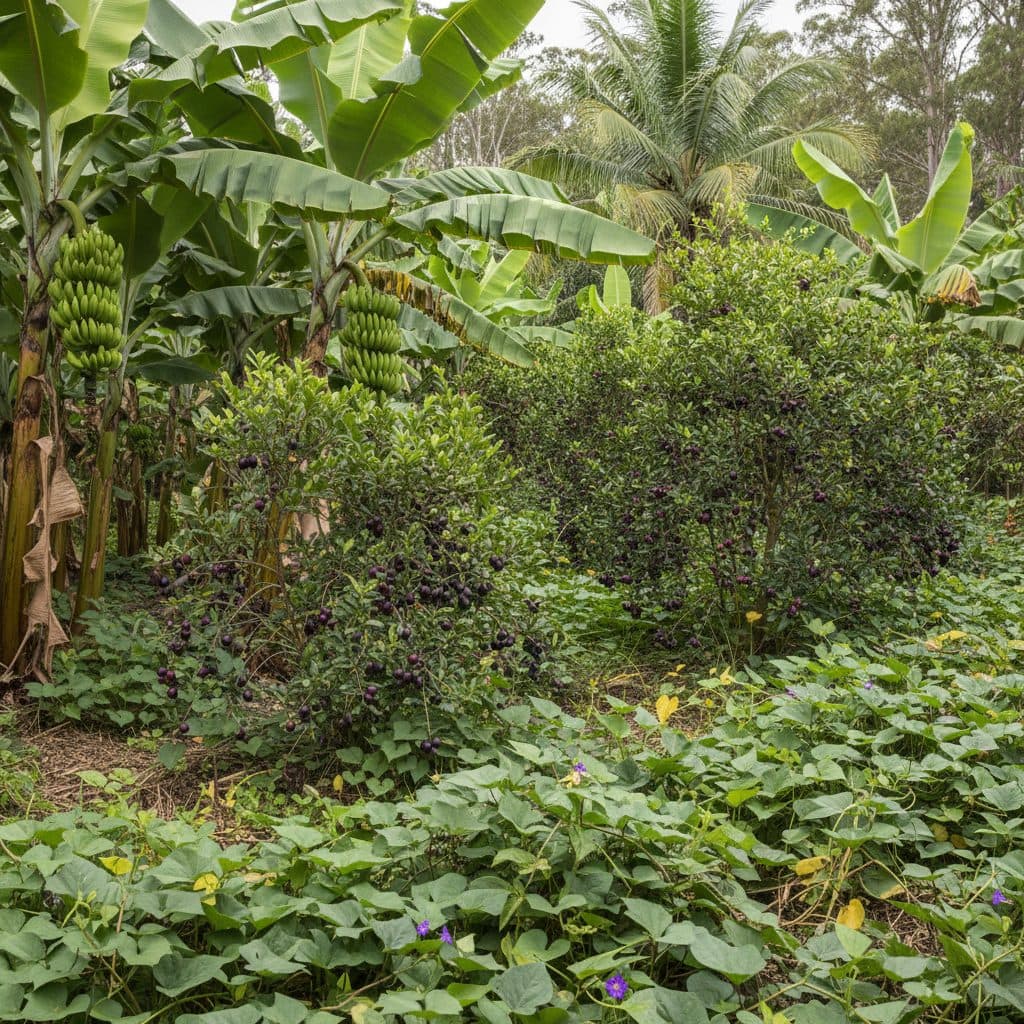
- Build vertical resilience using seven distinct layers, from tall macadamia canopies down to sweet potato ground cover.
- Establish fast-growing pioneer trees like pigeon pea and ice cream bean to generate chop-and-drop biomass.
- Select heat-adapted subtropical fruit trees including jaboticaba, grumichama, avocados, and approved biosecure bananas.
- Protect sensitive young understorey trees during hot Australian summers with living shade screens and dense mulch.
- Implement swales and organic mulch layers 15 cm deep to capture heavy subtropical summer downpours.
Quick answer: A subtropical food forest in Australia is a self-sustaining, multi-layered perennial orchard designed to mimic natural forest ecology. By combining hardy canopy trees, understorey fruit species, dynamic accumulators, and edible ground covers, growers in coastal Queensland and northern New South Wales produce abundant food that withstands intense heat and summer deluge.
Gardening in the Australian subtropics—from the Mid North Coast of New South Wales through South East Queensland to the Sunshine Coast—presents both exceptional growing energy and formidable climatic challenges. Long frost-free growing seasons, intense solar radiation, and torrential summer wet seasons can quickly exhaust unprotected soils and overwhelm standard annual veggie patches.
Designing a subtropical food forest channels this abundant heat and rainfall into a self-mulching, self-fertilising agricultural ecosystem. By moving away from short-lived annual crops that require constant cultivation and weeding, you establish deep-rooted perennial systems that build topsoil, retain moisture, and produce continuous harvests throughout the year.
Whether you are converting a suburban backyard or planting out acreage, understanding forest stratification, selecting climate-resilient subtropical food forest plants, and managing rapid biomass production ensures a productive and low-maintenance growing system.
The seven layers of a subtropical food forest
A thriving food forest organizes plants in vertical space, mirroring the structure of natural rainforest margins. In the Australian subtropics, generous sunshine allows dense stacking across all seven structural layers.
+-------------------------------------------------------------------------------+
|                    SUBTROPICAL FOOD FOREST STRATIFICATION                     |
|                                                                               |
|   1. CANOPY (8-15 m)       --> Macadamia, Pecan, Ice Cream Bean               |
|   2. UNDERSTOREY (4-8 m)   --> Avocado, Mango, Jaboticaba, White Sapote       |
|   3. SHRUB LAYER (1.5-3 m) --> Grumichama, Acerola, Pigeon Pea, Coffee        |
|  4. HERBACEOUS (0.5-1.5 m)--> Arrowroot, Comfrey, Lemongrass, Perennial Chilli|
|   5. ROOT LAYER (Soil)     --> Cassava, Cocoyam (Taro), Queensland Arrowroot  |
|  6. GROUND COVER (0-0.3 m)--> Sweet Potato, Warrigal Greens, Brazilian Spinach|
|   7. CLIMBER / VINE        --> Passionfruit, Dragonfruit, Vanilla (Glasshouse)|
+-------------------------------------------------------------------------------+
Cassava must be peeled and thoroughly boiled before eating — never raw, and discard the cooking water. Taro likewise must be cooked to break down its oxalate crystals, and warrigal greens should be blanched and the water discarded. Note on large trees: Bunya pine (Araucaria bidwillii) is an acreage-only tree reaching 30-45 m that drops 10 kg cones; never site one over paths, seating, sheds or fencelines.
For a comprehensive overview of fundamental forest gardening theory across varied regions, explore our guide on what is a food forest.
Best subtropical food forest plants for hotter conditions
Selecting species that endure high humidity, dry spring spells, and intense summer UV radiation is critical for Australian growers.
+-------------------+---------------------------+-------------------+-------------------------------------------+
| Layer             | Common Name               | Botanical Name    | Key Function & Yield                      |
+-------------------+---------------------------+-------------------+-------------------------------------------+
| Overstorey        | Ice Cream Bean            | Inga edulis       | Nitrogen fixation, heavy chop biomass     |
| Overstorey        | Macadamia Nut             | Macadamia integr. | Native canopy tree, nutrient-dense nuts   |
| Mid Canopy        | Jaboticaba                | Plinia cauliflora | Cauliflorous fruit, shade tolerant        |
| Mid Canopy        | Dwarf Lady Finger Banana  | Musa (AAB) 'Lady' | Requires QLD/NSW biosecurity approval     |
| Shrub             | Pigeon Pea                | Cajanus cajan     | Short-lived pioneer, edible peas, nitrogen|
| Herbaceous        | Queensland Arrowroot      | Canna indica (ed.)| High biomass; keep contained from creeks  |
| Ground Cover      | Sweet Potato              | Ipomoea batatas   | Living weed barrier, edible leaf tips     |
| Vine              | Panama Red Passionfruit   | Passiflora edulis | Fast vertical climber, heavy summer juice |
+-------------------+---------------------------+-------------------+-------------------------------------------+
High-value subtropical fruit trees
- Jaboticaba (Plinia cauliflora): A slow-growing, highly resilient understorey tree that bears grape-like purple fruits directly on its trunk and major branches usually once or twice a year in the Australian subtropics, with extra flushes only where it is kept warm, well fed and never dry.
- Grumichama (Eugenia brasiliensis): Often called the Brazilian cherry, this handsome shrub-tree tolerates partial shade and produces sweet, cherry-like black fruits — but like most soft subtropical fruit it is a Queensland fruit fly host, so bag or net the crop and clear fallen fruit daily.
- Avocado (Persea americana): Grafted cultivars like Reed (upright, compact, summer-bearing) and Sharwil (rich flavour) thrive when planted on well-drained mounds or swale berms.
- Citrus and Finger Limes: Native finger limes (Citrus australasica) and tahitian limes provide acid fruit and essential nectar for native beneficial pollinators.
- Bananas: Planting bananas requires approval in both Queensland and NSW, and plants must come from an approved, disease-tested source — never from a neighbour's sucker. This is to keep Panama disease TR4 and banana bunchy top virus out of home gardens. Check with Biosecurity Queensland or NSW DPI before you buy.
Pioneer species and chop-and-drop fertility
In hot subtropical climates, soil organic matter oxidises rapidly when exposed to direct sunlight. You cannot rely solely on imported bags of fertiliser. Instead, your food forest must grow its own fertility on site through intensive chop-and-drop management.
Plant pioneer nitrogen-fixing species at double density alongside your primary fruit trees:
- Pigeon Pea (Cajanus cajan): Grows rapidly to 2 to 3 metres in its first year, providing protective dappled shade to delicate young fruit saplings during their first scorching summer. Cut back hard three times per year to mulch surrounding soil.
- Ice Cream Bean (Inga edulis): Fixes atmospheric nitrogen rapidly through root nodules and produces massive leaf flushes. Prune the canopy heavily twice a year, dropping woody branches and leafy mulch around heavy-feeding fruit trees.
- Vetiver Grass ('Monto' sterile type only) and Lemongrass: Plant along contours to trap eroding silt and cut every two months to yield thick, pest-resistant straw mulch.
To master advanced regenerative pruning and succession techniques, consult our guide on syntropic farming.
Water harvesting, swales and summer deluge management
Subtropical Australia experiences distinct rainfall phases: dry, windy conditions in late winter and spring, followed by intense, high-volume summer downpours. Effective subtropical permaculture earthworks must store spring water while safely shedding torrential wet season deluges.
+-------------------------------------------------------------------------------+
|                   SUBTROPICAL CONTOUR SWALE & BERM PROFILE                    |
|                                                                               |
|                       Rainfall Infiltration                                   |
|                                 |                                             |
|                                 v                                             |
|    [Level Swale Trench]  ~~~~~~~~~   [Elevated Planting Berm]             |
|    Filled with coarse    (Water sinks)   Avocados, Citrus, Inga edulis        |
|    woodchip / biochar                    Deep uncompacted, aerated root zone  |
+-------------------------------------------------------------------------------+- Construct On-Contour Swales: Dig level ditches across slopes to intercept surface runoff. Water pooling in the trench infiltrates deeply into the subsoil, creating a subterranean moisture lens that sustains trees through spring droughts.
- Plant on Elevated Berms: Mound excavated topsoil onto the downhill side of the swale to form a planting ridge. Sensitive subtropical fruit trees (such as avocados and citrus) require outstanding drainage; planting on elevated berms prevents root rot during prolonged monsoon downpours.
- Maintain Deep Living Mulch: Establish a living carpet of how to grow sweet potatoes vines or Brazilian spinach over the berms to prevent heavy raindrops from capping and crusting exposed soil.
For detailed civil design calculations and tree integration on contours, study our guide on swale berm planting nitrogen fixers fruit trees.
Wildlife interactions and pest management in Australia
A biodiverse subtropical food forest attracts native wildlife, requiring respectful coexistence and smart physical protection:
- Native Possums and Flying Foxes: Possums and fruit bats are protected native wildlife across all Australian states and territories. Never attempt to trap, relocate, or harm native animals. Use wildlife-safe netting only — white mesh of 5 mm x 5 mm or finer at full stretch, pulled taut over a frame so it never hangs loose. This is a legal requirement for household fruit netting in Victoria and best practice everywhere else; loose or wide-gauge netting entangles and kills flying foxes and possums. Never handle an entangled bat yourself — call your state wildlife rescue line, because of Australian bat lyssavirus.
- Queensland Fruit Fly (Bactrocera tryoni): Fruit fly pressure peaks during humid summer months. Practice strict orchard hygiene by collecting all fallen fruit daily into sealed bins. Hang male-attractant pheromone monitoring traps and enclose developing stone fruit and guavas in protective exclusion bags as soon as petals fall.
- Beneficial Predators: Incorporate flowering companion plants—such as sweet alyssum, native daisies (Brachyscome), and flowering coriander—to sustain hoverflies, predatory wasps, and ladybirds that regulate aphids and scale insects naturally.