Key takeaways
- Permaculture zones organize a homestead based on frequency of human interaction, from Zone 0 (home) to Zone 5 (wilderness).
- Effective zone placement reduces labor, conserves resources like water, and increases overall productivity for a US homestead.
- Zone 1 typically includes daily-accessed plants like herbs and salad greens, often within 10 feet of the kitchen door.
- Zone 2 hosts orchards and larger annual beds, requiring weekly attention and often covering 0.25 to 1 acre.
- Zone 3 is for main crops and larger livestock, needing less frequent visits, perhaps 1-2 times per month.
- Zones 4 and 5 are for foraging, timber, and wild observation, representing decreasing levels of human intervention.
Quick answer: Permaculture zones organize a homestead based on frequency of human interaction, from Zone 0 (home) to Zone 5 (wilderness), to reduce labor, conserve resources, and increase productivity. This system helps place elements requiring frequent attention closest to the home and less-frequented elements further away.
In the rolling hills of Tennessee, a two-acre homestead can produce over 2,000 pounds of food annually, but only with thoughtful design. Permaculture offers a framework for this, organizing the landscape into zones based on how often you interact with them. This system, developed by Bill Mollison and David Holmgren, helps growers in regions like USDA zone 6 maximize efficiency and productivity by placing elements that need frequent attention closest to the home, and those that require less interaction further away.
Understanding zones 0 through 5 helps organize a homestead by frequency of use. Applying these principles cuts the walking and carrying a homestead demands each day, and puts the plants that need the most attention where you will see them.
Zone 0: the core of human activity
Zone 0 is the home or main dwelling, the center of daily activity on the homestead. This zone focuses on creating a comfortable and energy-efficient living space, often integrating elements like passive solar design to reduce heating costs by 20-40% in colder climates like USDA zone 5 or 6. It’s where you spend the majority of your time, so it’s designed for maximum comfort and resource efficiency.
integrating systems within zone 0
Key considerations for Zone 0 include insulation levels, window placement for natural light and heat gain, and water harvesting systems from the roof, which can collect hundreds of gallons of water from a single rain event. For instance, a 1,000 square foot roof can yield 620 gallons of water from one inch of rain. This zone also includes immediate outdoor living spaces, such as patios or decks, where daily relaxation or food preparation might occur. Designing Zone 0 means planning the flow of people and resources so the house functions as an integrated part of the overall layout. Consider these elements:
- Passive solar design: Orienting the home to maximize winter sun exposure and minimize summer heat gain.
- Rainwater catchment: Collecting water from roof surfaces for garden irrigation or household use.
- Composting toilets: Reducing water consumption by up to 30% and producing a soil amendment — though most states and counties regulate installation, and rules on where the finished material may be used vary widely.
- Greywater systems: Reusing water from sinks and showers for landscape irrigation where your state and county allow it — rules differ sharply, and many jurisdictions require a permit or restrict reuse to subsurface distribution.
- Efficient appliances: Selecting appliances that reduce energy consumption by 15-25% or more.
Zone 1: the kitchen garden and daily needs
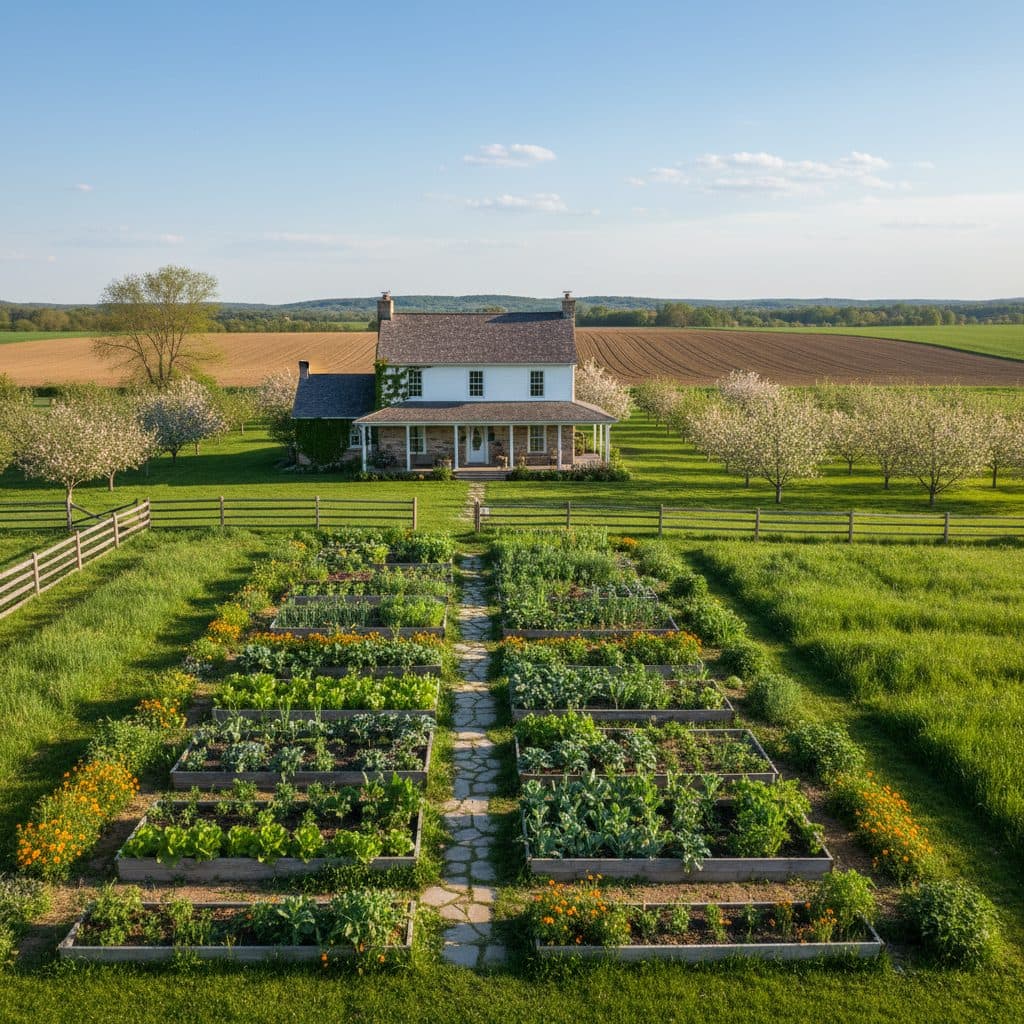
Zone 1 is the area immediately surrounding Zone 0, typically within 10 to 50 feet of the house, and is visited multiple times a day. This is where you place elements requiring the most frequent attention, such as kitchen gardens, herb spirals, and small fruit bushes like strawberries or blueberries. In a USDA zone 7 climate, a well-worked 100 square foot bed close to the door can cover much of a household’s salad and herb use through the growing season. The goal is to minimize travel time and effort for daily tasks like harvesting, weeding, and watering.
designing for high-frequency interaction
This zone often includes intensive annual beds, small cold frames, or even a small greenhouse for season extension, allowing for harvests up to 10 months a year. Raised beds are common here, making gardening more accessible and letting you work the soil earlier in spring than in-ground beds allow. Consider integrating a compost bin for kitchen scraps, easily accessible from the house, and a propagation area for starting seeds. A well-planned Zone 1 reduces daily travel around the homestead, keeping food production routine and manageable. For more on layout planning, see our guide on permaculture garden plans.
- Herb spiral: Maximizing growing space for 10-15 different herbs in a 3-foot diameter.
- Salad greens bed: Providing daily harvests of lettuce, spinach, and arugula.
- Small fruit bushes: Offering fresh berries within easy reach, like three blueberry bushes.
- Compost bin: Conveniently located for kitchen waste, processing 50 pounds of scraps weekly.
- Seed starting area: A small bench or table for propagating 20-30 seedlings at a time.
Zone 2: orchards, main annuals, and small livestock
Moving further out, Zone 2 encompasses areas visited weekly or a few times a month. This zone, typically spanning 50 to 200 feet from the house, is ideal for orchards with fruit and nut trees, larger annual vegetable beds, and small livestock like chickens or ducks. A small orchard of 10-15 fruit trees, such as apples and peaches, can provide hundreds of pounds of fruit annually in a USDA zone 6 climate. The plants here still require regular attention, but not the daily scrutiny of Zone 1.
integrating productive systems in zone 2
This zone is often where you’ll find food forests (multi-layered plantings of edible trees, shrubs, and groundcovers) designed for long-term productivity and minimal maintenance once established. Chickens, for example, forage for insects and fertilize the soil as they go, which takes some pressure off the orchard floor. Swales, or contour ditches, are often integrated here to capture and spread rainwater, ensuring that trees and perennial plants receive adequate moisture, even during dry spells. A 100-foot swale can hold 500 gallons of water during a heavy rain. For principles on reading your site and designing these elements, refer to permaculture design guidance.
- Fruit tree guild: Planting apple trees with sterile Bocking 14 comfrey for chop-and-drop mulch — mulch, not food or fodder, since comfrey’s pyrrolizidine alkaloids are hepatotoxic — plus chives and nitrogen-fixing clover.
- Chicken tractor: Mobile coop for 6-10 chickens to fertilize and weed garden beds.
- Main vegetable beds: Larger plots for corn, squash, and potatoes, covering 0.25 to 1 acre.
- Berry patches: Extensive plantings of raspberries, blackberries, and currants, yielding 50+ pounds per season.
- Small pond: Holds water for ducks and attracts wildlife, often 10-20 feet in diameter.
Zone 3: broadacre crops and larger livestock
Zone 3 is the area for broadacre crops, larger livestock, and substantial woodlots, visited perhaps once a month or seasonally. This zone typically extends from 200 feet up to several hundred feet or even acres from the home. Here, the focus shifts to systems that require less intensive management but provide significant yields over time, such as staple crops like grains or potatoes grown on a larger scale, covering 1-5 acres. In a state like Iowa, a 3-acre field of corn can yield over 500 bushels.
managing larger scale production
This zone might include pasture for grazing animals like sheep or cattle, managed with rotational grazing so each paddock gets a real rest period and forage recovers between grazings. A woodlot for timber, firewood, or mushroom cultivation is also common, providing a sustainable resource for the homestead. The design here emphasizes larger scale efficiency and natural processes, with less direct human intervention. For example, nitrogen-fixing trees can build fertility over a decade, but choose them carefully. Black locust fixes nitrogen and coppices readily, yet cutting it is precisely what makes it sucker from severed roots and spread, and it is listed as invasive across much of the US outside its native southern Appalachian and Ozark range. Its bark, foliage and seeds are toxic to horses and to ruminants, so it does not belong in or beside the pasture this same zone describes. Where it is a poor fit, a regionally native nitrogen fixer such as an alder or New Jersey tea, or simply a clover and vetch understory, does the same job without the risk. These systems are designed to be largely self-maintaining once established, requiring only periodic checks and harvests.
- Pasture rotation: Moving 5-10 sheep through 3-5 paddocks every 3-7 days.
- Staple crop fields: Growing 2 acres of winter wheat or dry beans for storage.
- Woodlot management: Harvesting 1-2 cords of firewood annually from 5 acres.
- Nut tree grove: Establishing 20-30 pecan trees for long-term harvest. If you plant black walnut instead, site it well clear of the orchard and vegetable beds — its roots release juglone, which kills or stunts tomatoes, peppers, potatoes and blueberries and can damage apples, out to the dripline and beyond — and keep horses away from fallen nuts and walnut shavings.
- Large-scale composting: Creating windrows for 10-20 cubic yards of compost from animal manures.
Zones 4 and 5: semi-wild and wilderness areas
Zones 4 and 5 represent the outer reaches of the homestead, with decreasing levels of human intervention. Zone 4 is a semi-wild area that is occasionally visited for foraging, timber, or seasonal grazing, perhaps a few times a year. This might include a managed forest for specific timber harvests, a wild berry patch, or an area for collecting wild edibles like mushrooms. In the Pacific Northwest, a 10-acre Zone 4 forest could yield 500-1,000 board feet of timber annually or 20-50 pounds of wild mushrooms seasonally. The focus here is on minimal management, allowing natural systems to do most of the work.
observing and protecting the wild edge
Zone 5 is an untouched or minimally disturbed section of the property visited primarily for observation. This zone is a benchmark for natural ecosystems that provides habitat for wildlife and supports biodiversity. It’s an area where you can observe natural patterns, plant succession, and the interactions between different species without interference. This observation can inform designs in other zones, offering insights into resilient plant guilds or water flow patterns. For example, observing natural water retention in a Zone 5 wetland can inspire swale designs in Zone 2. The South African Eastern Cape settlements also emphasize the importance of natural areas for resource provision and ecological balance [1].
- Wild foraging: Harvesting 5-10 pounds of wild berries or nuts seasonally.
- Timber stand improvement: Selectively felling 1-2 trees per acre annually for lumber.
- Wildlife habitat: Maintaining brush piles and diverse plantings for birds and small mammals.
- Erosion control: Allowing natural vegetation to stabilize slopes and stream banks.
- Ecological observation: Spending 2-4 hours monthly observing plant and animal interactions.
Mapping your homestead: a sample layout for a 2-acre property
Applying these permaculture zones to a real property requires careful site assessment and planning. Imagine a 2-acre homestead in USDA zone 6, with the house situated centrally on a slight rise. The goal is to create an efficient flow from the most frequently visited areas to the least. This layout approach, described by Ben Falk for resilient farms, organizes elements by how frequently they are used.
a practical homestead map breakdown
The house (Zone 0) sits at the heart. Immediately surrounding it, within 20 feet, is Zone 1, featuring a 200 square foot kitchen garden, an herb spiral, and a small greenhouse. Moving outward, Zone 2 extends to about 100 feet, containing a 0.5-acre orchard with 20 fruit trees, 0.25 acres of main annual vegetable beds, and a chicken coop for 15 birds. Beyond that, Zone 3 might cover 1 acre, dedicated to larger staple crops like corn and potatoes, and a small pasture for 3-5 sheep. That accounts for about 1.8 acres once the house and kitchen garden are counted, leaving roughly 0.2 acres at the property’s edge for Zone 4 foraging and a small woodlot, with an untouched corner as Zone 5 — and that is before any driveway, paths or setbacks. This layout conserves resources and reduces daily walking across the property. For more on site analysis before planting, see our article on permaculture design.
- Zone 0: 1,500 square foot house with a 200 square foot patio.
- Zone 1: 200 square foot kitchen garden, 10 feet from the back door.
- Zone 2: 0.5-acre orchard and 0.25-acre main annual beds, 50-100 feet from home.
- Zone 3: 1-acre staple crop field and pasture for 3 sheep, roughly 100 to 200 feet from home.
- Zone 4: managed woodlot and foraging area at the property’s outer edge.
- Zone 5: 0.05-acre untouched wilderness patch at the property’s furthest edge.
Permaculture zones at a glance
Zone number | Proximity to home | Frequency of visits | Typical elements | Management intensity |
|---|---|---|---|---|
Zone 0 | The home itself | Constant | House, passive solar, rainwater systems | High (design & maintenance) |
Zone 1 | 0-50 feet | Daily | Kitchen garden, herbs, small fruits, compost | High (intensive cultivation) |
Zone 2 | 50-200 feet | Weekly to bi-weekly | Orchards, main annuals, chickens, swales | Medium (regular care) |
Zone 3 | 200-500+ feet | Monthly to seasonally | Staple crops, larger livestock, woodlot | Low (periodic intervention) |
Zone 4 | Outer perimeter | Seasonally to yearly | Foraging, managed timber, wild edibles | Very Low (observation, occasional harvest) |
Zone 5 | Wilderness edge | Rarely, for observation | Untouched forest, wetland, native habitat | None (observation only) |
Water Savings: A 1,000 square foot roof can yield 620 gallons of rainwater from one inch of rain, significantly reducing irrigation needs for Zone 1 and 2.
Yield Increase: Intensive Zone 1 raised beds warm earlier and can be worked closer, so the same footprint carries more successions through the season.
Frequently asked questions
What is the primary purpose of permaculture zones?
Permaculture zones organize a homestead or property based on the frequency of human interaction and the intensity of management required. This system aims to minimize labor and maximize efficiency by placing elements needing daily attention closest to the home, which cuts the walking that routine tasks demand.
How large should each permaculture zone be?
The size of each zone varies greatly depending on the total property size and specific needs. For a 2-acre homestead, Zone 1 might be 200 square feet, Zone 2 could be 0.75 acres, and Zone 3 around 1 acre, with Zones 4 and 5 making up the remainder. Proximity and function are more important than exact dimensions.
Can permaculture zones be applied to urban settings?
Yes, permaculture zones are highly adaptable to urban environments. A balcony or small backyard can be Zone 1, while a community garden plot a few blocks away could function as Zone 2 or 3. Even a small city lot can benefit from this design, potentially yielding 100+ pounds of produce annually.
What role does water management play in zone design?
Water management applies across all zones. Zone 0 can include rainwater harvesting from roofs, collecting hundreds of gallons. Zones 1 and 2 often use drip irrigation or swales to water plants, reducing water consumption by 30-50%. Zone 3 might incorporate larger ponds or earthworks for livestock and broader landscape irrigation.
How do I determine my USDA plant hardiness zone?
Your USDA plant hardiness zone is determined by the average annual extreme minimum winter temperature. You can find your specific zone by entering your zip code on the USDA Natural Resources Conservation Service website. This information guides plant selection across all zones so crops survive local minimum temperatures.
What are ‘plant guilds’ and where do they fit into zones?
Plant guilds are groups of plants that support each other’s growth, mimicking natural ecosystems. They are most commonly found in Zone 1 and Zone 2, where intensive planting and observation are frequent. For example, a fruit tree guild in Zone 2 might include a fruit tree, nitrogen-fixing plants, dynamic accumulators, and pest deterrents, supporting each other so the planting needs less intervention.
References
- Ethnographic insights on rural sustainability; homestead design and permaculture of Eastern Cape settlements in South Africa (2018). Ethnographic insights on rural sustainability; homestead design and permaculture of Eastern Cape settlements in South Africa.
- Ben Falk: The resilient farm and homestead: an effective permaculture and whole systems design approach (2014). Ben Falk: The resilient farm and homestead: an effective permaculture and whole systems design approach.
- USDA Natural Resources Conservation Service (2024). USDA Natural Resources Conservation Service.