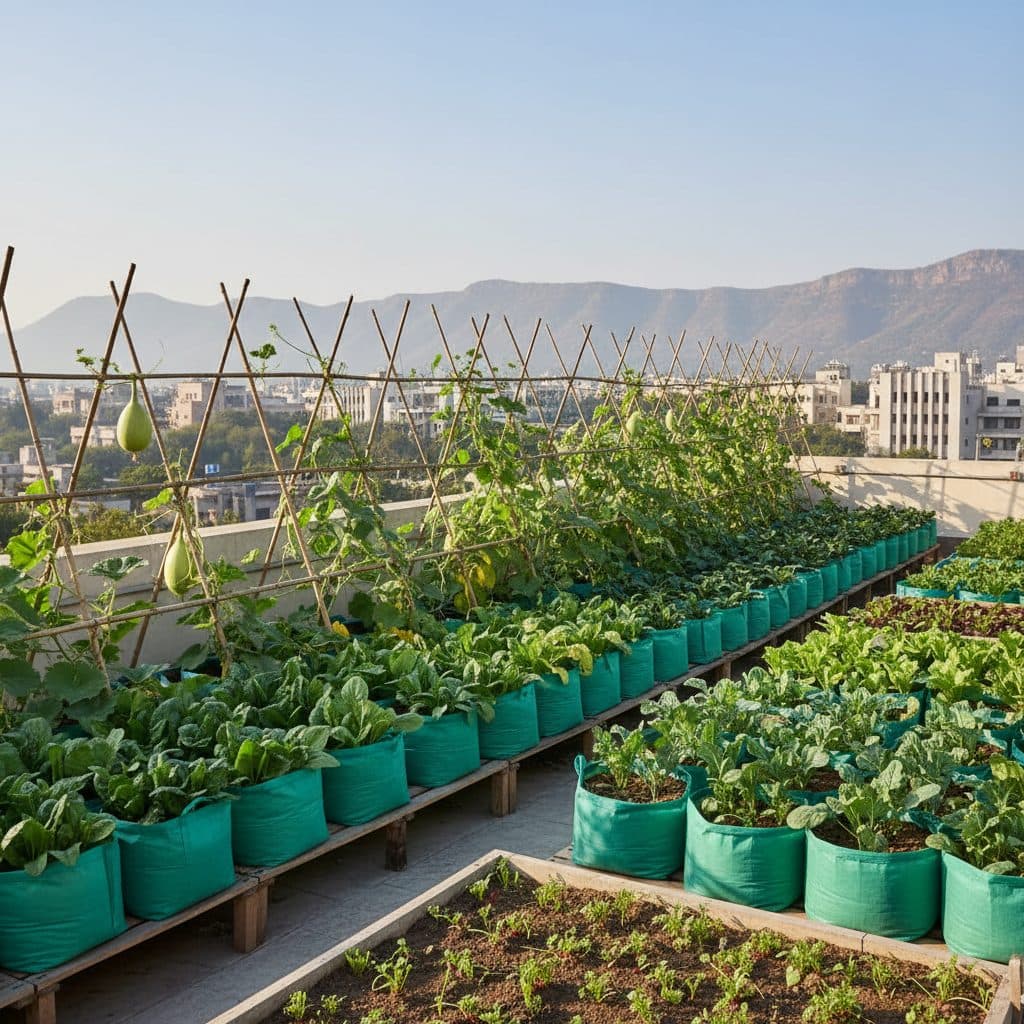
Key takeaways
- Terrace gardening in Chandigarh requires managing distinct seasonal extremes: scorching 45°C dry summer heat, heavy monsoon downpours, and crisp, sunny winters.
- Install a 50 percent green agro-shade net from April to June to shield rooftop plants from blistering solar radiation, leaf scorch, and dry northern Loo winds.
- Winter (October to February) is the peak growing season in North India, producing bumper harvests of sarson, palak, methi, peas, cauliflower, and carrots when sown from September onwards.
- Use lightweight HDPE grow bags filled with 40% cocopeat, 30% vermicompost, 20% garden soil, and 10% sand/perlite amended with neem cake to protect rooftop weight limits.
- Elevate all grow bags on PVC runners or drain cell tiles to prevent water pooling and protect the concrete terrace slab from moisture seepage.
- Position large containers and dwarf fruit trees directly over structural columns and load-bearing beams rather than the centre of the roof span.
Quick answer: To build a successful terrace garden in Chandigarh, adapt to the region's climate by using lightweight cocopeat-based potting soil in UV-treated grow bags. Protect plants from peak 45°C summer heat with a 50 percent green shade net, elevate pots for monsoon drainage, and maximize the crisp winter season for leafy greens and brassicas.
Chandigarh and the surrounding Tricity region (Mohali and Panchkula) sit against the Shivalik foothills and have a long tradition of green open spaces and private home gardens. With spacious flat concrete rooftops common across urban residences, more homeowners are converting unused terrace slabs into lush, productive food gardens.
However, establishing a terrace garden chandigarh setup presents unique microclimatic challenges. Rooftop gardens in North India endure extreme seasonal temperature swings—from near-freezing winter nights in January to dry 45°C heatwaves in May and June, followed by intense monsoon downpours in July and August. Managing structural load, waterproofing, seasonal shading, and crop selection ensures your rooftop garden remains productive throughout the entire year.
+-------------------------------------------------------------+
|              CHANDIGARH ROOFTOP CLIMATE CALENDAR            |
|                                                             |
|   1. SUMMER / ZAID (April to June):                         |
|   - Temps: 38°C to 45°C; dry *Loo* winds                    |
|   - Management: 50% Green shade net; twice-daily watering   |
|   - Crops: Mint (Pudina), Cucumbers, Amaranth (Chaulai)     |
|                                                             |
|   2. MONSOON / KHARIF (July to September):                  |
|   - High humidity; heavy tropical rains                     |
|   - Management: Elevate bags on drain tiles; neem fungicide |
|   - Crops: Bhindi, Brinjal, Bottle Gourd (Lauki), Chillies  |
|                                                             |
|   3. WINTER / RABI (October to March - The Golden Season):  |
|   - Temps: 5°C to 24°C; bright clear sunshine               |
|   - Management: Full sun exposure; heavy composting         |
|   - Sowing: Sep-Oct for brassicas/roots; succession greens  |
|   - Crops: Sarson, Palak, Methi, Coriander, Peas, Broccoli  |
+-------------------------------------------------------------+
Rooftop structural safety, load distribution, and waterproofing
Before hauling bags of soil and heavy pots up the stairs, understand the structural principles of rooftop gardening.
+-------------------------------------------------------------+
|                 TERRACE LOAD & DRAINAGE DESIGN              |
|                                                             |
|   [ Parapet Wall ]                                          |
|   |  [ Heavy 45 cm Fruit Tree Bags on Load-Bearing Beams ]  |
|   |  +---------------------------------------------------+  |
|   |  | [ Drain Cell Mat / Recycled PVC Pipe Runners ]    |  |
|   |  +---------------------------------------------------+  |
|   |  =========================================== Slab       |
|   |  (Polyurethane Waterproofing Barrier Layer)             |
|   |                                                         |
|   |  <----- Clear Central Span for Light Greens ----->      |
|   +---------------------------------------------------------+
Weight distribution guidelines
Standard residential RCC slabs are typically engineered for a design live load of 150 to 200 kg/m2 (30 to 40 lbs/sq ft). Large planters, soil tubs, and water storage tanks easily exceed this when fully saturated — always position heavy containers directly over load-bearing columns and beams, not at the centre of slab spans, and consult a structural engineer before adding large planters.
- Position over beams: Place heavy containers, citrus trees, and large water storage drums along the outer edges of the terrace directly over load-bearing structural walls and columns.
- Keep centre light: Use the central span of the roof slab for lightweight shallow grow bags (for herbs and greens) or movable seedling racks.
Protecting the terrace slab: waterproofing and drain tiles
Never place grow bags or terracotta pots directly flat against bare concrete roof slabs. Standing water trapped beneath pots will seep into micro-cracks over time, causing ceiling dampness in living rooms below.
- Waterproofing inspection: Ensure your terrace has a sound polyurethane or elastomeric waterproof coating with clean slope drainage toward rainwater downpipes.
- Elevate containers: Set all grow bags on interlocking plastic drain cells, recycled PVC pipe runners, or baked clay bricks. This creates a 2.5 to 5 cm air gap beneath each container, allowing monsoon runoff to flow freely to roof drains while aerating the container root zone.
For general home growing fundamentals, explore our overview in what is a kitchen garden.
Formulating a lightweight potting mix for North Indian terraces
Traditional field dirt (khet ki mitti) is heavy, dense, and sets like hard brick when exposed to 42°C rooftop heat. A lightweight, porous potting mix is essential for terrace success.
+-------------------------------------------------------------+
|                 NORTH INDIA TERRACE POTTING BLEND           |
|                                                             |
|   - 40% Washed Cocopeat / Leaf Mould (Moisture retention)   |
|   - 30% Aged Vermicompost / Well-Rotted Gobar Khad          |
|   - 20% Native River Loam / Garden Soil (Mineral body)      |
|   - 10% Perlite / Coarse River Sand (Aeration & drainage)   |
|   - Handful Neem Cake Powder (*Neem Khali*) per container   |
+-------------------------------------------------------------+
Ingredient | Proportion | Purpose |
|---|---|---|
Cocopeat / Leaf Mould | 40 percent | Holds up to 8 times its weight in water; keeps containers featherweight |
Vermicompost / Gobar Khad | 30 percent | Delivers organic nitrogen, humic acids, and beneficial soil bacteria |
River Loam / Garden Soil | 20 percent | Provides mineral body, clay particles, and structural root anchoring |
Perlite / Coarse Sand | 10 percent | Enhances internal root aeration and ensures rapid drainage during rains |
Neem Cake (Neem Khali) | 100 g per 30 cm bag | Natural bio-pesticide that suppresses root grubs and soil fungus |
To convert household kitchen peels into rich, free potting compost on your rooftop, follow our vermicomposting at home worm bin guide.
Summer heat management in Chandigarh: shade nets and hydration
Between April and June, Chandigarh experiences intense solar radiation and dry, dust-laden Loo winds sweeping across the northern plains. Potted plants on concrete roofs can desiccate within hours without protection.
+-------------------------------------------------------------+
|                SUMMER SURVIVAL PROTOCOL (45°C HEAT)         |
|                                                             |
|   1. 50% Green Agro-Shade Net:                              |
|   - Erect frame 2.5 metres above terrace level              |
|   - Shields foliage from solar scorch and transpiration drop|
|                                                             |
|   2. Twice-Daily Watering Routine:                          |
|   - Deep soak at 6:00 AM before concrete heats up           |
|   - Secondary evening refresh at 6:30 PM after sunset       |
|                                                             |
|   3. Surface Mulching:                                      |
|   - 5 cm blanket of dry sugarcane bagasse or wheat straw    |
|   - Prevents topsoil baking and reduces evaporation by 60%  |
|                                                             |
|   4. Microclimate Grouping:                                 |
|   - Cluster grow bags together to create collective humidity|
+-------------------------------------------------------------+
Erecting a summer shade structure
Install a sturdy galvanized iron or bamboo frame across your terrace at a height of 2.5 metres. Stretch a 50 percent green monofilament agro-shade net over the frame by early April. Shading with 50% green agro-net protects foliage from direct solar radiation and leaf scorch, significantly reducing transpiration stress during peak heatwaves while allowing sufficient diffused light for photosynthesis. Remove or roll back the shade net in October to give winter crops full, unobstructed winter sunlight.
For compact balcony adaptations that manage intense solar exposure, read our practical steps for balcony container vegetable gardening.
Seasonal crop selection: from winter greens to monsoon gourds
Timing your crops with Chandigarh's distinct seasons ensures high productivity.
+-------------------------------------------------------------+
|               CHANDIGARH TERRACE CROP SELECTION             |
|                                                             |
|   WINTER CROPS (Sow Sep to Nov - Rabi):                     |
|   - Leafy: Sarson, Palak, Methi, Coriander (Dhania), Bathua |
|   - Roots: Red Radish (*Mooli*), Turnip (*Shalgam*), Carrots|
|  - Brassicas: Cauliflower (*Phool Gobhi*), Cabbage, Broccoli|
|                                                             |
|   SUMMER & MONSOON CROPS (Sow Feb to March & June to July): |
|  - Climbers: Bottle Gourd (*Lauki*), Bitter Gourd (*Karela*)|
|  - Staples: Bhindi (Okra), Brinjal (Baingan), Green Chillies|
|   - Herbs: Mint (*Pudina*), Tulsi, Lemongrass               |
|                                                             |
|   PERENNIAL ROOFTOP FRUITS:                                 |
|   - Kagzi Lemon, Guava (Lucknow 49), Pomegranate (*Anar*)   |
+-------------------------------------------------------------+
The glorious North Indian winter (Rabi season)
The period from October to March is the golden window for terrace gardening in Chandigarh. Sowing window: September to October for winter brassicas (cauliflower, cabbage, broccoli) and root crops (mooli, carrots, turnips); leafy greens (palak, methi, sarson, coriander) can be succession-sown through November. Avoid sowing cool-season brassicas and delicate greens in August heat and heavy monsoon rains, which rot seeds and trigger damping-off.
Monsoon climbing gourds (Kharif season)
During the July to September monsoon, climbing gourds thrive. Build vertical bamboo trellises or string nylon nets along terrace perimeter walls. Bottle gourd (lauki), ridge gourd (torai), sponge gourd (ghia torai), and bitter gourd (karela) produce rampant vines that climb rapidly, producing heavy hanging gourds away from wet roof surfaces.
To keep your ornamental terrace plants blooming alongside edible crops, see our care steps for hibiscus plant care.
Organic pest management and monsoon fungal prevention
Terrace gardens in North India face two distinct pest cycles: sucking pests in summer and fungal rot in monsoon.
+-------------------------------------------------------------+
|                ORGANIC ROOFTOP PEST CONTROLS                |
|                                                             |
|   NEEM OIL EMULSION (Every 10 to 14 Days):                  |
|   - 5 ml pure neem oil + 2 ml liquid soap in 1L warm water  |
|   - Helps keep aphids, whiteflies, and spider mites in check|
|                                                             |
|   FERMENTED BUTTERMILK SPRAY (*Khatta Chhaas*):             |
|   - Ferment sour buttermilk for 4 days in copper pot        |
|   - Dilute 1:5 with water; spray to prevent powdery mildew  |
|                                                             |
|   MEALYBUG TARGETED ALCOHOL REMOVAL:                        |
|   - Spot-treat cottony mealybugs on brinjal, chilli, or     |
|     hibiscus stems with isopropyl alcohol or soap spray     |
+-------------------------------------------------------------+
Neem oil foliar sprays help keep mealybugs, aphids, and whiteflies in check when applied regularly before populations build. During humid monsoon weeks, check grow bag drainage daily. If white cottony mealybugs attack your brinjal, chilli, or hibiscus plants, follow the organic elimination protocols in our guide on how to get rid of mealybugs on plants.