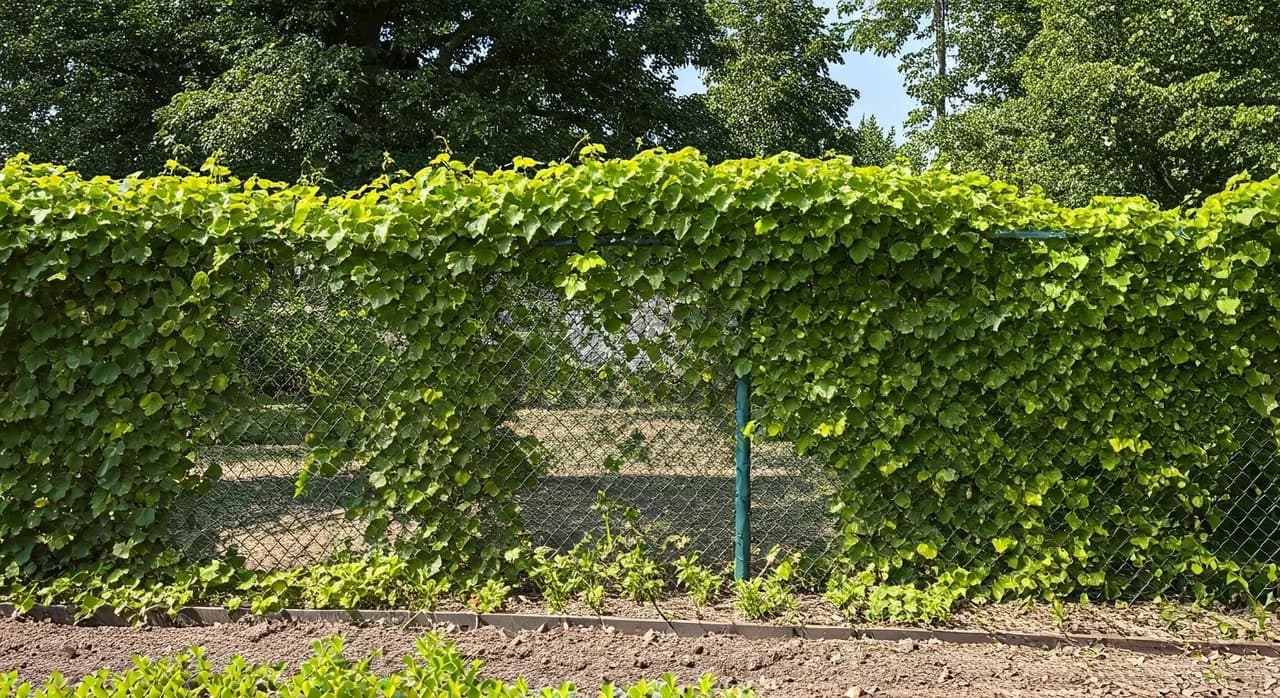
Key takeaways
- Dense foliage closing over 70% of chain-link mesh turns an open fence into a solid wind sail under CLFMI WLG 2445 and ASCE 7 rules, quadrupling lateral force when wind speed doubles.
- Match species weight to framing: keep 16- or 17-gauge residential fences to seasonal annuals, add 7-gauge tension wires for medium gourds or clematis, and reserve heavy woodies for Schedule 40 posts.
- Verify a property survey before loading boundary wire: get written neighbor consent for shared fences, plant 18–24 inches inside your lot, and follow corner sight-triangle and HOA rules.
- Purge invasive sweet autumn clematis (smooth leaflet edges) alongside chocolate vine, kudzu, English ivy, Japanese honeysuckle, and Oriental bittersweet.
- Call 811 before digging post footings, keep pet-toxic Clematis montana and raw butterfly pea seeds away from foraging animals, and follow Northeast state harvest rules on hardy kiwi.
Quick answer: To screen a US chain-link fence quickly without bending rails or sparking neighbor disputes, match vine biomass to pipe strength, verify property-line ownership first, and plant non-invasive climbers 18 to 24 inches inside your lot. Light 16- or 17-gauge residential fences handle annual pole beans, trellis cucumbers, or butterfly pea safely. Heavy perennial woodies like hardy kiwi and European grapes demand ASTM F1083 Group IA Schedule 40 posts in 30-to-36 inch concrete footings at 6-to-8 foot spans. Exclude sweet autumn clematis, chocolate vine, kudzu, and true ivies.
Wind-Sail Buckling Physics and Chain-Link Load Ratings
Bare chain-link fabric survives 60 mph gusts because 2-inch diamond gaps pass roughly 80% of airflow. Cover that mesh in overlapping foliage, and aerodynamics shift fast. Under Chain Link Fence Manufacturers Institute (CLFMI) Wind Load Guide WLG 2445 and ASCE 7 standards, any screen exceeding roughly 70% closure behaves structurally as a solid wall.
Lateral wind force scales with velocity squared (F ∝ V²), so doubling a 25 mph gust to 50 mph multiplies horizontal pressure by four times. Add winter freezing rain onto persistent woody canes, and light tubing kinks downward along top rails while shallow footings tilt out of wet clay.
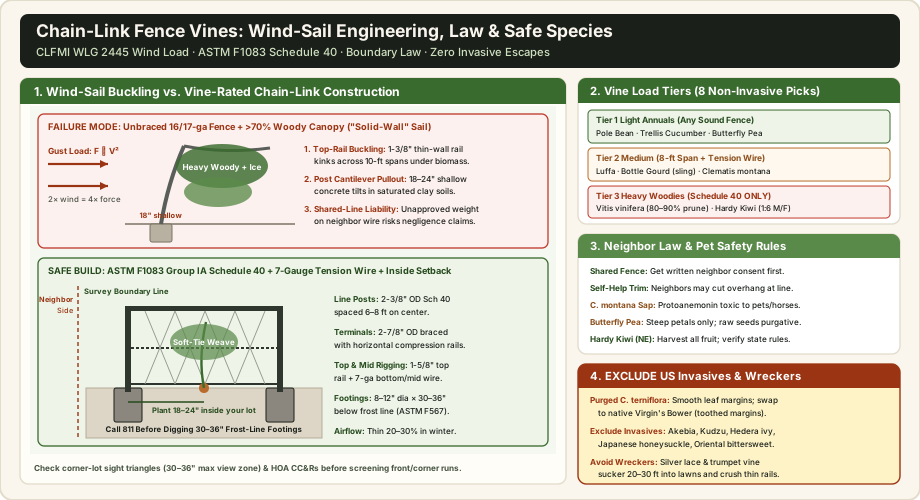
Standard backyard chain-link uses thin 16- or 17-gauge Group IC tubing (0.065 in wall) with 1-3/8 in top rails, 1-5/8 in or 1-7/8 in posts spaced 10 ft apart, and 18–24 in shallow concrete collars. Upgrading to ASTM F1083 / F1043 Group IA Schedule 40 (30,000 psi steel) at 6–8 ft spacing prevents post buckling under permanent vines.
Chain-Link Fence Hardware Grades, Wind-Sail Limits, and Safe Vine Load Classes
Fence Structural Grade | Post and Rail Dimensions | Spacing and Concrete Footing | Safe Vine Biomass Class | Mandatory Upgrade or Limit |
|---|---|---|---|---|
Standard Light Residential (16/17-ga Group IC) | 1-5/8 or 1-7/8 in line posts; 1-3/8 in top rail; 11.5-ga mesh | 10 ft spacing; 18–24 in shallow footing | Tier 1 lightweight annuals only (pole beans, cucumbers, butterfly pea) | Dies back each fall; never load with woody perennials or winter ice weight |
Tension-Braced Residential Retrofit | 1-7/8 in line posts; 1-5/8 in top rail; added 7-ga mid and bottom wires | 8 ft spacing; 24–30 in footing | Tier 1 annuals plus medium gourds and Clematis montana | Sling heavy bottle gourds to posts; thin 20–30% canopy weight to vent summer gusts |
Heavy-Duty Vine Rated (ASTM F1083 Group IA Sch 40) | 2-3/8 in OD Sch 40 line posts; 2-7/8 in braced terminals; 1-5/8 in rail | 6–8 ft spacing; 8–12 in dia × 30–36 in frost-line footing (ASTM F567) | Tier 3 heavy woody perennials (grapes, hardy kiwi) plus Tiers 1–2 | Add corner truss rods and compression rails; prune 80–90% of grape wood in winter |
Shared or Neighbor-Owned Boundary Fence | Any existing frame sitting on or across parcel line | Verify via survey plat | Zero attachment without written neighbor consent | Erect an interior trellis 18–24 in inside your lot; check deer fence setbacks |
Call 811 before digging post footings or deep planting trenches: Setting 30-to-36 inch frost-line footings per ASTM F567 along boundary corridors frequently intersects shallow electric, gas, fiber, and water lines. Submit a free 811 locate request two to three business days before excavating.
Neighbor Fence-Ownership Rules, Sight Lines, and Property Law
Before training shoots through wire mesh, confirm whether the chain-link stands wholly on your lot, wholly on your neighbor's parcel, or atop the surveyed line as a shared boundary fence. Attaching slats, fabric, or heavy woody climbers to a neighbor-owned or shared fence without written agreement invites trespass claims and repair liability if gusts buckle the rails.
- Confirm survey pins first: Even a fence sitting 4 inches inside a neighbor's deeded boundary belongs exclusively to them.
- Plant 18 to 24 inches inside your lot: Keep trunks off neighbor concrete; if wire belongs to them, build freestanding vertical crop trellises 2 feet inside your parcel.
- Self-help trimming law: Across US jurisdictions, neighbors may legally prune overhanging shoots cleanly back to the boundary plane at their cost without crossing onto your land or poisoning the root crown.
- Corner sight triangles and HOA rules: Keep vegetative screening under 30 to 36 inches inside municipal intersection sight triangles (typically 20–30 ft from curb corners) and check HOA covenants before modifying visible chain-link.
For standalone border screening that stays inside your property line, compare shrub hedges in our living berry fence guide or filter regional options using the plant finder tool.
Eight Non-Invasive Catalog Vines Ranked by Fence Weight and Zone
University of Illinois Extension separates climbers by attachment physics: twining stems and curling tendrils or petioles grip open diamond mesh cleanly without prying rails apart, whereas clinging aerial rootlets pry joints and damage coatings. Each verified catalog species below works cleanly on chain-link when matched to the right pipe tier and climate.
Non-Invasive Catalog Vines for US Chain-Link Fences: Growth, Zone, Load, and Care
Catalog Vine Species | USDA Zone & Growth Rate | Climbing Habit & Fence Tier | Sun & Culture | Critical Pruning, Safety, or Regional Caveat |
|---|---|---|---|---|
Pole bean (Phaseolus vulgaris) | All US zones (annual); 6–10 ft/season | Counter-clockwise twining stem; Tier 1 light | Full sun (6–8+ hr); direct sow at 65°F+ | Choose indeterminate pole varieties, not bush types; zero winter ice load; fixes nitrogen |
Trellis cucumber (Cucumis sativus) | All US zones (annual); 6–8 ft/season | Coiling tendrils; Tier 1 light | Full sun; rich compost + even drip moisture | Select vining trellis cultivars over bush types; crisp harvest in 55–65 days |
Butterfly pea (Clitoria ternatea) | Zones 10–12 perennial (Zones 3–9 warm annual); 6–10 ft | Lightweight twining stem; Tier 1 light | Full sun; thrives above 75°F | Steep blue petals only for tea; mature raw seeds and pods contain purgative cyclotides |
Sponge gourd (Luffa cylindrica) | Warm-summer US (110–150+ frost-free days); 12–20 ft | Sturdy tendrils; Tier 2 medium | Full sun; start indoors 4–6 wk early in north | Requires 7-ga mid-wire support once 1–2 lb gourds swell in late summer |
Bottle gourd (Lagenaria siceraria) | Warm-summer US (long season); 12–20+ ft | Strong tendrils; Tier 2 medium-heavy | Full sun; high moisture and compost demand | Hang heavy gourds in cloth slings tied to line posts so weight never bows thin top rails |
Himalayan clematis (Clematis montana) | Zones 6–9 perennial; 15–25+ ft/yr | Twining leaf petioles; Tier 2–3 medium-heavy | Full-sun canopy + mulched cool root zone | Group 1 pruning right after spring bloom; protoanemonin sap irritates skin and is toxic to dogs, cats, and horses |
European grape (Vitis vinifera) | Zones 6/7–9 perennial (winter-kills below -10°F); 8–12 ft/yr | Woody tendrils on cordon wire; Tier 3 heavy | Full sun (7–8+ hr) + sloped air drainage | Remove 80–90% of one-year wood each winter; Southeast Pierce's disease risk limits vinifera outside dry zones |
Hardy kiwi (Actinidia arguta) | Zones 4–8 perennial (-30°F dormant); 15–20+ ft/yr | Muscular woody twiner; Tier 3 Schedule 40 ONLY | Full sun; avoid low frost pockets (early budbreak) | Plant 1 male per 6–8 females within 100 ft (or self-fertile Issai); check Northeast MA/CT escape rules and harvest all fruit |
Tier 1 annual screens: rapid privacy with zero winter wind-sail load
Renters and owners with budget 16-gauge fences get fast 6-to-8 week summer screening from seasonal annuals that die down before ice storms. Indeterminate pole beans ('Kentucky Wonder', 'Rattlesnake') and trellis cucumbers ('Marketmore 76', 'Suyo Long') climb wire effortlessly; pair them with spacing advice in our green bean guide, cucumber trellis guide, and balcony bean screen tutorial.
In warm summers, butterfly pea wraps wire in vibrant cobalt blooms while fixing atmospheric nitrogen. Use strictly petals for herbal infusions because raw mature seeds and pods contain purgative cyclotides and saponins. Compare more seasonal options in annual vs. perennial climbers and edible container vines.
Tier 2 gourds and Clematis montana: medium-load screens
On 8-foot spans reinforced with 7-gauge mid and bottom tension wires, sponge gourd and bottle gourd build broad leaf privacy by July. Because Luffa needs 110 to 150+ frost-free days, northern gardeners should start peat pots indoors 4 to 6 weeks ahead of last frost and tie heavy bottle gourds into breathable fabric slings anchored to line posts.
In USDA Zones 6–9, Himalayan clematis blankets fences in May blooms without shedding invasive seed clouds. Keep roots shaded under 3 inches of bark mulch, prune right after spring flowers fade (Pruning Group 1), and wear gloves—protoanemonin sap irritates skin and harms dogs, cats, and horses if ingested.
Tier 3 woody fruit vines and non-invasive US natives
Permanent fruit screens require Schedule 40 galvanized framing. European grapes succeed in Zones 6/7–9 (winter-killing below -10°F) when pruned by 80% to 90% each late winter; see patio training basics in growing grapes in containers. Growers below -10°F in Zones 3–5 should pick unlinked American Vitis labrusca hybrids, humid Southeast yards should stick to Pierce's-resistant muscadines (Vitis rotundifolia), and foragers can review wild grape safety in wild grapes vs. moonseed.
Hardy kiwi handles -30°F dormant winters in Zones 4–8 but loses tender spring shoots in low frost pockets and needs 1 male per 6 to 8 females within 100 feet (or self-fertile 'Issai'). Because invasive plant councils in Massachusetts and Connecticut flag Actinidia arguta canopy escapes, Northeast growers must check local ordinances, prune twice yearly, and pick every berry before birds disperse seed. For lower-maintenance wildlife fences without Schedule 40 fruit engineering, consider unlinked US natives—coral honeysuckle (Lonicera sempervirens), crossvine (Bignonia capreolata), American wisteria (Wisteria frutescens), and native virgin's bower (Clematis virginiana)—featured in native fence vines and non-invasive quick-coverage vines.
Why Sweet Autumn Clematis and US Invasives Are Purged From Fence Lists
Legacy fence lists frequently recommended invasive or destructive climbers based purely on speed. We purged sweet autumn clematis (Clematis terniflora) alongside aggressive trumpet vine (Campsis radicans), silver lace vine (Fallopia aubertii), and heavy self-seeding morning glory (Ipomoea purpurea). USDA PLANTS, NC State Extension, and UF/IFAS Extension document Clematis terniflora dispersing thousands of wind-blown achenes that blanket forest edges and smother native trees.
Invasive and Fence-Wrecking Vines Excluded From US Chain-Link Fences and Safe Swaps
Excluded Species | Primary Ecological or Fence Hazard | Diagnostic Tell or Spread Mechanism | Safe Replacement Option |
|---|---|---|---|
Sweet autumn clematis (Clematis terniflora) | Aggressive US woodland invasive (USDA PLANTS CLTE4) | Smooth un-toothed leaflet edges vs. native toothed edges; wind-borne seed | Native Virgin's Bower (unlinked) or Clematis montana (Zones 6–9) |
Chocolate vine (Akebia quinata) | Regulated eastern US invasive; forms dense monoculture mats | Five-leaflet palmate semi-evergreen foliage and woody twining stems | Native coral honeysuckle (unlinked) or seasonal pole beans |
Kudzu and Indian kudzu (Pueraria montana / P. tuberosa) | Federal/state noxious weed; buries fences, utility lines, and trees | Up to 1 ft/day summer surge and deep tuberous crowns | Luffa or bottle gourd for bold summer cover without overwinter spread |
English and Nepal ivy (Hedera helix / H. nepalensis) | Severe PNW and eastern forest invasive; collapses top rails | Clinging aerial rootlets trap moisture and climb tree canopies | Crossvine or star jasmine in mild zones; see evergreen privacy vines |
Japanese honeysuckle and Oriental bittersweet | Girdle saplings and invade boundary hedgerows | Bird-spread berries and constricting woody stems | Coral honeysuckle or American wisteria (unlinked) |
Silver lace vine, Trumpet vine, Morning glory | 30 ft fence-crushing mass, 20–30 ft lawn suckers, or toxic weed seeding | Trumpet vine pries joints; morning glory is weed-listed in AZ/AR with toxic seeds | Butterfly pea, trellis cucumber, or cordon grapevines |
How to separate invasive sweet autumn clematis from native virgin's bower: Both species carry foamy white blossoms in late summer, causing frequent nursery mislabeling. Check leaflet margins closely: native Clematis virginiana displays toothed, jagged leaflet edges, whereas invasive Clematis terniflora has smooth, un-toothed edges and thicker foliage.
Soil Preparation, Drip Establishment, and Seasonal Pruning Discipline
Fence strips often hold compacted fill, turf competition, and reflected metal heat. Five practical habits establish healthy screens while keeping neighbors happy:
- Build a 24-inch turf-free bed: Strip grass 18 to 24 inches inside your wire, loosen the top 10 to 12 inches of soil, and mix in 2 to 3 inches of finished compost. Avoid high-nitrogen lawn fertilizers near clematis or native honeysuckles.
- Mulch root crowns cool: Lay 2 to 3 inches of shredded bark (kept 2 inches clear of trunks) to protect roots from summer slab heat, using methods from our container mulching guide.
- Water bases with drip lines: Supply 1 to 2 inches weekly through drip or soaker tubing rather than overhead sprinklers to prevent mildew—tailoring sun or shade water schedules via southwest fence climbers and shade-wall climbers.
- Weave horizontally along the bottom first: Tie young shoots laterally along the lowest 18 to 36 inches every 12 to 18 inches with soft fabric strips so coverage fills from ground level up.
- Thin 20% to 30% annually for wind bleed: Prune Group 1 Clematis montana right after spring bloom, cut 80% to 90% of one-year grape canes in late winter, pull dried annuals every fall, and pair bloom periods with pollinator garden plantings.