Key takeaways
- Plant bare root fruit trees during the UK dormant window between November and March when the ground is unfrozen.
- Heel in trees immediately into a temporary shallow trench if ground conditions prevent planting upon delivery.
- Soak root systems in a bucket of water for two hours before planting to rehydrate fine feeder roots.
- Dig planting holes as deep as the root system and twice as wide, keeping the graft union at least 5 cm above ground level.
- Stake low on the lower third of the trunk using a flexible rubber tree tie to allow trunk strengthening while anchoring roots.
Quick answer: Bare root fruit trees are dormant trees lifted directly from field soil and sold without pots between November and March in the UK. They establish vigorous root networks faster and cost significantly less than potted specimens. Gardeners must plant them while dormant into unfrozen, weed-free soil, ensuring the root collar remains level with the soil surface and the graft union stays clear of soil.
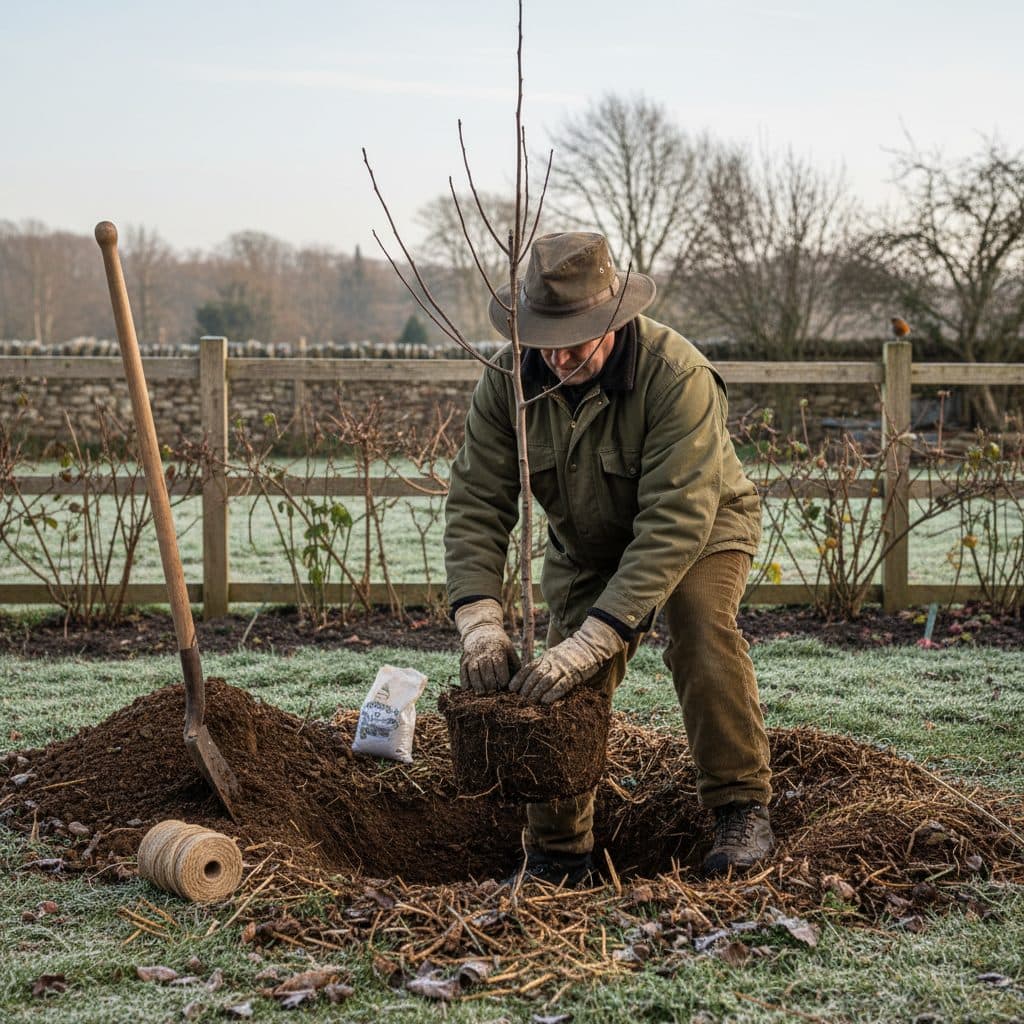
Planting bare root fruit trees represents one of the most reliable and economical ways to establish apples, pears, plums, and cherries across UK gardens and allotments. Supplied without soil around their roots during their winter dormancy, these field-grown specimens adapt quickly to native ground once spring arrives.
Unlike container-grown alternatives that spend months or years restricted in plastic pots, bare root stock develops an open, unrestricted root structure. When planted correctly between late autumn and early spring, the roots begin establishing microscopic connections with soil fungi and native soil particles well before top growth emerges.
Understanding how to source, handle, and plant bare root stock ensures high survival rates and sets your home orchard up for decades of productive cropping. Whether you manage a dedicated allotment plot or a modest suburban garden, following proven dormant-planting practices guarantees healthy tree establishment.
Bare root vs potted trees: advantages and trade-offs
When establishing an orchard or adding a single specimen tree, choosing between bare root vs potted trees comes down to timing, cost, and root architecture. Containerised trees are available throughout the year, but bare root specimens offer distinct biological advantages.
+------------------------+-----------------------------------+-----------------------------------+
| Feature                | Bare Root Fruit Trees             | Potted / Container Trees          |
+------------------------+-----------------------------------+-----------------------------------+
| Planting Window        | November to March (dormant season)| Year-round (avoiding frozen/dry)  |
| Cost                   | Substantially lower per tree      | Higher due to potting and transit |
| Root Architecture      | Wide, natural radial spread       | Potential circling / root-bound   |
| Cultivar Choice        | Extensive specialist nurseries    | Limited garden centre selections  |
| Water Need at Planting | Moderate initial soak             | High and continuous in summer     |
+------------------------+-----------------------------------+-----------------------------------+
Bare root trees are lifted directly from nursery fields after leaf drop in late autumn. Because nurseries ship them without heavy pots and compost, transportation is straightforward and cost-effective. More importantly, their roots spread outward naturally into surrounding soil rather than spiralling within a container boundary.
The principal trade-off is the strict seasonal window. You must plant bare root trees while they remain fully dormant. Once buds break open in mid-spring, nurseries cease lifting field stock to avoid severe transplant shock.
When to plant bare root trees in the UK
The optimal window for when to plant bare root trees across Britain runs from November through to the end of March. During this period, deciduous trees rest in deep dormancy, meaning having dropped their leaves, the trees lose almost no moisture, while their roots slowly acclimatise to cold ground.
Aim to plant as early in the dormant season as possible. Planting in November or December allows the root system to settle into native soil over winter, taking advantage of residual autumn warmth. Come March, early root development is already underway before warm spring days prompt bud burst.
Avoid planting under two specific conditions:
- Frozen ground: Never plant into frozen soil or backfill with frosty clods, as air pockets and cold damage will harm tender root hairs.
- Waterlogged soil: If heavy winter rains leave standing water or sticky, saturated clay, digging will compact soil structure and suffocate roots.
If weather prevents immediate planting when your nursery bundle arrives, you must protect the exposed roots using a technique called heeling in.
Heeling in bare root trees during delays
Nursery trees arrive with their roots wrapped in damp straw, coir, or plastic bags. If frozen ground, waterlogging, or scheduling delays keep you from permanent planting within two days of arrival, heeling in bare root trees is essential to prevent root desiccation.
To heel in your trees:
- Select a sheltered, well-drained corner of the garden or allotment.
- Dig a V-shaped trench approximately 30 cm to 40 cm deep, angled at roughly 45 degrees.
- Remove outer delivery packaging, untie the bundle, and lay the tree stems along the sloping side of the trench.
- Cover all roots and the lower 15 cm of the trunks with loose garden soil or well-rotted compost.
- Firm the soil lightly with your boot to eliminate large air voids, and water thoroughly if the ground is dry.
Trees can remain safely heeled in for several weeks throughout the winter. If digging a trench is impossible because ground is frozen solid, place the trees in an unheated shed or garage, pack damp compost around their roots inside a stout garden bag, and plant as soon as the thaw arrives.
Step-by-step guide to planting bare root fruit trees
Proper soil preparation and planting technique provide the foundation for rapid spring growth. Follow this systematic approach for planting bare root fruit trees:
1. Rehydrate Roots    --> Soak in bucket of water for 1 to 2 hours
2. Check Soil         --> Assess drainage and remove perennial weeds
3. Excavate Hole      --> Dig wide and shallow (2x root spread, same depth)
4. Insert Low Stake   --> Drive stake on windward side before planting
5. Position Tree      --> Align nursery soil mark level with ground
6. Backfill & Firm    --> Work friable soil around roots; firm gently
7. Water & Mulch      --> Apply 10 litres water and 7 cm woodchip mulch
1. Root inspection and pre-soaking
Unwrap the root bundle and inspect the root system. Use clean, sharp secateurs to prune away any broken, crushed, or damaged root tips, making clean cuts that heal rapidly. Place the entire root system into a large bucket or trug of clean water for one to two hours before planting. Avoid soaking roots for more than four hours, as prolonged immersion depletes oxygen.
2. Preparing the planting hole
Clear all grass and perennial weeds from a 1-metre circle around your planting site. Check local ground conditions by performing a basic soil drainage percolation test if your plot sits on heavy clay.
Dig a hole twice as wide as the root spread, but no deeper than the root system itself. Loosen the sides of the hole with a garden fork so expanding roots penetrate easily into surrounding ground. Avoid digging too deep; planting in deep, soft soil causes the tree to sink over time, burying the root collar.
3. Staking and root alignment
For bare root trees on dwarfing or semi-dwarfing rootstocks, insert a sturdy wooden stake before positioning the tree to prevent damaging roots. Drive the stake at least 45 cm to 60 cm into firm, undisturbed ground at the base of the hole on the side of the prevailing wind (usually the south-west in the UK).
Place the tree in the centre of the hole. Look closely at the lower stem to locate the nursery soil line—a faint colour change marking the depth at which the tree grew in the field. Ensure this mark aligns exactly with your garden soil level. The graft union (the noticeable bulge where the fruiting cultivar meets the rootstock) must sit at least 5 cm to 10 cm above ground level. If the graft union is buried, the scion variety will throw its own roots, negating the dwarfing characteristics of the rootstock.
4. Backfilling and firming
Spread the roots outward radially in all directions. Backfill using the excavated native topsoil. Gently shake the trunk up and down as you fill to allow fine soil particles to settle between dense root strands, eliminating air pockets.
Firm the soil gently using the ball of your foot. Avoid heavy stomping, which compacts wet winter soil and restricts oxygen movement. Fasten the tree to its stake using a flexible rubber buckle tie with an integrated spacer pad, positioning the tie about 45 cm to 60 cm above the ground (roughly one third of the tree's height). A low stake allows the upper stem to sway in the wind, encouraging thicker trunk diameter and stronger anchor roots.
First-year care, mulching and formative pruning
Initial post-planting care determines how vigorously your bare root tree performs during its first growing season:
- Watering: Water the tree thoroughly with 10 to 15 litres of water immediately after planting to settle the soil around fine roots. Even during damp UK winters, this initial soak establishes essential soil-to-root contact.
- Mulching: Apply a 7 cm layer of coarse bark or composted woodchips across the cleared 1-metre circle. Keep the mulch at least 10 cm clear of the trunk to prevent fungal collar rot. For weed suppression on tough allotment plots, combine mulch with sheet mulching cardboard weed control.
- Pruning: Carry out initial pruning of apples and pears in late winter while the tree is dormant. Never winter-prune plums, cherries or other Prunus: prune them between late spring and midsummer, in dry weather, when the tree is in active growth and can seal wounds against silver leaf and bacterial canker. Shorten the leading stem and balance lateral branches to establish a balanced open-centre bush or central leader shape. Detailed structural pruning methods are explained in our guide to formative pruning young fruit trees.
- Weed Management: Keep the base of the tree entirely free of competing grass and weeds for the first three years. Grass roots compete aggressively for surface moisture and soil nutrients during critical spring development.
For growers working with restricted plots, bare root stock can be trained into space-saving cordons, espaliers, or fans, as detailed in our guide on fruit trees for small gardens.