Key takeaways
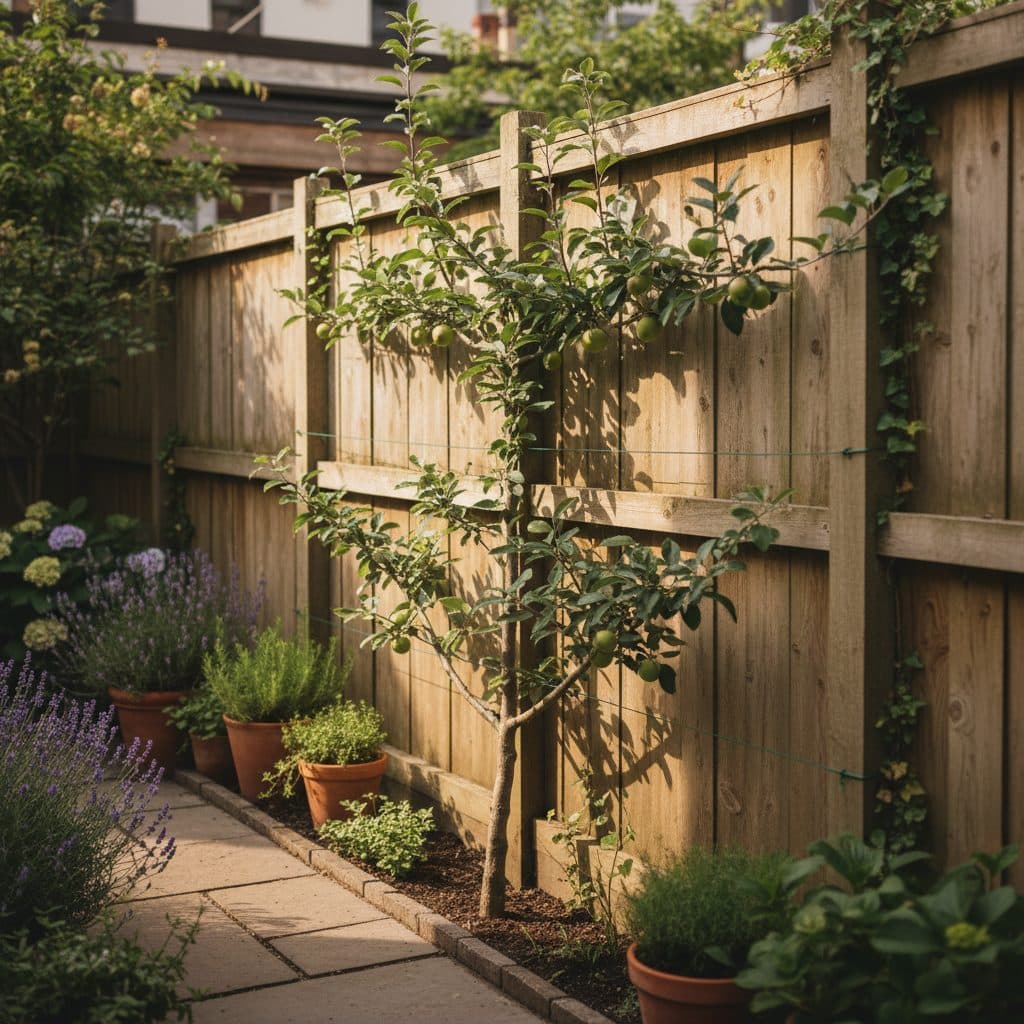
- Choose dwarfing rootstocks — M27 for the smallest apples (1.2 to 1.8 m), M9 for apples and Quince C for pears (roughly 2 to 3 m) — to keep every branch reachable from the ground.
- Train trees as vertical or oblique cordons spaced just 75 cm apart along walls, fences, or post-and-wire supports.
- Plant self-fertile fruit cultivars to guarantee heavy crops without needing partner pollinator trees nearby.
- Grow compact stepover apples as decorative, productive 40 cm high living borders along garden pathways.
- Grow dwarf patio cherries on Gisela 5 and compact plums on Pixy in 35 to 45 cm containers on sunny terraces.
Quick answer: The most productive fruit trees for small gardens in the UK are trained as cordons, espaliers, or dwarf container bushes on dwarfing rootstocks like M9 (apples), Quince C (pears), and Gisela 5 (cherries). These compact trees produce full-sized fruit while occupying less than a metre of ground space against fences, walls, or patio borders.
Limited outdoor space should never prevent British gardeners from harvesting baskets of fresh dessert apples, juicy pears, plums, and cherries. Modern horticulture allows you to cultivate an abundance of fruit within a compact suburban plot, a paved courtyard, or a narrow terrace using dwarfing rootstocks and formal training systems.
Growing fruit trees for small gardens is not about planting miniature or bonsai novelties; it relies on grafting premium full-flavoured cultivars onto vigour-controlling rootstocks. The resulting trees yield standard, full-sized fruit within two years of planting while remaining compact enough to manage without tall ladders.
By pairing the right dwarfing rootstocks with space-efficient training shapes such as cordons, espaliers, fans, and stepovers, you can turn bare boundary walls, fence lines, and pathway borders into highly productive vertical orchards.
Understanding UK rootstocks: the key to compact trees
A grafted fruit tree consists of two parts: the scion (which determines the fruit variety and flavour) and the rootstock (which determines mature tree height, vigour, precocity, and soil tolerance). Selecting the correct rootstock is the foundation of compact fruit growing.
+---------------+-------------------+-------------------+-----------------------------------------------+
| Fruit Type    | Rootstock Name    | Mature Height     | Best Garden Application                       |
+---------------+-------------------+-------------------+-----------------------------------------------+
| Apple         | M27 (Extreme)     | 1.2 to 1.8 metres | Stepover borders, miniature patio pots        |
| Apple         | M9 (Dwarfing)     | 2.0 to 2.5 metres | Cordons, small espaliers, permanent pots      |
| Apple         | M26 (Semi-dwarf)  | 2.5 to 3.0 metres | Small garden bushes, large espaliers          |
| Pear          | Quince C (Dwarf)  | 2.0 to 2.5 metres | Cordons, espaliers on walls, compact bushes   |
| Cherry        | Gisela 5 (Dwarf)  | 2.5 to 3.0 metres | Potted patio cherries, fan-trained walls      |
| Plum / Gage   | Pixy (Dwarf)      | 2.5 to 3.0 metres | Compact bushes, pyramids, container plums     |
+---------------+-------------------+-------------------+-----------------------------------------------+
For tiny gardens and narrow side returns, M9 (apples) and Quince C (pears) represent the ideal balance. They induce early fruiting—often bearing a modest crop in their second summer—while keeping root spread compact. When purchasing your stock as bare root fruit trees in the winter dormant season, always check the nursery label to confirm the specific rootstock.
Space-saving training forms: cordons, espaliers and stepovers
Instead of letting a tree grow into a sprawling three-dimensional dome, training branches along a two-dimensional plane maximises sunlight exposure and fits into narrow footprints.
+-------------------------------------------------------------------------------+
|                       TWO-DIMENSIONAL TRAINING SHAPES                         |
|                                                                               |
|   1. OBLIQUE CORDON (45° Angle):                                              |
|      /   /   /   --> Spaced 75 cm apart along fence wires                     |
|                                                                               |
|   2. HORIZONTAL ESPALIER:                                                     |
|      --|--|--    --> Horizontal tiers spaced 35 cm apart vertically           |
|                                                                               |
|   3. STEPOVER BORDER:                                                         |
|      ----|----   --> Single horizontal tier 40 cm above ground along path     |
+-------------------------------------------------------------------------------+
1. Cordon fruit trees
Cordons consist of a single main stem pruned to maintain short lateral fruiting spurs. Planting oblique cordons angled at 45 degrees slows sap flow, encouraging heavy spur formation along the entire stem length. You can plant cordon fruit trees just 75 cm to 90 cm apart along a fence, allowing you to grow five or six distinct dessert and culinary varieties in a 5-metre run.
2. Espaliers and fans
Espaliers feature a central vertical trunk with pairs of branches trained horizontally at 35 cm vertical intervals. Apples and pears take naturally to espalier training against sunny south- or west-facing boundary walls. Stone fruits—including plums, cherries, and peaches—produce better when trained as radiating fan shapes, as stone fruit wood does not respond well to the rigid right-angle bending required by espaliers.
3. Stepover trees
Stepovers are single-tiered horizontal espaliers pruned to form a productive 40 cm high living fence. Positioned along vegetable garden beds or flower borders, stepover apples define garden pathways while yielding dessert apples at knee height.
For complete structural pruning methods across young and mature trained specimens, read our guide on formative pruning young fruit trees.
Best fruit trees for small gardens UK: top cultivar picks
When space allows only one or two trees, choose self-fertile or partially self-fertile cultivars so you harvest heavy crops without needing a neighbouring pollinator tree.
+-------------------+-------------------+-------------------+-------------------------------------------+
| Fruit Variety     | Pollination Group | Flavour & Quality | Why It Excels in Small UK Gardens         |
+-------------------+-------------------+-------------------+-------------------------------------------+
| Greensleeves (App)| Self-fertile (Gp3)| Crisp, sharp-sweet| Heavy reliable cropper on M9; good cordon |
| Scrumptious (App) | Fully Self-fertile| Honeyed, aromatic | Heavy cropper on M9; superb garden apple  |
| Concorde (Pear)   | Self-fertile      | Sweet, juicy, rich| Compact habit; reliable on Quince C       |
| Victoria (Plum)   | Fully Self-fertile| Classic sweet plum| Prolific dual-purpose; reliable on Pixy   |
| Stella (Cherry)   | Fully Self-fertile| Rich, dark sweet  | Compact on Gisela 5; easily netted birds  |
| Brown Turkey (Fig)| Parthenocarpic    | Rich, honeyed fig | No pollination needed; great in 40 cm pot |
+-------------------+-------------------+-------------------+-------------------------------------------+
Cultivating a dedicated container fruit tree such as a fig tree in pot pairs naturally with dwarf potted cherries and compact cordon apples to create a multi-layered, small-space orchard on paved terraces.
Soil preparation, staking and post-and-wire supports
Dwarfing rootstocks have relatively small, brittle root systems that require permanent physical anchoring and nutrient-rich soil.
- Erecting Support Wires: For cordons and espaliers along fences or walls, fix heavy-duty galvanised 2.5 mm steel wires horizontally across the structure using screw eye bolts and barrel strainers. Space wires 35 cm to 40 cm apart vertically. Fix battens 5 cm away from masonry to ensure good air circulation behind foliage, which deters fungal powdery mildew.
- Permanent Staking for Bushes: Freestanding dwarf bushes on M9 or Quince C require a permanent wooden stake driven 45 cm into the ground. Use a stake reaching about two-thirds of the trunk's height, with an adjustable rubber buckle tie near the top of the stake and a second lower down; leave both in place for the life of the tree.
- Soil Enrichment: Clear a 1-metre circle of grass and weeds around each planting station. Incorporate generous compost into the top 25 cm of soil. Avoid excessive synthetic nitrogen, which prompts unwanted vegetative surge at the expense of fruiting spurs.
For additional insights on shaping and maintaining diverse Mediterranean and temperate fruit cultivars in compact spaces, consult our detailed instructions on pruning care pomegranates figs persimmons mulberries.
Summer pruning for space and fruitfulness
Winter pruning stimulates vigorous vegetative growth—the opposite of what small-space growers want. Instead, trained small garden fruit trees depend primarily on summer pruning carried out in late July and August.
- The Modified Lorette System: In late July or early August, cut back new leafy lateral shoots originating from the main stem to three leaves above the basal cluster. Cut shoots arising from existing fruiting spurs to just one leaf above the basal cluster.
- Sunlight Penetration: Summer pruning admits maximum sunlight to ripening fruit, which improves colour and sweetness, checks tree vigour, and keeps the tree within its prescribed frame.
- Fruit Thinning: In late June (after the natural 'June drop'), thin heavy clusters so only one or two well-spaced fruitlets remain per cluster. This prevents branch snapping and avoids biennial bearing cycles.