Key takeaways
- Sow winter green manures between August and October to protect bare soil from heavy winter rainfall and erosion.
- Grazing rye and winter field beans establish strong root networks in cold weather, scavenging nitrogen that would otherwise leach away.
- Winter tares (vetch) fix atmospheric nitrogen into the soil, providing natural fertility for heavy-feeding brassicas and potatoes the following spring.
- Terminate cover crops in early spring at least three to four weeks before sowing maincrop vegetables to allow green matter to decompose.
- No-dig gardeners can cut winter green manures at ground level and cover with compost rather than digging plants into the subsoil.
Quick answer: Winter green manures are cold-hardy cover crops sown in late summer or autumn across bare UK garden beds and allotment plots. Species such as grazing rye, winter tares, and field beans prevent autumn rainfall from washing soluble nutrients out of topsoil, suppress winter weed growth, and improve soil biological structure. In early spring, the foliage is cut back or incorporated to feed earthworms and provide organic fertility for the next growing season.
Leaving garden soil bare through a damp British winter exposes delicate soil structure to compaction from driving rain, surface capping, and severe nutrient leaching. Nitrate leaches readily over a wet winter, and sulphate with it; on light sandy soils potassium and magnesium go too. Heavier soils hold potassium better, but the nitrogen loss alone leaves empty beds hungry by spring.
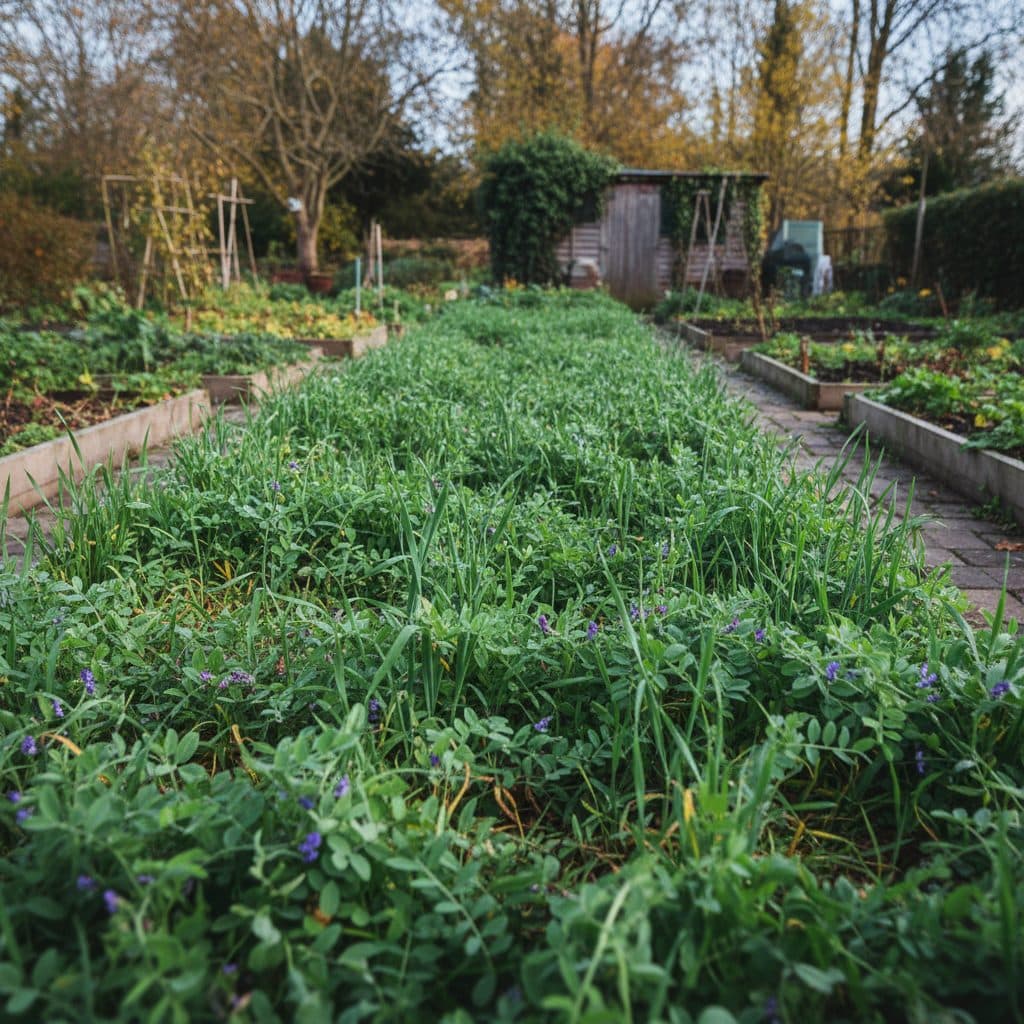
Sowing winter green manures provides living root systems that actively anchor soil particles, shelter beneficial microorganisms, and hold residual fertility within plant tissues. These plants keep capturing sunlight through late autumn and turn it into organic biomass over winter.
Selecting the right species for your soil type and spring cropping plan ensures smooth termination and maximum fertility return. By understanding sowing dates, species pairings, and non-inversion termination methods, you can maintain healthy soil across all your growing beds year-round.
Why bare soil suffers during UK winters
The British climate presents specific challenges for overwintering garden beds. High seasonal precipitation paired with low evaporation rates means unprotected topsoil remains saturated for months.
+------------------------+-----------------------------------+-----------------------------------+
| Soil Condition         | Bare Uncovered Soil               | Soil Protected by Green Manure    |
+------------------------+-----------------------------------+-----------------------------------+
| Nutrient Leaching      | High (nitrates wash away freely)  | Minimal (nutrients held in roots) |
| Soil Compaction        | Heavy crusting from rain impact   | Foliage buffers raindrop energy   |
| Biological Activity    | Little surface food or cover for worms | Living roots and residue feed worms & fungi|
| Weed Suppression       | Chickweed, bittercress colonise   | Dense cover smothers weed seeds   |
| Spring Workability     | Cold, sticky, slow to drain       | Well-structured, dries out faster |
+------------------------+-----------------------------------+-----------------------------------+
By keeping a living canopy over the ground, raindrop impact is absorbed by leaves rather than pounding fine soil aggregates into an impermeable crust. Deep-rooting cover crops create vertical biopores that improve drainage on heavy ground, a benefit easily evaluated by a soil drainage percolation test.
Top winter green manure species for the UK
Different cover crop species offer distinct biological advantages. Sowing a mix of grasses and legumes provides both biomass production and nitrogen fixation.
+------------------------+-------------------+-------------------+-------------------------------+
| Species                | Sowing Window     | Hardiness Level   | Primary Function              |
+------------------------+-------------------+-------------------+-------------------------------+
| Grazing Rye (Secale)   | August to November| Extremely hardy   | Massive root mass, scavenges N|
| Winter Tares (*V. sativa*)| August to October| Fully hardy       | Nitrogen-fixing legume        |
| Winter Field Beans     | September to Nov  | Fully hardy       | Deep taproot, clay improver   |
| Crimson Clover (*T. incarnatum*)| March to August| Half-hardy (mild winters)| Fast summer/early cover, bees |
| Mustard (Sinapis alba) | August to Sept    | Frost tender      | Fast autumn cover, winterkill |
+------------------------+-------------------+-------------------+-------------------------------+
1. Hungarian grazing rye (Secale cereale)
Grazing rye is the most reliable cold-tolerant cover crop for UK growers. It can be sown as late as November and will continue root growth whenever temperatures rise above 4°C. Its extensive fibrous root network holds sandy soils together and traps soluble nitrates with remarkable efficiency.
2. Winter tares (Vicia sativa)
Winter tares (common vetch) are hardy scrambling legumes that fix atmospheric nitrogen into root nodules. Hairy vetch (Vicia villosa) is a separate species sold under its own name; it is hardier still but slower to establish from autumn sowings. Count tares as part of your legume rotation: do not sow them on ground that has just grown broad beans or peas, or is about to, or you carry over foot rot, chocolate spot, and rust.
3. Winter field beans (Vicia faba)
Field beans are agricultural selections of the broad bean (Vicia faba). Their strong taproots follow existing cracks, old root channels, and worm burrows deep into heavy clay, opening drainage routes and drawing on subsoil nutrients. They will not break a genuine compacted pan — that needs loosening with a fork, and time. Because they are the same species as broad beans, do not sow field beans before or after broad beans or peas to avoid carrying over soil-borne foot rot and chocolate spot.
4. Crimson clover (Trifolium incarnatum)
Crimson clover is a fast-growing, pollinator-friendly legume best sown between spring and late summer. Because it is only half-hardy in the UK and may not survive severe winter frosts, treat it as a quick gap-filler for mild districts and early autumn ground rather than a dependable overwintering cover.
5. White mustard (Sinapis alba)
Mustard grows rapidly from late August sowings, smothering autumn weeds within weeks. However, mustard is frost-tender and will winter-kill during hard frosts (temperatures below -5°C). The frost-killed residue forms a protective dry mulch on the soil surface that can be raked aside in spring. Note: avoid mustard in beds designated for brassicas the following season to prevent clubroot buildup.
How to sow winter green manures
Establishing a clean, dense stand of green manure requires straightforward ground preparation.
+-------------------------------------------------------------------+
|               GREEN MANURE SOWING PROCEDURE                       |
+-------------------------------------------------------------------+
|1. Clear Spent Summer Crops  --> Remove diseased haulms and weeds  |
| 2. Rake Surface Friable      --> Create 2 cm fine tilth           |
| 3. Broadcast Seed Evenly     --> Cross-pattern sowing for coverage|
| 4. Rake & Tamp Down          --> Ensure 1 to 2 cm seed-to-soil    |
| 5. Water Thoroughly          --> Keep moist until germination     |
+-------------------------------------------------------------------+
Seedbed preparation
As summer crops finish in August and September, clear spent tomato stems, bean vines, and weeds. You do not need to dig deeply; simply rake the top 2 cm of soil to create a fine, crumbly seedbed.
Broadcasting vs drilling
For small beds and allotments, broadcast seed evenly across the surface by hand. Sowing in two passes at right angles ensures uniform coverage without gaps. Rake the seed into the surface to a depth of 1 cm to 2 cm (or 3 cm to 5 cm for large field beans) to protect them from foraging pigeons. Walk over the bed with small steps or press with the flat head of a rake to ensure firm seed-to-soil contact.
If managing newly built no dig raised beds, sowing green manure across fresh compost keeps the growing medium biologically active until spring.
Terminating winter green manures in spring
Proper timing during spring termination is critical to avoid cover crops setting seed or locking up soil nitrogen.
When to terminate
Terminate winter green manures between late February and early April, approximately three to four weeks before you plan to sow or transplant your first spring vegetables. Terminating before plants flower ensures the stems remain succulent and break down quickly. If allowed to set hard, woody seed stems, the high carbon content will temporarily tie up available soil nitrogen as microorganisms work to decompose the tough fibres.
No-dig termination methods
No-dig gardeners do not dig or rotavate green manures into the subsoil. Instead, use one of these non-inversion techniques:
- Cut and Mulch: Cut and mulch works for tares, field beans and frost-killed mustard. Grazing rye is the exception — cut while it is still growing it simply regrows from the crown, and a compost mulch will not stop it. For rye, use the tarp method below, cut it repeatedly, or leave it until it is in flower before cutting.
- Light-Deprivation Tarping: Cut top growth and lay an opaque silage tarp or thick cardboard over the bed for four to six weeks (longer in a cold spring, and at the upper end of that range for grazing rye). Deprived of light, root systems die naturally, and earthworms consume the decaying organic matter underground.
Incorporating green manure management into your annual cycle is a cornerstone of an allotment first year plan, ensuring fertility builds year after year without costly chemical inputs.