Key takeaways
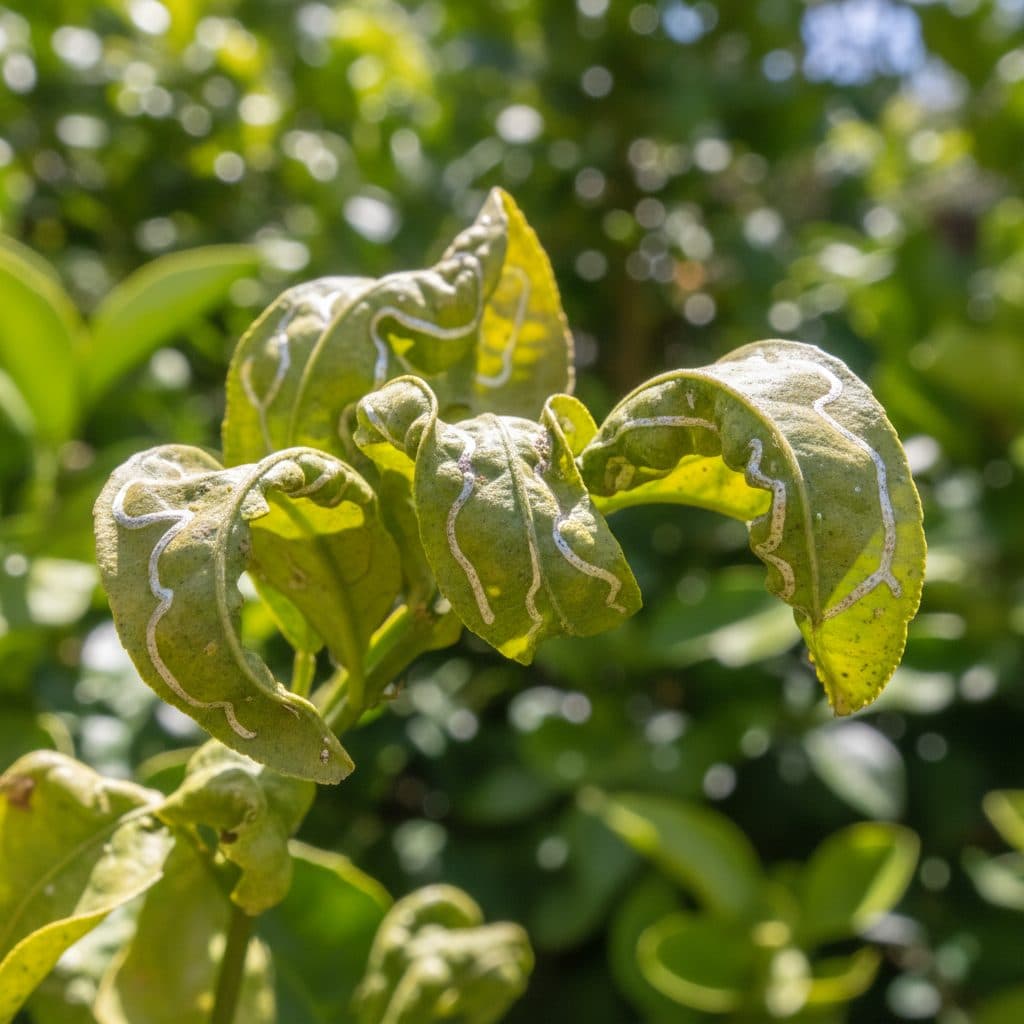
- Citrus leaf miner is a tiny nocturnal moth whose larvae tunnel beneath the cuticle of tender new citrus foliage, creating silvery serpentine mines and curling leaves.
- Peak infestation in Australia occurs during late summer and autumn (January to May) when trees produce their secondary flush of new growth.
- Spraying horticultural pest oil or botanical oil creates a protective physical barrier that deters female moths from laying eggs on fresh flush.
- Apply oil sprays late in the afternoon when temperatures are below 30°C to prevent solar leaf scorch.
- Mature, hardened leaves are immune to citrus leaf miner; the pest only attacks soft, young leaves under 4 cm in length.
- Avoid heavy high-nitrogen fertilisation in mid-to-late summer, which stimulates excessive tender foliage during peak moth activity.
Quick answer: To treat citrus leaf miner in Australia, spray vulnerable new flush every 7 to 14 days with an organic horticultural pest oil or botanical white oil late in the afternoon. Oil deters the adult moth from laying eggs and suffocates emerging larvae with little residual effect on beneficial insects once the spray has dried — though wet oil will kill soft-bodied predators and parasitoids on contact, so spray only the flush that needs it.
Citrus trees—including lemons, limes, oranges, mandarins, and kumquats—are staples in Australian backyards and veggie patches. However, many gardeners encounter curled, twisted, and silvery-streaked young leaves on their citrus trees in late summer and autumn, often mistaking the damage for fungal leaf curl disease or drought stress.
The culprit is the citrus leaf miner (Phyllocnistis citrella), an introduced micro-moth whose larvae feed inside tender leaf tissue. While leaf miner damage rarely kills a mature, established tree, it severely stunts young trees, reduces photosynthetic capacity, and leaves unsightly, distorted foliage. Understanding the insect's life cycle and applying organic barrier treatments allows you to protect new flushes and maintain vigorous, productive trees.
+-------------------------------------------------------------+
|              CITRUS LEAF MINER LIFE CYCLE TIMELINE          |
|                                                             |
|   1. ADULT MOTH: Tiny (4 mm wingspan), silver-white, night- |
|      flying moth. Lays single eggs on underside of new leaves|
|                                                             |
|   2. LARVA (Mining Phase): Translucent yellow caterpillar   |
|      tunnels inside leaf lamina for 5 to 10 days            |
|                                                             |
|   3. SILVERY MINES: Serpentine translucent trails filled    |
|      with dark central frass lines                          |
|                                                             |
|   4. PUPAL FOLD: Larva curls leaf margin over itself to     |
|      form a protective silk cocoon before emerging          |
+-------------------------------------------------------------+
Identifying citrus leaf miner damage vs other citrus pests
Correct identification ensures you apply the right treatment rather than spraying unnecessary compounds.
+-------------------------------------------------------------+
|               CITRUS PEST SYMPTOM COMPARISON                |
|                                                             |
|   CITRUS LEAF MINER:                                        |
|   - Silvery, translucent squiggly tunnels on leaf surface   |
|   - Leaves curl into tight cylinders; blistered texture     |
|   - Attacks only soft, new growth flush (under 4 cm)        |
|                                                             |
|   CITRUS GALL WASP:                                         |
|   - Woody, swollen, bumpy galls on green stems and twigs    |
|   - No leaf tunneling; leaves remain flat                   |
|                                                             |
|   BRONZE ORANGE BUG / STINK BUGS:                           |
|   - Large shield bugs clustered on young flower stems       |
|   - Causes wilting shoot tips, blossom drop, black sooty spot
+-------------------------------------------------------------+
Visual symptoms of leaf miner
As the larva feeds on cell contents just beneath the leaf cuticle, it leaves a hollow, air-filled trail that reflects sunlight as a distinct silvery or translucent serpentine mine.
As the larva reaches maturity, it migrates to the outer edge of the leaf, spins a silk thread, and curls the leaf margin over itself to form a pupal chamber. The leaf dries, becomes brittle, curls inward, and fails to expand to its normal shape.
For a broader diagnostic routine across fruit tree pests, consult our garden pest scouting checklist and compare leaf distortions with nutrient issues in leaf nutrient deficiency diagnosis.
The seasonal biology and vulnerability window
In Australia, citrus leaf miner activity is closely linked to ambient temperature and citrus flush cycles.
Australian Season | Moth Activity Level | Tree Growth State | Management Action |
|---|---|---|---|
Winter (June to August) | Dormant / Inactive | Low growth activity | None needed; moths do not reproduce |
Spring (September to November) | Low to Moderate | Main flowering and spring growth flush | Inspect flush; spot-spray if mines appear |
Summer (December to February) | High | Rapid summer flush | Spray pest oil every 10 to 14 days on new flush |
Autumn (March to May) | Peak Infestation | Secondary autumn growth flush | Spray pest oil weekly; inspect leaf undersides |
This calendar suits temperate and Mediterranean areas. In tropical and warm subtropical regions the moth stays active almost year-round — there, time sprays to flush, not to the calendar.
Adult moths emerge at dusk and mate during warm evenings. Females lay only on very soft, juvenile foliage — leaves less than about 4 cm long — because the newly hatched larva can only mine tissue that is still soft; once the leaf hardens and the cuticle thickens, the larva cannot establish. This creates a specific vulnerability window: once leaves fully expand, turn dark green, and harden off, they are completely safe from new attacks.
For year-round cultivation advice, explore our comprehensive guide on growing citrus in Australia.
Organic treatment: applying horticultural pest oils
Because citrus leaf miner larvae feed entirely inside the protective leaf sandwich, contact insecticides like pyrethrum cannot reach them once they are tunneling inside the leaf. Broad-spectrum chemical sprays also kill beneficial predatory wasps and lacewings, worsening future infestations.
+-------------------------------------------------------------+
|                 HOW HORTICULTURAL OIL WORKS                 |
|                                                             |
|   [ Pest Oil Spray Droplets Coat Foliage ]                  |
|   ~~~~~~~~~~~~~~~   |
|   1. Olfactory Deterrent: Masks citrus volatile scent so    |
|      adult female moths cannot locate tender leaves         |
|   2. Physical Slippery Barrier: Prevents egg adhesion       |
|   3. Ovicide Action: Coats and smothers newly laid eggs     |
|   4. Low Residual Action: Little effect once oil dries      |
+-------------------------------------------------------------+
Step-by-step pest oil application:
- Monitor new growth: As soon as tiny, pale green leaf buds appear (1 cm long), begin inspection.
- Dilution: Follow the rate printed on your product label — for summer and autumn sprays on soft new growth this is usually around 5 to 10 mL of oil per litre of water. Never use the heavier winter/dormant rate on tender flush.
- Complete coverage: Spray both the upper and lower surfaces of all new growth flushes until the leaves glisten with a fine, even film.
- Spray timing: Always spray late in the afternoon or early evening when direct sunlight has faded and temperatures drop below 30°C. Spraying oil in the heat of midday causes solar leaf burn (phytotoxicity).
- Frequency: Reapply every 7 to 14 days while new leaves continue to emerge, or immediately following heavy rain. Stop spraying once leaves reach full size and darken in colour.
You can learn how to blend effective home botanical sprays in our guide to homemade bug spray for plants.
Cultural practices to reduce leaf miner pressure
Modifying your feeding and pruning routines reduces the volume of vulnerable foliage available during peak moth flights.
+-------------------------------------------------------------+
|               CULTURAL LEAF MINER MANAGEMENT                |
|                                                             |
|   DO:                                                       |
|   - Fertilise heavily in late winter/early spring (August)  |
|   - Encourage a single, massive spring flush before moths   |
|   - Leave slightly damaged leaves on the tree to harden     |
|                                                             |
|   AVOID:                                                    |
|   - Applying high-nitrogen manure in late summer (Feb/March)|
|   - Pruning healthy citrus in midsummer (triggers flush)    |
|   - Stripping every curled leaf (stresses the root system)  |
+-------------------------------------------------------------+
Strategic fertilisation timing
Apply the bulk of your citrus fertiliser (well-rotted poultry manure, blood and bone, and compost) in late winter (August) and late spring (November). This pushes a massive burst of spring growth when moth populations are low. Avoid heavy high-nitrogen applications in January and February, which trigger tender, late autumn flushes right when leaf miner moth numbers reach their annual peak.
Pruning damaged leaves correctly
Do not strip off every curled leaf from your citrus tree. A curled leaf with old, inactive mines still conducts photosynthesis and feeds the tree. Stripping leaves forces the tree to push out another round of emergency growth flush, providing fresh food for the next generation of moths. Only prune off severely damaged, dead branch tips during winter clean-up.
Encouraging natural biological control
A healthy Australian backyard ecosystem supports a variety of native beneficial insects that prey on citrus leaf miner larvae:
- Parasitic wasps: Native eulophid wasps and introduced parasitoids (Ageniaspis citricola) lay their eggs inside leaf miner larvae. The parasitoid larva feeds internally on the leaf miner, killing it before it can pupate.
- Lacewings and generalist predators: Green lacewing larvae and generalist predators such as spiders and small predatory bugs take eggs and exposed larvae.
- Protecting predators: Avoid synthetic pesticides that eradicate beneficial insects and disrupt natural garden balance.
Managing other common Australian citrus pests
While managing leaf miner, monitor for other seasonal citrus pests:
Bronze orange bug (Musgraveia sulciventris)
These large, shield-shaped stink bugs suck sap from tender shoots, flower stalks, and developing fruitlets from spring through summer.
- Safety caution: Adult bronze orange bugs squirt a caustic, foul-smelling chemical that causes severe eye irritation and skin staining. Always wear protective safety glasses and gloves when inspecting trees.
- Organic control: Hand-pick nymphs using long tongs and drop them into a bucket of warm soapy water, or vacuum them off branches using a shop vacuum.
Citrus gall wasp (Bruchophagus fellis)
Gall wasps lay eggs into green spring twigs, causing woody, bulbous swellings (galls) to form along branches. Prune out all galls in late winter, before adults emerge in spring, and destroy the prunings — seal them in a bag in the sun, or put them in the general waste bin. Never compost or chip them, and never leave them lying under the tree. Yellow sticky traps can be used to monitor emergence.
For specific varietal care profiles, examine our cultivation notes for Citrus Eureka lemon.