Key takeaways
- Scale insects are sap-sucking pests protected beneath waxy, shell-like armor that shields them from standard contact sprays.
- Distinguish between armored scale (no honeydew) and soft scale (which excrete sticky honeydew that fosters black sooty mold).
- Target the vulnerable, mobile "crawler" stage in late spring with organic horticultural oil or insecticidal soap sprays.
- Apply dormant horticultural oil sprays in late winter to suffocate overwintering adults on deciduous fruit trees before bud break.
- Control foraging ants with sticky trunk barriers to prevent them from protecting soft scale colonies from natural predators.
Quick answer: To get rid of scale insects on plants, scrape off heavy encrustations manually, apply dormant horticultural oil in late winter, and spray mobile crawlers with insecticidal soap or summer oil in spring. Suppress mutualist ants with sticky trunk barriers to allow beneficial predatory lady beetles to consume colonies.
Controlling scale on plants is a practical skill for protecting backyard fruit trees, ornamental shrubs, and indoor houseplants. Belonging to the insect superfamily Coccoidea, scale insects are immobile sap-suckers that look more like small, raised bumps, scabs, or waxy shells on plant stems than living bugs.
Because adult scale insects secrete a thick, waxy, protective shell over their bodies, standard synthetic and organic contact pesticides simply bounce off without harming the insect underneath. Left untreated, hundreds of scale insects encrust woody branches, drain sap or cell contents depending on the group, cause localized leaf yellowing and twig dieback, and eventually kill whole branches. Furthermore, soft scale species excrete enough sticky honeydew to coat leaves, fruit, and anything parked beneath in black sooty mould.
Eradicating scale requires exploiting the natural vulnerabilities in their lifecycle, specifically targeting the unarmored juvenile crawler stage, applying suffocating horticultural oils during dormancy, and enlisting the help of parasitic wasps and predatory lady beetles.
Armored scale vs soft scale: identification guide
Before selecting a treatment, identify which major group of scale insects has colonized your plants:
1. Armored scale (family Diaspididae)
- Examples: San Jose scale, oystershell scale, euonymus scale, and California red scale.
- Physical Appearance: Small (1/16 to 1/8 inch / 1.5 to 3 mm long), flat, circular, or oyster-shaped. The hard waxy shell is a separate, detached cover that can be pried off with a fingernail, revealing the soft yellow or purple insect body underneath.
- Feeding & Symptoms: Feed by puncturing individual plant cells and sucking out cell contents, injecting toxic saliva. They do not excrete honeydew. Heavily infested leaves develop yellow chlorotic spots and drop prematurely.
2. Soft scale (family Coccidae)
- Examples: Brown soft scale, black scale, European fruit lecanium, and cottony maple scale (Pulvinaria innumerabilis). Cottony cushion scale (Icerya purchasi) sits in a related family, Monophlebidae, but behaves like a soft scale: it excretes honeydew and is treated the same way.
- Physical Appearance: Larger (1/8 to 1/4 inch / 3 to 6 mm long), smooth, rounded, dome-shaped, or waxy white and cottony. The waxy armor is an integral part of the insect's actual body wall and cannot be separated.
- Feeding & Symptoms: Feed directly on vascular phloem sap. They excrete copious amounts of clear, sugary liquid called honeydew. Black sooty mold fungus colonizes this honeydew, turning leaves, fruit, and patios black.
For broader diagnostic steps when inspecting orchard citrus for sap-feeding pests, explore our guide on citrus tree diagnostics for home orchards.
The scale lifecycle: finding the vulnerable crawler window
Scale insects undergo three distinct lifecycle phases:
- Egg Stage: Adult females lay dozens to hundreds of microscopic eggs protected directly beneath their hard maternal shell.
- The Crawler Stage (Vulnerable Window): Eggs hatch into tiny, microscopic, six-legged nymphs called crawlers. Pale yellow or orange, crawlers emerge from under the mother's shell and walk across stems to find new, uncolonized leaves and twigs. Crawlers lack any protective waxy coating, making this the stage when organic contact sprays (insecticidal soaps and light oils) work.
- Settled Nymph and Adult Stages: Once a crawler inserts its long, thread-like piercing mouthparts into the plant, it moults and settles permanently (armoured scale lose their legs entirely, while soft scale keep vestigial ones but stop moving) and begins secreting its protective waxy covering, remaining stationary for the rest of its life.
In most temperate zones, the main crawler emergence flush occurs in late spring and early summer (typically May and June in the Northern Hemisphere).
Organic control methods: step-by-step
Deploying a multi-tiered organic approach clears scale with far less collateral damage; oils and soaps still kill bees on direct contact, so spray early or late when pollinators are not foraging and never spray open blossom.
1. Manual removal and pruning
For localized infestations on houseplants or small garden shrubs:
- Pruning Heavy Encrustations: Prune away severely infested, dead, or stunted twigs and branches using sharp pruners, and seal the pruned material in a garbage bag. Learn proper branch removal geometry in our guide on how to prune fruit trees.
- The Alcohol Swab Method: Dip a cotton swab or soft toothbrush in 70% isopropyl rubbing alcohol and rub it directly over adult scale shells on houseplants and smooth-barked stems. Alcohol dissolves the outer wax and desiccates the insect instantly.
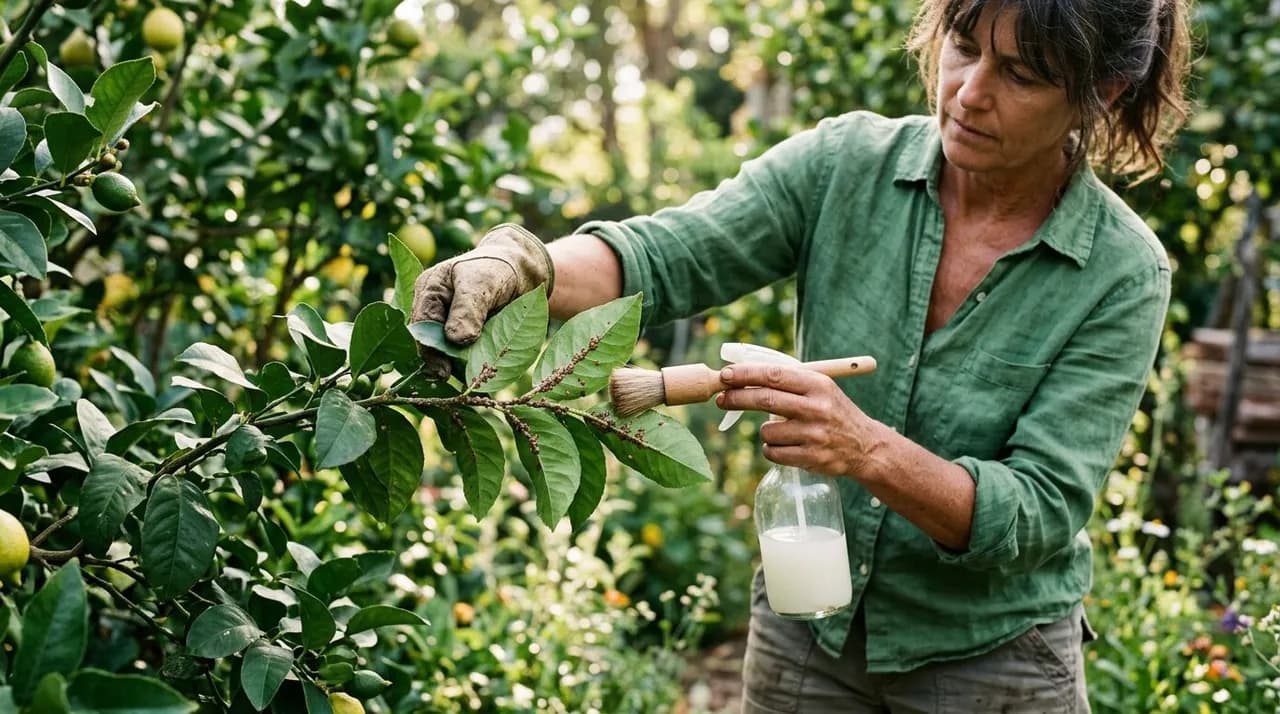
- Scrubbing Stems: Use a soft-bristled brush soaked in mild soapy water to gently scrub mature scale off woody trunks and branches.
2. Dormant horticultural oil sprays (late winter)
Applying organic dormant horticultural spray oil (mineral oil or vegetable-based emulsified oil) in late winter before spring bud break is the most effective preventative treatment for deciduous fruit trees, roses, and shrubs:
- How it Works: The thick oil film coats the overwintering adult scale shells and penetrates microscopic air pores (spiracles), completely suffocating the insects and overwintering eggs.
- Application Guidelines: Spray on a clear, dry day in late winter when ambient temperatures will remain above 40°F (4°C) for at least 24 hours. Ensure complete, dripping coverage of all trunks, branch crotches, and twigs.
3. Summer horticultural oils and insecticidal soaps (crawler season)
During late spring and early summer when crawlers are actively walking on stems:
- Application: Spray lightweight summer horticultural oil (1% to 2% dilution) or pure insecticidal soap (potassium salts of fatty acids) every 7 to 10 days for two to three consecutive applications.
- Precautions: Never spray horticultural oils when temperatures exceed 85°F to 90°F (29°C to 32°C) or on severely drought-stressed plants, as oil can cause leaf burn (phytotoxicity).
To differentiate scale treatment timings from other common garden pests, compare these protocols with how to get rid of thrips and how to get rid of aphids.
Biological control: predators and ant management
In balanced organic ecosystems, natural biological control agents keep scale populations below damaging thresholds.
1. Preserving natural enemies
- Parasitic Mini-Wasps (Aphytis and Metaphycus species): These microscopic, non-stinging wasps lay their eggs inside living scale bodies. Look closely at old scale shells on your plants: tiny, circular exit holes in the center of the armor indicate that beneficial wasps have successfully parasitized and killed the scale.
- Predatory Lady Beetles: The Vedalia beetle (Rodolia cardinalis) famously controls cottony cushion scale, while the twice-stabbed lady beetle (Chilocorus stigma) voraciously consumes armored scale colonies.
2. The ant connection
If you observe trails of ants marching up and down your tree trunks, they are actively protecting soft scale colonies:
- Ant Mutualism: Ants love the sweet honeydew excreted by soft scale. To protect their food supply, aggressive ants will attack and kill predatory lady beetles, lacewings, and parasitic wasps.
- Trunk Barriers: Apply a band of sticky pest barrier (such as Tanglefoot) around the lower trunk over a protective layer of masking tape or tree wrap. This prevents ants from climbing the tree, allowing natural predators to feast on the scale unimpeded.
Houseplant scale treatment protocol
Indoor houseplants (such as Ficus, citrus, orchids, and ferns) often suffer chronic scale outbreaks due to the absence of natural predators:
- Quarantine Immediately: Move the infested houseplant away from your other indoor plants to prevent crawlers from spreading.
- Spot-Treat with Alcohol: Dab every visible scale bump with an alcohol-soaked cotton swab.
- Spray Foliage: Spray the plant thoroughly with cold-pressed neem oil or insecticidal soap, paying special attention to the undersides of leaves and leaf axils where stems join.
- Repeat Weekly: Reapply the spray every 7 days for four consecutive weeks to catch newly hatched crawlers.
By identifying the scale group, applying dormant oils to woody stems, targeting crawler emergence in late spring, and excluding protective ants, you can successfully eliminate scale insects and maintain thriving, productive plants across your garden.