Key takeaways
- Apply Nosema locustae spore bait when nymphs are at the second to third instar (about 1/4 to 1/2 inch long, usually mid-May to early June) for optimal uptake.
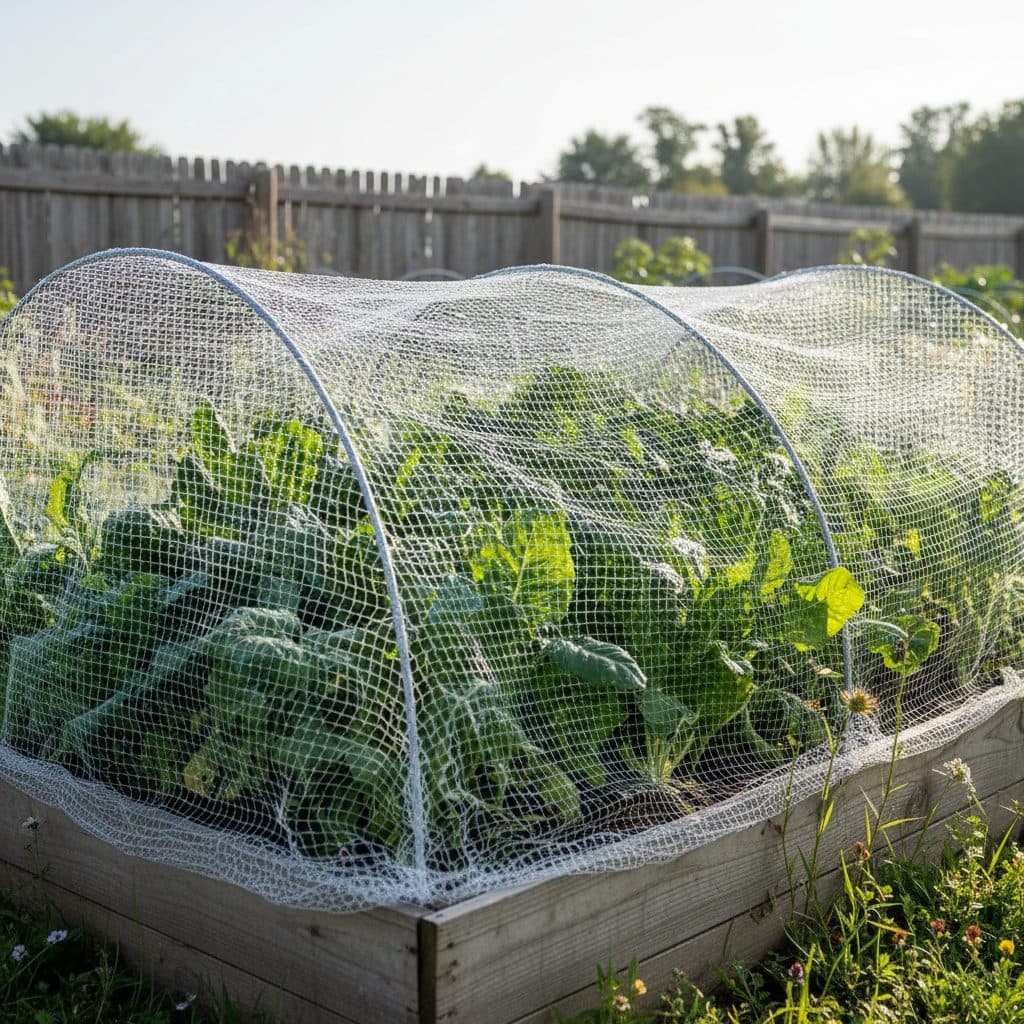
- Install 1/8-inch (3 mm) woven insect netting over vulnerable crops before adult grasshopper swarms arrive from surrounding rangeland.
- Deploy pastured guinea fowl or chickens around the garden perimeter to work steadily through hoppers along the garden margins during peak emergence.
- Maintain a green trap crop border (such as tall sweet corn or sorghum) around garden beds to intercept migrating hoppers before they reach vegetables.
- Till unplanted garden perimeter borders in late autumn to break up the egg pods mechanically and expose them to drying and to foraging birds.
Quick answer: Controlling grasshoppers organically requires an integrated strategy targeting their life cycle before adult swarms develop wings in mid-summer. Gardeners succeed by applying the microsporidian pathogen Nosema (Paranosema) locustae to spring nymphs, covering vulnerable crops with physical barrier netting (1/8-inch mesh), utilizing perimeter poultry foraging, and spraying kaolin clay barrier suspensions on foliage to deter chewing pests naturally.
Grasshopper outbreaks present one of the most severe challenges for home gardeners and homesteaders across western North America and the Great Plains. When drought conditions dry out native prairie grasses, migrating swarms descend on irrigated garden plots, defoliating tomato vines, corn silk, brassicas, and fruit trees within hours.
Unlike soft-bodied aphids or caterpillars that succumb quickly to contact organic sprays, mature grasshoppers possess thick chitinous exoskeletons, strong mobility, and voracious chewing mouthparts. Spraying broad-spectrum chemicals often kills beneficial predatory insects without stopping the next wave of flying adults.
Successfully managing grasshoppers requires understanding their life cycle, intervening early during the nymphal emergence phase, establishing physical exclusion barriers, and recruiting natural biological allies.
The grasshopper life cycle and treatment windows
Timing determines the success of organic grasshopper management. Intervening while hoppers are young nymphs yields high mortality, whereas battling fully winged adults is largely a defensive containment effort.
+------------------------+-------------------+-------------------+-------------------------------+
| Life Stage             | Timing (Northern) | Size & Mobility   | Most Effective Control Method |
+------------------------+-------------------+-------------------+-------------------------------+
| Egg Pods (Subterranean)| Autumn to Winter  | Buried in topsoil | Autumn tilling / poultry       |
| Early Nymphs (2nd-3rd) | Mid-May to June   | 1/4 to 1/2 inch   | Nosema locustae spore bait     |
| Late Nymphs (4th-5th)  | June to Mid-July  | 1/2 to 1.0 inch   | Spinosad bait*, insect netting |
| Winged Adults          | July to September | 3/4 to 1.5 inches | Kaolin clay, physical netting |
+------------------------+-------------------+-------------------+-------------------------------+
+-------------------------------------------------------------------+
| GRASSHOPPER DEVELOPMENT TIMELINE |
+-------------------------------------------------------------------+
| [May] Nymphs hatch from soil; feed on tender grass shoots |
| [June] Nymphs grow rapidly; spread from perimeter borders |
| [July] Adults develop wings; long-distance swarms migrate |
| [August] Peak defoliation; females deposit egg pods in soil |
| [Sept-Oct] Adults die off with hard frosts; egg pods overwinter |
+-------------------------------------------------------------------+Grasshopper eggs remain buried 1 to 2 inches beneath the soil surface inside tough, rice-shaped pods throughout the winter. When warm spring soils reach 60°F (15°C), the tiny wingless nymphs emerge and immediately begin feeding on tender young grasses along field ditches and garden borders.
Biological control: Nosema locustae spore bait
The most selective biological control for grasshoppers is Nosema locustae (classified as Paranosema [Antonospora] locustae), a naturally occurring microsporidian pathogen (a fungal-lineage organism) that infects only grasshoppers and crickets.
+------------------------+-----------------------------------+-----------------------------------+
| Feature                | Nosema locustae Biological Bait   | Chemical Contact Sprays           |
+------------------------+-----------------------------------+-----------------------------------+
| Target Specificity     | Affects only grasshoppers/crickets| Kills bees, ladybugs, pollinators |
| Secondary Transmission | Cannibalism spreads disease       | No secondary spread               |
| Optimal Target Stage   | Young nymphs (under 1/2 inch)     | Mixed efficacy on large adults    |
| Environmental Safety   | Safe for birds, pets, and humans  | Toxic residues on edible crops    |
+------------------------+-----------------------------------+-----------------------------------+
How to apply Nosema bait
Formulated on wheat bran flakes, Nosema locustae must be broadcast across grassy field perimeters, roadsides, and garden borders when nymphs are at the second to third instar (about 1/4 to 1/2 inch long — in the northern US usually mid-May to early June). When young hoppers ingest the bait, the pathogen multiplies inside their fat bodies, causing lethargy, reduced appetite, and death within two to three weeks.
Because healthy grasshoppers cannibalise dead and dying individuals, the pathogen spreads through the population. Spread is slow and partial. Treat it as gradual population reduction over a season or more, not a rescue treatment, and bait as much of the surrounding grassland as you can get access to. Apply on a sunny morning when rain is not forecast for at least 48 hours to ensure the bran flakes remain dry and palatable to feeding nymphs. (Note: If using spinosad baits for late nymphs, remember spinosad is highly toxic to bees while wet — apply baits in the evening and keep them off flowering plants).
Physical barriers and crop netting
Once grasshoppers develop wings in July, biological baits become less effective against incoming swarms. Physical exclusion becomes the primary defense for high-value garden beds.
+-------------------------------------------------------------------+
|                 EXCLUSION TUNNEL CONSTRUCTION                     |
+-------------------------------------------------------------------+
| 1. Hoop Frame:        1/2-inch EMT conduit or flexible MDPE pipe  |
| 2. Netting Material:  Woven high-density polyethylene (1/8" mesh) |
| 3. Base Anchoring:    Bury edges with 4 inches of soil or gravel  |
| 4. Support Structure: Suspend netting 6 inches above crop foliage |
+-------------------------------------------------------------------+
Selecting the right mesh
Standard bird netting has large 3/4-inch openings that grasshoppers crawl through easily. Use specialized insect netting with mesh openings no larger than 1/8 inch (3 mm). On squash, cucumbers and other insect-pollinated crops, open or remove the netting during flowering or hand-pollinate; fine mesh also raises daytime temperatures under the cover, so vent it in hot weather. Ensure the netting does not touch plant foliage directly; grasshoppers will chew leaves pressed against the mesh.
Anchor the edges of the netting securely to the ground using landscape staples, soil, or heavy lumber. Grasshoppers naturally congregate at ground level and will crawl under loose net margins to gain access to tender vegetables.
Natural deterrents: kaolin clay and garlic barrier sprays
For mature fruit trees, sweet corn, and crops too large to net conveniently, mineral barrier sprays deter feeding damage.
Kaolin clay (Surround WP)
Kaolin clay is a refined natural mineral powder mixed with water (typically 1/2 to 1 cup per gallon) and sprayed directly onto foliage. As the spray dries, it leaves a powdery white film across leaves and stems:
- Tactile Deterrence: The fine clay particles irritate grasshopper tactile receptors and mouthparts, making foliage unpalatable.
- Visual Camouflage: The reflective white coating alters how insects perceive leaf color, deterring landing.
- Sunburn Protection: Reflective clay buffers leaves and fruit against heat stress during high summer temperatures.
Reapply kaolin clay after heavy rainstorms or as new vegetative growth emerges during peak summer feeding periods.
Habitat traps and biological predators
Integrating natural predators and perimeter trap crops creates multi-tiered ecological suppression.
Poultry pasturing
Guinea fowl, turkeys, and chickens are voracious grasshopper hunters. A small flock of guinea fowl foraging along garden margins will work steadily through hoppers along the garden margins without scratching up garden beds as aggressively as standard chickens. Establishing mobile poultry tractors around the garden edge creates an active biological buffer zone that intercepts hoppers before they reach vegetables.
Creating perimeter green traps
In semi-arid climates, grasshoppers migrate toward the greenest vegetation. Plant a 6-foot wide border of tall sorghum, sweet corn, or sunflowers around your garden perimeter. Maintain moisture in this border so grasshoppers concentrate there, where they can be hand-collected, targeted with organic sprays, or consumed by poultry before penetrating main vegetable beds.
Review foundational pest management frameworks in pest action thresholds when treat, explore polyculture defenses in polyculture interplanting pest control, and consult organic caterpillar beetle control and organic vertebrate pest control for comprehensive garden protection.