Key takeaways
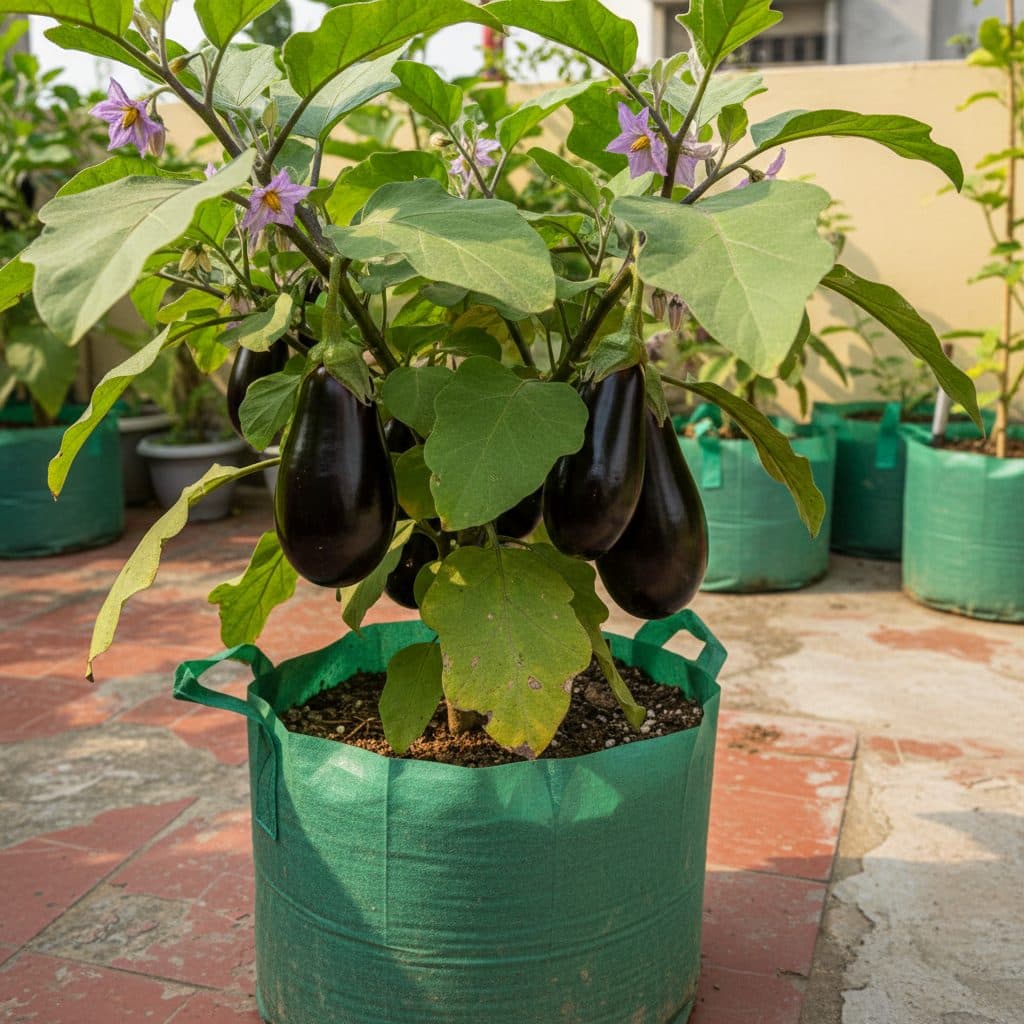
- Brinjal (Solanum melongena, baingan or eggplant) is one of India's most productive perennial warm-season vegetables for terrace gardens and pots.
- Sow seeds during three main Indian seasons: summer (zaid, February to March), monsoon (kharif, June to July), and winter (rabi, September to October in plains and southern regions).
- Use containers or HDPE grow bags with a minimum size of 30 cm by 30 cm (12 x 12 inches) with generous bottom drainage holes.
- Formulate a lightweight potting mix of 40% washed coco peat or loamy garden soil, 30% well-aged cow dung or vermicompost, 20% coarse river sand or perlite, and 10% rice husk, mixing 50 to 100 g of neem cake powder through each 12-inch bag.
- Prevent flower drop by maintaining consistent root moisture, providing 50% shade netting during 40°C peak summer heat, and hand-vibrating blossom clusters.
- Manage shoot and fruit borers through daily sanitation (clipping wilted tips and bored fruit), pheromone traps, and deterrent neem sprays.
Quick answer: To grow brinjal at home in India, sow seeds in small nursery trays and transplant sturdy 5-week-old seedlings into 30 to 40 cm deep pots or grow bags filled with compost-rich potting soil. Place pots in full sunlight (6 to 8 hours), water consistently at the base, feed monthly with vermicompost or mustard cake liquid, and harvest glossy fruits when young.
Brinjal, known across India as baingan or vangi, is a beloved staple of desi kitchen gardens and urban terrace setups. From slender green varieties and striped round types to massive purple Bharta baingan, this resilient nightshade thrives in warm Indian climates, producing continuous harvests of glossy vegetables for nine to twelve months from a single planting.
Growing brinjal at home requires adapting container care to Indian climate conditions. High concrete terrace temperatures exceeding 40°C during peak summer, torrential monsoon downpours that cause waterlogging, and shoot borer caterpillars present challenges that require careful management.
Whether you are starting seeds on an apartment balcony or managing a full terrace garden in grow bags, this guide walks you through the entire growing cycle from seed to kitchen harvest.
+-------------------------------------------------------------+
|              INDIAN BRINJAL SEASONAL SOWING CALENDAR        |
|                                                             |
|   SEASON           SOWING MONTHS       TRANSPLANT & HARVEST |
|   ------           -------------       -------------------- |
|   Zaid (Summer)    February - March    April to June harvest|
|   Kharif (Monsoon) June - July         August to Nov harvest|
|   Rabi (Winter)    Sept - October      Dec to March harvest |
|   *(Note: Tropical South India and coastal zones grow year-round)*
+-------------------------------------------------------------+
When should you sow brinjal seeds across Indian seasons?
Brinjal is a warm-season crop that thrives when ambient temperatures range between 22°C and 35°C. In India, sowing schedules align with the three primary agricultural seasons:
- Summer sowing (Zaid / Early Summer): Sow seeds in February or early March across the northern and central plains. Seedlings establish during warm spring days and fruit before the intense dry heatwaves of May and June.
- Monsoon sowing (Kharif): Sow seeds in June or July with the arrival of the southwest monsoon rains. Plants grow rapidly in humid conditions and yield heavily throughout autumn and early winter.
- Winter sowing (Rabi): In the plains of northern India, coastal regions, and southern India (Tamil Nadu, Karnataka, Maharashtra, Andhra Pradesh), sow in late September or October for winter and spring production. In frosty Himalayan hill districts, avoid winter sowings and concentrate on spring planting.
+-------------------------------------------------------------+
|              BRINJAL SEED-RAISING METRICS                   |
|                                                             |
|   PARAMETER             TARGET SPECIFICATION                |
|   ---------             --------------------                |
|   Sowing Depth          0.5 to 1.0 cm                       |
|   Germination Time      6 to 10 Days                        |
|   Transplant Age        30 to 40 Days (4-5 true leaves)     |
|   Ideal Pot Size        30 x 30 cm (12x12 in) or larger     |
+-------------------------------------------------------------+
How do you prepare potting soil and containers for terrace gardens?
Brinjal develops an extensive fibrous root system and heavy above-ground foliage that demands a deep, nutritious growing medium.
Pot selection
- Minimum dimensions: Choose terracotta pots, plastic containers, or UV-stabilised HDPE/fabric grow bags measuring at least 30 cm in diameter and 30 cm in depth (12 x 12 inches). For large Bharta varieties, upgrade to 38 x 38 cm (15 x 15 inches).
- Drainage check: Ensure every pot has multiple unobstructed drainage holes. During monsoon downpours, excess water must drain freely within seconds to prevent Pythium root rot and collar rot.
Potting mix formulation
Heavy native clay soils become rock-hard in summer terrace heat. Formulate a lightweight, porous potting mix by volume:
+-------------------------------------------------------------+
|              TERRACE BRINJAL POTTING FORMULATION            |
|                                                             |
|   - 40% Washed Coco Peat or Loamy Garden Soil               |
|   - 30% Well-Aged Cow Dung (Gobar Khad) or Vermicompost     |
|   - 20% Coarse River Sand or Perlite (for drainage)         |
|   - 10% Rice Husk or Extra Coco Peat                        |
|   *(Mix 50-100g Neem Cake Powder per pot for root health)*  |
|   - 1 Tablespoon Bone Meal or Rock Phosphate (Root strength)|
+-------------------------------------------------------------+
For setting up complete balcony and roof layouts, review our beginner overview on how to start a home kitchen garden and organic enrichment methods using cow dung fertilizer for plants.
How do you transplant and care for baingan plants?
- Hardening and transplanting: When seedlings in your nursery tray have 4 to 5 true leaves and stand 10 to 12 cm tall (about 30 to 40 days), transplant one seedling per grow bag. Transplant in the late afternoon or evening to minimize transplant shock, and water gently.
- Sunlight requirements: Brinjal plants require a minimum of 6 to 8 hours of direct, unfiltered sunlight daily. Lack of sunlight causes spindly, leggy stems and poor flower bud formation.
- Summer terrace protection: When concrete terrace temperatures exceed 40°C in May and June, erect 50% green agro-shade netting over your pots. Extreme heat bakes roots in plastic containers and scorches tender blossom clusters.
- Staking: As plants begin to load with heavy fruits, the central stem will bend or snap in strong terrace winds. Insert a sturdy 1-metre bamboo stake (lathi) beside the stem and secure it with soft cloth ties.
+-------------------------------------------------------------+
|              POTTED BRINJAL MONTHLY FEEDING CYCLE           |
|                                                             |
|   TIMING               ORGANIC FEEDING REGIMEN              |
|   ------               -----------------------              |
|   Every 15 Days        2 handfuls Vermicompost lightly      |
|                        worked into topsoil with a khurpi    |
|   During Flowering     Diluted Fermented Mustard Cake       |
|                        (Sarson Khali liquid, 1:10 dilution) |
|   Monthly Foliar       Seaweed Extract or Panchagavya Spray |
+-------------------------------------------------------------+
Why are your brinjal flowers falling off without setting fruit?
One of the most common issues on Indian terrace gardens is seeing abundant purple and white brinjal flowers yellow at the stem and drop to the floor.
+-------------------------------------------------------------+
|             BRINJAL FLOWER DROP ROOT CAUSES & REMEDIES      |
|                                                             |
|   CAUSE                      SYMPTOM / TRIGGER   REMEDY     |
|   -----                      -----------------   ------     |
|   Extreme Heat (>38°C)       Pollen burns dry    Shade net  |
|   Moisture Stress            Dry/soggy soil rootsEven water |
|   Lack of Pollination        Unfertilised blooms Hand shake |
|   Excessive Chemical NitrogenGiant leaves, no setStop urea  |
+-------------------------------------------------------------+- Extreme heat stress: Brinjal pollen becomes sterile when temperatures rise above 38°C to 40°C. Deploy shade netting and mulch the surface of the grow bags with 3 cm of dry leaves or straw to keep root zones cool.
- Irregular watering: Alternating between letting the pot soil dry out completely and then flooding it triggers immediate flower drop. Keep the potting mix consistently moist like a wrung-out sponge.
- Hand vibration pollination: Brinjal blossoms are hermaphroditic (carrying both male and female parts) but require physical vibration (buzz pollination by bees or wind) to release pollen from the anthers. In enclosed balconies lacking insect activity, gently tap or vibrate the flowering branches with your finger every morning between 8:00 AM and 10:00 AM.
- Companion marigolds: Interplant pots of marigolds beside your brinjal grow bags to attract honeybees and predatory hoverflies. Follow step-by-step seed starting in our guide on how to grow marigold from seeds.
How do you control common brinjal pests organically?
Indian brinjal plants face specific pest pressures during the monsoon and post-monsoon months:
+-------------------------------------------------------------+
|              BRINJAL PEST MANAGEMENT PROTOCOL               |
|                                                             |
|   PEST                       ORGANIC ACTION                 |
|   ----                       --------------                 |
|   Shoot & Fruit Borer        Clip wilting tips; neem spray  |
|   Whiteflies & Aphids        Yellow sticky traps; soap wash |
|   Epilachna Beetle           Handpick yellow spiky larvae   |
|   Bacterial Wilt             Sterile mix; discard plants    |
+-------------------------------------------------------------+- Brinjal shoot and fruit borer (Leucinodes orbonalis): The most damaging pest. The moth lays eggs on shoots; larvae bore into young stems, causing tips to wilt and droop. Later, they bore into fruits.
- Remedy: Neem oil deters egg-laying on exposed shoots but cannot touch larvae already tunnelling inside a stem or fruit. Effective control at home relies on daily sanitation: clip and bin every wilted tip and every bored fruit as soon as you see it, backed by a Leucinodes orbonalis pheromone trap to catch adult moths.
- Aphids, whiteflies, and jassids: Sucking pests that cluster on leaf undersides. Wash leaves with a forceful jet of water and deploy yellow sticky traps above the plant canopy. For organic spray recipes, see our guide to organic aphid control.
- Hadda / Epilachna beetle: Distinctive spotted ladybird-like beetles and spiky yellow larvae that skeletonize leaves into lace-like patterns. Handpick beetles in the early morning and crush egg clusters found beneath leaves.
- Bacterial wilt (Ralstonia solanacearum): Whole plants wilt and collapse within days with no yellowing, and a cut stem oozes milky threads in a glass of water. There is no cure. Never reuse potting mix from a wilted plant, do not plant brinjal, tomato, or chilli in the same mix two seasons running, and use grafted plants on resistant rootstock in areas where it recurs.
How and when should you harvest brinjal?
- Harvest while glossy: Pick brinjals when the skin is smooth, bright, and glossy. Once the fruit loses its gloss and turns dull or yellowish, the interior seeds have hardened and the flesh turns bitter and spongy.
- Use sharp shears: Never twist or yank fruits from the plant, which tears branches. Use sharp pruning snips to cut through the thick, spiny green calyx stem, leaving 2 cm of stem attached to the fruit.
- Continuous picking: Harvesting mature brinjals every 3 to 4 days encourages the plant to initiate fresh flowering trusses and extend production throughout the season.
With deep grow bags, rich compost feeds, steady moisture, and routine pest patrols, home baingan plants produce steady harvests on an Indian terrace.