Key takeaways
- Root-knot nematodes are microscopic parasitic roundworms that infect plant roots, causing irregular swollen galls that disrupt water and nutrient uptake.
- Above-ground symptoms mimic severe drought stress: midday wilting, stunted yellowing foliage, and poor fruit set despite moist soil.
- Choose genetically resistant vegetable cultivars marked with the "N" code (such as VFN-resistant tomato and pepper varieties).
- Soil solarization—covering moist, tilled soil with clear UV-stabilized plastic for six to eight weeks in peak summer—drastically reduces topsoil nematode populations.
- Dense plantings of French marigolds (Tagetes patula) release natural nematicidal root compounds (alpha-terthienyl) that suppress nematode reproduction.
- Amend soil with crab meal, shrimp meal, and heavy compost to stimulate chitinolytic soil microbes that consume nematode egg shells.
Quick answer: To control root-knot nematodes organically, use an integrated approach: plant resistant "N" coded vegetable varieties, perform summer soil solarization using clear plastic for 6 to 8 weeks, grow dense French marigold cover crops, and incorporate chitin-rich crab meal and compost to foster predatory soil organisms.
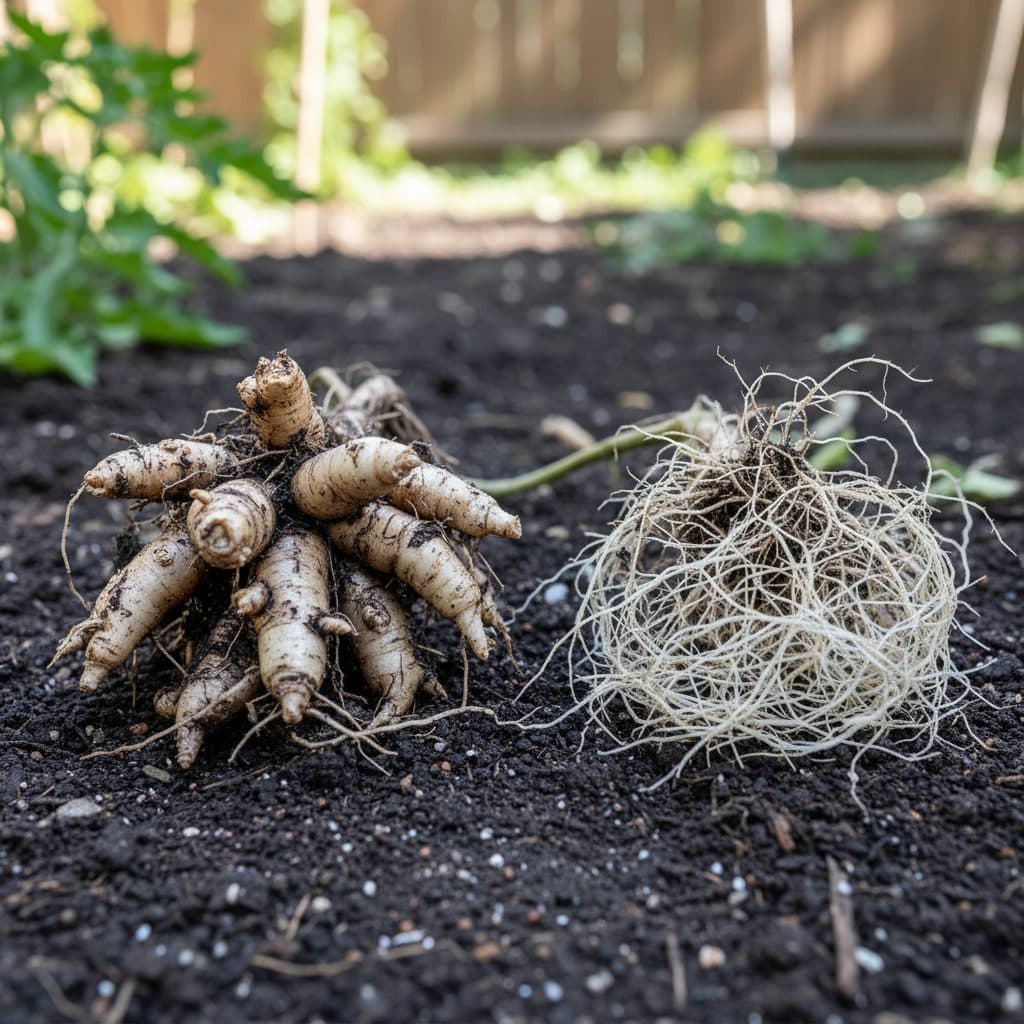
Few soil-borne garden challenges are as frustrating as parasitic nematodes. Gardeners often watch vigorous tomato, pepper, or cucumber plants mysteriously decline: leaves turn yellow, vines wilt under midday sun despite deep irrigation, and fruit production drops to near zero. Upon digging up the struggling plant, the roots reveal lumpy, swollen, tangled knots.
These distortions are caused by root knot nematodes (Meloidogyne spp.), microscopic, unsegmented roundworms that live in the soil and feed inside living root tissue. Because chemical nematicides are toxic to beneficial soil life and restricted for home use, managing root-knot nematodes requires a smart organic strategy that combines genetic resistance, thermal solarization, biological trap cropping, and soil ecology enhancements.
+-------------------------------------------------------------+
|              ROOT-KNOT NEMATODE INFECTION CYCLE             |
|                                                             |
|   1. SOIL JUVENILE (J2 Stage): Microscopic worm swims in    |
|      soil water film toward plant root tips                 |
|                                                             |
|   2. ROOT PENETRATION: Enters root elongation zone; injects |
|      secretions that cause cells to enlarge into "giant cells"
|                                                             |
|   3. GALL FORMATION: Root tissue swells into irregular      |
|      knots, crushing internal vascular xylem and phloem     |
|                                                             |
|   4. EGG PRODUCTION: Sedentary female swells into pear      |
|      shape, laying hundreds of eggs in gelatinous egg masses|
+-------------------------------------------------------------+
Identifying root-knot nematode damage vs beneficial nodules
Accurate diagnosis prevents confusing harmful nematode infestations with beneficial soil biology.
+-------------------------------------------------------------+
|               HARMFUL GALLS VS BENEFICIAL NODULES           |
|                                                             |
|   ROOT-KNOT NEMATODE GALLS:                                 |
|   - Irregular, lumpy swellings integral to root cylinder    |
|   - Cannot be detached without tearing internal root tissue |
|   - White, tan, or brown interior; causes root death        |
|   - Found on tomatoes, peppers, carrots, squash, okra       |
|                                                             |
|   BENEFICIAL RHIZOBIAL NODULES (Legumes Only):              |
|   - Rounded attachments on the side of the root             |
|   - Can be rolled off with a thumbnail cleanly              |
|   - Pink or red interior (active leghemoglobin / nitrogen)  |
|   - Found only on beans, peas, clover, and legumes          |
+-------------------------------------------------------------+
Above-ground symptoms
Because swollen galls crush the plant's internal plumbing (xylem and phloem), water and essential minerals cannot travel from the soil to the leaves:
- Midday wilting: Plants wilt severely during the heat of the day, even when the surrounding soil is thoroughly moist, recovering partially overnight.
- Stunted growth and chlorosis: Leaves turn pale green or yellow due to nitrogen, iron, and potassium deficiencies caused by root failure.
- Forked, deformed root crops: Carrots, parsnips, and radishes develop hairy, branched, split, and unmarketable roots.
Rhizobial nodules are distinct, rounded attachments on the side of the root that can be rolled off with a thumbnail without breaking the main root cylinder; nematode galls are irregular swellings of the root itself that cannot be detached without tearing the root tissue.
To build systemic fungal and biological defenses around susceptible crops, explore our analysis of biofungicides for soil and roots.
Planting resistant crop varieties: the VFN code
The most reliable first line of defense is planting vegetable cultivars bred with genetic resistance to nematode infection.
+-------------------------------------------------------------+
|                 UNDERSTANDING SEED RESISTANCE CODES         |
|                                                             |
|   V = Verticillium Wilt Resistance                          |
|   F = Fusarium Wilt Resistance (F1, F2, F3 Races)           |
|   N = Root-Knot Nematode Resistance (*Meloidogyne* spp.)    |
|   T = Tobacco Mosaic Virus Resistance                       |
+-------------------------------------------------------------+
When browsing seed catalogs or nursery tags, look for tomato and pepper varieties carrying the "N" designation. These cultivars carry the Mi resistance gene, which triggers a localized hypersensitive response inside the root when a nematode attempts to feed, starving the parasite before it can establish a feeding site or reproduce.
Top nematode-resistant vegetable cultivars:
- Tomatoes: Celebrity (VFN), Better Boy (VFN), Early Girl (VFN), Mountain Gem (VFN), Park's Whopper (VFN), Roma VF/N.
- Peppers: Carolina Wonder (Sweet Bell), Charleston Belle (Nematode-resistant bell).
- Sweet Potato: 'Covington' (moderate-to-high resistance) and 'Bonita'; avoid 'Beauregard', which is susceptible.
- Rootstocks: Grafting heirloom or open-pollinated tomatoes onto vigorous hybrid rootstocks (such as 'Maxifort' or 'Shin Cheong Gwang') provides complete root-knot nematode immunity while preserving heirloom fruit quality.
For detailed varietal recommendations and resistance ratings, read our guide on building a disease-resistant tomato lineup with VFN codes.
Soil solarization: thermal reduction of nematode populations
In sunny, warm climates, soil solarization provides powerful, non-chemical pasteurization of the top 15 to 20 cm (6 to 8 in) of garden soil.
+-------------------------------------------------------------+
|                 SOIL SOLARIZATION STACK                     |
|                                                             |
|   [ Intense Summer Sun (July / August) ]                    |
|   ~~~~~~~~~~~~~~~   |
|   [ 1 to 2 Mil Clear UV-Stabilized Polyethylene Film ]      |
|   -------------------------------------------------------   |
|   [ Moist, Smooth, Finely Tilled Topsoil Layer ]            |
|   - Top 5cm reaches 50-60°C; 15-20cm reaches 38-45°C        |
|   - Thermal threshold kills nematode juveniles and eggs     |
|   =======================================================   |
|   [ Sealed Trench Perimeter - Edges Buried 15 cm Deep ]     |
+-------------------------------------------------------------+
Step-by-step solarization protocol:
- Timing: Execute during the hottest, sunniest six to eight weeks of the year (typically late June through mid-August in North America).
- Soil preparation: Remove all spent crop residues. Till or fork the soil thoroughly to a depth of 20 cm (8 in) to break up all clumps, creating a flat, smooth seedbed.
- Soak the bed: Irrigate the soil deeply until it is saturated to a depth of 30 cm (12 in). Moisture conducts heat deep into the soil and stimulates dormant nematode eggs to hatch, making them highly vulnerable to thermal death.
- Lay clear plastic: Stretch clear, transparent polyethylene sheeting (1 to 2 mil thickness) tightly over the bed. Do not use black plastic; black plastic absorbs heat on the surface rather than transmitting solar radiation into the soil beneath.
- Seal the edges: Dig a shallow trench around the perimeter of the bed, bury the plastic edges completely in soil, and tamp down firmly to prevent steam and heat from escaping.
- Maintain for 6 to 8 weeks: Under clear UV-stabilised polythene in high-sun climates, the top 5 cm (2 in) can reach 50°C to 60°C (122°F to 140°F), while temperatures at 15 to 20 cm (6 to 8 in) typically reach 38°C to 45°C (100°F to 113°F) — lethal to most juveniles over a 4 to 8 week period, but leaving some survival at depth.
For managing sandy, warm soils where nematodes are most persistent, review our regional advice in gardening in Florida sandy soil.
Biofumigation and cover cropping: marigolds and mustard
Certain cover crops release natural bio-chemical compounds that actively suppress and kill nematodes.
+-------------------------------------------------------------+
|               BIOFUMIGANT COVER CROPS COMPARED              |
|                                                             |
|   FRENCH MARIGOLDS (*Tagetes patula*):                      |
|   - Roots release alpha-terthienyl; dead-end decoy host     |
|   - Must be grown as a dense solid cover crop for 60-90 days|
|   - Chop and till entire plant into soil at season end      |
|                                                             |
|   MUSTARD GREENS (*Brassica juncea*):                       |
|   - 8 to 12 Weeks (Grow + Incorporate)                      |
|   - When chopped and incorporated, forms isothiocyanate gas |
|   - Acts as a natural organic biofumigant in soil           |
|                                                             |
|   SUNN HEMP (*Crotalaria juncea*):                          |
|   - Tropical legume; fixes nitrogen while starving nematodes|
|   - Non-host crop that halts nematode reproductive cycles   |
+-------------------------------------------------------------+
How to use French marigolds effectively
Interplanting a few single marigold plants next to a tomato vine will not eliminate nematodes. Not all marigolds are equal here. French marigold (Tagetes patula) cultivars (such as 'Tangerine', 'Single Gold' and 'Ground Control') produce alpha-terthienyl and act as dead-end decoy hosts when grown as a dense, solid cover crop for at least 60 to 90 days. African marigold (Tagetes erecta) is less reliable and some varieties can actually host certain Meloidogyne species; signet marigold (Tagetes signata / tenuifolia) is also a host and should not be used for nematode control.
- Sow French marigolds densely across the entire affected bed, spacing plants no more than 15 cm (6 in) apart so their roots form an interconnected underground mat.
- Allow the marigolds to grow for 60 to 90 days. The roots attract juvenile nematodes but release toxic alpha-terthienyl, preventing the nematodes from feeding or reproducing.
- Mow the plants down and till the chopped biomass directly into the soil to add organic matter.
To integrate companion plantings that repel insect vectors and enhance ecosystem diversity, read our guide on tomato companion plants.
Boosting soil ecology: chitin amendments and beneficial nematodes
Creating an intensely biological, organic-rich soil environment naturally suppresses parasitic nematode populations through competition and predation.
- Crab meal and shrimp meal: Chitin amendments stimulate chitinolytic microorganisms that degrade nematode eggshells; the breakdown of the meal also releases ammonia into the soil pore water, which is directly nematicidal at sufficient concentrations.
- Beneficial entomopathogenic nematodes: Apply beneficial predatory nematodes (such as Steinernema carpocapsae or Heterorhabditis bacteriophora). While beneficial nematodes target soil-dwelling insect grubs and beetles rather than plant-parasitic nematodes, they add to a balanced soil food web. To learn how to apply biological predators, read our guide on beneficial nematodes for soil pests.
- Heavy organic mulching: Maintain thick blankets of woodchips and compost. Fungi that thrive in decomposing wood produce microscopic hyphal loops that snare, paralyze, and consume plant-parasitic nematodes in the root zone.