Key takeaways
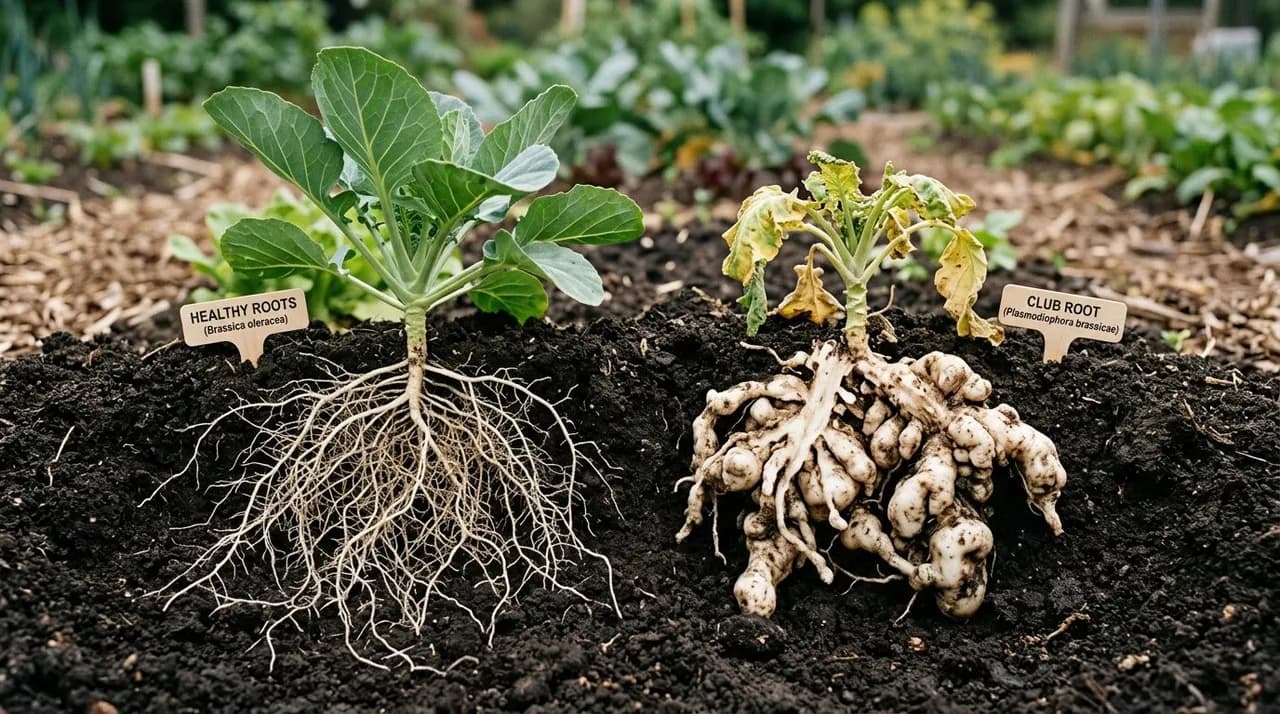
- Club root (Plasmodiophora brassicae) is a persistent soil-borne protist causing swollen, distorted root galls on all brassica crops.
- Resting spores survive in garden and allotment soil for up to 15 to 20 years, making total eradication nearly impossible.
- Symptoms include daytime wilting under bright sun, purplish foliage, stunted top growth, and rotted, foul-smelling root masses.
- Raising soil pH to 7.2 or above by applying agricultural lime suppresses resting spore germination and limits infection severity.
- Sow into modular trays, then pot seedlings on into 9 cm or 1-litre pots of sterile compost so they build a strong root ball before planting into infected beds.
Quick answer: Club root is managed organically by raising soil pH above 7.2 with agricultural lime, improving bed drainage, planting certified resistant varieties, and raising seedlings in clean pots before transplanting. Because resting spores survive for up to 20 years, strict plot hygiene and crop rotation are essential.
Finding club root in your vegetable beds is one of the most disheartening discoveries for any UK gardener or allotment holder. Known scientifically as Plasmodiophora brassicae, this microscopic, soil-dwelling organism attacks members of the cabbage family (Brassicaceae), transforming healthy, fibrous root systems into grotesque, swollen, knobbly masses.
Across British allotment sites with decades of continuous brassica cultivation, club root is widely endemic. Plants infected in warm, acidic, or damp soils struggle to absorb water and essential minerals. Cabbages, cauliflowers, broccoli, and Brussels sprouts stall in growth, wilt dramatically during sunny afternoons, and eventually rot in the ground before forming edible heads.
While chemical treatments for home gardeners are non-existent and unapproved in the UK, having club root on your plot does not mean giving up on homegrown brassicas. By understanding the pathogen's infection biology, shifting soil chemistry through strategic liming, selecting modern resistant cultivars, and practising container barrier methods, you can consistently harvest crisp, healthy brassicas even from infested ground.
What is club root and how does it infect brassicas?
Historically categorised as a fungus, Plasmodiophora brassicae is an obligate biotrophic protist. It cannot reproduce or multiply without living inside the cellular structure of a host brassica plant.
- Microscopic zoospores: In moist soil, microscopic resting spores germinate into mobile, two-tailed zoospores that swim through thin films of soil water toward plant root hairs.
- Cellular invasion: Upon reaching a root hair, the zoospore pierces the cell wall, injects its genetic material, and triggers massive cellular hypertrophy (abnormal enlargement) and hyperplasia (uncontrolled cell division).
- Gall formation: The root tissue swells into massive, irregular clubs and knobbly tumours. These swollen tissues crush the plant's vascular xylem and phloem, cutting off water and nutrient transport to the leaves.
- Secondary decay and spore release: In late summer and autumn, the swollen galls rot away under bacterial decay, releasing millions of tough, thick-walled resting spores back into the surrounding soil.
- Longevity: These resting spores can remain viable in a dormant state for 15 to 20 years, waiting for the chemical root exudates of a new brassica host before germinating.
For a broader systematic framework on diagnosing unknown garden ailments, consult our plant disease diagnosis flowchart.
Recognising the symptoms on your plot
Because the initial infection occurs entirely underground, early symptoms of club root are often mistaken for general drought stress or nitrogen deficiency.
Above-ground symptoms
- Daytime wilting: Plants wilt severely during warm, sunny spells even when the surrounding soil is visibly damp, but temporarily recover their turgidity overnight.
- Foliage discoloration: Outer leaves take on a dull, bluish-purple or sickly yellowish cast as nutrient uptake stalls.
- Stunted development: Cabbages fail to heart, cauliflowers produce tiny, loose buttons, and Brussels sprout stems remain spindly and bare.
Below-ground symptoms
- Carefully lift a struggling plant with a garden fork. Instead of fine, pale, fibrous root networks, infected plants reveal thick, distorted, spindle-shaped or club-like root tumours.
- In advanced stages, these swollen masses become soft, water-soaked, and rot with a distinct, pungent cabbage odour.
Distinguish club root from turnip gall weevil (Ceutorhynchus pleurostigma) by slicing open a swollen gall with a clean knife. Gall weevil damage produces small, hollow spherical chambers containing a tiny white larva. Club root galls are solid, fleshy, and uniform throughout.
Proven organic control strategies
Because the resting spores remain dormant for decades, organic management focuses on creating soil conditions that actively suppress spore germination while giving young plants a physical head start.
1. Soil liming to raise pH
Plasmodiophora brassicae resting spores require acidic to slightly neutral soil conditions (pH 5.0 to 6.5) to germinate and infect root hairs. Raising the soil pH to 7.2 – 7.5 substantially reduces infection rates:
- Test your soil: Determine your starting pH using a reliable digital meter or chemical testing kit.
- Apply agricultural lime: Apply ground agricultural limestone (calcium carbonate) or hydrated lime to target brassica beds in autumn or early winter.
- Application rates: On sandy soils, apply approximately 200 to 300 grams per square metre to raise pH by one point; on heavy clay soils, start at 500 g per square metre, then re-test the following season and top up instead of doubling the dose in one go.
- Do not over-lime adjacent beds: Avoid applying lime to beds scheduled for potatoes or acid-loving soft fruit in your crop rotation.
2. Improving soil drainage and aeration
The swimming zoospores depend entirely on standing water films to navigate toward host roots. Improving soil structure denies them the moisture pathways they need:
- Create raised growing beds 15 cm to 25 cm above surrounding paths to ensure rapid gravitational water drainage.
- Incorporate liberal quantities of coarse organic compost and horticultural grit into heavy clay.
- Test your plot's percolation rate using our soil drainage percolation test.
3. The large-pot barrier technique
Young, tender brassica seedlings are most vulnerable to lethal infection within their first four to six weeks of growth. Establishing a mature, dense root ball in clean compost protects the plant's vascular core:
- Never direct-sow brassica seeds into soil known to carry club root.
- Sow seeds into modular trays using fresh, sterile, peat-free potting compost.
- Pot seedlings on into 9 cm or 1-litre pots of compost, allowing them to form a thick, fibrous root ball before transplanting outdoors.
- Dig a generous planting hole in the garden bed, line the bottom with a handful of fresh compost and a dusting of agricultural lime, and set the potted plant in place. The outer roots may eventually encounter spores, but the plant's mature central crown will sustain the crop through harvest.
Learn more about healthy seedling development in our guide on seed starting for beginners.
4. Deploying beneficial soil microbes
Applying certified organic microbial inoculants containing beneficial Trichoderma fungi or Bacillus subtilis bacteria helps colonise the rhizosphere, physically competing with soil-borne pathogens. Review how biological amendments work in our analysis of biofungicides for soil root disease suppression.
Growing club root resistant brassica varieties
Decades of professional horticultural breeding have produced modern F1 hybrid cultivars with high genetic resistance to common strains of Plasmodiophora brassicae. Integrating these varieties allows you to produce full harvests even in heavily infected ground.
Top resistant cultivars for UK growers
- Cabbage: 'Kilaton' F1 (outstanding autumn/winter ballhead cabbage with superb storage ability) and 'Kilagreg' F1 (round, white-hearted summer cabbage with clubroot resistance).
- Cauliflower: 'Clapton' F1 (the first commercially bred resistant cauliflower, producing dense, snow-white curds from late summer to autumn).
- Calabrese / Sprouting Broccoli: 'Monclano' F1 (vigorous autumn calabrese producing large central heads followed by generous side shoots).
- Brussels Sprouts: 'Crispus' F1 (hardy, high-yielding winter sprout holding firm, tightly wrapped buttons).
- Swede: 'Marian' (traditional culinary swede with purple tops, yellow flesh, and strong natural club root resistance).
Remember that genetic resistance is not total immunity; pairing resistant varieties with soil liming and pot-established transplants provides the highest level of crop protection.
Strict allotment hygiene and biosecurity
Preventing the spread of resting spores across uninfected zones is necessary on community allotment sites:
- Never compost infected roots: Do not add infected brassica root clubs to domestic compost heaps. Cold heaps will not destroy resting spores. Seal infected roots in bags for municipal council disposal or burn them if local allotment association rules permit.
- Sterilise tools and footwear: Scrape soil from spades, forks, wheelbarrows, and boots after working in an affected bed. Clean blades with a garden disinfectant solution before working clean ground. Learn best practices in sterilizing pruners to stop plant disease.
- Control wild brassica weeds: Remove common brassica-family weeds such as shepherd's purse (Capsella bursa-pastoris), charlock (Sinapis arvensis), and hairy bittercress (Cardamine hirsuta). These wild plants act as reservoir hosts, maintaining spore populations even during long vegetable crop rotations.
- Grow in containers: If your ground is severely contaminated, grow quick-maturing brassicas (such as pak choi, radishes, and dwarf kales) in dedicated plastic tubs, troughs, or grow bags filled with fresh peat-free potting compost.
To discover perennial edibles that provide alternative greens without brassica disease vulnerability, explore our comprehensive guide on perennial vegetables for UK gardens.