Key takeaways
- Composting toilets transform human waste into a stable soil conditioner, with pathogen levels greatly reduced when the material is properly hot-composted and then cured, using aerobic biological decomposition rather than water flushes.
- Urine-diverting systems eliminate foul bathroom odors by separating liquids from solids, preventing the anaerobic conditions that create sewage smells.
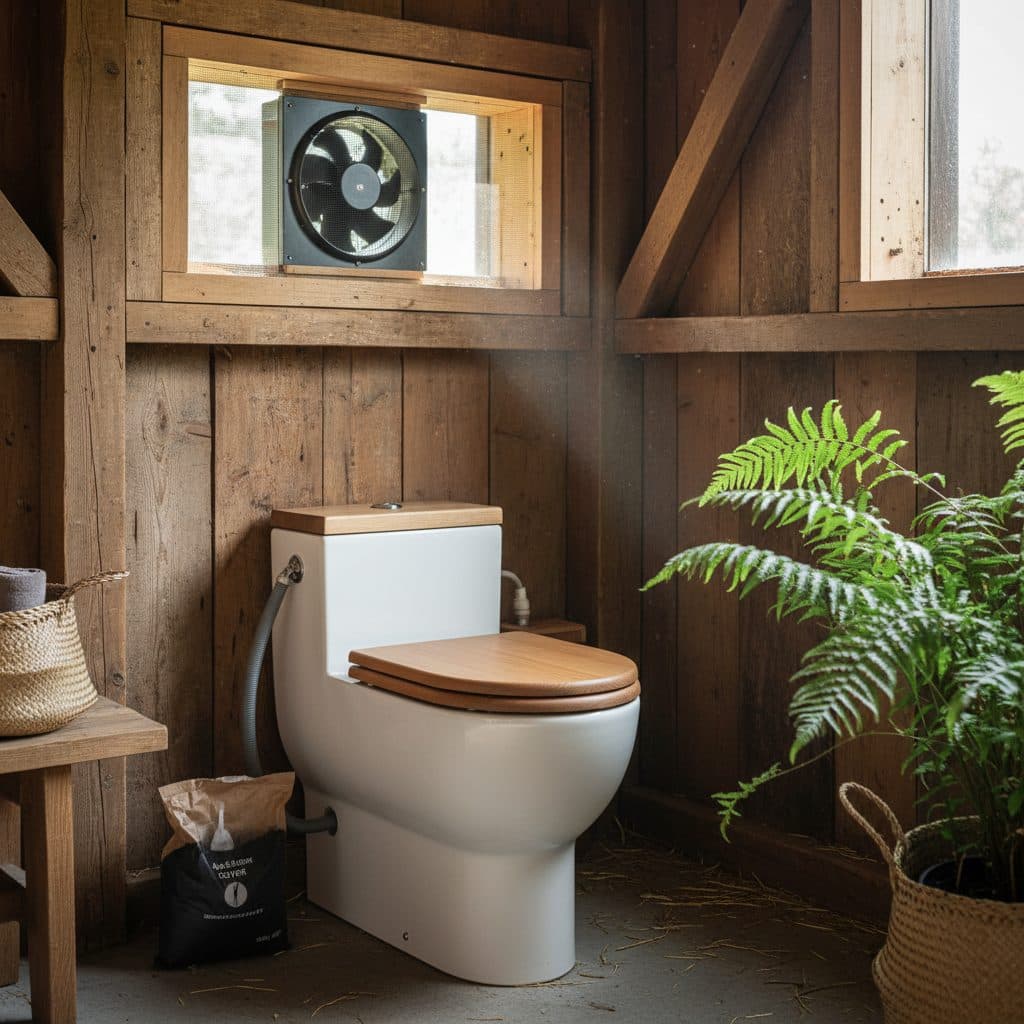
- Self-contained manufactured units (such as Separett and Nature's Head) utilize small 12-volt exhaust fans to vent moisture and draw continuous fresh air through the bowl.
- Low-cost DIY bucket systems rely on generous carbon cover materials (fine kiln-dried hardwood sawdust or coconut coir) and secondary outdoor thermophilic composting bays.
- Composting toilets bypass the need for expensive septic drain fields on remote, rocky, or steep off-grid homestead sites.
- Composted humanure must cure in an outdoor biological compost pile for a minimum of 12 to 24 months before being applied to ornamental plantings, windbreaks and timber belts; keep it away from any crop that is eaten raw or grows in contact with the soil, and check your state's rules before applying it in a food-producing area.
Quick answer: Composting toilets for off-grid living work by biologically breaking down human waste without water. Urine-diverting models separate liquid from solid waste to eliminate odor, while solid waste is covered with carbon material like coconut coir or sawdust and composted aerobically. They provide reliable sanitation for remote homesteads without needing septic tanks or plumbing infrastructure.
Establishing reliable sanitation is one of the primary infrastructure hurdles when setting up an off-grid homestead, remote cabin, or tiny home. Traditional flush toilets require tens of thousands of gallons of pressurized water annually, expensive plumbing networks, and engineered septic tanks paired with leach fields. Installed septic costs vary widely by state, soil and site access — get local quotes rather than working from a national figure.
For remote properties with rocky terrain, high water tables, steep slopes, or strict environmental zoning, composting toilets for off grid living provide a practical, waterless alternative. By harnessing natural aerobic microorganisms, these systems convert human waste into safe, stable organic soil conditioner while protecting local groundwater aquifers.
+-------------------------------------------------------------+
|              OFF-GRID SANITATION SYSTEM ARCHITECTURE        |
|                                                             |
|   1. URINE-DIVERTING MECHANISM:                             |
|   - Liquid diverted to front container or greywater soakaway|
|   - Solids fall vertically into dry holding chamber         |
|                                                             |
|   2. CONTINUOUS AERATION & VENTILATION:                     |
|   - 12V DC exhaust fan draws air downward through bowl      |
|   - Moisture and odors vented through 2 in (5 cm) roof pipe |
|                                                             |
|   3. CARBON COVER ADDITIONS:                                |
|   - Coconut coir, peat moss, or fine hardwood sawdust       |
|   - Balances carbon-to-nitrogen ratio (30:1 target)         |
|                                                             |
|   4. SECONDARY THERMOPHILIC CURING BAY:                     |
|   - Outdoor hot compost bay reaching 131°F (55°C)           |
|   - 12 to 24 month aging cycle greatly reduces pathogens    |
+-------------------------------------------------------------+
How composting toilets work: the biology of decomposition
Understanding the biological processes inside a composting toilet dispels the misconception that these systems function like smelly outhouse pits.
+-------------------------------------------------------------+
|                AEROBIC COMPOSTING VS ANAEROBIC ROTTING      |
|                                                             |
|   AEROBIC DECOMPOSITION (Composting Toilet):                |
|   - High oxygen environment maintained by bulking agents    |
|   - Microorganisms produce carbon dioxide, water, and heat  |
|   - Odor profile: Earthy, fresh forest floor smell          |
|                                                             |
|   ANAEROBIC ROTTING (Traditional Outhouse / Cesspool):      |
|   - Wet, stagnant, oxygen-deprived environment              |
|   - Bacteria produce hydrogen sulfide, ammonia, and methane |
|   - Odor profile: Pungent, foul sewage stench               |
+-------------------------------------------------------------+
The role of urine diversion
In human biology, liquid urine and solid feces serve different ecological roles. Urine contains roughly 80 to 90 percent of the nitrogen and most of the moisture excreted by the human body, and carries a far lower pathogen load than faeces — though it is not sterile, so it should still be handled as a waste stream, diluted before use on soil, and kept away from edible crops and drinking-water sources. Solid waste contains organic carbon, phosphorus, potassium, and gut microbes.
When urine and feces mix in an enclosed container without abundant oxygen, anaerobic bacteria thrive, producing volatile sulfur compounds and ammonia. Urine-diverting composting toilets (UDDTs) separate these streams at the source. A molded front bowl catches urine and drains it into an internal jug, an external holding tank, or a dedicated gravel basin. The solid waste drops into a dry, aerated rear chamber where it immediately begins aerobic breakdown.
To manage liquid kitchen and bathroom water sustainably alongside your toilet system, explore our design steps for laundry to landscape greywater setups and review greywater safe soaps and detergents.
Manufactured commercial toilets vs DIY bucket systems
Off-grid homesteaders generally choose between self-contained manufactured commercial units and low-cost DIY sawdust bucket systems. Manufactured units generally run to four figures, while DIY bucket systems run to two — check current retail pricing.
System Type | Cost Range | Power Requirement | Emptying Frequency | Best Application |
|---|---|---|---|---|
Manufactured Self-Contained (e.g. Nature's Head, Air Head) | Four figures (check current retail) | 12V DC fan (0.1 amps) | Solids: 4 to 6 weeks (2 people)<br/>Liquids: 2 to 3 days | Cabins, tiny homes, camper vans, indoor bathrooms |
Separating Central System (e.g. Separett Villa) | Four figures (check current retail) | 12V / 120V fan | Solids: 3 to 5 weeks<br/>Liquids: Piped outside | Full-time off-grid homes with year-round occupancy |
DIY 5-Gallon Bucket System (Humanure Style) | Two figures (DIY bucket & seat) | Zero power required | Bucket: 3 to 7 days per 5 gal (19 L) bucket | Simple homesteads with dedicated outdoor compost bays |
+-------------------------------------------------------------+
|               DIY 5-GALLON BUCKET SYSTEM DESIGN             |
|                                                             |
|   +-------------------------------------------------------+ |
|   | Standard Toilet Seat & Hinged Lid                     | |
|   |                                                       | |
|   | [ Plywood Box Cabinet Structure ]                     | |
|   | |  +-----------------------------------------------+  | |
|   | |  | 5-Gallon (19-Litre) Heavy-Duty Plastic Bucket |  | |
|   | |  |                                               |  | |
|   | |  | Deposit: Solid/Liquid Waste                  |  | |
|   | |  | Cover: 2 in (5 cm) Kiln-Dried Sawdust Blanket |  | |
|   | |  +-----------------------------------------------+  | |
|   | +-----------------------------------------------------+ |
+-------------------------------------------------------------+
Commercial manufactured units
Commercial units feature molded ABS plastic or fiberglass bodies, an integrated urine container, an internal agitator handle (spider handle) to stir the compost matrix, and a tiny 12-volt exhaust fan that runs continuously off a small solar battery bank. The fan creates slight negative air pressure inside the housing, ensuring zero bathroom odor escapes into living quarters.
DIY sawdust bucket systems
Popularized by Joseph Jenkins' Humanure Handbook, the DIY bucket system uses a standard 5-gallon (19-litre) plastic bucket mounted inside a wooden cabinet with a standard toilet seat. After every use, the user covers the deposit with two cups of fine, dry hardwood sawdust or peat moss. The carbon cover completely caps odors and absorbs excess moisture. When full, the bucket is emptied directly into an outdoor hot composting bin.
To compare different container designs for yard waste and homestead composting, review our analysis in best DIY and store-bought compost bins.
Composting toilet vs traditional septic systems
Evaluating sanitation options for an off-grid building site involves comparing structural footprints and financial outlays.
+-------------------------------------------------------------+
|                 SEPTIC SYSTEM VS COMPOSTING TOILET          |
|                                                             |
|   CONVENTIONAL SEPTIC:                                      |
|   - Cost: Varies widely by site access & soil ($8k-$25k+)   |
|   - Requires heavy excavation machinery, perc test approval |
|   - Consumes 8,000+ gal (30,000+ L) water / person annually |
|   - Prone to drain field failure in rocky, clay, or wet soil|
|                                                             |
|   COMPOSTING TOILET:                                        |
|   - Cost: Low entry point (two to four figures typical)     |
|   - Zero water consumption; zero excavation footprint       |
|   - Operates independent of soil percolation tests          |
|   - Recycles nutrients safely into homestead soil ecology   |
+-------------------------------------------------------------+
Legal codes, health departments, and permitting
On remote acreage where bedrock is shallow or heavy clay soils fail standard percolation (perc) tests, installing an engineered septic system with raised sand mounds can be financially prohibitive.
A composting toilet can remove the drain-field constraint, but it does not by itself settle the permitting question. Composting toilet approval, whether a certified unit (such as NSF/ANSI 41) is required, whether a septic or greywater system is still needed for occupancy, and whether finished humanure may be applied to land are all set by your state and county health department — confirm the rules for your parcel with your local health and building department before you build.
The outdoor thermophilic humanure composting protocol
Solid waste collected from dry toilet chambers or sawdust buckets is only pre-composted; it requires secondary thermophilic (hot) biological aging in an outdoor compost bay to ensure pathogen reduction.
+-------------------------------------------------------------+
|               THERMOPHILIC COMPOSTING PROTOCOL              |
|                                                             |
|   [ Fresh Deposits + Heavy Straw Cover ]                    |
|   =======================================================   |
|   Active Thermal Core: 131°F to 149°F (55°C to 65°C)        |
|   - High core temperatures sustained during active heating  |
|   - Greatly reduces enteric bacteria, viruses, and parasites|
|   =======================================================   |
|   Curing & Resting Phase: 12 to 24 Months                   |
|   - Transforms into stable, dark organic humus              |
|   - Apply to ornamentals, windbreaks, timber belts          |
+-------------------------------------------------------------+
Step-by-step outdoor curing process:
- Construct dedicated dual bins: Build two 4x4 ft (1.2 x 1.2 m) timber pallet bins on bare, well-drained soil. Line the bottom with 12 in (30 cm) of coarse woody brush for base aeration.
- Add carbon cover blanket: Every time a bucket or container is emptied into the active bin, immediately cover the fresh material with a 6 in (15 cm) blanket of clean straw, hay, or autumn leaves.
- Monitor core temperatures: In a properly constructed pile with adequate moisture and carbon, thermophilic bacteria multiply rapidly, pushing core temperatures to between 131°F and 149°F (55°C to 65°C). Sustained temperatures in this range kill most enteric bacteria, viruses and helminth ova — but only in material that actually reaches the hot core, which is why the pile must be turned so edges pass through the centre, and why a long curing period follows.
- Cure for one to two years: Once the first bin is filled, cover it with a final thick layer of straw and let it rest undisturbed for 12 to 24 months while you fill the second bin. This 12 to 24 month aging cycle greatly reduces pathogen survival.
- Safe application: After 12 to 24 months of biological curing, the waste is indistinguishable from rich forest loam. As a conservative precaution — and subject to your state's rules on land application — apply to ornamental plantings, windbreaks and timber belts; keep it away from any crop that is eaten raw or grows in contact with the soil, and check your state's rules before applying it in a food-producing area.
If your compost pile exhibits odor or imbalance during active decomposition, consult our troubleshooting guide on fixing compost smells and ammonia and learn corrective techniques in rebalancing problem compost piles.
Routine maintenance, bulking materials, and winter care
Operating a composting toilet reliably through all four seasons requires simple, routine maintenance habits:
- Selecting bulking materials: Use fine coconut coir, peat moss, or dry kiln-dried sawdust from untreated timber. Avoid cedar or redwood shavings, which contain natural antifungal compounds that inhibit beneficial composting microbes.
- Fan power and condensation: In freezing winter weather, warm indoor air rising through cold exhaust pipes can cause moisture condensation to run back down into the unit. Insulate the vertical vent pipe with foam wrap where it passes through unheated attic spaces.
- Cleaning protocol: Clean the bowl using mild, biodegradable cleaners such as a diluted vinegar solution or hydrogen peroxide spray. Never pour harsh synthetic chemical disinfectants (such as chlorine bleach) into the toilet, as they will harm the living microbial community.