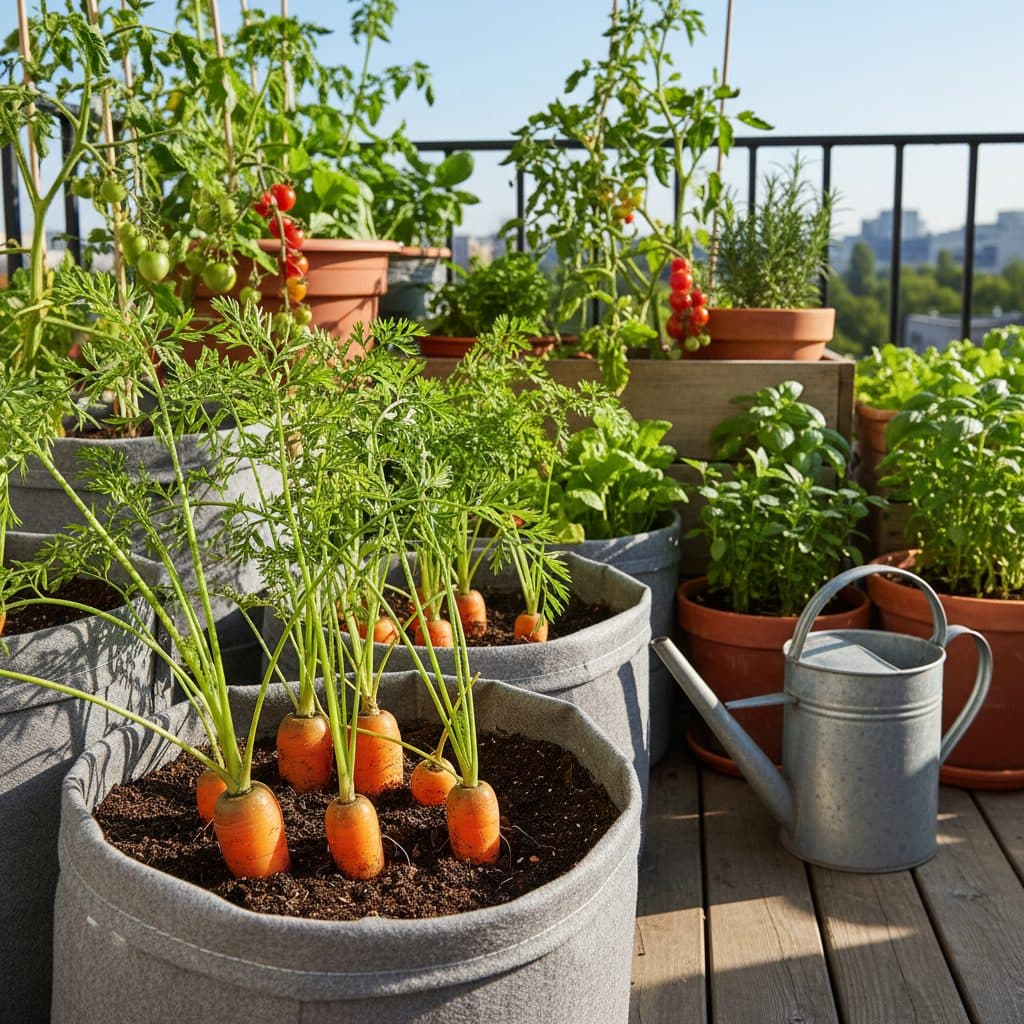
Key takeaways
- Select containers at least 12 inches deep for most carrot varieties to prevent forking.
- Create a soil mix with 40% compost, 40% sand, and 20% perlite for optimal drainage and aeration.
- Ensure consistent moisture; use a soil moisture meter to maintain ideal conditions, especially in arid regions like Southern California.
- Thin seedlings to 2-3 inches apart when they are 1 inch tall to allow roots to develop fully.
- Fertilize with a low-nitrogen, high-potassium blend (e.g., 2-5-5) every 3-4 weeks after germination.
- Avoid soil compaction from the start by using a light, well-draining mix and careful watering.
Quick answer: To grow straight carrots in containers, use a loose, well-draining soil mix of 40% compost, 40% coarse sand, and 20% perlite. Ensure containers are at least 12 inches deep and maintain consistent moisture to prevent forking.
Growing carrots in containers on a balcony in New York City or a rooftop in Chicago presents unique challenges compared to an in-ground garden. Many growers in zone 6 and elsewhere find their container carrots developing strange, forked shapes or remaining stubbornly small, often no larger than 2 inches. It’s almost always a direct result of the soil environment and cultural practices within the confined space of a container.
Understanding the specific needs of carrot roots — which are, after all, the part we eat — is key to success. Carrots demand a deep, loose, and consistently moist soil profile to grow straight and reach their full 6-8 inch potential. When these conditions aren’t met, the root’s development is hindered, leading to the common issues of forking and stunted growth that can frustrate container gardeners across the US.
Why container carrots fork
Carrots fork when their taproot encounters an obstruction or an inconsistent soil environment during its downward growth. In a container, this often means hitting a hard layer, a rock, or even a clump of un-decomposed organic matter. For instance, a carrot root aiming for a depth of 8 inches might hit a compacted area just 4 inches down, causing it to split and grow around the obstacle. This issue is particularly prevalent in containers filled with heavy garden soil, which can compact quickly, especially after several watering cycles.
Common causes of root splitting
Beyond physical barriers, uneven moisture or nutrient distribution can also contribute to forking. If one side of the root has better access to water or nutrients, it can grow faster, leading to an asymmetrical, forked shape. In a 10-gallon container, for example, inconsistent watering can create dry pockets that force roots to deviate. Using a soil moisture meter can help maintain uniform moisture levels. The goal is to provide a uniform, obstacle-free path for the root to grow straight down for its full 6-8 inch length.
- Soil compaction: Dense soil or hard layers prevent straight growth.
- Physical obstructions: Rocks, wood chips, or large soil clumps.
- Uneven moisture: Dry spots can cause roots to branch out.
- Inconsistent nutrients: Localized nutrient deficiencies or excesses.
- Shallow containers: Roots hit the bottom too soon, forcing lateral growth.
Why container carrots stay small
Small carrots in containers are often a symptom of insufficient resources or improper growing conditions. The primary culprits are inadequate container size, poor soil nutrition, and inconsistent watering. A carrot needs space to develop its taproot, typically 6-8 inches long for varieties like ‘Danvers 126’. If a container is only 8 inches deep, the carrot simply cannot reach its full genetic potential, often stopping at 3-4 inches in length. In regions like the Pacific Northwest, where summers are mild, carrots can thrive if given proper depth, and a standard 5-gallon bucket, at roughly 14 inches tall, is deep enough for most main-crop varieties.
Nutrient and water deficiencies
Carrots are moderate feeders, but they do require a balanced supply of nutrients, particularly phosphorus and potassium, to develop large, sweet roots. Too much nitrogen, often found in general-purpose fertilizers, can promote lush foliage at the expense of root development, resulting in small, leafy plants. In a 15-gallon grow bag, a lack of consistent moisture can also stunt growth; roots need steady water to swell. Organic matter in the mix helps it hold water, which matters for container success. Water whenever the top inch of mix feels dry — in warm weather that can mean daily for a fabric grow bag.
- Shallow containers: Restricts root growth to less than 6 inches.
- Nutrient imbalance: Too much nitrogen, not enough phosphorus or potassium.
- Inconsistent watering: Fluctuations in soil moisture stunt root expansion.
- Overcrowding: Too many plants competing for resources in a 12-inch pot.
- Poor soil aeration: Compacted soil limits oxygen to roots, hindering growth.
Preparing the ideal container soil mix
The foundation for straight, large carrots in containers is the soil mix. Forget heavy garden soil; it compacts too easily and lacks the aeration carrots need. Your goal is a loose, well-draining, yet moisture-retentive medium that offers no resistance to the developing taproot. For a 15-gallon fabric grow bag, you’ll need about 2 cubic feet of mix. A good starting point is a blend of 40% compost, 40% coarse sand, and 20% perlite or vermiculite. This combination ensures excellent drainage while retaining enough moisture for consistent growth, even during 80°F summer days in the Midwest. The coarse sand provides structure and prevents compaction, while the compost supplies a steady stream of nutrients for 60-75 days.
Mixing for optimal structure and nutrition
When preparing your mix, ensure all components are thoroughly combined. Break up any large clumps in the compost to eliminate potential obstructions. For example, if you’re using a lightweight garden hand trowel, mix the ingredients in a large tote or wheelbarrow. This living soil approach, discussed further in our Organic gardening soil article, is vital for container success. Aim for a pH between 6.0 and 6.8, which is ideal for carrot nutrient uptake.
- Coarse sand: Provides drainage and prevents compaction, 40% by volume.
- Quality compost: Supplies nutrients and retains moisture, 40% by volume.
- Perlite or vermiculite: Enhances aeration and drainage, 20% by volume.
- Balanced pH: Target 6.0-6.8 for optimal nutrient availability.
- No garden soil: Avoid heavy, compacting native soil from your yard.
Planting and ongoing care for straight carrots
Once your ideal soil mix is prepared and your containers are ready (choose ones at least 12 inches deep and 8 inches wide for good root development), it’s time to plant. Sow carrot seeds directly into the container, about 1/4 inch deep and 1/2 inch apart. Carrots do not transplant well, so direct sowing is essential. After sowing, gently water the container to settle the seeds. Germination typically takes 10-21 days, and consistent moisture during this period is critical, especially in warm weather, when the surface can dry out between waterings. Covering the surface with damp burlap, a board, or a piece of shade cloth holds moisture until the seeds break through; lift it as soon as sprouts appear. Avoid clear plastic in a sunny spot: it can cook the seedbed on a hot day.
Thinning, watering, and feeding for success
Thinning is perhaps the most important step for preventing small or forked carrots. When seedlings are about 1 inch tall, thin them to 2-3 inches apart. This gives each carrot root ample space to grow to its full 6-8 inch length without competition. Water consistently, aiming for evenly moist soil without being waterlogged. In a 15-inch deep container, check moisture levels 4-6 inches down. Fertilize every 3-4 weeks with an organic liquid fertilizer low in nitrogen and higher in phosphorus and potassium, such as a 2-5-5 blend. For more on feeding, see our Organic gardening fertilizer guide. Avoid high-nitrogen feeds, which encourage leafy growth at the expense of the root. Harvest ‘Nantes’ carrots in about 70 days when their shoulders are 1 inch wide.
- Direct sow: Plant seeds 1/4 inch deep, 1/2 inch apart.
- Thin aggressively: Space seedlings 2-3 inches apart when 1 inch tall.
- Consistent moisture: Keep soil evenly moist, not soggy or bone dry.
- Low-nitrogen fertilizer: Use a 2-5-5 or similar blend every 3-4 weeks.
- Adequate depth: Use containers at least 12 inches deep for root development.
Container Depth vs. Carrot Root Development
Container Depth | Expected Carrot Length | Risk of Forking/Stunting |
|---|---|---|
6-8 inches | 2-4 inches | Very High |
10-11 inches | 4-6 inches | Moderate |
12-15 inches | 6-8 inches | Low |
18+ inches | 8+ inches (for long varieties) | Very Low |
Optimal Soil pH: Carrots thrive in a soil pH range of 6.0 to 6.8, which supports efficient nutrient uptake and strong root development.
Container Volume: A 15-gallon fabric grow bag, roughly 15 inches deep and 18 inches wide, provides sufficient space for 15-20 carrots to grow to full size.
Frequently asked questions
What is the best container size for carrots?
For most carrot varieties like ‘Danvers 126’ or ‘Nantes’, a container at least 12 inches deep is essential to allow the taproot to grow straight and reach its full 6-8 inch length without resistance.
Can I use regular garden soil for container carrots?
No, regular garden soil is generally too heavy and prone to compaction for container carrots. It can lead to forking and stunted growth. A lighter, custom mix with 40% compost and 40% coarse sand is much better.
How often should I water container carrots?
Container carrots need consistent moisture. Check the mix 4-6 inches down and water whenever it feels dry. In hot climates, you might need to water daily, especially if temperatures exceed 85°F.
When should I thin carrot seedlings?
Thin carrot seedlings when they are about 1 inch tall. Space them 2-3 inches apart to ensure each developing root has enough room and resources to grow to its full size, typically 6-8 inches.
What kind of fertilizer do carrots need?
Carrots benefit from a low-nitrogen, higher phosphorus and potassium fertilizer, such as a 2-5-5 blend. Apply it every 3-4 weeks after germination to support strong root development without excessive leafy growth.
References
- USDA Natural Resources Conservation Service (2024). USDA Natural Resources Conservation Service.