Key takeaways
- Always confirm identification of elderberry (Sambucus canadensis) with multiple reliable sources before consuming.
- Water hemlock (Cicuta maculata) is highly toxic, containing cicutoxin, and can be mistaken for elderberry or wild carrot.
- Key distinctions include stem characteristics, leaf arrangement, flower structure, and the presence of a chambered root in water hemlock.
- Forage sustainably, taking no more than 10% to 20% of plant material, and always conduct a small taste test for new edibles.
- Familiarize yourself with local look-alikes in your specific USDA zone or region to avoid dangerous errors.
Quick answer: To safely identify elderberry, look for woody stems with white pith, compound leaves with 5-9 opposite leaflets, and flat-topped white flower clusters. Distinguish it from toxic water hemlock by its purple-streaked hollow stems, umbrella-shaped flower clusters, and chambered root system.
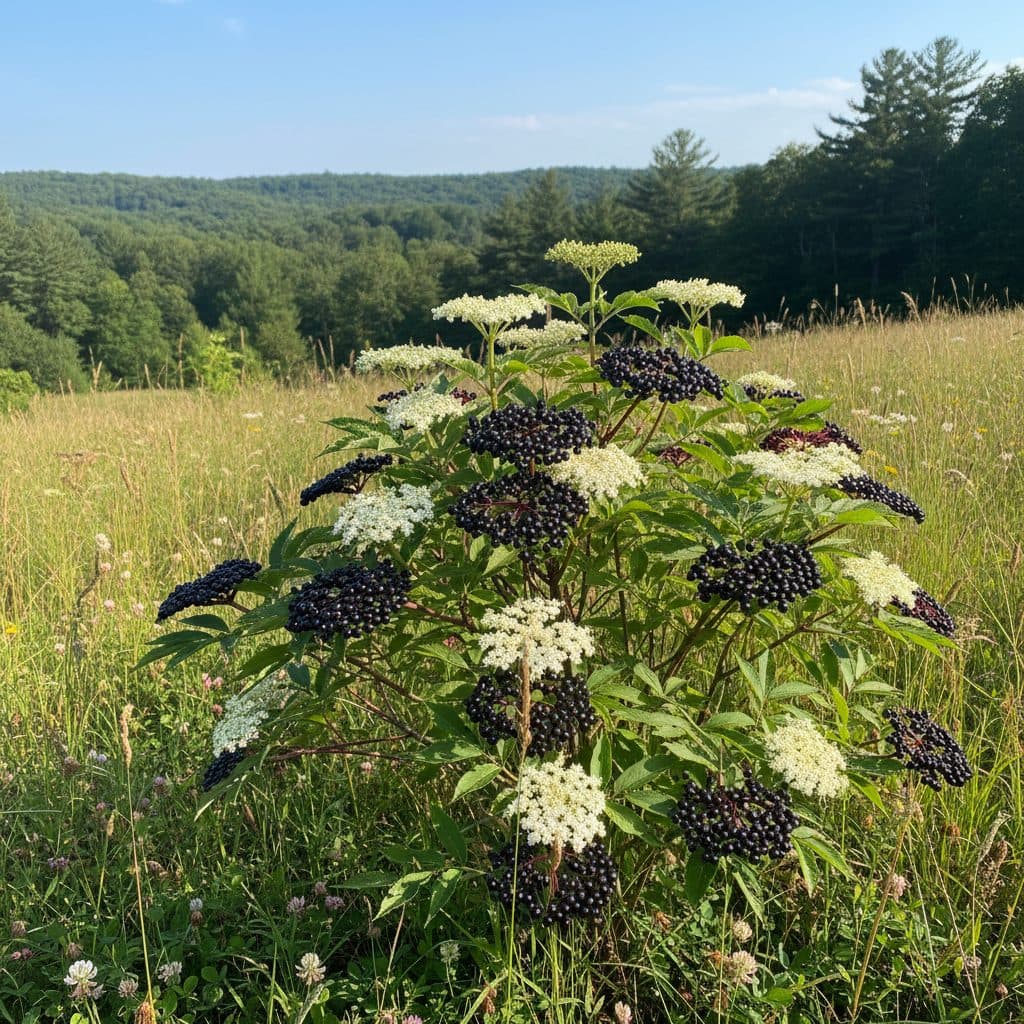
In the humid summers of the Southeast, from Florida up to Maryland, the American elderberry (Sambucus canadensis) gives a bounty of flowers and berries, valued for centuries. This native shrub, often found along stream banks and forest edges in USDA zones 3 to 9, can reach heights of 5 to 12 feet, presenting flat-topped clusters of creamy white flowers up to 10 inches across. Foraging for these edible treasures can be a rewarding experience, connecting us to the land and its seasonal rhythms, but it demands careful attention to detail.
However, the plant world holds many look-alikes, some benign, others deadly. Among the most dangerous is water hemlock (Cicuta maculata), a highly poisonous member of the carrot family that shares visual similarities with elderberry, especially to the untrained eye. In regions like the Pacific Northwest and throughout the Midwest, where both plants can grow, distinguishing between them is essential to prevent poisoning. This guide aims to equip US foragers with the knowledge to safely identify elderberry and avoid its toxic imposters, helping foragers identify elderberry safely.
The edible bounty of American elderberry
American elderberry (Sambucus canadensis) is a versatile native shrub, thriving across much of the contiguous United States, from USDA zone 3 to 9. It typically grows to a height of 5 to 12 feet, flourishing in moist, well-drained soils, often found in open woodlands, along fencerows, and near water sources. Its large, flat-topped flower clusters, which can measure 6 to 10 inches in diameter, appear in late spring to early summer, followed by small, dark purple berries, about 1/4 inch across, ripening from July to September. These berries are rich in nutrients and have been used for centuries in pies, jams, and medicinal preparations.
Identifying elderberry’s distinct features
Proper identification starts with understanding its unique characteristics. The stems of American elderberry are typically woody, often light brown to gray, with prominent lenticels and a soft, white pith in older branches. Its leaves are compound, usually with five to nine finely toothed leaflets arranged oppositely along the stem. Each leaflet is oval to lance-shaped, measuring 2 to 6 inches long. The flowers are small, five-petaled, and creamy white, forming those iconic flat-topped cymes. When ripe, the berries hang in drooping clusters, turning a deep purplish-black. In the Northeast, for example, a mature elderberry bush might yield 10 to 15 pounds of berries in a good season. For more general foraging tips, see our guide on Foraging for beginners: identifying common wild edibles safely.
- Opposite leaf arrangement: Leaves grow directly across from each other on the stem.
- White pith: Older stems have a soft, spongy white center.
- Compound leaves: Typically 5-9 leaflets per leaf.
- Flat-topped flower clusters: Cymes measuring 6-10 inches wide.
- Dark purple berries: Small, 1/4 inch diameter, ripening in late summer.
The deadly imposter: water hemlock
While elderberry offers sustenance, water hemlock (Cicuta maculata) presents a severe danger. This plant, native to wet areas across North America, including marshes, ditches, and stream banks in USDA zones 4 to 9, is considered one of the most poisonous plants on the continent. All parts of the plant, especially the roots, contain cicutoxin, a potent neurotoxin that can cause seizures, respiratory failure, and death. Symptoms can manifest rapidly, often within 15 to 30 minutes of ingestion, making immediate medical attention critical.
Recognizing water hemlock’s toxic traits
Water hemlock can grow 3 to 7 feet tall, and its stems are smooth, hollow, and often streaked with purple, particularly at the base. Unlike elderberry, its leaves are compound, but they are typically twice or thrice pinnate, with leaflets that are lance-shaped and sharply toothed, measuring 1 to 4 inches long. A key distinguishing feature is the veins of the leaflets, which terminate in the notches between the teeth, not at the tips. The flowers are small and white, forming umbrella-shaped clusters (umbels) that are 2 to 5 inches wide, appearing in summer. The roots are perhaps the most dangerous part, forming a cluster of fleshy tubers that, when cut, often exude a yellowish, oily liquid. This root structure is chambered, a unique characteristic not found in elderberry. Water hemlock is a significant cause of plant-related livestock poisoning incidents in the Midwest.
- Purple-streaked stems: Especially at the base, smooth and hollow.
- Veins terminating in notches: A critical leaf identification point.
- Umbrella-shaped flower clusters: Compound umbels, 2-5 inches wide.
- Chambered root system: Fleshy tubers with internal cross-partitions.
- Highly toxic: Contains cicutoxin, affecting the central nervous system.
Key identification markers: a side-by-side look
When foraging, systematic identification is essential. Focusing on several key features simultaneously reduces the risk of misidentification. Foragers in regions like the Great Lakes states, where both elderberry and water hemlock are common, must pay close attention to stem, leaf, flower, and root characteristics. While both plants can grow in moist environments, elderberry prefers slightly drier, sunnier spots compared to water hemlock’s preference for standing water or very boggy conditions. A difference of just 1 to 2 feet in elevation can sometimes separate their preferred habitats.
Distinguishing features at a glance
Consider the stem: elderberry has a woody stem with white pith, while water hemlock has a smooth, hollow stem often streaked with purple, particularly near the base. The leaves are another critical differentiator; elderberry leaves are oppositely arranged with 5 to 9 leaflets, whereas water hemlock leaves are alternate, twice or thrice compound, with veins terminating in the notches. Elderberry flower clusters are broad and flat-topped, 6 to 10 inches across, while water hemlock produces smaller, more umbrella-shaped compound umbels, typically 2 to 5 inches wide. Finally, the roots offer a definitive clue: elderberry has fibrous roots, while water hemlock has a cluster of fleshy, chambered tubers. Always inspect at least three different parts of the plant before making a decision. Inspect multiple plant parts before harvesting.
- Stem pith: White and spongy in elderberry, hollow in water hemlock.
- Leaflet venation: To tips in elderberry, to notches in water hemlock.
- Flower shape: Flat-topped cymes for elderberry, umbrella-shaped umbels for water hemlock.
- Root structure: Fibrous for elderberry, chambered tubers for water hemlock.
- Odor: Water hemlock roots may have a strong, parsnip-like odor when cut.
Regional considerations and safe foraging practices
Foraging depends on local ecosystems, and what grows in one region might differ significantly from another. In the arid Southwest, for example, elderberry varieties might be less common than in the wetter climates of the Pacific Northwest or the humid Southeast. Understanding your local flora, including common look-alikes, is an essential first step for any forager. The USDA Plants Database [1] is an excellent resource for checking native ranges and specific characteristics of plants in your state, offering details for over 100,000 plant species in North America.
Beyond identification: responsible harvesting
Beyond accurate identification, responsible foraging involves sustainable harvesting practices. Never take more than 10% to 20% of any plant from a single area so enough remains for regeneration and wildlife, a principle championed by organizations like SARE [3]. Always obtain permission if foraging on private land, and be aware of local regulations in state or national parks. When trying a new wild food, start with a very small portion (perhaps a single berry or a quarter-teaspoon of cooked greens) and wait 24 hours to observe any adverse reactions. This small taste test is a sensible safety precaution, especially for plants like Small-Leaved Wild Grape, which can have varying edibility. Even with known edibles, individual sensitivities can occur. Always carry a field guide specific to your region, and consider attending a local foraging workshop, many of which are offered annually in states like Pennsylvania and Oregon.
- Know your region: Familiarize yourself with local plants and their look-alikes.
- Sustainable harvest: Take no more than 10-20% of a plant.
- Permission and regulations: Always forage legally and ethically.
- Small taste test: Try a tiny amount and wait 24 hours for new edibles.
- Use reliable guides: Carry a field guide and cross-reference multiple sources.
Beyond water hemlock: other umbel look-alikes
The carrot family (Apiaceae), to which water hemlock belongs, is notorious for containing both delicious edibles and deadly poisons. Many of these plants share the characteristic umbrella-shaped flower clusters, or umbels, making differentiation challenging. Beyond water hemlock, foragers must also be wary of poison hemlock (Conium maculatum) and wild carrot (Daucus carota), also known as Queen Anne’s Lace. These plants are widespread across North America, with poison hemlock found across most of the US and wild carrot thriving in disturbed soils across most of the continental US.
Poison hemlock and wild carrot distinctions
Poison hemlock is another highly toxic plant, identifiable by its smooth, hollow stem that is often mottled with purple spots, especially towards the base. It can grow much taller than water hemlock, reaching 6 to 10 feet in height. Its leaves are finely divided, fern-like, and emit a strong, unpleasant ‘mousy’ odor when crushed. Wild carrot, or Queen Anne’s Lace, is generally less sturdy, growing 1 to 4 feet tall, with hairy stems and a distinctive single dark purple or red flower in the center of its white umbel. Its roots smell distinctly of carrot when crushed. While wild carrot is edible, it’s often confused with poison hemlock, making careful identification essential. For example, in Kansas, a 2022 report documented 15 cases of accidental poisoning from misidentified wild plants, showing the risk of confusing these species. Remember, when in doubt, do not eat it; it’s a rule that has saved countless foragers.
- Poison hemlock: Smooth, purple-spotted stem, fern-like leaves, mousey odor.
- Wild carrot: Hairy stem, central dark floret in umbel, carrot-scented root.
- Cow parsnip: Large, coarse leaves, stout hairy stem, can cause phytophotodermatitis.
- Angelica: Large, hollow stems, often purple, strong aromatic scent.
- Fool’s parsley: Smaller, finely divided leaves, often confused with edible parsley.
Main differences between elderberry, water hemlock, and poison hemlock.
Feature | American elderberry | Water hemlock | Poison hemlock |
|---|---|---|---|
Stem | Woody, white pith, 5-12 ft tall | Smooth, hollow, purple streaks, 3-7 ft tall | Smooth, hollow, purple spots, 6-10 ft tall |
Leaves | Opposite, 5-9 leaflets, toothed | Alternate, veins to notches, 1-4 in long | Alternate, fern-like, finely divided |
Flowers | Flat-topped cymes, 6-10 in wide | Umbrella-shaped umbels, 2-5 in wide | Umbrella-shaped umbels, 2-6 in wide |
Roots | Fibrous | Fleshy, chambered tubers | Taproot, parsnip-like |
Odor (crushed) | Mild, slightly sweet | Strong, parsnip-like (roots) | Strong, ‘mousey’ or acrid (leaves) |
Toxicity | Raw berries mildly toxic; cooked safe | Highly toxic (cicutoxin) | Highly toxic (coniine) |
Habitat | Moist, open, USDA zones 3-9 | Wet, boggy, USDA zones 4-9 | Disturbed areas, roadsides, all 50 states |
Elderberry Zones: American elderberry (Sambucus canadensis) thrives across USDA zones 3 to 9, reaching heights of 5 to 12 feet.
Hemlock Toxicity: Water hemlock poisoning symptoms can appear within 15 to 30 minutes due to its potent neurotoxin, cicutoxin.
Foraging Rule: Always take no more than 10% to 20% of a wild plant’s available parts to ensure sustainable growth.