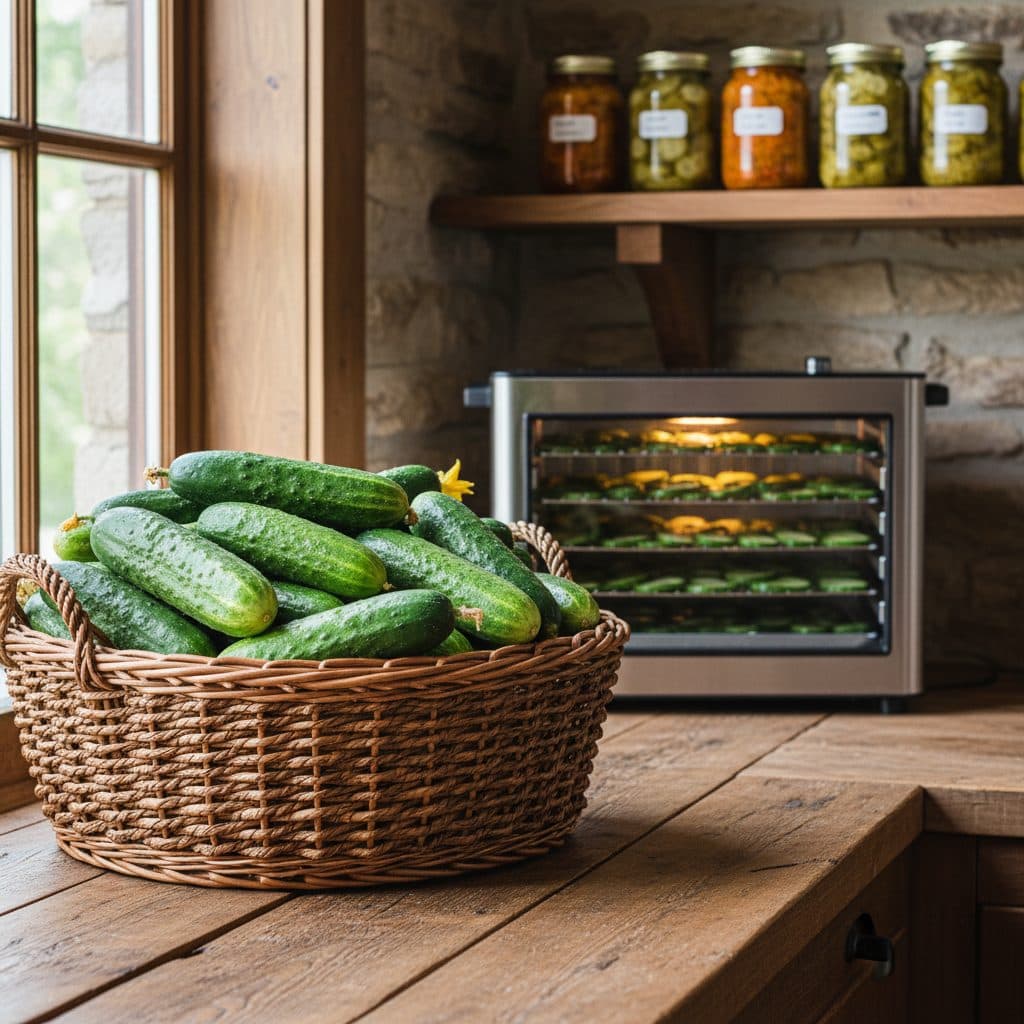
Key takeaways
- Dehydrate cucumbers into chips or powder at 125-135°F for versatile, long-term storage.
- Ferment cucumbers into relishes or krauts using a 2-3% salt brine to extend their shelf life beyond traditional pickling.
- While not ideal for root cellaring, short-term cool storage at 50-55°F and high humidity can extend cucumber freshness for 10-14 days.
- Freezing cucumbers is best for purees or brined chunks, as their high water content changes texture significantly.
- Consider growing diverse cucumber varieties like Armenian cucumbers for varied preservation outcomes and culinary uses.
- Proper pre-treatment, like salting or blanching, maintains quality across different preservation methods.
Quick answer: To manage a cucumber glut, diversify preservation methods beyond traditional pickling, focusing on dehydrating into chips or powder, fermenting into relishes or krauts, and utilizing short-term cold storage.
In many parts of the United States, from the fertile fields of central Iowa to the backyard gardens of coastal California, the arrival of summer often brings with it an abundance of cucumbers. Gardeners in USDA zone 5, for instance, can easily find themselves with 15 pounds or more of fruit from a single `Cucumis sativus` plant, especially with consistent watering and adequate sunlight. This prolific yield, while initially welcome, can quickly become a glut, far exceeding what a family can consume fresh or even pickle in traditional ways.
While dill and bread-and-butter pickles remain common preservation methods, other techniques also handle a large harvest. Dehydrating, fermenting into relishes, and short-term cold storage extend the harvest without wasting excess produce.
Understanding the cucumber harvest: more than just pickles
The common garden cucumber, `Cucumis sativus`, is a highly productive plant. A healthy vine in a good growing season can produce between 10 and 20 pounds of cucumbers, sometimes even more, especially in regions like the Ohio River Valley where summer conditions are favorable. This yield often leads to a surplus that outpaces fresh consumption, making preservation a necessity. While pickling is a time-honored tradition, dating back thousands of years, focusing solely on brined pickles can limit the culinary versatility of your stored produce. For example, research from 2016 highlights that different cropping systems can significantly influence the yield of cucumbers destined for pickles [2].
Diversifying your preservation strategy
To manage a cucumber glut, diversify your preservation strategy. Methods that transform cucumbers into different textures and flavors prevent waste and provide a wider array of ingredients for your pantry. For instance, a single 10-pound harvest could be split, with 5 pounds going to traditional pickles and the remaining 5 pounds processed using other methods. This balanced approach ensures you have a variety of preserved goods to enjoy throughout the year, from crisp dehydrated slices to tangy fermented relishes.
- Harvest cucumbers when 6-8 inches long for best texture.
- Avoid over-ripening, which leads to tough skins and bitter flavor.
- Wash cucumbers thoroughly under cool, running water before processing.
- Use within 24 hours of picking for optimal freshness and quality.
- Consider growing diverse varieties like the Armenian Cucumber for different preservation characteristics.
Dehydrating cucumbers for long-term storage
Dehydrating cucumbers is an excellent way to reduce their bulk and create a shelf-stable product that is far from a pickle. This method removes over 90% of the cucumber’s water content, concentrating its flavor and making it incredibly light. For best results, select firm, unwaxed cucumbers, ideally 6-8 inches in length. After washing, slice them uniformly, about 1/8 to 1/4 inch thick, using a mandoline or sharp knife for consistency. Pre-treatment protects quality: a quick blanch in boiling water for 30 seconds followed by an ice bath, or a light salting for 30 minutes to draw out moisture, improves texture and color retention.
Drying methods and uses
You can dehydrate cucumbers using a food dehydrator set to 125-135°F, which typically takes 8-12 hours until they are brittle. An oven set to its lowest temperature with the door slightly ajar can also work, though it may take longer, up to 15 hours. Once fully dry, store the cucumber chips in airtight containers in a cool, dark place. These chips can be rehydrated for use in soups or stews, or crushed into a powder for seasoning. A 5-pound batch of fresh cucumbers can yield less than 1 pound of dehydrated product, saving significant storage space in your pantry.
- Slice cucumbers uniformly, 1/8 to 1/4 inch thick.
- Blanch for 30 seconds or salt for 30 minutes before drying.
- Dry at 125-135°F in a dehydrator until brittle.
- Store in airtight containers for up to 12 months.
- Use dehydrated cucumber powder as a savory seasoning in dressings or rubs.
Fermenting cucumbers into relishes and krauts
Beyond the classic dill pickle, fermentation offers a dynamic way to preserve cucumbers, transforming their flavor and texture into new culinary forms. You can create tangy relishes or even incorporate cucumbers into vegetable krauts. Successful fermentation requires maintaining an anaerobic environment and a proper salt concentration, typically a 2-3% salt brine. For a simple fermented cucumber relish, finely chop 3 pounds of cucumbers, along with 1 cup of onion and 1/2 cup of bell pepper. Mix with 2 tablespoons of non-iodized salt, within the 2-3% range above, and pack into a clean half-gallon jar, leaving 2 inches of headspace and keeping the vegetables submerged under the brine.
Fermentation process and benefits
The `Lactobacillus` bacteria, naturally present on vegetables, convert sugars into lactic acid, which preserves the food and creates a distinctive sour flavor. This process typically takes 7-14 days at room temperature, around 68-72°F. You will observe bubbling as carbon dioxide is produced. Once fermentation is complete, store the relish in the refrigerator, where it will last for several months. This method extends the life of cucumbers and introduces beneficial probiotics. Some traditional recipes added copper salts to brighten the green color of pickles. That practice is unsafe and long obsolete, because copper salts are toxic, and modern fermentation relies on salt and lactic acid alone [3].
- Use non-iodized salt for fermentation, typically 2-3% of the vegetable weight.
- Ensure vegetables remain submerged under the brine to prevent mold growth.
- Ferment at room temperature, 68-72°F, for 7-14 days.
- Store finished fermented products in the refrigerator for extended shelf life.
- Experiment with different spices like dill, mustard seed, or celery seed for varied flavors.
Cold storage and freezing cucumbers
While cucumbers are not ideal candidates for long-term root cellaring due to their high water content and susceptibility to chilling injury, short-term cold storage can extend their freshness for 10-14 days. The optimal conditions for cucumbers are much warmer than most root cellar staples, ideally 50-55°F with 95% humidity. A refrigerator crisper, at roughly 40°F, is already below what cucumbers tolerate; if it is all you have, bag them in perforated plastic and plan on about a week. For comparison, a root cellar runs 32-40°F, well under the roughly 50°F threshold at which cucumbers begin to show chilling injury as pitting and water-soaked spots.
Freezing for specific uses
Freezing cucumbers is another option, though it significantly alters their texture due to their high water content. They will become soft and watery upon thawing, making them unsuitable for fresh slicing. However, freezing is excellent for preparing cucumbers for specific uses like smoothies, cold soups, or relishes. To freeze, peel and deseed 4 pounds of cucumbers, then chop them into chunks or puree them. You can blanch the chunks for 2 minutes before freezing to help retain some texture, or simply freeze the puree in ice cube trays. These frozen portions can be stored for up to 6 months in an airtight freezer bag or container, providing a convenient base for future meals.
- Store cucumbers at 50-55°F for up to 2 weeks; a refrigerator crisper is colder than ideal and buys about a week.
- Avoid storing cucumbers below 50°F for more than a few days to prevent chilling injury.
- Peel and deseed cucumbers before freezing to reduce water content.
- Freeze cucumber chunks or purees in airtight containers for up to 6 months.
- Use frozen cucumbers exclusively in cooked dishes, smoothies, or blended recipes.
Beyond the common cucumber: exploring other varieties
While `Cucumis sativus` is the most widely grown cucumber, exploring other varieties can offer different characteristics better suited for specific preservation methods or simply provide more culinary diversity. For instance, the Armenian cucumber, technically a melon, has a thinner skin and fewer seeds, making it excellent for fresh eating but also for quick lacto-fermented slices that retain a pleasant crunch.
Preserving diverse cucumber types
When dealing with a glut, having different types of cucumbers can guide your preservation choices. For example, the thick-skinned pickling varieties of `Cucumis sativus` are naturally robust for brining, while the thin-skinned slicing types might be better for dehydration or pureeing. Regardless of the variety, the goal remains the same: to extend the life of your harvest and enjoy its flavors long after the growing season has passed. With a little planning, your 15-pound cucumber yield can become a year-round pantry staple.
- Grow a mix of slicing and pickling cucumbers for varied uses.
- Consider specialty varieties like Armenian cucumbers for unique textures.
- Match cucumber characteristics to the preservation method for best results.
- Harvest specialty cucumbers at their optimal size for specific recipes.
- Record which varieties perform best for your chosen preservation techniques each year.
Cucumber preservation methods comparison
Method | Best use | Shelf life | Texture change |
|---|---|---|---|
Dehydrating | Chips, powder, rehydrated for soups | Up to 12 months | Crisp to brittle (dry), soft (rehydrated) |
Fermenting (relish/krauts) | Condiments, side dishes | 3-6 months (refrigerated) | Softened, tangy crunch |
Freezing (puree) | Smoothies, cold soups, sauces | Up to 6 months | Very soft, watery upon thawing |
Cold storage (refrigerator) | Fresh eating, salads | 10-14 days | Minimal if stored correctly |
Dehydration Temp: Maintain a consistent temperature of 125-135°F for 8-12 hours when dehydrating cucumbers to ensure thorough drying.
Fermentation Brine: A 2-3% salt brine is optimal for fermenting cucumbers, providing the right environment for beneficial bacteria to thrive.
Cold Storage Limit: Cucumbers should not be stored below 50°F for more than a few days to prevent chilling injury and maintain quality.
Frequently asked questions
Can I freeze whole cucumbers?
Freezing whole cucumbers is generally not recommended because their high water content, over 90%, causes them to become very mushy upon thawing. It’s better to puree or chop them into chunks for specific uses like smoothies or soups.
What is the best temperature for dehydrating cucumbers?
The best temperature for dehydrating cucumbers is between 125-135°F. This range allows for efficient moisture removal without cooking the cucumbers, typically taking 8-12 hours to achieve a brittle texture.
How long do fermented cucumber relishes last?
Fermented cucumber relishes, stored in an airtight container in the refrigerator, can last for 3-6 months. The lactic acid produced during fermentation acts as a natural preservative, maintaining quality and flavor.
Are there any cucumbers that root cellar well?
No, cucumbers are generally not suitable for root cellaring. They prefer much warmer temperatures, around 50-55°F; a typical root cellar at 32-40°F is cold enough to cause chilling injury within a few days.
What is the ideal salt percentage for fermenting cucumbers?
An ideal salt percentage for fermenting cucumbers is a 2-3% salt brine. This concentration inhibits undesirable bacteria while allowing beneficial `Lactobacillus` to thrive for a safe and flavorful ferment over 7-14 days.
Can I use a regular oven to dehydrate cucumbers?
Yes, you can use a regular oven to dehydrate cucumbers, but it’s less efficient than a dedicated dehydrator. Set your oven to its lowest temperature, ideally 135°F or below, and prop the door open slightly to allow moisture to escape. Drying time can be 10-15 hours or more.
References
- Cucumber Pickles and Fermentations (2021). Cucumber Pickles and Fermentations.
- Yield of cucumber pickles with different cropping systems (2016). Yield of cucumber pickles with different cropping systems.
- The Behavior of Copper Added to Cucumber Pickles (1962). The Behavior of Copper Added to Cucumber Pickles.
- Evaluation of Pickles from Cucumber Plants1 Treated with 2-Chloroethylphosphonic Acid (1970). Evaluation of Pickles from Cucumber Plants1 Treated with 2-Chloroethylphosphonic Acid.
- Sorbic Acid as a Preservative for Sweet Cucumber Pickles (1955). Sorbic Acid as a Preservative for Sweet Cucumber Pickles.