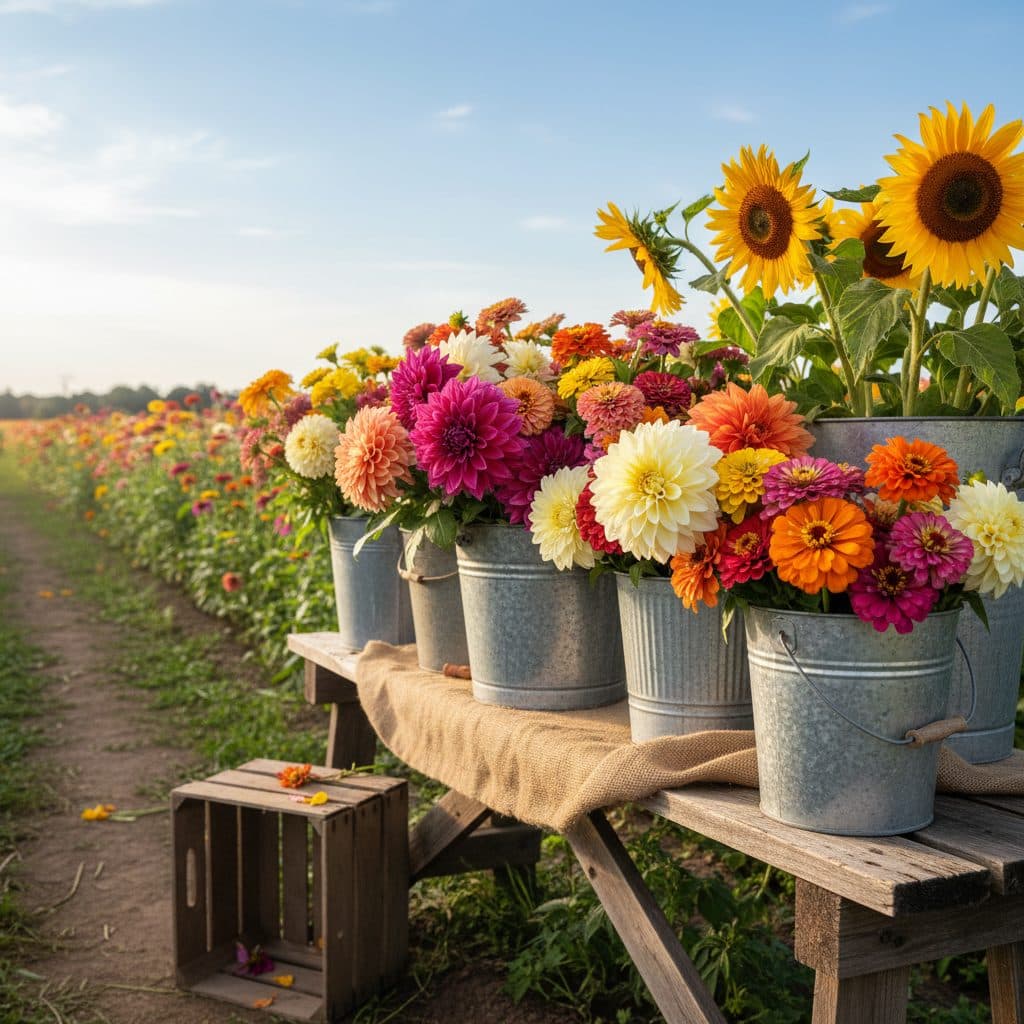
Key takeaways
- A quarter-acre (about 10,890 sq ft) plot can generate meaningful homestead revenue when focused on intensive high-stem-yield cut flower crops.
- Grow a balanced mix of focal flowers (dahlias, sunflowers), spike flowers (snapdragons, celosia), and airy fillers (ammi, cosmos).
- Sow successions of fast-maturing annuals every two to three weeks to maintain steady weekly harvest volumes throughout the frost-free season.
- Harvest cut flowers during the cool early morning or late evening hours, placing stems immediately into clean buckets of conditioned water.
- Diversify local sales outlets across community subscriptions (CSAs), weekly farmers markets, florist wholesale accounts, and farmstand sales.
Quick answer: Flower farming involves growing specialty cut flowers on small acreage for direct local sale to retail customers, florists, and event designers. Smallholders and homesteaders can establish a productive cut flower enterprise on as little as a quarter-acre by building high-density raised beds, installing drip irrigation, planting succession crops, and focusing on high-value varieties that do not ship well commercially, such as dahlias, sweet peas, and heirloom zinnias.
Demand for locally grown, seasonal cut flowers has grown in recent years across North America. Retail consumers and independent florists increasingly seek fresh, fragrant blooms harvested within miles of their homes rather than imported flowers shipped thousands of miles in chemical preservatives.
Cut flowers can return more per square foot than most field vegetables, but only where you have reliable local outlets and the labour to harvest weekly. A modest quarter-acre plot, managed with bio-intensive spacing and succession planting, produces thousands of marketable stems from late spring through autumn frost.
Succeeding as a commercial grower requires more than loving flowers. It demands disciplined crop scheduling, efficient harvesting systems, post-harvest hydration management, and active local marketing.
Structuring the flower plot: layout and bed sizing
Efficient field layout streamlines planting, weeding, netting, and harvesting. Standardizing your beds ensures repeatable crop planning from season to season.
+-------------------------------------------------------------------+
|               STANDARD CUT FLOWER BED LAYOUT (30 INCH)            |
+-------------------------------------------------------------------+
| <==== 12 to 18 inch Walking Pathway (Mulched or Woodchip) ====>   |
| [---------------------------------------------------------------] |
| [  30-Inch (75 cm) Wide Growing Bed | 50 to 100 Feet Long       ] |
| [  2 to 4 Rows per Bed with Drip Irrigation Tape                ] |
| [  Hortonova Support Netting Suspended Above Plants             ] |
| [---------------------------------------------------------------] |
| <==== 12 to 18 inch Walking Pathway (Mulched or Woodchip) ====>   |
+-------------------------------------------------------------------+
Standardized 30-inch beds
Standardize all field beds to a 30-inch (75 cm) width with 12 to 18-inch pathways. This width allows you to reach comfortably across the bed from either side without stepping on cultivated soil. Standard bed dimensions also match commercial tools, row covers, flame weeders, and Hortonova support netting.
Soil preparation and fertility
Cut flowers demand fertile, well-drained soil rich in organic matter. Apply a 2-inch layer of well-rotted compost across each bed before planting. Avoid excessive synthetic nitrogen fertilizer, which produces lush, weak foliage and hollow, brittle stems prone to snapping in summer storms. Lay two parallel lines of drip irrigation tape beneath landscape fabric or woodchip mulch to keep foliage dry and prevent fungal leaf spot. Selecting proper natural amendments is detailed in our guide on soil amendments demystified.
Top high-value cut flower varieties for beginners
Select varieties that produce abundant stems, have long vase lives, and command strong market prices: most of your volume crops should give 7 to 10 days in the vase; a few short-lived specialties such as sweet peas earn their place on fragrance and price instead.
+------------------------+-------------------+-------------------+-------------------------------+
| Flower Type            | Sowing / Planting | Stem Harvest Stage| Key Market Value              |
+------------------------+-------------------+-------------------+-------------------------------+
| Dahlias                | Tubers in Spring  | 3/4 to fully open (does not open post-cut) | Premium focal bloom, high $   |
| Sunflowers (Pollenless)| Successions (2 wk)| Color showing     | Reliable weekly staple        |
| Zinnias (Benary Giant) | Successions (3 wk)| Stiff stem test   | High volume, bold colors   |
| Snapdragons (Rocket)   | Early Spring Plug | Lowest 1/3 to 1/2 florets open | Long vertical spike element   |
| Cosmos (Double Click)  | Spring Seed/Plug  | Petals cracking   | Airy textural filler          |
| Sweet Peas             | Late Winter Seed  | 2 blossoms open   | Exceptional spring fragrance  |
+------------------------+-------------------+-------------------+-------------------------------+
+-------------------------------------------------------------------+
| BALANCED BOUQUET INGREDIENT RECIPE |
+-------------------------------------------------------------------+
| 1. Focal Flowers (20-30%): Large blooms that draw the eye |
| Examples: Dahlias, Sunflowers, Peonies, Ranunculus |
| 2. Spike Flowers (20-25%): Linear blooms that provide height |
| Examples: Snapdragons, Celosia, Larkspur, Gladiolus |
| 3. Filler & Textural (30%): Multi-branching clusters and discs |
| Examples: Zinnias, Feverfew, Cosmos, Rudbeckia |
| 4. Foliage & Greens (20%): Structure and natural contrast |
| Examples: Basil (Aroma), Eucalyptus, Honeywort, Mint |
+-------------------------------------------------------------------+To support strong early season plantings, master propagation techniques from seed starting for beginners and pair annual flowers with insectary borders detailed in pollinator companion flowers fruit set.
Succession planting for continuous weekly harvests
One of the most common beginner mistakes is planting all seeds in early spring, leading to a brief glut of flowers in July followed by empty beds in August and September.
+-------------------------------------------------------------------+
|               SUCCESSION SOWING SCHEDULE (EXAMPLE)                |
+-------------------------------------------------------------------+
| Sunflowers (Single Stem): Sow every 10 to 14 days from May to July|
| Zinnias & Cosmos:         Sow 3 successions (May 1, June 1, July 1)|
| Basil & Fillers:          Sow 3 successions across spring/summer   |
+-------------------------------------------------------------------+
By planting single-stem sunflowers in small batches every two weeks, you ensure a steady harvest of clean, uniform stems throughout the entire season. Calculate your bed turnover dates in advance so spent spring crops (such as ranunculus or sweet peas) can be cleared and immediately replanted with quick-maturing heat-tolerant summer annuals.
Harvesting and post-harvest conditioning
Proper harvest timing and sanitation determine the vase life of cut flowers.
+------------------------+-----------------------------------+-----------------------------------+
| Post-Harvest Factor    | Critical Action                   | Benefit                           |
+------------------------+-----------------------------------+-----------------------------------+
| Harvest Window         | Early morning (before 09:00)      | Maximum plant turgor, cool stems  |
| Bucket Cleanliness     | Scrub with bleach/soap solution   | Eliminates vascular bacteria      |
| Water Temperature      | Cool, clean potable water         | Lowers respiration rate           |
| Stem Cut Quality       | Sharp snips cut at 45-degree angle| Prevents crushing water vessels   |
| Cold Conditioning      | Rest in cool room for 4+ hours    | Extends final retail vase life    |
+------------------------+-----------------------------------+-----------------------------------+
Always strip foliage from the lower third of each stem before placing it into water. Leaves submerged underwater decay rapidly, creating bacterial growth that blocks the stem's vascular system. Hold harvested buckets in a cool 40°F to 50°F (4°C to 10°C) cellar or walk-in cooler for several hours before arranging bouquets to ensure stems take a deep drink of water.
Sales channels: direct-to-consumer and wholesale
Diversify your revenue streams to protect against market fluctuations:
- Bouquet Subscriptions (Flower CSA): Customers pay upfront in late winter for an 8 to 12-week subscription of fresh weekly bouquets. This provides early-season working capital for seeds, tubers, compost, and irrigation supplies.
- Farmers Markets: Selling mixed wrapped bouquets and straight bunches at local weekend markets connects you directly with retail buyers and generates immediate cash flow.
- Florist Wholesale: Independent retail florists seek premium specialty blooms (like dinnerplate dahlias and fragrant sweet peas) that arrive in pristine condition without bruised petals.
- Roadside Farmstand: An unstaffed honesty-box farmstand located along a busy country road captures impulse drive-by sales with low overhead.
Review broader homestead planning principles in what is homesteading to build a rewarding farm business on your land.