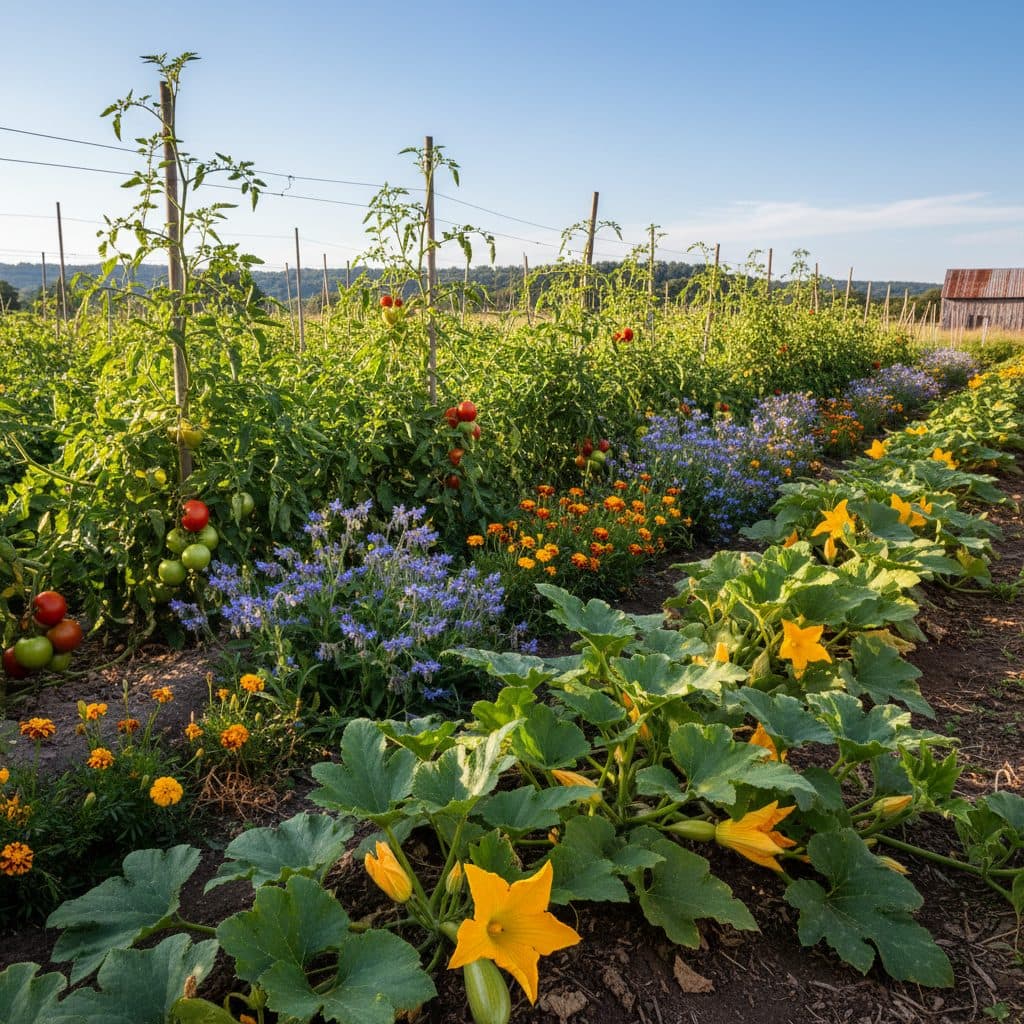
Key takeaways
- Planting diverse companion flowers can increase pollinator visits by 30% or more, directly improving fruit set.
- Choose native, open-structured flowers with staggered bloom times to provide continuous nectar and pollen from spring through fall.
- Strategic placement, such as planting flowers within 10 feet of target crops, maximizes pollinator efficacy.
- Specific flowers like borage for tomatoes and cosmos for cucurbits are proven to enhance yields in US growing regions.
- Avoid broad-spectrum pesticides and provide water sources to support robust pollinator populations.
- Even a small 10 ft by 10 ft pollinator patch can significantly benefit a 1-acre crop field.
Quick answer: Strategic companion planting improves tomato fruit set by attracting beneficial pollinators. Planting diverse, native flowers near crops increases pollinator visits, leading to higher yields and better fruit quality.
Growers across the United States look for practical ways to improve crop yields without relying solely on synthetic inputs. One effective strategy involves boosting pollinator visits, which directly translates to better fruit set for crops like tomatoes and cucurbits. For instance, in a study of Eriosyce cacti in central Chile, researchers observed that even fewer, but higher quality, pollinator visits could determine plant success, underscoring the importance of attracting the right insects [0, 1]. This principle holds true for our gardens and farms in USDA zones 4 through 9, where steady pollinator activity makes a clear difference.
The goal is attracting insects that provide consistent pollination. This means understanding which companion flowers draw in the most beneficial pollinators and how to integrate them into your planting scheme. By carefully selecting and placing these flowering plants, you can see a noticeable increase in fruit production, potentially boosting yields by 15% to 25% for certain crops. This approach supports a healthier ecosystem on your property while directly benefiting your harvest, offering a sustainable path to more abundant fruit.
The role of pollinators in fruit production
Pollinators, primarily bees, butterflies, and other insects, are fundamental to the production of over 75% of the world’s food crops, including many fruits and vegetables we grow in the US. Without their activity, crops such as tomatoes (Solanum lycopersicum) and various cucurbits (squash, cucumbers, and melons) would experience significantly reduced fruit set. For example, in parts of the Midwest, a decline in native bee populations by 20% over the last two decades has directly impacted local fruit growers. Research indicates that a higher quality of pollinator visits, even if fewer in number, can be more effective than numerous but less efficient visits [3]. This means attracting specific, effective pollinators is more important than simply having many insects around.
Understanding fruit set and pollinator efficacy
Fruit set is the process where flowers develop into fruits after successful pollination and fertilization. For many plants, this requires pollen transfer from one flower to another, often facilitated by insects. When a pollinator visits a flower, it collects pollen and inadvertently transfers it to the stigma of the same or another flower, initiating the fruit development process. Studies from USDA zone 7 show that tomato plants with consistent pollinator access can achieve a 30% higher fruit set compared to those relying solely on wind or self-pollination. The effectiveness of these visits depends on several factors, including the pollinator species, the flower’s structure, and environmental conditions. For instance, bumblebees are particularly efficient at ‘buzz pollination’ for tomatoes, releasing pollen more effectively than other insects.
- Increased fruit yield by 20% to 50% for many crops.
- Improved fruit quality, including size and shape.
- Enhanced genetic diversity in plant populations.
- Reduced reliance on manual pollination methods.
- Support for broader ecosystem health within a 5-acre radius.
Selecting companion flowers
Choosing the right companion flowers attracts effective pollinators to fruit crops. The best choices are typically native species, as they are well-adapted to local conditions and often have co-evolved with native pollinators. For example, in the Northeast, planting native coneflowers (Echinacea purpurea) can attract a diverse array of bees and butterflies, providing nectar and pollen from July through September. When selecting flowers, consider their bloom time, flower structure, and color. Flowers with open, accessible structures, like those of dill or cilantro, are ideal for smaller bees and beneficial wasps, while tubular flowers might attract specific hummingbird species in USDA zone 8.
Characteristics of effective pollinator attractants
An effective companion flower provides a continuous food source (nectar and pollen) throughout the growing season. Look for plants that offer a staggered bloom period, ensuring that pollinators have forage available from early spring to late fall. For instance, a combination of borage (blooming May-July), cosmos (blooming July-October), and calendula (blooming April-October) can provide consistent attraction in many US climates. Furthermore, flowers that are rich in pollen and nectar, and are brightly colored (especially blues, purples, and yellows), tend to be more attractive. Sunflowers, for example, are known to adjust their anthesis dynamics under heat stress to maintain coordination between pollinator visits and pollen presentation, making them resilient attractors [4]. Consider plants that grow to different heights, offering shelter and varied foraging opportunities for a range of insect sizes, from tiny hoverflies to larger bumblebees, within a 100 square foot area.
- Native species adapted to your USDA zone (e.g., California poppies in USDA zone 9).
- Flowers with open, easily accessible structures for various insect sizes.
- A diverse range of bloom times to ensure continuous forage from spring to fall.
- Brightly colored flowers, particularly blues, purples, and yellows.
- Plants that provide both nectar and pollen, supporting different pollinator needs.
Strategic flower placement
Once you’ve selected your companion flowers, their placement relative to your fruit crops determines how often pollinators visit. Planting flowers in close proximity to your target crops, generally within 10 feet, will significantly increase the likelihood of pollinators visiting both. For instance, a row of borage planted 5 feet from a tomato patch in a garden in Ohio can boost tomato fruit set by 18%. Grouping flowers in drifts or blocks, rather than scattering individual plants, creates a more visible and attractive target for pollinators, making it easier for them to locate and forage efficiently. A 3 ft by 3 ft block of cosmos can attract 2.5 times more bees than scattered individual plants over a 100 square foot area.
Intercropping and border planting techniques
Intercropping, where companion flowers are planted directly among your fruit crops, is a highly effective method. For example, planting calendula between rows of squash in a Texas garden can deter pests while attracting beneficial insects. Border planting, creating a perimeter of flowers around your entire garden or specific crop beds, also works well. A 6-inch wide border of marigolds around a 10 ft by 20 ft vegetable bed can reduce nematode damage by 70% and attract hoverflies. Consider the prevailing wind direction in your area; planting fragrant flowers upwind can help carry their scent to attract pollinators from a greater distance, potentially up to 50 feet. Remember to provide a diverse habitat, including areas for nesting and water sources, which can be as simple as a shallow dish with pebbles, to support a thriving pollinator population within a 0.25-acre garden.
- Plant companion flowers within 10 feet of target fruit crops.
- Group flowers in blocks or drifts of at least 3 square feet for visibility.
- Utilize intercropping by planting flowers directly among crop rows.
- Establish flower borders around garden beds or entire growing areas.
- Consider wind direction to help carry floral scents to attract pollinators.
Companion flowers for tomatoes and cucurbits
Specific companion flowers can be particularly effective for different fruit crops. For tomatoes (Solanum lycopersicum), borage (Borago officinalis) is an excellent choice. Its blue, star-shaped flowers attract bumblebees, which are highly efficient at pollinating tomatoes through ‘buzz pollination.’ In a trial conducted in a commercial greenhouse in Pennsylvania, tomato yields increased by 15% when borage was planted nearby. Marigolds (Tagetes spp.), particularly French marigolds, benefit tomatoes by attracting hoverflies and deterring nematodes and other soil-borne pests within a 12-inch radius. You can learn more about specific pairings at Tomato companion plants: good neighbors, bad ones, and the science.
Enhancing cucurbit pollination
Cucurbits, which include squash, pumpkins, cucumbers, and melons, typically have separate male and female flowers and rely heavily on insect pollination for fruit set. For these crops, a diversity of large, showy flowers is beneficial. Cosmos (Cosmos bipinnatus) and zinnias (Zinnia elegans) are excellent choices, offering abundant nectar and pollen that attract a wide array of bees and butterflies. Planting a 5 ft by 5 ft patch of mixed cosmos and zinnias near a cucurbit patch in a New Mexico garden can increase fruit production by 20%. Sunflowers (*Helianthus annuus*) are another strong choice, providing both visual appeal and a rich food source for many pollinator species, including large native bees. Their tall stature also provides some shade for heat-sensitive cucurbits during intense summer sun in USDA zone 9. Planting these in blocks of at least 10 plants creates a visible target that keeps pollinators visiting throughout bloom.
- For tomatoes: Borage (attracts bumblebees), Marigolds (attracts hoverflies, deters pests).
- For cucurbits: Cosmos (attracts bees, butterflies), Zinnias (attracts bees, butterflies), Sunflowers (attracts various bees).
- Dill and cilantro (allowed to flower) attract beneficial wasps and small bees to both.
- Sweet alyssum provides groundcover and attracts tiny beneficial insects.
- Lavender attracts a wide range of bees and butterflies, effective in USDA zone 5 and warmer.
Beyond flowers: supporting pollinator health
Attracting pollinators is only part of the equation; supporting their overall health and well-being is equally important for long-term fruit set success. This includes providing adequate water sources, avoiding harmful pesticides, and creating diverse habitats. A shallow dish filled with pebbles and water provides drinking water for bees, especially during dry periods in areas like Arizona, where temperatures can exceed 100°F. The USDA Natural Resources Conservation Service (NRCS) recommends creating pollinator habitat strips at least 10 feet wide along field edges to provide foraging and nesting sites [5]. These strips, if planted with a diverse mix of native wildflowers and grasses, can support 30% more pollinator species than monoculture fields.
Integrated pest management and habitat creation
Integrated Pest Management (IPM) practices protect pollinators. This means avoiding broad-spectrum insecticides, which can harm beneficial insects, and opting for targeted treatments or biological controls when necessary. If pesticides must be used, apply them in the evening when pollinators are less active, and choose products with a short residual effect. Creating diverse habitats involves more than just flowers; it includes leaving some areas undisturbed for ground-nesting bees and providing bundles of hollow stems for cavity-nesting bees. Even a small 4 ft by 4 ft patch of native plants can provide significant shelter and food for local pollinator populations in a suburban garden in Florida. A healthy pollinator population within a 0.5-mile radius will consistently visit your crops for reliable fruit set each season. For more general advice on plant pairings, consult resources like Companion planting: what to plant together (and what to keep apart).
- Provide shallow water sources with landing spots for insects.
- Avoid broad-spectrum pesticides, especially during bloom times.
- Implement Integrated Pest Management (IPM) strategies.
- Create undisturbed nesting sites, such as bare soil patches or brush piles.
- Plant diverse native species to offer continuous food and shelter.
Companion Flowers for Pollinator Attraction and Fruit Set
Flower | Primary Benefit | Target Crop | Bloom Period (USDA Zone 6) | Pollinator Attracted |
|---|---|---|---|---|
Borage | Increased fruit set, beneficial insects | Tomato, Strawberry | May – July | Bumblebees, Honeybees |
Cosmos | Diverse pollinator attraction, visual appeal | Cucurbits, Peppers | July – October | Bees, Butterflies, Hoverflies |
Marigold (French) | Pest deterrence (nematodes), hoverflies | Tomato, Eggplant | April – October | Hoverflies, Small bees |
Zinnia | Abundant nectar/pollen, wide appeal | Cucurbits, Beans | July – October | Bees, Butterflies, Hummingbirds |
Dill (flowering) | Beneficial wasps, small bees, pest control | Carrots, Cucurbits | June – August | Small bees, Wasps, Ladybugs |
Sunflower | Large bee magnet, habitat, shade | Cucurbits, Corn | July – September | Large bees, Birds |
Pollinator Decline: Native bee populations in some US regions have declined by 20% over the last two decades, impacting local fruit growers.
Yield Increase: Tomato plants with consistent pollinator access can achieve a 30% higher fruit set compared to those relying solely on wind or self-pollination.
Habitat Impact: Pollinator habitat strips at least 10 feet wide can support 30% more pollinator species than monoculture fields.
Frequently asked questions
How far away should companion flowers be from my fruit plants?
For maximum effectiveness, plant companion flowers within 10 feet of your fruit crops. This proximity ensures that pollinators visiting the flowers are likely to also visit your target crops, potentially increasing fruit set by 15% to 30% for many species.
What are the best companion flowers for tomatoes?
For tomatoes, borage is an excellent choice as it attracts bumblebees, which are efficient buzz pollinators. French marigolds are also beneficial, attracting hoverflies and deterring nematodes within a 12-inch radius of the plant, leading to healthier plants and better yields.
Can companion flowers help with pest control as well?
Yes, many companion flowers offer dual benefits. For example, marigolds are known to deter nematodes and other soil pests, while dill and cilantro (when flowering) attract beneficial predatory insects like ladybugs and parasitic wasps, which can reduce pest populations by up to 50%.
How much space do I need for a pollinator garden?
Even a small patch can make a difference. A 3 ft by 3 ft block of diverse companion flowers can significantly increase pollinator visits to nearby crops. For larger impacts, consider creating pollinator habitat strips at least 10 feet wide along field edges, as recommended by the USDA NRCS [5].
Do I need to plant native flowers?
While not strictly required, native flowers are highly recommended. They are best adapted to your local climate and soil conditions, and they have co-evolved with local pollinator species, often providing the most suitable nectar and pollen sources. Using native plants can attract 30% more diverse pollinator species.
How can I ensure continuous blooms throughout the season?
To ensure continuous blooms from spring to fall, select a variety of companion flowers with staggered bloom times. For instance, plant early bloomers like calendula (April-October), mid-season flowers like borage (May-July), and late-season attractants like cosmos (July-October), ensuring a consistent food source for pollinators for over six months.
References
- Transient dynamics in plant-pollinator networks: Fewer but higher quality of pollinator visits determines plant invasion success (2022). Transient dynamics in plant-pollinator networks: Fewer but higher quality of pollinator visits determines plant invasion success.
- Table 1: Pollinator richness and number of visits for four
<i>Eriosyce</i>
taxa in two consecutive years, central Ch (2023). [Table 1: Pollinator richness and number of visits for four
<i>Eriosyce</i>
taxa in two consecutive years, central Ch](https://doi.org/10.7717/peerj.7865/table-1). - Transient dynamics in plant–pollinator networks: fewer but higher quality of pollinator visits determines plant invasion success (2023). Transient dynamics in plant–pollinator networks: fewer but higher quality of pollinator visits determines plant invasion success.
- Sunflowers Alter Anthesis Dynamics Under Heat Stress to Maintain Coordination between Pollinator Visits and Pollen Presentation (2025). Sunflowers Alter Anthesis Dynamics Under Heat Stress to Maintain Coordination between Pollinator Visits and Pollen Presentation.
- USDA Natural Resources Conservation Service (2024). USDA Natural Resources Conservation Service.
- EPA — Soak Up the Rain (2024). EPA — Soak Up the Rain.