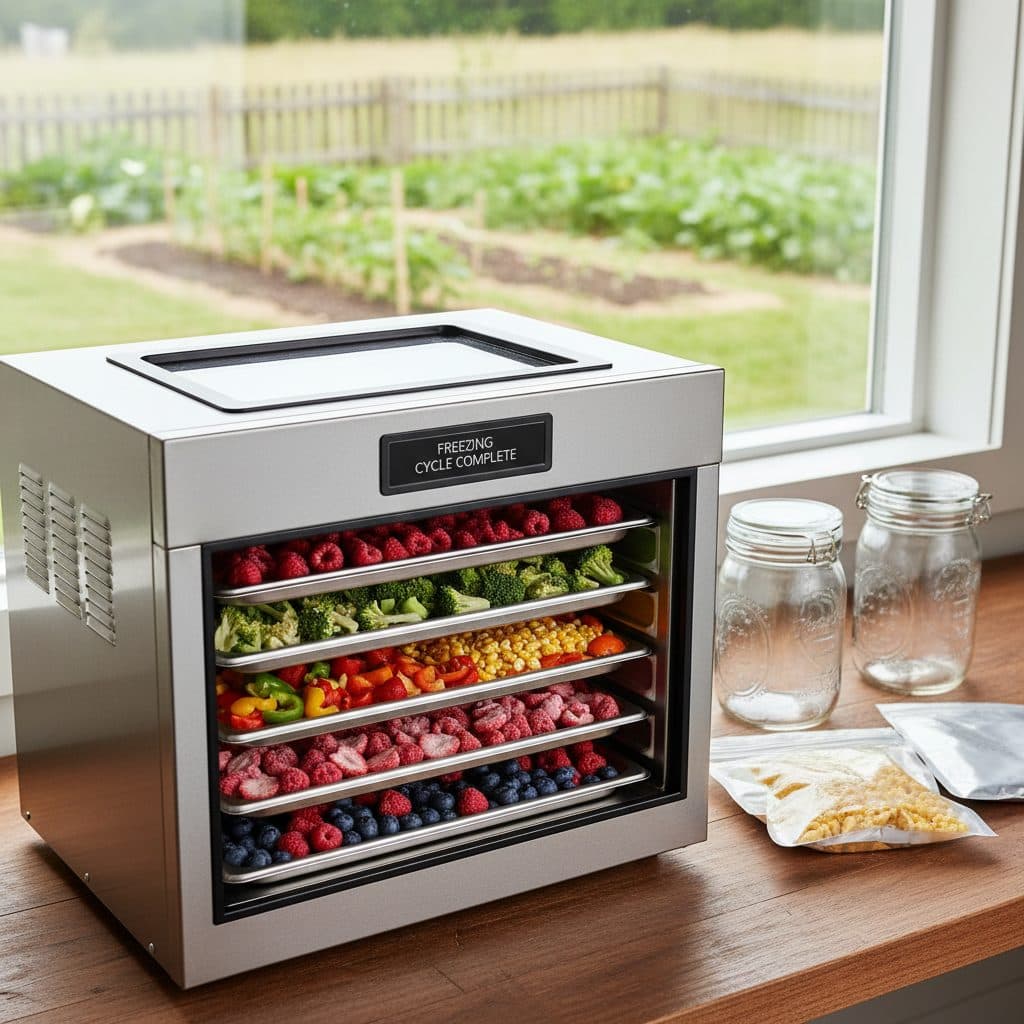
Key takeaways
- Freeze drying removes 98 to 99 percent of water content through sublimation under deep vacuum, preserving food shape, color, and nutritional value.
- Stored in 7-mil Mylar bags with proper oxygen absorbers in a cool space, well-dried food retains quality for years (manufacturers claim up to 25 years).
- Unlike dehydrators that use continuous heat, freeze dryers preserve heat-sensitive vitamins while allowing instant rehydration.
- Pre-freezing food solid in a home freezer before loading shortens the machine's freeze stage and can meaningfully cut total cycle time.
- High-fat meats and oily foods freeze-dry poorly and can turn rancid in storage; prioritize lean meats, fruits, vegetables, and cooked dishes.
Quick answer: Freeze drying (lyophilization) is a food preservation method that freezes food solid and then lowers ambient chamber pressure using a vacuum pump, causing frozen ice crystals to vaporize directly into water vapor (sublimation) without melting into liquid water. Home freeze dryers preserve fruits, vegetables, pasteurised dairy, and complete cooked meals for extended shelf life; because the food is never heated above a low tray temperature, heat-sensitive vitamins survive better than in hot-air drying.
Homesteaders and food gardeners often produce large seasonal gluts of fruits, vegetables, and meats that exceed immediate fresh consumption. While water-bath canning, pressure canning, and dehydrating have preserved food for generations, each method alters texture, degrades heat-sensitive vitamins, and carries specific storage limitations.
Home freeze dryers represent a significant advancement in home food preservation. By operating under deep vacuum at sub-zero temperatures, freeze drying preserves cellular structure, prevents shrinkage, and creates a lightweight, shelf-stable product that rehydrates in minutes with boiling water.
Understanding how sublimation functions, preparing food properly, managing oil vacuum pumps, and sealing batches in moisture-proof packaging ensures your home pantry remains stocked with nutritious meals for decades.
[!WARNING]Freeze drying is not a kill step. Freeze drying preserves microorganisms rather than killing them. Food must be safe when it goes in (use pasteurised dairy, fully cooked meat and eggs where the recipe allows) and rehydrated food is perishable: refrigerate it and cook it as you would the fresh original.
How freeze drying works: the physics of sublimation
Freeze drying differs fundamentally from conventional hot-air dehydration. In dehydrators, warm air circulates around food, evaporating water from the outside inward. This heat exposure shrinks cellular structures, darkens sugars, and forms a tough outer skin that can make rehydration slow.
+------------------------+-----------------------------------+-----------------------------------+
| Parameter              | Home Freeze Drying                | Traditional Dehydrating           |
+------------------------+-----------------------------------+-----------------------------------+
| Moisture Removed       | 98% to 99% of total moisture      | 85% to 90% of moisture            |
| Process Mechanism      | Sublimation (Ice to vapor directly)| Evaporation (Heat turns liquid gas)|
| Storage Shelf Life     | Long-term (mfrs claim up to 25 yr)| 1 to 2 years                      |
| Nutrient Retention     | High (low heat preserves vitamins)| Moderate (heat degrades vitamins) |
| Structural Shrinkage   | None (retains original size/shape)| Significant shrinkage and hardening|
| Rehydration Speed      | 2 to 5 minutes with hot water     | 30 to 60 minutes of simmering     |
+------------------------+-----------------------------------+-----------------------------------+
The three operational phases
- Freezing Phase: The chamber cools food to between -30°F and -40°F (-34°C to -40°C), freezing all internal moisture into solid ice crystals.
- Primary Drying (Sublimation): The vacuum pump pulls chamber pressure down below 500 mTorr. Controlled heating elements beneath each tray warm the food slightly, causing frozen water molecules to vaporize directly into gas without melting into liquid. The vapor condenses and freezes onto cold chamber walls.
- Secondary Drying (Desorption): The chamber temperature rises slightly to drive off any remaining bound water molecules from the food matrix.
+-------------------------------------------------------------------+
|                 FREEZE DRYING PROCESS CYCLE                       |
+-------------------------------------------------------------------+
| 1. Pre-Freeze Food (-10°F to -40°F)  --> Solidifies ice crystals  |
| 2. Pull Deep Vacuum (< 500 mTorr)    --> Lowers boiling point     |
| 3. Controlled Tray Heat (Sublimation)--> Ice vaporizes to gas     |
| 4. Ice Collects on Chamber Walls     --> Traps moisture as ice    |
|5. Final Dry Cycle (Desorption)      --> Removes residual bound H2O|
+-------------------------------------------------------------------+
During this entire cycle, the vacuum prevents liquid water from existing. As ice converts directly to water vapour, the food structure remains open and porous, creating micro-channels that allow instant rehydration when water is reintroduced.
Best and worst foods for home freeze drying
While most garden produce and kitchen leftovers freeze-dry exceptionally well, high-fat and high-sugar foods require special handling or should be avoided.
+------------------------+-----------------------------------+-----------------------------------+
| Category               | Ideal Foods to Freeze Dry         | Foods to Avoid or Limit           |
+------------------------+-----------------------------------+-----------------------------------+
| Fruits                 | Berries, apples, peaches, bananas | Jams with excessive sugar syrup   |
| Vegetables             | Sweet corn, peas, green beans, kale| Unblanched dense root vegetables  |
| Meats & Protein        | Cooked shredded beef, chicken, ham| Fatty bacon, high-fat sausages    |
| Dairy                  | Pasteurised milk, yogurt, cheese  | Pure butter, high-fat cream       |
| Complete Meals         | Chili, stew, lasagna, rice dishes | Oily dressings, pure peanut butter|
+------------------------+-----------------------------------+-----------------------------------+
Fats and oils do not contain water and cannot be sublimated. High fat content coats food particles, trapping moisture underneath and causing fats to turn rancid within months of storage. Always trim visible fat from meats before freeze drying, and blot cooked meats with paper towels to remove surface oil.
Raw eggs can be whisked and freeze-dried into a powder, but that powder is unpasteurised — freeze drying does not kill Salmonella. Rehydrated raw-egg powder must be cooked through, exactly like a raw egg; never use it in frosting, mousse, raw dough, eggnog or smoothies. Freeze-drying cooked scrambled egg avoids the issue.
Step-by-step food preparation and processing
Following proper preparation protocols ensures even drying and prevents uncompleted cycles.
1. Uniform slicing and blanching
Slice fruits and vegetables to a uniform thickness of 1/4 to 1/2 inch (6 mm to 12 mm). Blanch vegetables in boiling water before cooling to deactivate enzymes that cause flavor loss and discoloration during storage (broccoli florets 3 minutes; cut sweet corn 4 minutes; sliced/diced carrots 2 minutes; small whole carrots 5 minutes).
2. Pre-freezing trays
Always spread prepared food onto trays and place them in your home deep freezer for 12 to 24 hours before loading them into the freeze dryer. Pre-freezing significantly reduces machine cycle time, saving electricity and reducing vacuum pump wear.
3. Testing for dryness
When the machine signals cycle completion, open the chamber and inspect the thickest pieces. Break a large piece in half: the center must feel dry and warm to the touch. If the center feels cold or cool, residual moisture remains; close the door and run two hours of additional dry time.
4. Vacuum pump maintenance
Regular maintenance of the vacuum pump is essential for machine longevity. Standard rotary vane pumps require frequent oil maintenance — follow the manufacturer's interval, typically filtering or changing the oil after each batch or every few batches to remove moisture and contaminants. Clean, clear oil ensures the pump can pull down to deep vacuum levels reliably. Oil-less scroll pumps eliminate oil maintenance but carry higher initial equipment costs.
Packaging and long-term storage
Freeze-dried food is intensely hygroscopic, meaning it absorbs moisture from ambient room air within minutes. Package food immediately upon cycle completion.
+-------------------------------------------------------------------+
|               LONG-TERM PACKAGING BEST PRACTICES                  |
+-------------------------------------------------------------------+
| Containers:       7-mil Heavy Mylar Foil Pouches or Mason Jars    |
| Oxygen Absorbers: 300cc for Quart Bags | 500cc for Gallon Bags    |
| Sealing Method:   Impulse Heat Sealer (10 mm wide seal bar)       |
| Storage Climate:  Cool, dark, dry room (50°F to 65°F / 10°-18°C)  |
+-------------------------------------------------------------------+
Drop an oxygen absorber packet into each Mylar bag immediately before sealing. The absorber consumes residual oxygen inside the pouch within 24 hours, preventing oxidation and preserving food quality for up to 25 years. Store sealed Mylar pouches inside heavy plastic storage totes or metal drums to protect against rodent chewing. Mason jars fitted with oxygen absorbers work well for foods intended for consumption within one to two years.
To complement your pantry preservation library, compare freeze drying with traditional methods in water bath canning, avoid common processing errors with safe canning beginner mistakes, and explore no-electricity root cellar techniques in root cellaring no power storage and preserving garden glut crop playbooks.