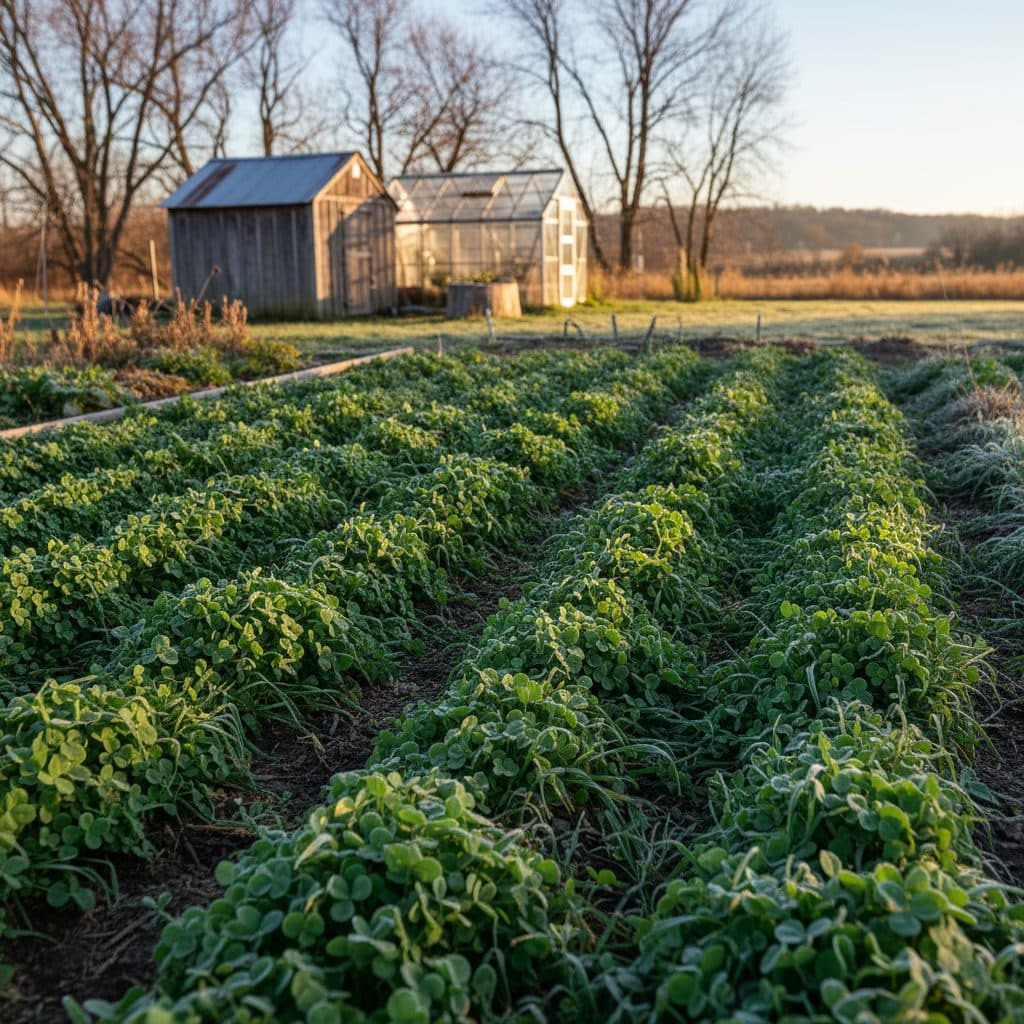
Key takeaways
- Cover crops significantly improve soil health by adding organic matter and fixing atmospheric nitrogen.
- Leguminous cover crops, like crimson clover or hairy vetch, can fix between 50 and 200 pounds of nitrogen per acre.
- Biomass builders, such as cereal rye or oats, contribute substantial organic matter, improving soil structure and water retention.
- Selecting the right cover crop depends on your USDA zone, planting goals, and the timing of your main crop.
- Integrating cover crops can reduce the need for synthetic fertilizers and help lower pesticide residues in soil.
- Proper termination methods, whether mowing, crimping, or tilling, matter for maximizing cover crop benefits.
Quick answer: Cover crops enhance soil health by adding organic matter, fixing atmospheric nitrogen, and improving water retention. This leads to increased microbial activity, reduced erosion, and ultimately, higher crop yields in gardens.
In the humid climate of the US Southeast, where summer rains can leach nutrients from garden beds, or in the arid West, where soil organic matter is often below 1%, gardeners face distinct challenges. For decades, growers across the country have turned to cover crops to address these issues, transforming bare soil into a living, working ecosystem. These plants act as active soil amendments, improving soil structure, suppressing weeds, and cycling nutrients. For instance, a well-managed cover crop system can increase soil organic matter by 0.1-0.2% annually, leading to measurable improvements in water infiltration and nutrient availability.
Cover crop choice can make a real difference in the crop that follows, though the size of the effect depends heavily on soil, season, and species. Cover crops also build a resilient soil system that supports healthier plants and reduces the need for external inputs. Cover crop adoption has grown among both commercial farmers and home gardeners in recent years.
The living soil: more than just dirt
When we talk about soil, many gardeners still picture a static medium for roots. But healthy garden soil is a dynamic, living system, teeming with billions of microorganisms per teaspoon. These microbes, along with earthworms and other soil fauna, are essential for nutrient cycling, disease suppression, and building stable soil aggregates. Cover crops play a critical role in feeding this underground workforce, providing a continuous supply of organic matter both above and below ground. For example, a dense stand of cereal rye can produce up to 8,000 pounds of dry biomass per acre, with a significant portion of that in its root system, which can extend 3-6 feet deep. This root mass helps to break up compacted layers, improving aeration and water penetration by up to 15% in heavy clay soils.
feeding the soil food web
The continuous presence of living roots from cover crops helps to maintain a stable soil temperature and moisture level, which is particularly beneficial in fluctuating climates like those found in USDA zone 5. This stable environment encourages beneficial microbial activity, leading to better decomposition of organic residues and increased nutrient availability for your cash crops. Research suggests that soils under continuous cover cropping can see a 10-20% increase in microbial biomass compared to bare fallow ground [4]. Research also indicates that living cover crops can help reduce pesticide residues in agricultural soil [1].
- Increased soil organic matter by 0.1-0.2% annually.
- Improved water infiltration rates.
- Enhanced nutrient cycling due to microbial activity.
- Reduced soil erosion by up to 90% in susceptible areas.
- Suppression of weed growth by a dense, light-blocking canopy.
Nitrogen fixers: feeding your plants naturally
One of the most compelling reasons to plant cover crops is their ability to fix atmospheric nitrogen, a process primarily carried out by legumes. These plants form a symbiotic relationship with specific bacteria in their root nodules, converting inert nitrogen gas from the air into a form usable by plants. This natural nitrogen source can significantly reduce or even eliminate the need for synthetic nitrogen fertilizers in your garden, saving you money and reducing environmental impact. For example, a good stand of crimson clover (Trifolium incarnatum) in USDA zone 7 can fix 80-150 pounds of nitrogen per acre, while hairy vetch (Vicia villosa) in zones 4-8 can fix 100-200 pounds per acre. That works out to roughly 0.2 to 0.5 pounds of nitrogen per 100 square feet.
choosing the right legume for your region
The effectiveness of nitrogen fixation varies by species, soil conditions, and climate. In cooler climates, like USDA zone 3 or 4, winter peas (Pisum sativum) or hairy vetch are excellent choices for fall planting, providing a substantial nitrogen boost by spring. For warmer regions, such as USDA zone 8 or 9, sunn hemp (Crotalaria juncea) can fix 100-150 pounds of nitrogen per acre in a short growing season. It’s important to inoculate legume seeds with the correct rhizobium bacteria for optimal nitrogen fixation, especially if you haven’t grown that particular legume in your soil before. You can learn more about specific cold-hardy options at Cold-Hardy Nitrogen Fixers for Zones 2-6.
- Crimson clover: fixes 80-150 lbs N/acre in zones 6-9.
- Hairy vetch: fixes 100-200 lbs N/acre in zones 4-8.
- Austrian winter pea: fixes 50-100 lbs N/acre in zones 3-7.
- Cowpea: fixes 70-120 lbs N/acre in zones 8-11.
- Alfalfa: fixes 150-250 lbs N/acre, perennial in zones 3-9.
Biomass builders: organic matter and weed suppression
Beyond nitrogen fixation, many cover crops excel at producing large amounts of organic matter, both above and below the soil surface. These biomass builders, often grasses or brassicas, improve soil structure, increase water holding capacity, and suppress weeds. Cereal rye (Secale cereale) is a prime example, capable of producing 6,000-10,000 pounds of dry matter per acre, even in marginal soils and cooler climates like USDA zone 4. Its extensive fibrous root system helps to scavenge residual nutrients, preventing them from leaching out of the soil profile, and can increase soil organic carbon by 0.05-0.1% annually. This added organic matter acts like a sponge, allowing the soil to hold 10-20% more water.
managing biomass for maximum benefit
The dense canopy created by biomass builders also provides excellent weed suppression. A thick stand of oats (Avena sativa) or buckwheat (Fagopyrum esculentum) can outcompete most annual weeds, reducing weed pressure sharply and minimizing the need for herbicides. When these cover crops are terminated and incorporated into the soil, they release nutrients slowly as they decompose, feeding your subsequent cash crops over several weeks. For instance, a cereal rye cover crop with a carbon-to-nitrogen ratio of 30:1 will decompose more slowly than a legume with a 15:1 ratio, providing a sustained release of nutrients. Proper termination timing is key to ensure the biomass breaks down effectively without tying up nitrogen needed by your next crop. You can find more specific guidance on termination in our article, Cover crops for the home garden: best species, timing, and termination.
- Cereal rye: produces 6,000-10,000 lbs dry matter/acre, zones 3-8.
- Oats: produces 3,000-6,000 lbs dry matter/acre, zones 3-7.
- Buckwheat: produces 2,000-4,000 lbs dry matter/acre, quick-growing in zones 3-10.
- Mustard: produces 2,000-5,000 lbs dry matter/acre, zones 4-9, also biofumigant.
- Sudangrass: produces 8,000-12,000 lbs dry matter/acre, warm season in zones 6-10.
Regional considerations: what to plant where
The effectiveness of a cover crop is heavily influenced by regional climate, soil type, and the timing of your primary cash crops. What thrives in the cool, moist conditions of the Pacific Northwest (USDA zone 8) might struggle in the hot, humid summers of the Gulf Coast (USDA zone 9). For example, in the upper Midwest (USDA zones 4-5), a common strategy is to plant a winter-hardy mix of cereal rye and hairy vetch in late summer or early fall. This combination provides both substantial biomass and nitrogen fixation, which can be terminated in spring before planting corn or soybeans, potentially reducing nitrogen fertilizer needs by 50-80 pounds per acre [5].
tailoring cover crop mixes to your climate
In the Mid-Atlantic region (USDA zones 6-7), crimson clover and oats are popular choices for fall planting, offering good winter hardiness and early spring growth. For gardeners in the arid Southwest (USDA zones 8-10), where water conservation is paramount, drought-tolerant options like cowpeas or sunn hemp can be planted in the summer, providing quick biomass and nitrogen fixation. These warm-season legumes can grow to 5-7 feet tall in just 60-90 days, adding significant organic matter to sandy soils. Always consider your local growing season length and typical frost dates when selecting cover crop species to ensure they have enough time to establish and provide their intended benefits. A soil moisture meter can be a valuable tool in these dry regions to monitor soil conditions before and after planting cover crops, helping ensure successful establishment. See our Soil Moisture Meter for more information.
- Northeast (zones 3-6): Hairy vetch, winter rye, red clover.
- Southeast (zones 7-9): Crimson clover, sunn hemp, cowpea, oats.
- Midwest (zones 4-6): Cereal rye, hairy vetch, annual ryegrass, oats.
- Pacific Northwest (zones 7-9): Crimson clover, fava beans, cereal rye.
- Southwest (zones 8-10): Cowpea, sunn hemp, buckwheat, barley.
Comparison of Common Cover Crop Types
Feature | Legumes (e.g., Clover, Vetch) | Grasses (e.g., Rye, Oats) | Brassicas (e.g., Mustard, Radish) |
|---|---|---|---|
Primary Benefit | Nitrogen fixation, moderate biomass | High biomass, nutrient scavenging | Soil penetration, biofumigation |
Nitrogen Contribution | 50-200 lbs/acre | Minimal (scavenges existing N) | Minimal (scavenges existing N) |
Biomass Production | 2,000-6,000 lbs/acre | 6,000-12,000 lbs/acre | 2,000-5,000 lbs/acre |
Root System | Taproot or shallow fibrous | Extensive fibrous | Deep taproot |
Weed Suppression | Moderate | Excellent | Good |
C:N Ratio (typical) | 15:1 to 25:1 | 30:1 to 80:1 | 20:1 to 30:1 |
Nitrogen Boost: Leguminous cover crops can contribute 50 to 200 pounds of nitrogen per acre, reducing synthetic fertilizer needs by up to 80%.
Organic Matter: Biomass-building cover crops like cereal rye can add 6,000-10,000 pounds of dry matter per acre, gradually raising soil organic carbon.
Pesticide Reduction: Living cover crops can help lower pesticide residues in soil [1].
Frequently asked questions
What is the best time to plant cover crops in the US?
The best time to plant cover crops varies significantly by region and species. For most winter-hardy cover crops like cereal rye or hairy vetch, planting in late summer or early fall (August to October) is ideal in USDA zones 4-7, allowing them to establish before winter. Warm-season cover crops like sunn hemp or cowpeas are typically planted in late spring or early summer (May to July) in zones 8-10, growing quickly before cooler weather.
How do cover crops improve soil pH?
While cover crops don’t directly alter soil pH in a rapid or dramatic way, they contribute to a more stable soil environment. The decomposition of organic matter from cover crops releases organic acids, which can help buffer soil pH, making it more resistant to drastic changes. Over several seasons, this can contribute to maintaining a more neutral pH range, typically between 6.0 and 7.0, which is optimal for most garden vegetables.
Can cover crops really reduce my need for fertilizer?
Yes, absolutely. Leguminous cover crops are particularly effective at reducing the need for synthetic nitrogen fertilizers. Species like hairy vetch can fix 100-200 pounds of nitrogen per acre, making a significant portion of that available to your subsequent crops. This can lead to a 50-80% reduction in applied nitrogen, depending on your soil’s initial fertility and crop needs.
What is the carbon-to-nitrogen ratio, and why does it matter for cover crops?
The carbon-to-nitrogen (C:N) ratio describes the proportion of carbon to nitrogen in organic materials. It’s crucial for cover crops because it dictates their decomposition rate and nutrient release. High C:N ratios (e.g., 30:1 or higher, like mature cereal rye) decompose slowly, tying up nitrogen temporarily. Low C:N ratios (e.g., 15:1 to 20:1, like young legumes) decompose quickly, releasing nitrogen rapidly for your next crop. Understanding this helps you time termination for optimal nutrient availability.
How do cover crops help with weed control?
Cover crops suppress weeds through several mechanisms. They create a dense canopy that shades out weed seedlings, physically outcompeting them for light, water, and nutrients. Some cover crops, like cereal rye, also release allelopathic compounds that inhibit weed seed germination and growth, reducing weed pressure substantially. This natural weed control can significantly reduce the need for manual weeding or herbicides, saving hours of labor in a 1,000 square foot garden.
References
- Living cover crops reduce pesticide residues in agricultural soil (2025). Living cover crops reduce pesticide residues in agricultural soil.
- Thoughts About Cover Crops (2020). Thoughts About Cover Crops.
- Impact of a living mulch cover crop on sugarbeet establishment, root yield and sucrose purity (2018). Impact of a living mulch cover crop on sugarbeet establishment, root yield and sucrose purity.
- Cover Crops and Soil Health (2018). Cover Crops and Soil Health.
- Cover Crops and Soil Health (2019). Cover Crops and Soil Health.
- USDA Natural Resources Conservation Service (2024). USDA Natural Resources Conservation Service.