Key takeaways
- Fresh manure can harm plants by burning roots and introducing pathogens, requiring proper composting or aging before garden use.
- Composting manure involves balancing carbon and nitrogen sources, maintaining moisture, and achieving thermophilic temperatures of 131-160°F to kill weed seeds and pathogens.
- Aging manure is a simpler, cooler process, suitable for smaller operations, but it takes longer and may not eliminate all pathogens or weed seeds.
- Regularly turning compost piles and monitoring moisture levels matters for effective decomposition and pathogen reduction.
- A finished composted manure product will be dark, crumbly, and have an earthy smell, with a C:N ratio closer to 20:1.
- Soil testing before applying manure compost helps determine appropriate application rates and nutrient needs for specific crops.
Quick answer: To safely use manure in gardens, especially in USDA Zone 6, it must be properly composted or aged to prevent plant burn and reduce pathogen risk. This process transforms raw manure into a stable, nutrient-rich soil amendment.
In many parts of the US, from the fertile Willamette Valley in Oregon to the humid farmlands of Georgia, incorporating organic matter into garden soil is a cornerstone of productive growing. For home gardeners, especially those in USDA zone 6, manure often presents itself as a readily available, nutrient-rich amendment. However, applying fresh manure directly to your vegetable beds can lead to significant problems, including nutrient burn and the spread of unwanted pathogens. A typical pile of fresh chicken manure, for instance, can have a nitrogen content as high as 4.5%, far too concentrated for direct application to most plants.
The solution lies in understanding the science and practice of composting or aging manure. By transforming raw manure into a stable, beneficial soil amendment, you protect your plants from harm and enrich your soil sustainably. This process reduces the risk of burning delicate roots and breaks down weed seeds, making your garden a healthier and more productive space for crops like Garden Pea or Garden Sage. Hot composting to 131°F or above also sharply reduces harmful bacteria like E. coli and Salmonella; passive aging does not reliably do either.
why fresh manure is a problem for your garden
Using fresh manure directly in your garden can cause several issues, mainly due to its high nitrogen content and potential for pathogens. For example, fresh chicken manure can contain up to 4.5% nitrogen and high levels of ammonia, which can severely burn plant roots and foliage, particularly in young seedlings or sensitive crops like lettuce. This ‘nitrogen burn’ is a common problem for gardeners in regions like the Midwest, where livestock operations are prevalent and fresh manure might be easily accessible. Fresh manure from animals like cattle, pigs, and poultry can also harbor human pathogens such as E. coli O157:H7 and Salmonella, which can contaminate edible crops if not properly managed [4].
the risks of direct application
Beyond chemical burn and pathogens, fresh manure can also introduce a significant number of weed seeds into your garden. A single cow can produce thousands of viable weed seeds in its manure annually, making weed control a constant battle if raw material is used. The decomposition process of fresh manure also consumes soil nitrogen, temporarily depriving plants of this essential nutrient as microbes work to break down the material. This nitrogen immobilization can lead to stunted growth and yellowing leaves, especially in heavy feeders like corn.
- High ammonia levels can cause nutrient burn in plant tissues.
- Presence of human pathogens like E. coli and Salmonella is a health risk.
- Introduction of viable weed seeds increases garden maintenance.
- Nitrogen immobilization can lead to temporary nutrient deficiencies for plants.
- Unpleasant odors can attract pests and flies to the garden area.
the science of hot composting manure
Hot composting, also known as thermophilic composting, is the most effective method for transforming raw manure into a safe and beneficial soil amendment. This process relies on a balanced carbon-to-nitrogen (C:N) ratio, adequate moisture, and proper aeration to encourage microbial activity. The ideal C:N ratio for composting manure is between 25:1 and 30:1, which can be achieved by mixing high-nitrogen manure with high-carbon materials like straw, wood chips, or dried leaves. For instance, cattle manure typically has a C:N ratio of 15:1 to 25:1, while straw can be 80:1, making them good partners [4].
achieving thermophilic temperatures
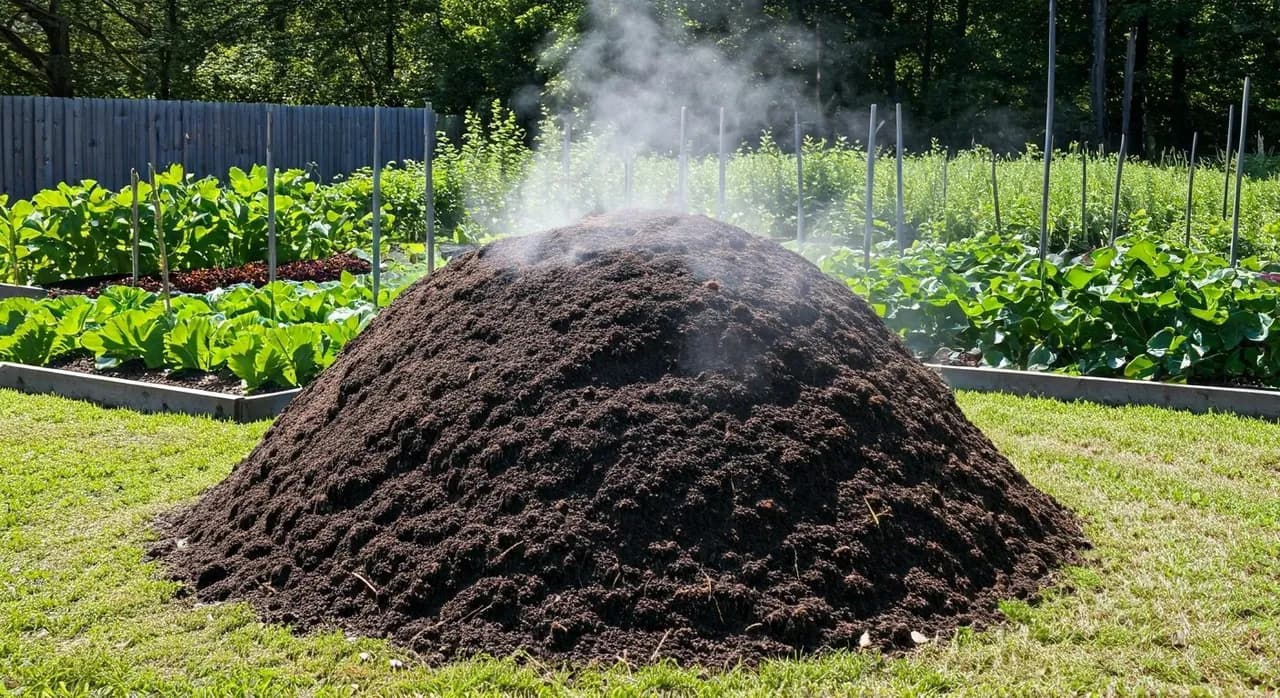
The key to hot composting is reaching and maintaining high temperatures, typically between 131°F and 160°F, for several days. These temperatures kill off most weed seeds, pathogens, and fly larvae. A compost pile of at least one cubic yard (3 ft x 3 ft x 3 ft) is often needed to generate and retain sufficient heat. Monitoring the temperature with a long-stemmed compost thermometer is essential; a gardener in Kansas might check their pile daily during the active phase. Turning the pile regularly, about once every three to five days, helps to aerate the material, redistribute moisture, and ensure all parts of the pile reach the necessary temperatures [1].
- Maintain a carbon-to-nitrogen ratio between 25:1 and 30:1 for optimal decomposition.
- Ensure moisture content is similar to a damp sponge, typically 40% to 60%.
- Turn the pile every three to five days to provide aeration and even heating.
- Achieve and sustain temperatures between 131°F and 160°F for pathogen elimination.
- Use a compost thermometer to monitor internal temperatures effectively.
practical composting methods for the home garden
For the home gardener, several practical methods exist for composting manure, each with its own advantages. The simplest approach involves building a freestanding pile, often at least 3 feet by 3 feet by 3 feet, to ensure sufficient mass for heating. This method is common in rural areas of states like Iowa, where space is not a limiting factor. Another popular option is using a three-bin system, which allows for continuous composting: one bin for fresh material, one for actively decomposing material, and one for finished compost. This system can process several cubic yards of material over a season.
passively aerated and vermicomposting options
For those seeking less labor-intensive methods, passively aerated composting can be effective. This involves incorporating perforated pipes or a central air shaft into the pile to draw in oxygen, reducing the need for frequent turning [5]. A gardener in a suburban setting might find this appealing, as it requires less physical effort. Alternatively, vermicomposting, using specific types of worms like red wigglers, is excellent for smaller batches of manure, particularly from rabbits or chickens, and can be done in a compact bin system [3]. This method typically operates at cooler temperatures, below 80°F, so it does not kill all pathogens or weed seeds, but it produces nutrient-rich worm castings in about two to three months. You can monitor the moisture in your vermicompost with a soil moisture meter to ensure optimal conditions for the worms.
- Freestanding piles are simple and effective for larger volumes, requiring regular turning.
- Three-bin systems allow for continuous processing and batch management.
- Passively aerated piles reduce turning frequency through built-in ventilation.
- Vermicomposting is ideal for small-scale manure processing, producing rich castings.
- Consider using cover crops in conjunction with composted manure to further improve soil health.
aging manure: a simpler, slower approach
While hot composting is efficient, aging manure offers a simpler, less labor-intensive alternative for gardeners, particularly those with smaller amounts of animal waste. Aging involves letting manure sit in a pile for an extended period, typically six months to one year, without actively managing the temperature or turning. This process allows natural decomposition to occur, reducing the nitrogen content and making the manure safer for plants. For instance, a gardener in rural Vermont might simply pile their horse manure in a corner of their property and let it sit through the winter and spring, allowing rainfall and natural microbial activity to break it down. After six months, the ammonia smell will have largely dissipated, and the material will be darker.
when aging is appropriate
Aged manure is generally safe for garden use, but it’s important to understand its limitations. Unlike hot composting, aging does not reliably reach thermophilic temperatures, meaning it may not kill all weed seeds or pathogens. If you’re growing root crops like carrots or potatoes, or leafy greens, it’s safer to use fully composted manure to minimize pathogen risk. However, for crops where the edible part does not directly contact the soil, such as tomatoes on stakes or fruit trees, aged manure can be a good option. A 2002 study on cattle manure composting noted that while aging reduces volume by 30-50%, pathogen reduction is less consistent than with managed composting [4]. Wait at least 120 days after applying aged manure before harvesting any crop whose edible portion contacts the soil, and at least 90 days for crops that do not — the intervals set by the USDA National Organic Program (7 CFR 205.203).
- Aging manure requires minimal labor compared to hot composting.
- It typically takes six months to one year for sufficient decomposition.
- Aged manure is suitable for crops where soil contact is minimal.
- It may not effectively kill all weed seeds or human pathogens.
- Volume reduction of aged manure can be 30% to 50%.
applying finished manure compost to your garden
Once your manure is fully composted or aged, it becomes a useful soil amendment. Finished compost should be dark brown, crumbly, and have a pleasant earthy smell, with no discernible traces of the original manure. Its C:N ratio will typically be around 20:1, making it an ideal slow-release fertilizer that won’t burn plants. Before applying, it’s always a good idea to perform a soil test to understand your garden’s specific nutrient needs and pH levels. A 3-in-1 soil pH, moisture, and fertility meter can provide quick insights, but a laboratory test offers more precise data, especially for nutrient concentrations.
incorporation rates and timing
For general garden improvement, a common application rate for finished manure compost is 1 to 2 inches spread over the soil surface and lightly incorporated into the top 4 to 6 inches. This translates to roughly 3 to 6 cubic yards per 1,000 square feet. For example, a 100 square foot raised bed would need about 8 to 17 cubic feet of compost. In colder climates, like USDA zone 4, applying compost in the fall allows winter weather to help integrate it into the soil. In warmer regions, such as USDA zone 8, compost can be applied in both spring and fall. Always ensure the compost is fully mature to avoid any residual issues. For crops like okra, which thrive in warm, well-drained soil, a generous application of compost in the spring can improve productivity.
- Perform a soil test to determine nutrient needs and pH before application.
- Apply 1 to 2 inches of finished compost, incorporating it into the top 4 to 6 inches of soil.
- Composted manure improves soil structure, water retention, and nutrient availability.
- For best results, apply compost in the fall or early spring.
- Ensure the compost is fully mature, and screen the manure source for persistent broadleaf herbicides such as aminopyralid and clopyralid, which survive composting and damage tomatoes, beans, and peas.
Composted Manure vs. Aged Manure
Feature | Hot Composted Manure | Aged Manure |
|---|---|---|
Process Time | 2-4 months | 6-12 months |
Temperature | 131-160°F (thermophilic) | Ambient (mesophilic) |
Pathogen Kill | High reliability | Low to moderate reliability |
Weed Seed Kill | High reliability | Low reliability |
Nitrogen Burn Risk | Very low | Low to moderate (depends on age) |
Labor Intensity | High (frequent turning) | Low (minimal turning) |
C:N Ratio | 20:1 – 25:1 | Variable, closer to 20:1 over time |
Manure Nitrogen: Fresh chicken manure can contain up to 4.5% nitrogen, which is too high for direct garden application.
Compost Temperature: Maintaining compost temperatures between 131°F and 160°F for several days kills pathogens and weed seeds.
Frequently asked questions
How long does it take to compost manure properly?
Hot composting manure typically takes two to four months, provided the pile is properly managed with regular turning and moisture. Aging manure, a less active process, can take six months to one year to become safe for garden use.
What is the ideal carbon-to-nitrogen ratio for composting manure?
The ideal carbon-to-nitrogen (C:N) ratio for composting manure is between 25:1 and 30:1. This balance ensures efficient decomposition and proper heat generation, helping the pile reach temperatures above 131°F.
Can I use fresh manure in my garden?
Using fresh manure directly in your garden is not recommended due to its high nitrogen content, which can burn plants, and the potential presence of human pathogens and weed seeds. Compost or age manure fully before applying it to edible crops, and observe the USDA National Organic Program interval: at least 120 days between applying raw or incompletely composted manure and harvesting a crop whose edible portion touches the soil, and at least 90 days for crops that do not.
How do I know when my manure compost is ready?
Finished manure compost will be dark brown, crumbly, and have an earthy smell, with no recognizable manure. The temperature inside the pile will have stabilized to ambient temperatures, and its volume will have reduced by 50% or more.
What temperature is needed to kill pathogens in manure compost?
To effectively kill most human pathogens and weed seeds, the internal temperature of a compost pile must reach and sustain between 131°F and 160°F for several days, typically 3 to 5 days, with regular turning.
Are there any manures that don’t need composting?
While all manures benefit from composting, rabbit and alpaca manures are often considered ‘cold’ manures that can be used with less processing. However, even these are best aged before use, and the 120-day and 90-day pre-harvest intervals still apply. Never use dog, cat, or pig manure on a food garden — these can carry parasites such as Toxocara, Toxoplasma, and Ascaris that home composting does not reliably destroy.
References
- Methods in composting pig manure (2023). Methods in composting pig manure.
- NH3 dynamics in composting : assessment of the integration of composting in manure management chains (2023). NH3 dynamics in composting : assessment of the integration of composting in manure management chains.
- Vermiculture: Reduce Your Manure through Worm Composting (2025). Vermiculture: Reduce Your Manure through Worm Composting.
- Environmental Impacts of Cattle Manure Composting (2002). Environmental Impacts of Cattle Manure Composting.
- Passively Aerated Composting of Straw-Rich Organic Pig Manure (2002). Passively Aerated Composting of Straw-Rich Organic Pig Manure.
- USDA Natural Resources Conservation Service (2024). USDA Natural Resources Conservation Service.