Key takeaways
- Banana plants (kela) are gigantic perennial herbs rather than woody trees, thriving in warm, tropical Indian conditions.
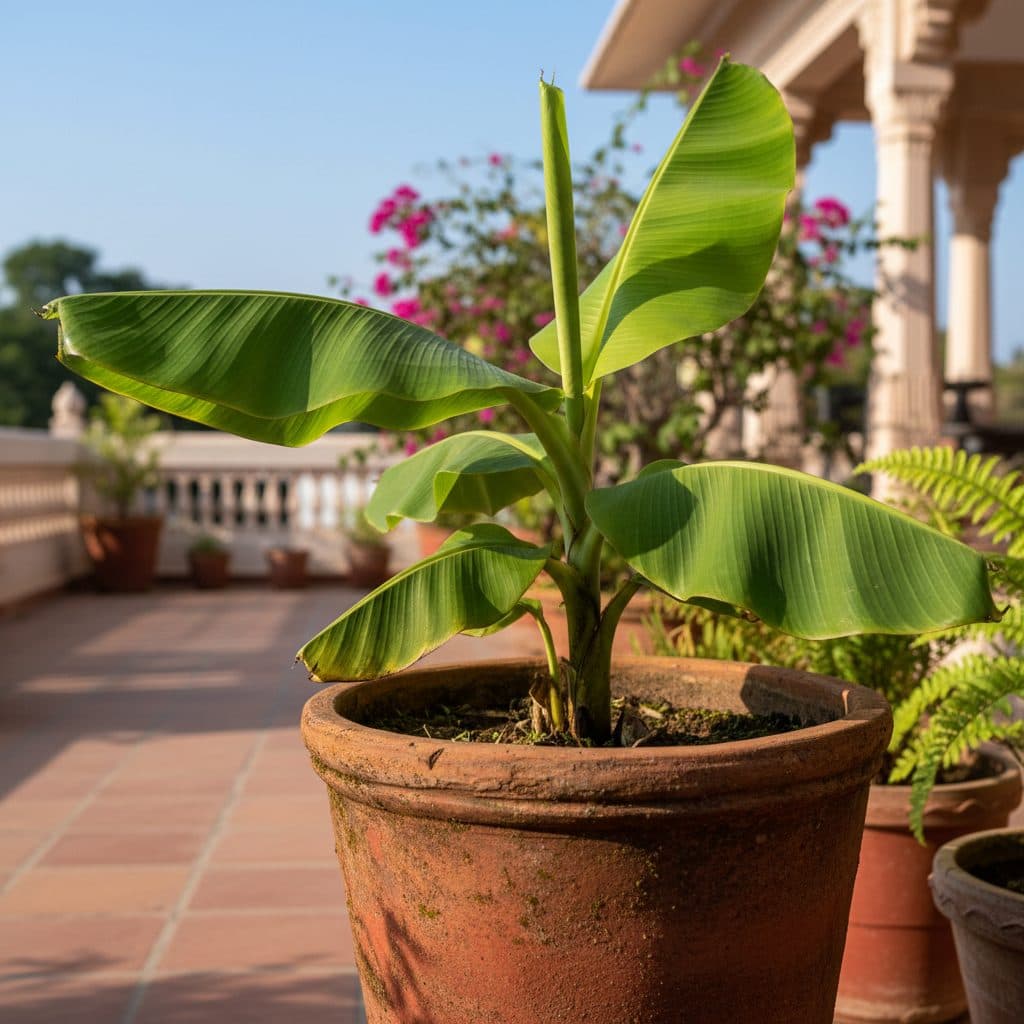
- Dwarf varieties—such as Dwarf Cavendish (Dwarf Basrai) and Grand Naine—are ideal for terrace pots and small courtyards.
- Containers should hold at least 50 to 75 litres of volume (or 60x60 cm grow bags) with free-flowing bottom drainage.
- Banana plants demand full sunlight (6 to 8 hours daily) and consistently moist, well-draining soil rich in organic manure.
- Heavy feeding with organic potassium sources—including compost liquid feeds, vermicompost, and mustard cake tea—is critical for flowering and fruit bunch development.
Quick answer: To grow a banana plant at home, plant a healthy sword sucker or tissue-cultured dwarf sapling (such as Dwarf Cavendish) in a 50 to 75 litre container or sunny garden spot. Use a fertile mix of garden soil, well-rotted cow manure, cocopeat, and neem cake. Place in full sun, water deeply to keep soil moist, feed bi-weekly with organic compost and mustard cake liquid, and prune extra suckers to harvest fresh bananas in 12 to 16 months.
In Indian households, the banana (cultivated clones derived from Musa acuminata × M. balbisiana; Cavendish types belong to the AAA Group), revered as the sacred kela plant, occupies a cherished place in courtyard and terrace gardens. Beyond its auspicious spiritual significance, learning how to grow banana plant at home provides an abundance of fresh culinary resources: broad green leaves for traditional dining, nutritious banana blossoms (mocha or vazhaipoo), tender edible stems (vazhaithandu), and bunches of naturally ripened sweet bananas.
Many urban gardeners assume that bananas require broad farmland, but compact dwarf cultivars thrive in large pots, grow bags, and small courtyard borders. Botanically, the banana is not a true woody tree but the world's largest herbaceous flowering plant, composed of tightly wrapped, moisture-rich leaf sheaths that form a sturdy pseudostem.
Success with home banana growing depends on providing adequate root volume, intense sunlight, continuous moisture, and generous organic feeding. By following structured planting guidelines and proper sucker management, Indian gardeners can cultivate healthy, fruiting banana plants on rooftops and in home gardens.
Best dwarf banana varieties for Indian homes and terraces
Selecting a compact variety is essential when growing bananas in containers or urban spaces:
+-------------------------------------------------------------+
|             POPULAR INDIAN HOME BANANA VARIETIES            |
|                                                             |
|  VARIETY                 HEIGHT         BEST ENVIRONMENT    |
|  ---------------------------------------------------------  |
|  Dwarf Cavendish (Basrai)1.5m - 2.0m    Terraces & Pots     |
|  Grand Naine (G9)        1.8m - 2.4m    Large Grow Bags/Yards|
|  Robusta (Harichal)      2.2m - 2.8m    Courtyard Soil Beds |
|  Red Banana (Sevvazhai)  2.5m - 3.0m    Ground Soil Planting|
|  Yelakki / Ney Poovan    2.2m - 2.8m    Courtyards & Patios |
+-------------------------------------------------------------+- Dwarf Cavendish (Dwarf Basrai): The premier choice for container growing across India. Reaching a manageable height of 1.5 to 2 meters, it produces large bunches of sweet, medium-sized fruit and features a short, stout pseudostem that stands up to wind better than tall varieties.
- Grand Naine (G9): A high-yielding tissue-cultured selection widely cultivated across Maharashtra, Gujarat, and South India. It produces heavy, uniform fruit bunches on sturdy 2-meter pseudostems.
- Yelakki (Chini Champa / Ney Poovan): Highly prized across South India for its intensely sweet, small, fragrant yellow bananas with thin skin. While slightly taller, it performs well in large courtyard containers.
Container selection and nutrient-rich potting mix
Because banana plants develop a massive, nutrient-absorbing root rhizome (corm), container size directly determines fruit bunch size.
+-------------------------------------------------------------+
|                 BANANA POTTING MIX COMPOSITION              |
|                                                             |
|  - 40% Rich Garden Soil or Red Loam                         |
|  - 30% Well-Rotted Cow Dung Manure (Gobar) or Vermicompost  |
|  - 20% Washed Cocopeat (Retains moisture on hot rooftops)   |
|  - 10% Coarse Sand or Perlite (Ensures rapid drainage)      |
|  - Add: 100g Neem Cake Powder (Khali) + 50g Bone Meal       |
+-------------------------------------------------------------+
Container specifications
Use heavy-duty HDPE grow bags measuring at least 60x60 cm, large terracotta tubs, or 75-litre half-drums. Drill several 1 cm drainage holes around the bottom rim. Before placing large containers on a terrace, have the slab's load capacity checked by a structural engineer, keep heavy pots over beams or close to load-bearing walls rather than mid-span, and protect the waterproofing membrane with stands or tiles — never let water stand under a pot. Elevate containers on bricks or pot stands so excess monsoon rainwater flows away freely. Standing water on concrete terraces causes corm rot.
Potting mix preparation
Banana roots require fertile, loose soil with a pH of about 6.0 to 7.5. Blend garden soil with seasoned cow manure and cocopeat to maintain moisture retention during hot summer months. Neem cake helps suppress soil nematodes and adds slow nitrogen; corm rot is prevented by drainage, not by neem cake.
Sunlight, watering, and humidity requirements
Replicating tropical rainforest conditions produces vigorous growth and healthy foliage.
- Sunlight: Banana plants require at least 6 to 8 hours of direct, unfiltered sunlight daily. On urban terraces, position containers against south-facing or west-facing walls where they receive maximum light and thermal radiance.
- Watering regime: Bananas have large, broad leaves that transpire immense volumes of water during warm weather. During summer (35°C to 42°C), water the plant deeply once or twice daily, ensuring the soil remains moist like a damp sponge. In winter, reduce watering, allowing the top 3 cm of soil to dry out between waterings.
- Wind protection: Heavy monsoon gusts or high terrace winds can shred delicate banana leaf blades along their lateral veins. While natural leaf tearing does not kill the plant, placing pots near parapet walls or erecting windbreak netting maintains lush foliage. If pigeons attempt to roost on leaf petioles, installing deterrent netting as detailed in how to protect balcony plants from pigeons prevents mechanical damage.
Organic feeding: fueling a heavy-feeding giant herb
Banana plants are among the heaviest feeders in the plant kingdom, requiring steady supplies of nitrogen for leaf production and potassium for fruit bunch development.
+-------------------------------------------------------------+
|               BANANA ORGANIC FEEDING CALENDAR               |
|                                                             |
|  EVERY 15 DAYS (Vegetative Phase):                          |
|  - Top-dress with 1-2 kg Vermicompost or Aged Cow Manure    |
|  - Drench root zone with diluted Mustard Cake Liquid Tea    |
|                                                             |
|  EVERY 30 DAYS (Flowering & Fruiting Phase):                |
|  - Apply 1 handful Wood Ash (if soil is not alkaline)       |
|  - Apply Fermented Banana Peel & Compost Liquid Feed        |
+-------------------------------------------------------------+
During the initial 6 months of rapid leaf formation, feed the plant bi-weekly with rich nitrogen sources. Applying diluted mustard cake fertilizer for plants provides soluble organic nitrogen that drives new leaf emergence every five to seven days.
Switch to potassium-rich feeds once the plant is carrying 10 to 12 healthy full-size leaves, roughly from month six. Use wood ash sparingly — at most one handful per pot, two or three times a season, and not at all where soil or irrigation water is already alkaline. For routine potassium use banana-peel/compost liquid feeds or sulphate of potash, which do not raise pH. Pairing bananas with other hardy terrace fruit trees like those in our guide on how to grow chiku tree creates a productive rooftop orchard.
Managing suckers and harvesting banana bunches
Banana plants reproduce naturally by sending up underground lateral shoots (suckers) from the parent corm.
+-------------------------------------------------------------+
|               SUCKER MANAGEMENT STRATEGY                    |
|                                                             |
|  SWORD SUCKERS (Narrow, spear-like leaves):                 |
|  - Strong, vigorous root connection to parent corm          |
|  - RETAIN ONE healthy sword sucker as the "follower" plant  |
|                                                             |
|  WATER SUCKERS (Broad, rounded leaves early on):            |
|  - Weak corm connection, slow to produce fruit              |
|  - Cut below soil level & gouge out growing point           |
+-------------------------------------------------------------+
The mother-and-daughter system
To maintain continuous production without overcrowding container soil, adopt the single-follower method:
- Maintain only the primary fruiting stem (the mother plant).
- Allow one strong sword sucker (the daughter plant) to grow alongside it when the mother plant reaches half-maturity.
- Cut away all additional emerging suckers below soil level and gouge out the growing point using a sharp trowel.
- After harvesting the fruit bunch, cut down the spent mother pseudostem at ground level; the daughter sucker immediately takes over as the primary fruiting stem.
Flowering and harvesting
Approximately 9 to 12 months after planting, a large purple heart-shaped flower bud (the inflorescence or banana bell) emerges from the center of the crown. As the bracts curl back, clusters of female flowers transform into tiers ("hands") of small green bananas. The bunch takes a further 90 to 120 days from flowering to harvest.
Once all female hands have opened and only small male flowers remain, snap off the lower purple flower bud; this directs all plant energy into expanding the developing fruit bunch. Harvest the entire bunch when the individual bananas round out, lose their sharp angular ridges, and transition from dark green to light yellowish-green.
By providing ample container volume, generous organic manure, and consistent moisture, you can harvest fresh, organic bananas directly from your home garden. At agripure, our Indian horticultural guides cover growing tropical fruit on terraces and in home gardens.