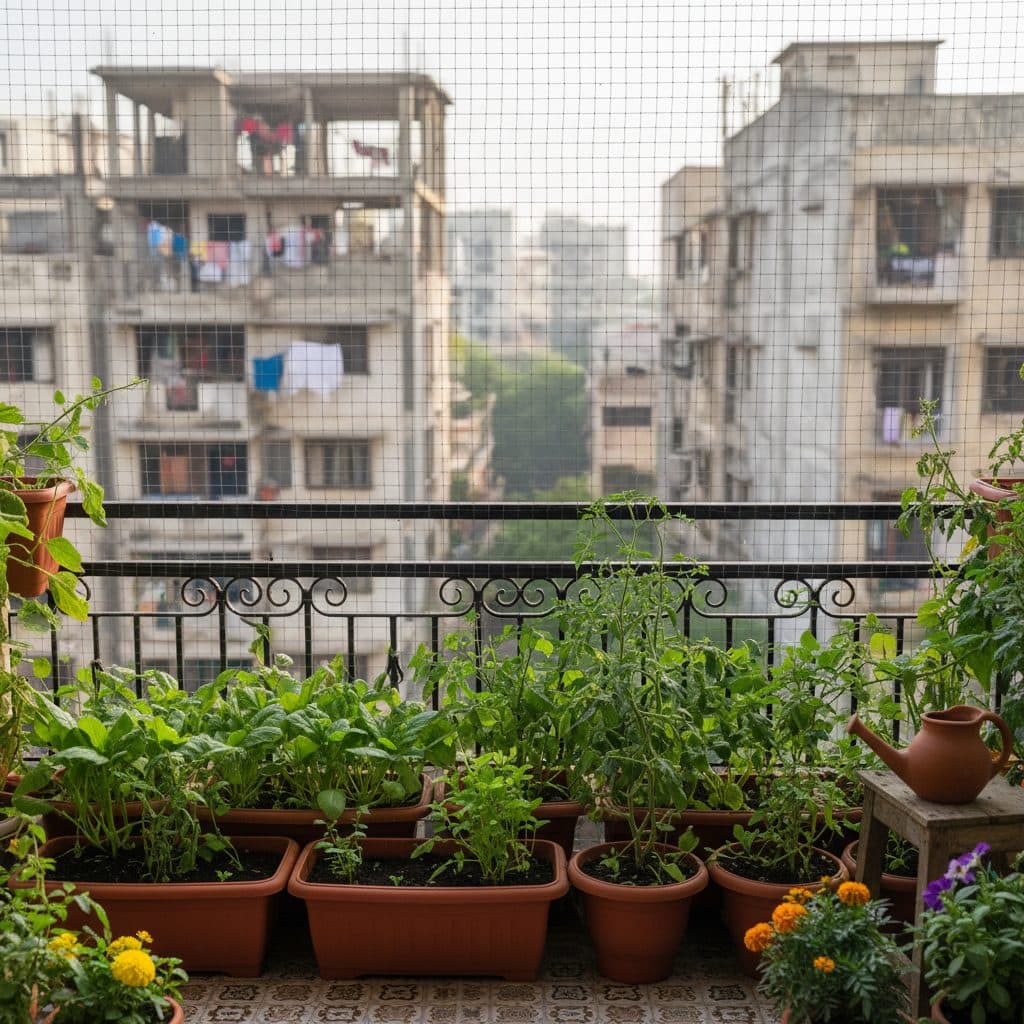
Key takeaways
- Feral blue rock pigeons (kabootar) destroy balcony plants by pecking tender seedlings, trampling foliage, and nesting in planter soil.
- Installing UV-stabilized transparent nylon or monofilament netting (25 to 30 mm mesh) provides permanent, humane physical exclusion.
- Blunt polycarbonate and stainless steel bird spikes along railings, air conditioner ledges, and parapets prevent roosting without harming birds.
- Reflective holographic scare tape, spinning pinwheels, and suspended CDs provide temporary visual deterrence against approaching flocks.
- Maintaining strict balcony hygiene—eliminating stagnant water saucers and cleaning droppings promptly—removes primary pigeon attractants.
Quick answer: To protect balcony plants from pigeons, install high-density UV-stabilized nylon netting (25 mm mesh) across the entire open balcony frame to create a complete physical barrier. For targeted protection, place blunt polycarbonate bird spikes along railings and AC compressor units, cover individual planter boxes with wire cloches, and hang reflective holographic tape around growing beds.
Urban apartment living in Indian metropolitan cities—such as Mumbai, Delhi-NCR, Bengaluru, Hyderabad, Chennai, Kolkata, and Pune—offers great opportunities for container gardening. However, urban gardeners frequently face a relentless adversary: feral blue rock pigeons. Learning how to protect balcony plants from pigeons is essential for anyone trying to grow fresh herbs, vegetables, and ornamentals in an Indian high-rise apartment.
Pigeons are drawn to high-rise balconies because concrete ledges and planter boxes mimic their natural cliff-dwelling nesting environments, completely sheltered from ground predators. Within hours, a small flock can decimate a thriving balcony garden by scratching up delicate potting soil, eating tender microgreens of methi and coriander, tearing tomato buds, and burying foliage beneath corrosive, disease-carrying droppings.
Resolving this chronic problem requires humane, long-lasting deterrent strategies rather than temporary fixes that birds quickly ignore. By combining physical exclusion netting, tactile railing barriers, and strict environmental hygiene, you can reclaim your balcony and grow healthy plants in safety.
Why pigeons target balcony gardens in Indian high-rises
Understanding pigeon behavior helps gardeners implement targeted countermeasures:
+-------------------------------------------------------------+
|             WHY URBAN PIGEONS TARGET BALCONIES              |
|                                                             |
|  1. SHELTERED ROOSTING: AC compressor units, duct corners,  |
|     and parapet ledges provide predator-free nesting sites  |
|  2. TENDER FOOD SOURCE: Sprouting seedlings of methi,       |
|     palak, coriander, and young tomato leaves provide food  |
|  3. NESTING MEDIUM: Soft potting soil, dry cocopeat, and    |
|     plant twigs are ideal for laying eggs                   |
|  4. WATER ACCESS: Drainage saucers under flower pots provide|
|     continuous drinking water                               |
+-------------------------------------------------------------+
Pigeons have acute spatial memory. Once a pigeon identifies a balcony as a safe source of food, water, and nesting material, it returns repeatedly and attracts other flock members. Their highly acidic droppings (rich in uric acid) alter soil pH, scorch foliage, and carry zoonotic pathogens like Cryptococcus and Salmonella.
Physical exclusion: balcony netting and mesh cloches
Physical barriers are the single most effective, long-term solution to keep pigeons away from balcony plants permanently.
+-------------------------------------------------------------+
|               PHYSICAL EXCLUSION NETTING SPECS              |
|                                                             |
|  MATERIAL: High-Density Polyethylene (HDPE) or Garware Nylon|
|  MESH SIZE: 25 mm to 30 mm square mesh                      |
|  UV TREATMENT: UV-stabilized to withstand 40°C+ summer heat |
|  COLOR: Transparent or Forest Green (Preserves skyline view)|
|  FASTENERS: Stainless steel J-hooks & tension wire perimeter|
+-------------------------------------------------------------+
Full-balcony enclosure netting
Enclosing the open balcony frame with heavy-duty, UV-stabilized nylon netting creates an impenetrable barrier while preserving natural sunlight and cross-ventilation:
- Measure the height and width of the open balcony space.
- Install stainless steel anchor hooks every 30 to 40 cm along the perimeter ceiling, floor, and side concrete walls.
- Thread a coated steel tension wire through the outer perimeter hooks.
- Fasten the 25 mm square nylon net tightly to the cable using weather-resistant cable ties.
- Ensure no gaps larger than 3 cm remain along edges, as determined pigeons will squeeze through loose netting.
Individual container mesh cloches
If your building society or housing association restricts full-balcony netting, protect individual pots and grow bags using custom wire cloches. Bend galvanized wire mesh (chicken wire or wire mesh hardware cloth) into lightweight domes or rectangular cages placed directly over planter boxes. This shields tender salad greens and vegetable seedlings like those in our how to grow ridge gourd guide while allowing sunlight and watering cans to reach the soil.
Anti-roosting spikes and railing deterrents
Pigeons prefer landing on flat railings, parapet edges, and air conditioner compressor brackets before stepping into garden containers.
+-------------------------------------------------------------+
|               BIRD SPIKE DEPLOYMENT GUIDE                   |
|                                                             |
|  DESIGN: Polycarbonate base with blunt stainless steel pins |
|  PIN SPREAD: 10 cm to 15 cm wide fan                        |
|  INSTALLATION: High-bond silicone adhesive or heavy zip ties|
|  LOCATIONS: Balcony top railings, window AC hoods, ledges   |
|  HUMANE EFFECT: Eliminates landing space without wounding   |
+-------------------------------------------------------------+- Polycarbonate bird spikes: Install flexible bird spike strips along the entire top surface of balcony metal railings, window sills, and AC compressor tops. The upward-angled blunt pins make it physically impossible for birds to fold their wings and land, forcing them to fly elsewhere without inflicting physical injury.
- Tensioned monofilament line: Stretch a 0.5 mm clear monofilament nylon fishing line 5 cm above and parallel to the top railing, anchored tightly at both ends with small eyelet screws. When a pigeon attempts to land, the flexible, nearly invisible wire disrupts its balance, preventing it from perching.
Humane visual and reflective scare tactics
Pigeons are visual foragers with highly sensitive eyesight that reacts strongly to sudden movement and reflected sunlight.
+-------------------------------------------------------------+
|               REFLECTIVE SCARE TACTICS                      |
|                                                             |
|  - Holographic Flash Tape: Strands tied above plant canopy  |
|  - Old Compact Discs (CDs): Suspended in pairs on strings   |
|  - Reflective Pinwheels: Inserted directly into potting soil|
|  - Predator Decoys: Plastic owls (move position every 3 days|
+-------------------------------------------------------------+- Holographic reflective scare tape: Tie 50 cm ribbons of dual-sided holographic ribbon to plant stakes and railing corners. As breezes blow, the tape twists rapidly, generating sudden flashes of light and crackling sounds that startle approaching birds.
- Hanging CDs and mirrors: Thread pairs of old CDs back-to-back on nylon fishing string and suspend them from the balcony ceiling directly above large potted specimens, such as those featured in how to grow banana plant at home.
- Rotating decoys: If using plastic predator owls or hawks, move their position every two to three days. Pigeons are intelligent birds that quickly realize stationary plastic figures pose no actual threat. For broader organic pest management across diverse vertebrate intruders, consulting organic vertebrate pest control provides more strategies.
Balcony hygiene and long-term pigeon prevention
Eliminating the environmental factors that attract pigeons ensures they do not establish permanent nesting habits on your terrace.
+-------------------------------------------------------------+
|               BALCONY HYGIENE PROTOCOL                      |
|                                                             |
|  1. Remove standing water: Empty pot saucers 30 mins after  |
|     watering to eliminate drinking water sources            |
|  2. Block nesting voids: Seal gaps behind AC compressors    |
|     with wire mesh before nesting begins                    |
|  3. Clean droppings safely: Spray with vinegar-water and    |
|     wipe while wearing an N95 mask and rubber gloves        |
|  4. Eliminate bird feeders: Never scatter grains or birdseed|
|     on or near balconies where container plants grow        |
+-------------------------------------------------------------+
Eliminating water and nesting sites
Empty all pot drainage saucers thirty minutes after watering your plants. In hot Indian summers, standing water in plant saucers is a primary magnet for thirsty urban birds. Inspect the hidden alcove behind your outdoor air conditioner compressor; seal this narrow opening with a sheet of wire mesh to prevent birds from building twig nests.
Safe cleaning of droppings
Never dry-sweep dusty pigeon droppings, as inhaling airborne spores can cause respiratory illness. Spray affected surfaces thoroughly with a solution of white vinegar and water (1:1 ratio) to soften dried matter, let sit for ten minutes, and wipe clean using disposable paper towels while wearing gloves and a protective mask.
For comprehensive container layout strategies that maximize space while keeping pests at bay, review our guide on rooftop patio container gardening.
Durable physical netting, anti-roosting spikes, and consistent hygiene practices keep pigeons off a balcony for good. At agripure, we share practical urban gardening advice for growing plants in Indian high-rise apartments.