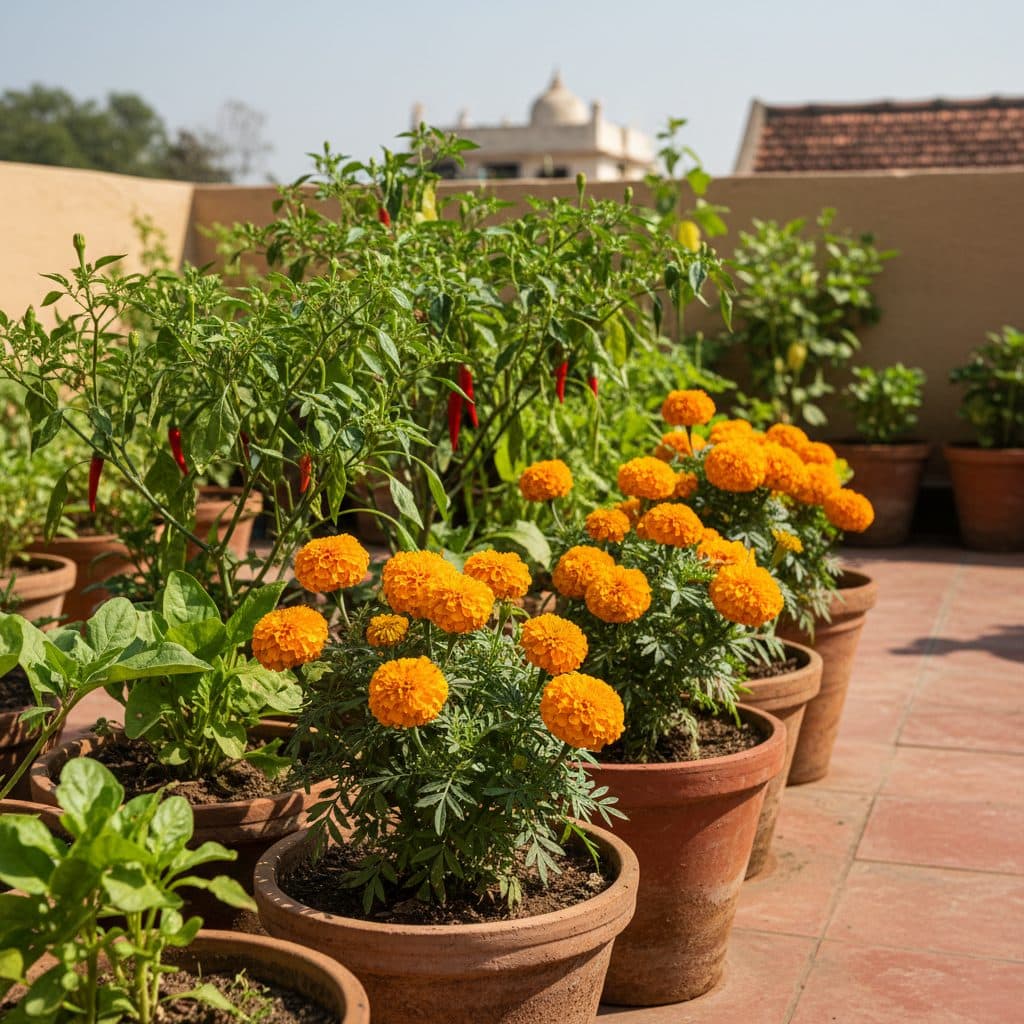
Key takeaways
- Marigold (Tagetes species, known across India as genda phool) can be grown reliably from seed packets or salvaged from dried festival garland flowers.
- In the Indian plains, sow seeds in August and September for abundant flowering during Dussehra, Diwali, and the winter months.
- Viable marigold seeds are two-toned and needle-like, featuring a firm, dark black base and a straw-coloured feathery pappus tip.
- Pinch out the central growing tip when seedlings reach 15 cm in height to encourage bushy lateral branching and multiple flower heads.
- French marigolds (Tagetes patula) release alpha-terthienyl to suppress root-knot nematodes when grown as a dense cover crop, while all marigolds draw pollinators to terrace vegetables.
- Place pots in full sunlight (at least 6 hours daily) and avoid overhead watering to prevent damping-off and Botrytis flower blight. Powdery mildew is driven by crowding and still air, not wet leaves — space plants and keep airflow open.
Quick answer: To grow marigolds from seeds in India, sow fresh needle-shaped seeds 0.5 cm deep in a light mix of coco peat and compost. Keep soil moist in warm, bright shade until germination (4 to 7 days), transplant seedlings into sunny pots after three weeks, pinch the main stem at 15 cm for bushiness, and deadhead spent blooms regularly.
Marigolds, affectionately known in Hindi as genda, occupy a central place in Indian culture and horticulture. From sacred puja rituals and temple offerings to festive wedding decorations, Dussehra ceremonies, and Diwali illuminations, their bright yellow, gold, and deep orange blossoms are traditional symbols of prosperity and joy.
Beyond their ornamental and cultural value, learning how to grow marigold from seeds provides immense benefits for your terrace and kitchen garden. French marigold (Tagetes patula) roots release alpha-terthienyl, which suppresses root-knot nematodes — but only where it is grown as a solid block over the infested soil for a full season and then dug in. A few plants dotted between pots will not clean a nematode problem; grow them for the bees and the colour, and use a marigold block as a rotation crop if you have root knot.
Whether you are germinating hybrid seeds from a garden centre or extracting free seeds from dried festival garlands, this practical guide details seasonal sowing calendars, nursery preparation, and plant care for Indian conditions.
+-------------------------------------------------------------+
|              INDIAN MARIGOLD SOWING & FLOWERING TIMELINE    |
|                                                             |
|   SEASON           SOWING MONTHS       FLOWERING PEAK       |
|   ------           -------------       --------------       |
|   Winter (Rabi)    August - September  October to February  |
|   Summer (Zaid)    January - February  March to May         |
|   Monsoon (Kharif) May - June          August to October    |
+-------------------------------------------------------------+
How do you harvest viable seeds from dried garland flowers?
One of the most rewarding and economical aspects of growing marigolds in India is harvesting seeds directly from spent puja or festival garlands.
+-------------------------------------------------------------+
|              MARIGOLD SEED ANATOMY & SELECTION              |
|                                                             |
|            [ Straw-Coloured Feathery Tip / Pappus ]         |
|                               |                             |
|                               v                             |
|            \=====================================/          |
|                                                             |
|   [ FIRM BLACK BASE ]                 [ PALE / HOLLOW BASE ]|
|   - Hard, plump, viable embryo        - Immature / Empty    |
|   - Well-filled seed germinates       - Will not germinate  |
|   - (KEEP FOR SOWING)                 - (DISCARD)           |
+-------------------------------------------------------------+- Select fully mature flowers: Choose blossoms that have dried naturally on the stem or clean, unfaded garland flowers. Avoid blossoms showing signs of grey mould or moisture damage.
- Disassemble the flower head: Grasp the withered petals and gently pull them away from the green or papery base cup (the calyx tube).
- Inspect the needle-like seeds: Attached to the base of each petal is an elongated, two-toned seed (achene). A viable seed has a hard, swollen, dark black or charcoal-coloured base and a light tan feathery tip. Discard pale white, papery, or hollow seeds, as they lack developed embryos and will not germinate. When using salvaged garland seed, sow a few extra rather than counting on a fixed rate.
- Dry thoroughly before storage: Spread the black seeds on a paper towel in a dry, well-ventilated room for two to three days. Store them in a paper envelope in a cool, dark drawer until sowing time.
One caveat: if the garland was grown from F1 hybrid seed (as much commercial genda is), the saved seed will germinate but will not match the parent. Expect a mixed patch of heights and colours, and buy fresh seed of a named open-pollinated type such as 'Pusa Narangi Gainda' when you want uniform blooms. Skip garlands that look dyed or sprayed.
When is the best season to sow marigolds across India?
Marigolds can be cultivated across India during three distinct seasons, though winter blooms are traditionally the largest and most abundant:
1. Winter season (Rabi crop - primary window)
- Sowing window: August to mid-September.
- Flowering window: October through February (timed for Dussehra, Diwali, and the winter garden).
- Regions: Ideal for the northern and central plains, coastal belts, and southern peninsular India. Winter sunshine and cool nights (12°C to 20°C) produce massive, tight flower heads that last weeks on the plant.
2. Summer season (Zaid crop)
- Sowing window: January to February.
- Flowering window: Late March through May.
- Care requirement: Requires 50% green shade netting during May heatwaves when terrace temperatures exceed 40°C.
3. Monsoon season (Kharif crop)
- Sowing window: Late May to June before the main rains.
- Flowering window: August to October.
- Care requirement: Raised nursery beds and containers with sharp drainage to prevent fungal damping-off during continuous downpours.
+-------------------------------------------------------------+
|              MARIGOLD SPECIES COMPARISON                    |
|                                                             |
|   SPECIES             COMMON NAME        FLOWER TRAITS      |
|   -------             -----------        -------------      |
|   Tagetes erecta      African Marigold   Large, globular,   |
|                       (Genda / Gainda)   pom-pom heads (10cm|
|   Tagetes patula      French Marigold    Compact bush,      |
|                       (Jafri Genda)      bicolour red/gold  |
|   Tagetes tenuifolia  Signet Marigold    Miniature, single  |
|                                          edible citrus bloom|
+-------------------------------------------------------------+
How do you prepare seed trays and germinate marigold seeds?
Marigold seeds germinate quickly when given a light, well-aerated seed-starting medium and consistent moisture.
+-------------------------------------------------------------+
|              SEED-STARTING TRAY PROFILE                     |
|                                                             |
|   [Surface]    0.5 cm light sprinkle of sifted coco peat    |
|   [Seed Zone]  Needle seeds laid flat on surface            |
|   [Substrate]  70% Washed Coco Peat + 30% Sifted Vermicompost|
|   [Moisture]   Mist gently with hand spray bottle           |
+-------------------------------------------------------------+- Prepare seed mix: Blend 70% fine washed coco peat and 30% sifted vermicompost. Sieve the mix to remove large chunks.
- Fill trays or pots: Fill a shallow seedling tray, disposable earthen cups (kulhads), or shallow pots with the mix and level the surface.
- Sow the seeds: Lay the needle-shaped seeds flat on the surface, spaced 2 cm apart.
- Light cover: Cover with a fine 0.5 cm layer of sifted coco peat. Press down gently to ensure good seed-to-soil contact.
- Water gently: Mist the tray with a fine spray bottle. Never pour water directly from a jug, which displaces small seeds.
- Germination conditions: Place the tray in a warm, bright location out of direct harsh midday sunlight. Seedlings typically emerge within 4 to 7 days. Once the first green cotyledons appear, move trays into morning sunshine.
For broader container crop propagation, review our guide to home kitchen garden design and pair with crops like brinjal in pots.
How do you transplant and care for genda plants in pots?
When seedlings develop 2 to 3 pairs of true leaves and stand 7 to 10 cm tall (roughly 20 to 25 days after sowing), they are ready to transplant into permanent pots.
+-------------------------------------------------------------+
|              POTTING MIX RATIO FOR MARIGOLDS                |
|                                                             |
|   - 50% Garden Loam / Good Quality Soil                     |
|   - 30% Decomposed Cow Dung (Gobar Khad) or Vermicompost    |
|   - 20% River Sand or Rice Husk (for aeration & drainage)   |
|   - 1 Handful Neem Cake Powder (Neem Khali per pot)         |
+-------------------------------------------------------------+- Container size: African marigolds (Tagetes erecta) reach 60 to 90 cm in height and need an 8 to 10-inch (20 to 25 cm) pot per plant. Compact French marigolds (Tagetes patula) can be grown in 6-inch (15 cm) pots or grouped in window boxes.
- Sunlight: Marigolds require a minimum of 6 hours of direct sun daily. Shady balcony locations result in leggy foliage and sparse flower buds.
- Watering rules: Water when the top 2 cm of soil feels dry to the touch. Water at the base of the plant using a narrow-spout can; avoid wetting the flowers and leaves, which encourages Botrytis grey mould in the packed flower heads and Alternaria leaf spot.
- Organic feeding: Feed with organic amendments such as cow dung fertilizer or liquid mustard cake (sarson khali) tea every 15 days once flower buds begin forming.
Why is pinching out terminal shoots essential for heavy blooms?
Pinching is the simple technique of removing the central apical growing tip to transform a single, leggy stem into a dense, multi-branched bush carrying dozens of flowers.
+-------------------------------------------------------------+
|              PINCHING TECHNIQUE FOR BUSHY GROWTH            |
|                                                             |
|                  \   /    <-- Pinch out top 2-3 cm tip      |
|                   \ /         (when plant is 15 cm tall)    |
|                  --|--                                      |
|                 /  |  \   <-- Forces 4 to 6 vigorous        |
|                /   |   \      lateral branches to emerge    |
+-------------------------------------------------------------+- Timing: Perform the first pinch when your young marigold plant is approximately 15 cm (6 inches) tall and has developed 4 to 6 sets of true leaves.
- Method: Using clean fingernails or small snips, pinch off the top 2 to 3 cm of the main central stem just above a leaf node.
- Result: Halting vertical dominance triggers dormant auxiliary buds below to sprout, producing 4 to 6 vigorous lateral branches. Each side branch forms its own terminal bud, so a pinched plant carries several times more blooms than an unpinched single stem.
- Deadheading: As flowers fade, snip off the spent blossoms at the stem base. Deadheading prevents the plant from expending energy on seed production and stimulates a continuous succession of new flower buds until late winter.
To explore how flowering borders attract pollinators to improve vegetable yields, consult pollinator companion flowers for fruit set.
By harvesting quality seeds from dried garlands, sowing during the autumn Rabi window, and practicing regular pinching and deadheading, your terrace garden will be blanketed in radiant golden genda blossoms all winter long.