Key takeaways
- Cow dung fertilizer (gobar khad) is India's most widely used organic soil amendment, providing balanced slow-release nutrients and beneficial microorganisms.
- Never apply raw, fresh, or wet cow dung directly to potted plants; high ammonia levels and decomposing heat will burn roots and introduce pathogens.
- Fully decomposed cow dung is dark brown, light, crumbly, and smells pleasantly of rich forest earth with zero foul odour.
- Incorporate aged cow dung at 25% to 30% by volume when preparing potting soil mixes for terrace grow bags and containers.
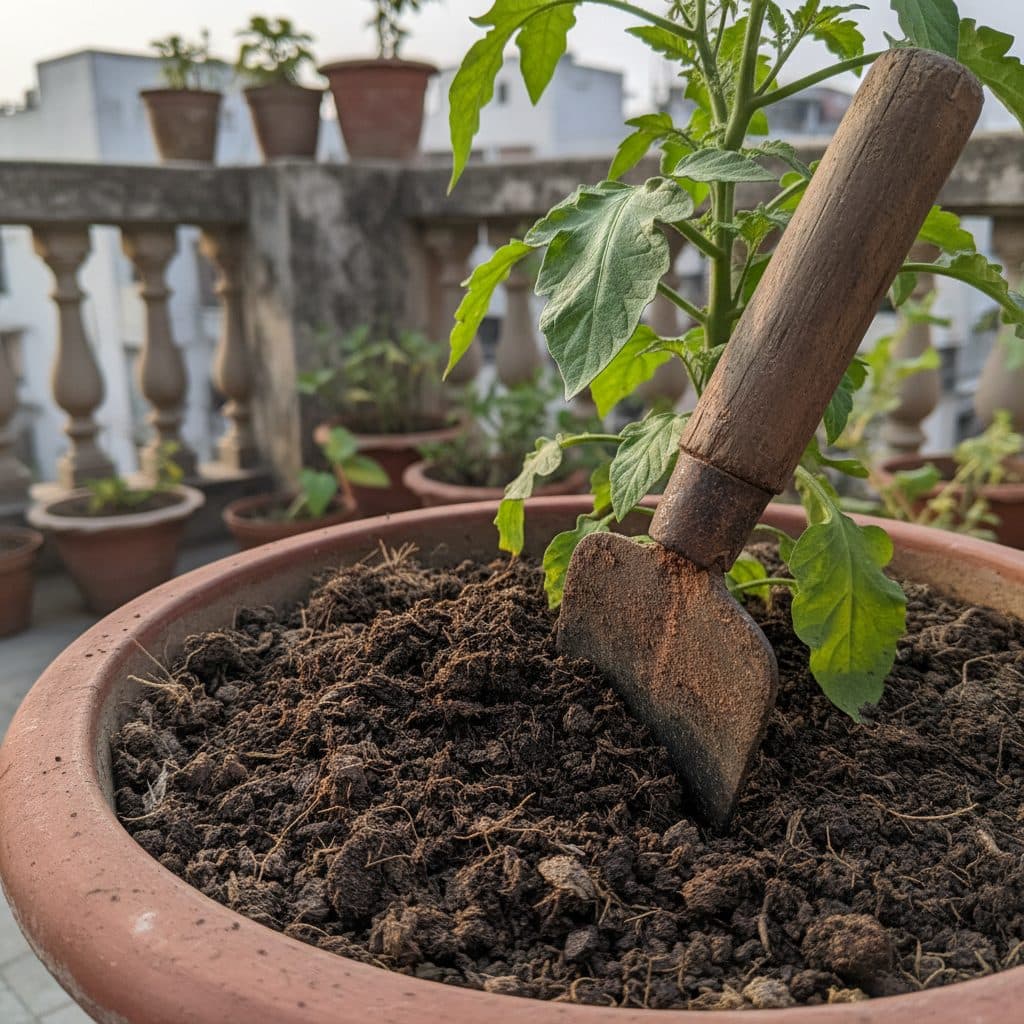
- For established potted plants, lightly aerate the top 2 to 3 cm of soil with a khurpi and work in 50 to 100 grams of powder every 25 to 30 days.
- Fermented liquid cow dung manure tea provides an immediate bio-stimulant boost for flowering and fruiting vegetables during active growth.
Quick answer: For potted plants, use only fully aged, dark, crumbly cow dung compost (paka hua gobar khad). Mix it at 25% to 30% by volume into new potting soils, or top-dress established containers with one to two handfuls (50 to 100 grams) every 25 to 30 days, scratching it into the topsoil with a khurpi before watering thoroughly.
In Indian agriculture and home gardening, cow dung fertilizer for plants (traditionally known as gobar khad) has been a central source of soil fertility for millennia. Derived from cattle manure, it provides nitrogen, phosphorus, and potassium (NPK) while feeding soil microorganisms, improving water retention, and rebuilding soil structure.
However, using cow manure on urban terrace gardens and container plants requires strict attention to maturity. While commercial bagged cow dung powder is sold in plant nurseries across every Indian city, applying fresh, unaged, or poorly fermented manure in closed pots leads to root scorch, foul odours, fungus gnats, and soil compaction.
Identifying properly aged gobar khad helps with formulating potting mixes, dosing established containers, and brewing liquid manure tea for home gardens.
+-------------------------------------------------------------+
|              COW DUNG MATURITY COMPARISON                   |
|                                                             |
|   FEATURE          RAW / FRESH DUNG      FULLY AGED GOBAR   |
|   -------          ----------------      ----------------   |
|   Colour           Greenish / Pale Brown Dark Brown to Black|
|   Texture          Wet, sticky, pasty    Crumbly, loose, dry|
|   Odour            Pungent, sour ammonia Sweet earthy forest|
|   Heat / Microbial High heat (active)    Stable, cool humus |
|   Garden Safety    [BURNS ROOTS & POTS]  [100% SAFE TO USE] |
+-------------------------------------------------------------+
Why must you never use fresh, raw cow dung in pots?
Applying fresh or semi-wet cow dung directly from a local dairy (gaushala or khattal) to potted balcony plants is one of the most common beginner errors in urban Indian gardening.
- Ammonia root scorch: Fresh manure contains urea and ammonium, along with volatile free ammonia. When placed in the confined root zone of a pot, ammonia chemically burns tender root hairs, causing foliage to wilt, blacken, and drop.
- Thermal heating: In fresh manure, rapid bacterial decomposition generates internal temperatures between 55°C and 65°C. In open farm fields, heat dissipates into the subsoil, but inside a container, this heat bakes plant root balls.
- Oxygen depletion in root zone: As aerobic microbes break down fresh organic matter, they consume available dissolved oxygen in the potting soil, suffocating plant roots and creating anaerobic root rot.
- Pathogens and weed seeds: Cattle feed on wild grasses and fodder, passing thousands of viable weed seeds through their digestive tracts. Fresh manure also harbours enteric bacteria like E. coli and Salmonella, whereas properly hot-composted manure reaches temperatures that eliminate both pathogens and weed seeds.
To understand proper farm-scale aging and curing parameters, review our guide to cow and horse manure composting and aging.
+-------------------------------------------------------------+
|              DECOMPOSITION STAGES OF GOBAR KHAD             |
|                                                             |
|   [ Weeks 1 - 4 ]  Thermophilic Phase (55-65°C): Destroys   |
|          |         weed seeds and eliminates pathogens      |
|          v                                                  |
|   [ Months 2 - 6]  Mesophilic Curing Phase: Cool breakdown  |
|          |                                                  |
|          v                                                  |
|   [ Months 6 - 12] Earthworm Colonisation & Humus: Dark,    |
|                    sweet-smelling, stable crumbly compost   |
+-------------------------------------------------------------+
What are the nutritional benefits of aged gobar khad?
Fully decomposed cow dung powder acts as a gentle, balanced, slow-release organic fertilizer.
- Balanced NPK profile: Typical aged cow manure provides approximately 0.5% to 1.5% Nitrogen (N), 0.2% to 0.8% Phosphorus (P), and 0.5% to 1.2% Potassium (K). While lower in raw nutrient percentages than chemical fertilizers like Urea or DAP, its nutrients are bound organically and release steadily over 60 to 90 days.
- Organic carbon and humus: Composted cow dung contains roughly 10% to 20% organic carbon. Carbon forms the structural sponge (humus) that increases the moisture-holding capacity of sandy soils and loosens heavy clay.
- Microbial inoculation: Gobar khad carries a large and diverse microbial population; free-living nitrogen fixers and phosphate-solubilisers occur in variable numbers that help convert locked soil minerals into bio-available forms.
- Micronutrient reservoir: Delivers trace elements including zinc, manganese, copper, iron, and boron essential for chlorophyll synthesis.
How do you use cow dung powder in potting mixes and containers?
Using commercial bagged cow dung powder or aged gobar khad in terrace pots requires precise volume ratios.
+-------------------------------------------------------------+
|              STANDARD TERRACE POTTING FORMULATION           |
|                                                             |
|   INGREDIENT                 VOLUME %    FUNCTION           |
|   ----------                 --------    --------           |
|   Good Garden Soil / Loam    40%         Mineral structure  |
|   Aged Gobar Khad / Powder   30%         Nutrients & carbon |
|   Washed Coco Peat           20%         Moisture retention |
|   River Sand or Perlite      10%         Sharp drainage     |
|   *(Add 50g Neem Cake Powder per 12-inch pot to deter pests)*|
+-------------------------------------------------------------+
1. Initial potting soil mix for vegetables and flowers
- Combine 40% loamy garden soil, 30% aged cow dung powder, 20% washed coco peat, and 10% coarse river sand.
- Add one handful (approx. 50 grams) of neem cake powder (neem khali) per pot to prevent soil-borne grubs and fungal damping-off.
- This formulation provides a fertile root run for heavy-feeding nightshades like brinjal in terrace pots and festive flowering annuals like marigold from seeds.
2. Top-dressing established potted plants
For plants already growing in containers:
- Frequency: Apply every 25 to 30 days during active growing seasons (spring, monsoon, and post-monsoon). Hold off on heavy feeding during extreme mid-winter dormancy or peak 42°C June heat.
- Aerate topsoil: Using a flat hand tool (khurpi), gently loosen the top 2 to 3 cm of soil around the inner rim of the pot, being careful not to damage the main root crown.
- Apply powder: Sprinkle 50 to 100 grams (one to two generous handfuls) of aged cow dung powder evenly over the loosened soil.
- Work in and water: Lightly mix the powder into the top layer and water immediately to wash dissolved nutrients down into the feeder root zone.
+-------------------------------------------------------------+
|              TOP-DRESSING DOSAGE BY CONTAINER SIZE          |
|                                                             |
|   POT DIAMETER              GOBAR KHAD DOSE    FREQUENCY    |
|   ------------              ---------------    ---------    |
|   6 to 8 Inch (Small Pot)   25 to 30 grams     Every 25-30 d|
|   10 to 12 Inch (Standard)  50 to 80 grams     Every 25-30 d|
|   15 to 18 Inch (Grow Bag)  100 to 150 grams   Every 25 days|
|   Fruit Trees in 50L Drum   250 to 500 grams   Quarterly    |
+-------------------------------------------------------------+
How do you make liquid cow dung fertilizer (manure tea)?
Liquid manure tea is a fast-acting bio-stimulant that delivers soluble nitrogen, enzymes, and active microbes directly to plant root zones.
+-------------------------------------------------------------+
|              LIQUID COW DUNG TEA BREWING CYCLE              |
|                                                             |
|   [ Step 1 ]  1 kg Aged Gobar Powder tied in porous cloth   |
|   [ Step 2 ]  Submerge in 10 Litres water bucket + 50g jaggery|
|   [ Step 3 ]  Steep for 48 to 72 hours; stir twice daily    |
|   [ Step 4 ]  Dilute 1 Litre dark tea with 5 Litres water   |
|   [ Step 5 ]  Apply 250 ml to 500 ml per pot as root drench |
+-------------------------------------------------------------+- Ingredients: Place 1 kg of dry, aged cow dung powder (or two broken dry dung cakes / uple) into a porous burlap sack or cloth bag.
- Steeping: Submerge the sack in a 10-litre bucket of clean water. Add 50 grams of organic jaggery (gud) to feed beneficial microbes.
- Fermentation: Cover the bucket with a breathable cloth and keep in the shade for 48 to 72 hours. Stir the mixture vigorously with a stick twice daily to aerate the tea.
- Dilution: Lift out the sack. The liquid will be dark brown like strong black tea. Always dilute: mix one part concentrated manure tea with five parts clean water (1:5 dilution).
- Application: Apply to the soil around the base of your potted vegetables and flowering plants every two weeks as a root drench. Never spray manure tea on foliage or on the edible parts of leafy vegetables, do not apply within a few weeks of harvest, always wash hands thoroughly after handling, and wash all produce before eating.
To integrate cow dung fertilization into broader home growing systems, review our complete setup guide on starting a home kitchen garden.
Using properly aged, crumbly gobar khad in potting media and supplementing with liquid manure tea provides steady organic nutrients for container plants.