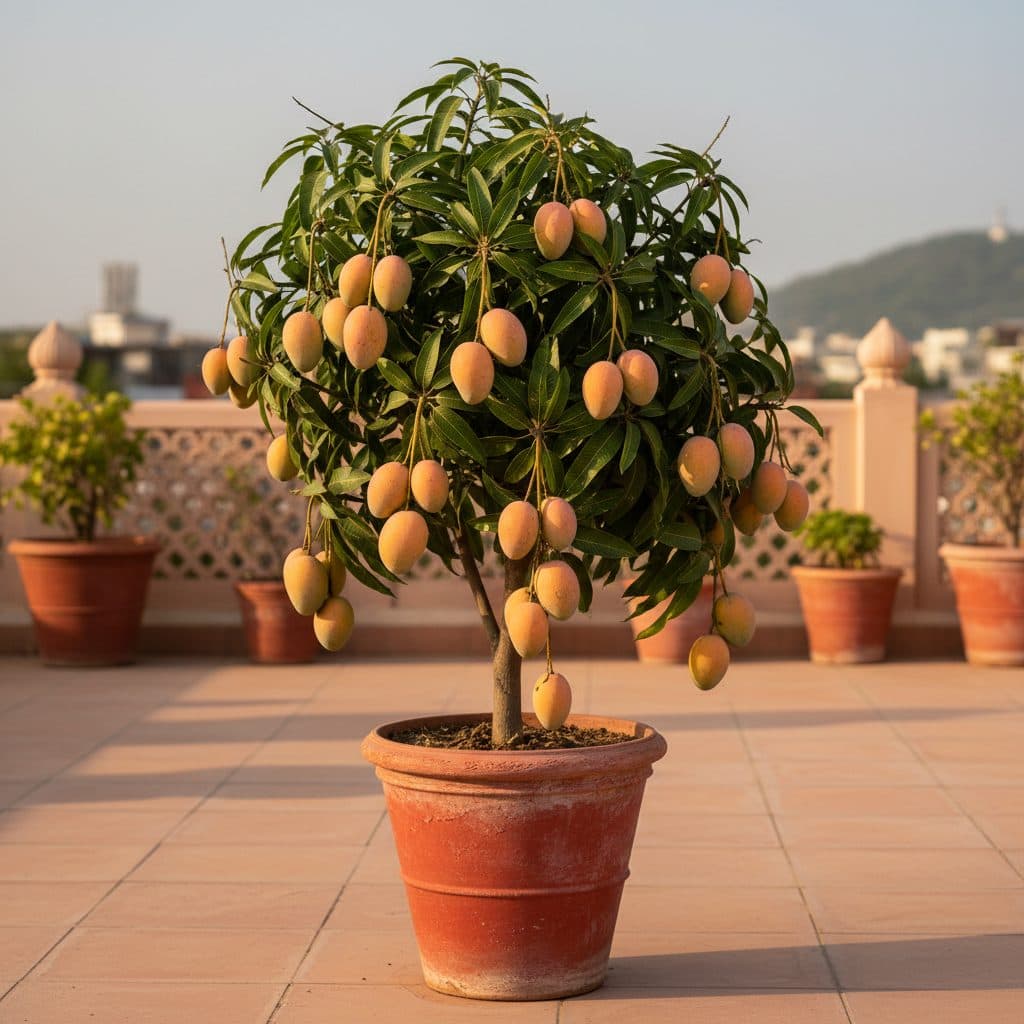
Key takeaways
- Select dwarf or semi-dwarf grafted cultivars such as Amrapali, Mallika, or Manjeera for successful pot culture.
- Use a large container of 50 to 100 litres with ample drainage holes to provide sufficient root volume for fruiting.
- Ensure the graft union sits 5 cm to 8 cm above the soil surface; burying the graft union leads to rot and sucker growth from the rootstock.
- Place the container in full sunlight where it receives a minimum of six to eight hours of direct, unfiltered sun daily.
- Reduce watering during the winter pre-flowering rest period to stimulate bloom induction, then water steadily as fruitlets swell.
- Prune the canopy annually after harvest to maintain a compact 1.5 to 2-metre umbrella shape suited for rooftop terraces.
Quick answer: To grow a mango tree in a pot in India, choose a grafted dwarf variety like Amrapali, plant it in a 50 to 100-litre container with well-draining soil, and keep the graft union above the soil line. Place the pot in full sunlight, water moderately, and prune after the summer harvest to maintain a compact, productive canopy.
The mango (Mangifera indica), celebrated as the king of fruits across India, is traditionally viewed as a sprawling orchard giant requiring extensive ground space. However, through the development of dwarf grafted cultivars and container management techniques, growing a fruitful mango tree on an urban terrace vegetable garden or sunny patio is entirely achievable.
Container mango cultivation requires understanding how root confinement affects tree growth and fruiting. By choosing adapted varieties, using a nutrient-dense, well-draining potting medium, managing seasonal watering, and controlling canopy dimensions, you can harvest sweet, sun-ripened homegrown mangoes from a compact container tree.
Choosing the best dwarf mango varieties for pots in India
Growing mangoes in pots requires grafted specimens of naturally compact or precocious varieties. Seedling trees grow too large and take 7 to 10 years to fruit, whereas grafted dwarf cultivars fruit in their second or third year.
+-------------------------------------------------------------+
|              TOP DWARF MANGO CULTIVARS FOR POTS             |
|                                                             |
|   1. AMRAPALI (Dasheri x Neelum):                           |
|   - Highly dwarf, regular annual bearer, deep orange pulp   |
|   - The premier variety for Indian container culture        |
|                                                             |
|   2. MALLIKA (Neelum x Dasheri):                            |
|   - Semi-dwarf, exceptionally sweet, disease tolerant       |
|                                                             |
|   3. ALPHONSO (Grafted):                                    |
|   - Vigorous, alternate bearer; needs heavy pruning in pots |
|                                                             |
|   4. MANJEERA (Rumani x Neelum):                            |
|   - Semi-dwarf, regular bearer, good for containers         |
+-------------------------------------------------------------+
Cultivar | Tree Habit | Bearing Pattern | Fruit Flavour & Quality | Container Suitability |
|---|---|---|---|---|
Amrapali | Distinctly dwarf | Regular (Annual) | Intensely sweet, rich orange flesh | Outstanding (Top choice) |
Mallika | Semi-dwarf | Regular | Honey-sweet, fiberless, large fruit | Excellent |
Alphonso | Vigorous (Pruned) | Alternate bearing | World-class aroma and rich taste; requires hard annual pruning | Fair to Moderate |
Manjeera (Rumani x Neelum) | Semi-dwarf | Regular | Sweet, juicy, compact cluster fruiting | Very Good |
Nam Dok Mai | Vigorous; kept small only by regular pruning | Regular | Sweet tropical dessert mango | Good |
When purchasing from a registered nursery, ensure the sapling is a certified graft with a healthy, healed union and no signs of disease. Alphonso is sometimes sold as a container mango, but it is a vigorous, alternate-bearing variety with no dwarf form — expect hard annual pruning and irregular crops.
Container selection and potting soil mix
Mango trees develop deep taproots in open soil, but in containers they adapt by forming a dense, fibrous root ball. Providing adequate volume and unobstructed drainage is critical.
Pot dimensions:
- Initial planting (Years 1–2): Start your young grafted sapling in a 40 cm diameter (35 to 45 litre) container.
- Permanent mature size (Year 3 onwards): Repot into a 50 to 100-litre container, half-cut food-grade drum, or heavy-duty 60 cm x 60 cm fabric grow bag.
- Drainage: Ensure the pot has at least 4 to 6 large drainage holes. Elevate the container on pot feet or bricks to allow water to run freely away on terrace floors.
Formulating the potting soil mix:
Mangoes thrive in a slightly acidic to neutral (pH 6.0 to 7.0), well-aerated medium that retains moisture without becoming soggy:
- 40% Red Soil or Loamy Garden Soil: Provides mineral body and anchor stability.
- 30% Well-Decomposed Vermicompost or Cow Dung Manure: Supplies slow-release nutrients and organic carbon.
- 20% Cocopeat or Coarse River Sand: Maintains porosity and prevents compaction.
- 10% Organic Amendments: Blend in 100 grams of neem cake powder, 50 grams of bone meal, and a handful of wood ash to support root vitality and suppress soil-borne pathogens.
For complementary tree care practices, consult our guide on swale berm planting with nitrogen fixers and fruit trees.
Potting your grafted mango tree: the graft union rule
Planting depth is the single most critical factor during the initial potting stage.
+-------------------------------------------------------------+
|              POTTING DEPTH & GRAFT UNION PLACEMENT          |
|                                                             |
|             \       /                                       |
|              ( Leafy Scion )                                |
|                \   /                                        |
|                 \ /                                         |
|                 (X)  <-- GRAFT UNION: MUST BE 5-8 CM        |
|                  |       ABOVE SOIL SURFACE                 |
|   ===============|=============== Potting Soil Line         |
|                  |                                          |
|            ( Rootstock )                                    |
|             /    |    \                                     |
|           (  Root Ball  )                                   |
+-------------------------------------------------------------+- Locate the graft union: Identify the diagonal scar or swollen joint where the named scion variety was joined to the seedling rootstock.
- Position in container: Place the root ball in the centre of the pot, and keep the graft union 5 cm to 8 cm above the finished soil line.
- Why this matters: If the graft union is buried under damp soil, the scion stem can develop fungal collar rot, or the rootstock beneath may produce aggressive wild suckers that rob the grafted scion of energy.
- Firm and water: Fill around the root ball with the potting mix, firm gently with your hands to remove air pockets, and water deeply until water drains from the base.
Seasonal watering and the winter flowering trigger
Water management directly dictates whether your container mango tree produces vegetative leaves or abundant spring blossoms.
+-------------------------------------------------------------+
|               SEASONAL MANGO WATERING CYCLE                 |
|                                                             |
|   OCT - NOV (Pre-Bloom Rest):                               |
|   - Restrict watering; let soil dry between light drinks    |
|   - Cool nights plus mild water stress trigger flower buds  |
|                                                             |
|   DEC - FEB (Flowering):                                    |
|   - Moderate, steady moisture; avoid overwatering           |
|                                                             |
|   MAR - MAY (Fruit Swelling):                               |
|   - Deep, consistent watering daily to size up fruit        |
|                                                             |
|   JUN - AUG (Monsoon):                                      |
|   - Suspend supplemental water; ensure rapid pot drainage   |
+-------------------------------------------------------------+- Winter Rest (October to November): As autumn cools, significantly reduce watering. Allow the top 7 cm of soil to dry out between light waterings. This mild water stress, combined with cooler winter nights, halts vegetative flushing and triggers the formation of floral panicles at branch tips.
- Flowering Phase (December to February): Maintain moderate, steady soil moisture. Never overwater during bloom, as saturated roots cause blossom drop.
- Fruit Swelling Phase (March to May): As temperatures rise and pea-sized fruitlets form, increase watering to daily deep soakings. Inconsistent moisture during hot summer weather causes fruit splitting and premature fruit drop.
To protect developing fruit trees during intense heatwaves, review our practical strategies in protecting fruit trees in a heatwave and preventing sunscald on trees and fruit.
Feeding and fertilising container mango trees
Because nutrients leach through container drainage holes over time, container mangoes require steady organic replenishment:
- Pre-Monsoon (June): Apply 2 kg of vermicompost mixed with 100 grams of neem cake and 50 grams of bone meal around the soil perimeter.
- Post-Monsoon (September): Apply another 2 kg of compost and 50 grams of wood ash or organic potash to support winter bud development.
- Fruit Set (March): Apply diluted liquid mustard cake fertiliser (fermented in water for 5 days) once every three weeks while fruits are swelling to supply balanced micronutrients.
Pruning for compact terrace size and fruit thinning
Canopy management keeps your potted mango tree manageable while ensuring light reaches inner branches.
Annual post-harvest pruning (July to August):
Immediately after harvesting your summer fruit:
- Cut back fruited branch tips by 15 cm to 20 cm just above a leaf node.
- Remove dead, diseased, crossing, or inward-growing branches to open the centre of the canopy to sunlight and airflow.
- Prune out any wild shoots (suckers) emerging below the graft union immediately.
Fruit thinning for tree health:
Young container trees often set more fruitlets than their root system can sustain:
- Years 1 and 2: Pinch off all flower panicles so the young sapling directs all energy toward building root mass and a strong branch structure.
- Year 3 onwards: When marble-sized fruitlets form, thin each cluster to leave only one or two well-formed mangoes. A container tree carries a modest crop — a few fruit in its first bearing years, more as it fills the pot. Thin hard rather than chasing a number.
Managing common pests and diseases
Keep your container tree healthy with preventative organic care:
- Mango Hopper (Idioscopus species): Tiny wedge-shaped insects that suck sap from tender flower panicles in spring, causing flowers to wither.
- Control: Spray neem oil (5 ml per litre of water with 2 ml soap) before flower buds open.
- Powdery Mildew (Oidium mangiferae): A white fungal coating on flower panicles during humid spring mornings.
- Control: Ensure full sun exposure and spray wettable sulphur or neem oil at early bud emergence. Do not apply sulphur when temperatures are above about 32°C or in direct afternoon sun, and never within a few weeks of an oil spray — both cause leaf and panicle scorch.
- Anthracnose (Colletotrichum gloeosporioides): The dominant fungal disease in humid conditions, causing dark brown to black blighted spots on flowers, young leaves, and developing fruit.
- Control: Maintain an open canopy through annual pruning, avoid overhead watering during flowering, and promptly remove and destroy blighted panicles and mummified fruit.
- Scale Insects and Mealybugs: Form white waxy colonies along leaf veins.
- Control: Wipe off small colonies with a cotton swab dipped in rubbing alcohol, or spray with insecticidal soap.
With the right dwarf cultivar, mindful watering, and annual post-harvest pruning, growing a mango tree in a pot provides the satisfaction of harvesting sweet, homegrown fruit from your own terrace.