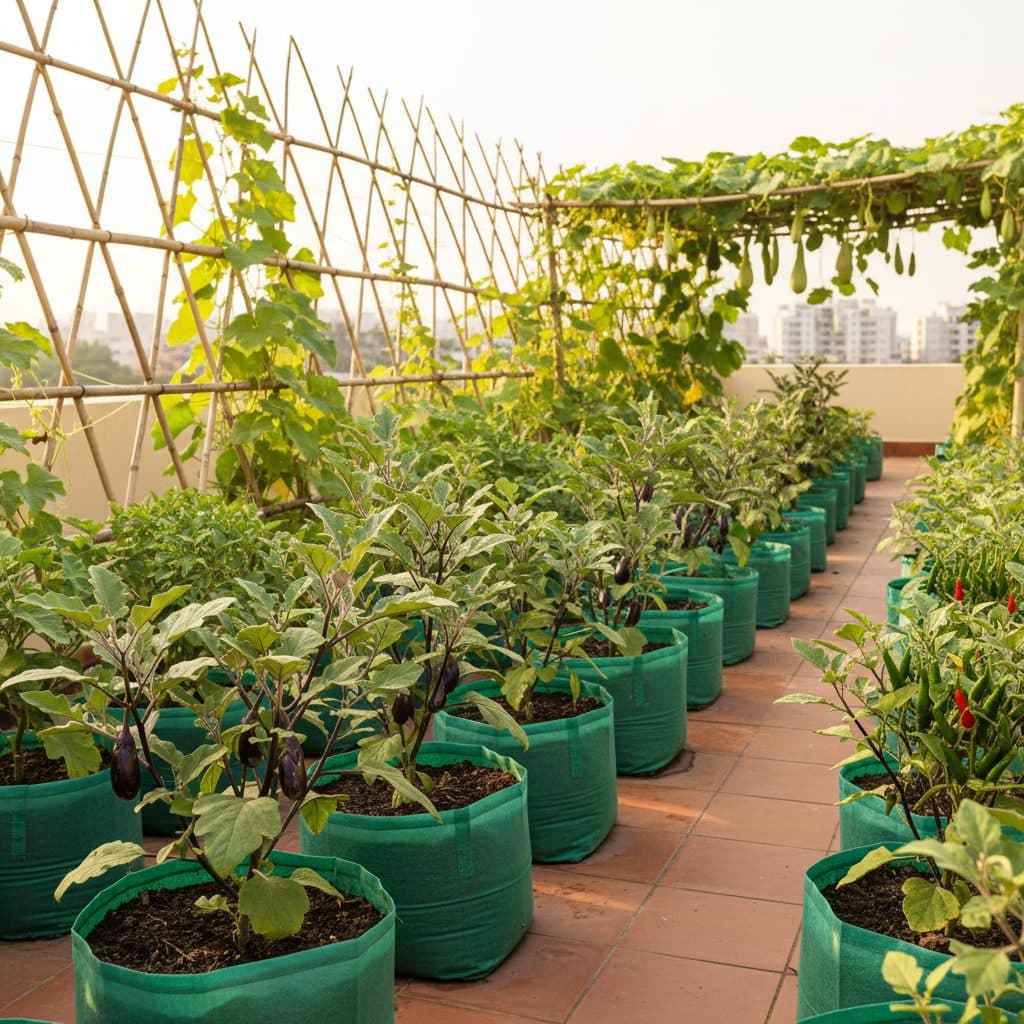
Key takeaways
- Assess rooftop structural load capacity and arrange heavy containers directly above load-bearing walls, beams, and structural columns.
- Protect concrete roof slabs by applying UV-stable waterproofing coatings and placing all grow bags on raised drainage stands or saucers.
- Use a balanced potting mix of 40% cocopeat, 25% to 30% vermicompost, and 30% to 35% red soil or sand for container stability and low salts.
- Align crop planting schedules with India's three distinct growing seasons: Kharif (monsoon), Rabi (winter), and Zaid (summer).
- Use 50% shade netting over leafy greens in peak summer, keeping fruiting crops in full sun or under lighter 30% shade.
- Combine vertical bamboo trellising with drip irrigation or olla pots to maximize growing space and water efficiency.
Quick answer: To start a terrace vegetable garden in India, place lightweight grow bags filled with a cocopeat-compost-sand mix on raised stands over structural roof beams. Choose seasonal crops like gourds for the monsoon and leafy greens for winter, install vertical trellises, and use shade netting over greens during peak summer heat.
Transforming a concrete rooftop into a productive terrace vegetable garden is one of the most rewarding ways for Indian urban households to produce fresh, chemical-free food. From leafy greens and herbs to climbing gourds and fruiting vegetables, rooftop gardening utilizes underused urban space while cooling the building beneath.
However, rooftop environments present distinct horticultural challenges, including intense solar radiation, high concrete temperatures, drying winds, and monsoon downpours. By understanding structural load management, waterproofing, lightweight potting media, and seasonal crop cycles, you can create a productive rooftop garden that thrives year-round.
Structural planning: weight limits and roof safety
Before purchasing pots and soil, evaluate your building's structural capabilities. Saturated soil and large containers add substantial weight to roof slabs.
+-------------------------------------------------------------+
|                TERRACE WEIGHT DISTRIBUTION PLAN             |
|                                                             |
|    [ Periphery / Beams ]          [ Center of Open Slab ]   |
|   =======================        =========================  |
|   - Large 50-100L pots           - Light seedling trays     |
|   - Fruit trees (Moringa, Mango) - Small 5L herb pots       |
|   - Deep compost bins            - Walkways & access paths  |
|   - Heavy climbing trellises     - Hanging planters         |
+-------------------------------------------------------------+
Key structural guidelines:
- Locate load-bearing points: Place your largest and heaviest containers (50 to 100-litre drums and deep planter boxes) directly over perimeter walls, main concrete beams, or supporting structural pillars.
- Keep centre spans light: Reserve the open centre spans of wide roof slabs for lightweight 5-litre herb pots, seedling trays, or open walking pathways.
- Calculate wet weight: Always evaluate container weight when fully saturated with water rather than when dry. Remember that potting mix doubles in weight when fully saturated after heavy monsoon downpours, and a 200-litre water storage barrel weighs over 200 kg — always locate high-volume water tanks directly over major structural columns.
Waterproofing and drainage management
Protecting your roof slab from dampness and water seepage is essential for long-term building health.
- Waterproof coatings: Apply an initial primer followed by two coats of UV-stable elastomeric polyurethane (PU) or cementitious waterproofing coating. Bituminous membranes soften and degrade under intense rooftop sun unless protected beneath tiles or a screed.
- Raised pot stands: Never sit flat-bottomed grow bags directly onto bare terrace concrete. Trapped moisture beneath bags encourages algae growth and causes water to penetrate micro-fissures in the concrete. Place containers on galvanised iron pot stands, plastic drainage trays, or pairs of kiln-fired bricks to maintain a 5 cm air gap.
- Clear rainwater drainage: Inspect terrace rainwater drain spouts weekly, especially before and during the monsoon. Ensure falling leaves or washed-away soil particles do not clog outlets, which can cause standing water on the roof.
For broader small-space setups, see our guide on vertical vegetable gardening in small spaces.
Formulating lightweight terrace potting soil
Traditional garden topsoil is heavy, compacts tightly inside containers, and turns rock-hard during hot Indian summers. A quality terrace potting mix must be lightweight, moisture-retentive, and well-aerated.
+-------------------------------------------------------------+
|              IDEAL TERRACE POTTING MIX RATIO                |
|                                                             |
|           40% COCOPEAT (Moisture & Light Weight)            |
|                             -                               |
|       25-30% VERMICOMPOST (Organic Fertility & Humus)       |
|                             -                               |
|       30-35% RED SOIL / SAND (Stability, Minerals & Drain)  |
|                             -                               |
|          Neem Cake (50g) + Bone Meal (20g) per bag          |
+-------------------------------------------------------------+- Hydrate washed cocopeat: Soak compressed cocopeat blocks in clean water. Ensure low-salinity washed cocopeat (EC < 0.5 mS/cm) is used to prevent salt toxicity.
- Combine components: Thoroughly mix 40% expanded cocopeat, 25% to 30% mature vermicompost or sieved cow dung manure, and 30% to 35% red soil or river sand to provide mineral weight against wind and keep soluble salts down.
- Add bio-fertiliser amendments: For every 20-litre grow bag, incorporate 50 grams of neem cake powder (to prevent soil grubs and nematodes), 20 grams of bone meal or rock phosphate, and 5 grams of Trichoderma viride bio-fungicide.
Seasonal planting calendar for Indian terrace gardens
Indian horticulture revolves around three primary cropping seasons. Selecting the right crops for each season ensures steady harvests throughout the year.
+-------------------------------------------------------------+
|                 INDIAN TERRACE CROPPING SEASONS             |
|                                                             |
|   1. KHARIF (Monsoon: June to September)                    |
|      - Bitter Gourd, Bottle Gourd, Ridge Gourd, Cucumber    |
|      - Bhindi (Okra), Brinjal, Chilli, Amaranthus           |
|                                                             |
|   2. RABI (Winter: October to February)                     |
|      - Palak (Spinach), Methi (Fenugreek), Coriander        |
|      - Radish, Carrot, Beetroot, Cauliflower, Cabbage, Peas |
|      - Tomatoes, Capsicum, Green Beans                      |
|                                                             |
|   3. ZAID (Summer: March to May)                            |
|      - Bitter Gourd, Bottle Gourd, Cluster Beans (Gowar)    |
|      - Mint (Pudina), Purslane, Summer Amaranth             |
+-------------------------------------------------------------+
Season | Sowing Window | Best Terrace Vegetables | Key Management Focus |
|---|---|---|---|
Kharif (Monsoon) | June – July | Gourds (karela, lauki, tori), bhindi, brinjal, chilli | Drainage, mildew prevention, vertical trellising |
Rabi (Winter) | October – November | Methi, palak, coriander, radish, carrots, peas, tomatoes | Full sun, steady watering, aphid scouting |
Zaid (Summer) | February – March | Bitter gourd, cucumber, cluster beans, mint, amaranth | 50% shade netting, daily watering, thick mulch |
Learn more about specific vine cultivation in our guide on how to grow bitter gourd.
Managing rooftop microclimates: summer heat and monsoon rain
Rooftop gardens experience more extreme temperature swings and wind speeds than ground-level gardens.
+-------------------------------------------------------------+
|                TERRACE AGRO-SHADE NET SETUP                 |
|                                                             |
|     ===================================================     |
|     [ 50% Green Shade Netting (Installed at 2.5m Height) ]  |
|        \                                             /      |
|         \  Diffused Sunlight & 4-6°C Cooling Effect /       |
|          v                                         v        |
|     +-------------------------------------------------+     |
|     |  Beds & Grow Bags Protected from Solar Scorch   |     |
|     +-------------------------------------------------+     |
+-------------------------------------------------------------+
Peak summer defense (April to June):
When concrete temperatures climb above 42°C:
- Shade Netting Strategy: Use 50% green shade netting over leafy greens and delicate crops during peak summer (April to June), but keep fruiting vegetables (tomatoes, chillies, gourds) in full sun or under lighter 30% shade to avoid blossom drop and leggy growth.
- Surface Mulching: Spread a 5 cm layer of dry sugarcane bagasse, crushed dry leaves, or coconut husk chips over the soil in every grow bag to reduce surface evaporation.
- Watering Routine: Water early in the morning before 8:00 AM and in the evening after 6:00 PM. Avoid watering during the middle of the day when hot water can scald root tissue. For arid strategies, review desert and arid vegetable gardening.
Monsoon defense (June to September):
- Elevate containers: Check that pot drain holes remain clear so heavy tropical downpours flow out freely.
- Fungal prevention: Spray organic neem oil solution or diluted buttermilk spray every 10 days to prevent leaf spot diseases.
- Wind staking: Tie tall plants like tomatoes, brinjal, and chillies to sturdy bamboo stakes to prevent stems from snapping in monsoon squalls.
Pest management and daily care routine
Maintaining healthy terrace crops relies on regular scouting and preventative organic controls:
- Neem oil spray: Mix 5 ml of cold-pressed neem oil and 2 ml of liquid soap in 1 litre of water. Spray top and underside of leaves every 10 to 14 days in the evening.
- Yellow and blue sticky traps: Hang sticky sheets 30 cm above the canopy to trap flying pests like whiteflies, aphids, and thrips without chemical sprays.
- Companion planting: Interplant marigolds, holy basil (tulsi), and mint alongside vegetables to attract beneficial pollinators and confuse pest insects with strong aromas.
By combining lightweight potting mixes, sensible structural layout, seasonal cropping, and protective summer shade, your terrace vegetable garden will deliver an abundant harvest of fresh produce for your family throughout the year.