Key takeaways
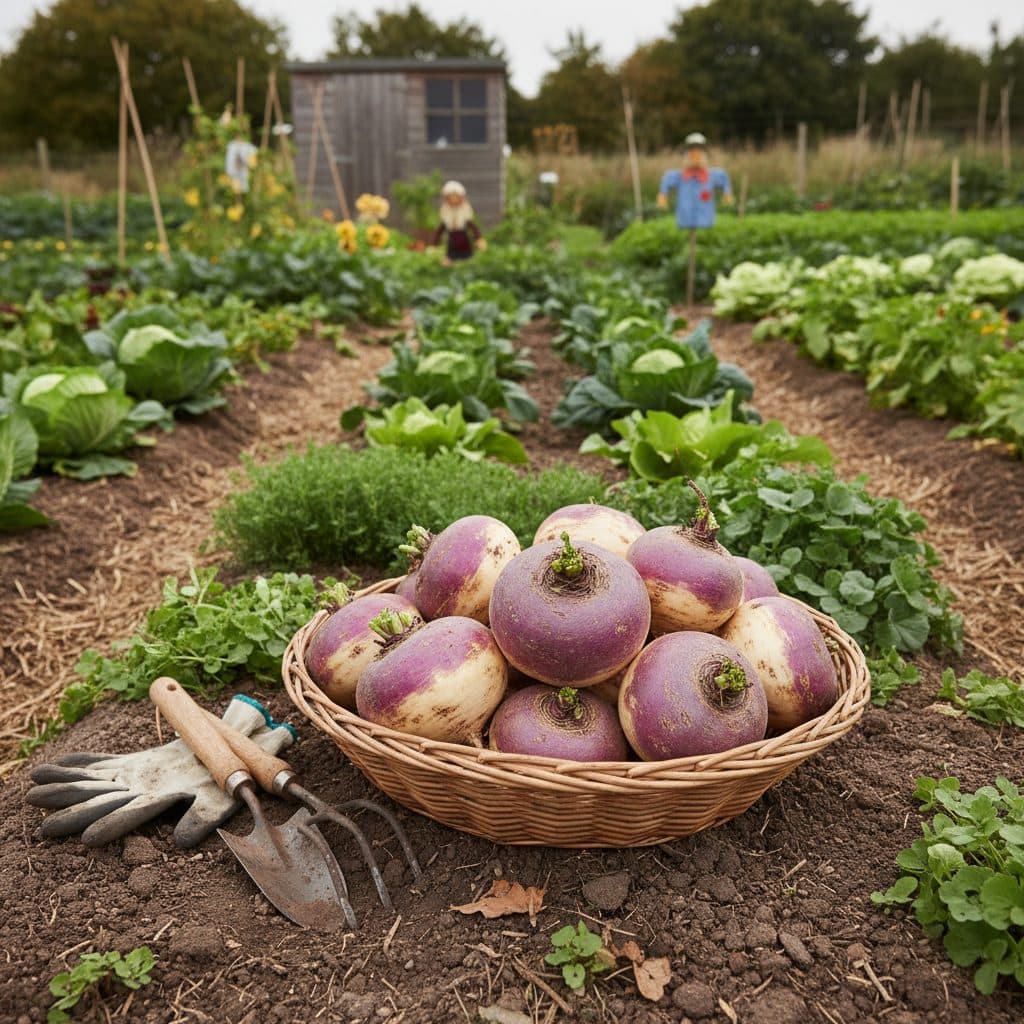
- Swede (Brassica napus var. napobrassica) is a hardy brassica root crop requiring a long growing season of roughly twenty weeks.
- Sow seeds directly into firm, moisture-retentive soil from mid-May to late June across the UK.
- Thin emerging seedlings gradually to a final spacing of 20 to 25 cm to encourage large, uniform root development.
- Protect crops immediately after sowing with fine insect mesh to exclude cabbage root fly and flea beetles without chemical sprays.
- Swede roots can remain in the ground throughout winter, with light frosts converting starches into natural sugars for superior flavour.
Quick answer: To grow swede successfully in the UK, sow seeds directly into firm, fertile soil between mid-May and late June. Thin seedlings to 20 to 25 cm apart, maintain consistent watering during summer dry spells to prevent woody roots, and cover beds with fine insect mesh to prevent cabbage root fly damage. Harvest roots as needed from October throughout winter, especially after the first frosts.
Swede is one of the most reliable and nourishing winter root vegetables for British allotments and home vegetable plots. With its sweet, golden flesh and exceptional cold tolerance, swede provides a dependable source of fresh home-grown produce when other garden beds lie dormant under winter frost. Learning how to grow swede allows gardeners to fill their winter pantries with nutrient-dense root staples.
Unlike fast-maturing summer radishes or quick turnips, swede is a long-season member of the brassica family that requires approximately twenty weeks from sowing to harvest. Sown in late spring, swede spends the summer building robust root systems, swelling steadily through early autumn to reach peak harvest quality just as winter sets in.
Because swede belongs to the cabbage family (Brassicaceae), it shares the same soil requirements and pest susceptibilities as cabbages and kale. By following proper crop rotation, applying physical insect netting, and maintaining consistent moisture levels, UK gardeners can produce sweet, tender roots with minimal maintenance.
Swede vs turnip: understanding the difference
Gardeners often confuse swedes and turnips, but they represent distinct botanical species with different culinary and cultural qualities:
+-------------------------------------------------------------+
|                     SWEDE VS TURNIP COMPARISON              |
|                                                             |
|  CHARACTERISTIC       SWEDE (Brassica napus) TURNIP (B. rapa)|
|  ---------------------------------------------------------  |
|  Growing Time         20 to 26 weeks        6 to 10 weeks   |
|  Sowing Window        May to June           March to August |
|  Flesh Colour         Yellowish-orange      Bright white    |
|  Skin Texture         Rough, purple crown   Smooth, white/pur|
|  Winter Hardiness     Extremely hardy       Moderate        |
|  Flavour Profile      Sweet, nutty, rich    Peppery, crisp  |
+-------------------------------------------------------------+
Botanically, swede arose as a natural cross between a wild cabbage and a turnip. It produces a larger, firmer root with rich yellow or cream flesh and a rough, ridged neck. Turnips grow rapidly, feature pure white flesh, and are best harvested young in summer or autumn. Swede excels as a winter storage crop that remains in the garden soil through freezing weather.
Selecting the best UK swede varieties
Choosing reliable cultivars suited to British weather improves your odds against disease, particularly against powdery mildew and clubroot.
- 'Marian': A traditional purple-topped British favourite with rich yellow flesh. Marian offers moderate resistance to clubroot and powdery mildew, making it ideal for allotment soils.
- 'Brora': Brora has exceptional winter hardiness and sweet flavour, with dark purple skin, uniform shape, and outstanding resistance to root splitting during wet autumns.
- 'Tweed': An early-maturing cultivar producing smooth, globe-shaped roots with excellent cooking quality and good mildew resistance.
- 'Gowrie': Bred by the Scottish Crop Research Institute, Gowrie provides high tolerance to both clubroot and powdery mildew, delivering heavy yields even in challenging northern soils.
- 'Helenor': A modern high-yielding commercial variety with smooth skin and consistent, tender yellow flesh that stores exceptionally well.
Soil preparation and sowing swede outdoors
Swede requires firm, well-draining soil with a near-neutral pH to develop smooth, unblemished roots.
+-------------------------------------------------------------+
|                 SWEDE BED PREPARATION TIMELINE              |
|                                                             |
|  AUTUMN / WINTER:                                           |
|  - Incorporate well-rotted garden compost or manure         |
|  - Add garden lime if soil pH tests below 6.5               |
|                                                             |
|  SPRING (MAY / JUNE):                                       |
|  - Consolidate soil by light treading to create a firm bed  |
|  - Rake surface to a fine, crumbly seedbed tilth            |
|  - Direct sow seeds 1.5 cm deep in rows 35 to 40 cm apart   |
+-------------------------------------------------------------+
Soil requirements and pH
Prepare the bed on ground that has not hosted brassicas for at least three years to reduce the build-up of clubroot and other brassica soil problems — note that clubroot resting spores can persist for around 20 years, so rotation alone will not clear infected ground. Swedes prefer soil rich in organic matter incorporated the previous autumn. Avoid applying fresh manure directly before sowing, as it encourages forked roots. Hollow, brown centres are a separate disorder — brown heart — caused by boron deficiency, which is more likely on freshly limed, sandy or drought-prone soils. In acidic soils, apply agricultural lime to raise pH to 6.5–7.0.
Direct sowing technique
Swedes resent root disturbance and should always be sown directly where they are to mature rather than in seed trays. Using stale seedbed weed control prior to sowing ensures emerging seedlings do not compete with fast-growing spring weeds:
- Draw shallow drills 1.5 cm deep, spacing rows 35 to 40 cm apart.
- Sow seeds thinly along the drill, aiming for one seed every 5 to 8 cm.
- Backfill with fine soil, firm gently with the back of a rake, and water thoroughly using a fine rose.
- Cover the bed immediately with insect mesh to deter pests.
Thinning seedlings
When seedlings reach 5 cm in height, thin them to 10 cm apart. Once leaves begin to touch, perform a final thinning, leaving individual plants spaced 20 to 25 cm apart. Practicing methodical seedling care and thinning provides roots with adequate room to swell to tennis-ball size without overcrowding.
Watering, netting, and organic pest prevention
Maintaining consistent moisture and physical protection are the two cornerstones of successful swede cultivation.
+-------------------------------------------------------------+
|               ORGANIC SWEDE PROTECTION MEASURES             |
|                                                             |
|  PEST / PROBLEM          PHYSICAL & CULTURAL SOLUTION       |
|  ---------------------------------------------------------  |
|  Cabbage Root Fly        Ultra-fine 0.8mm insect mesh net   |
|  Flea Beetles            Insect netting & moist soil        |
|  Cabbage White Butterfly Fine butterfly netting over hoops  |
|  Powdery Mildew          Consistent watering & wide spacing |
|  Root Splitting / Woody  Even moisture (avoid drought cycles|
+-------------------------------------------------------------+
Consistent moisture management
Swedes require continuous soil moisture through July and August. Irregular watering—where dry soil is suddenly flooded by heavy rainfall—causes the expanding roots to split and crack, allowing rot organisms to enter. Water beds deeply once or twice a week during dry spells rather than giving daily shallow sprinkles.
Physical insect protection
Pesticide approvals change frequently in the UK, making non-chemical physical barriers the safest and most reliable control method:
- Cabbage root fly (Delia radicum): Small white maggots burrow into expanding roots, creating brown tunnels and stunting growth. Cover the crop immediately upon sowing with ultra-fine horticultural mesh (0.8 mm), weighting edges securely with stones or soil.
- Flea beetles: Tiny jumping beetles chew small "shot holes" in young leaves. Keeping seedbeds moist and netted deters them until plants establish.
- Caterpillars: Netting also prevents cabbage white butterflies (Pieris brassicae and P. rapae) from laying eggs on swede foliage.
Reviewing our core principles on prevention first gardening pests helps establish a chemical-free pest barrier across your entire plot.
When and how to harvest swede for winter storage
Swedes can be harvested from October onward, but their flavour improves dramatically after exposure to cold weather.
Frost and flavour enhancement
As autumn temperatures drop below freezing, the swede plant converts stored root starches into natural sugars to act as a biological anti-freeze. This process removes bitterness, resulting in the rich, sweet taste prized in traditional winter soups, pasties, and roasts.
Harvesting and in-ground storage
- Harvesting as needed: In most parts of the UK, swedes can be left directly in the ground throughout winter. Lift roots with a garden fork as needed for the kitchen, digging carefully beneath the bulb to avoid slicing the skin.
- Protecting against extreme freezes: In severe northern regions, cover in-ground swede rows with a thick 15 cm blanket of straw or bracken to keep the soil workable during prolonged freezes.
- Cellar or shed storage: If ground space is needed for winter maintenance, lift roots in November, twist off foliage 2 cm above the crown (leaving the taproot intact), and pack dry, unwashed roots into crates of dry sand or sawdust stored in a frost-free shed.
As your winter harvest winds down, planning ahead with our seasonal guide on what to plant in december uk ensures your plot remains active throughout the dormant months. At agripure, proven allotment practices help British gardeners enjoy fresh, resilient root crops from autumn through spring.