Key takeaways
- December is midwinter in the UK, focusing on dormant bare-root fruit planting, late garlic cloves, and protected indoor greens.
- Bare-root apple trees, pear trees, raspberry canes, and currant bushes can be planted whenever the soil is neither frozen solid nor waterlogged.
- Hardneck and softneck garlic can still be planted outdoors in early December if ground conditions permit good drainage.
- Cold frames, unheated polytunnels, and sunny indoor windowsills support winter salad leaves, pea shoots, and mustard microgreens.
- Winter plot maintenance, including mulching beds, turning compost heaps, and ordering seeds, sets the foundation for early spring sowing.
Quick answer: Knowing what to plant in December UK centers on dormant bare-root fruit trees and canes, late-season garlic cloves, and protected winter salad leaves. While outdoor seed sowing pauses across frozen soils, growers can plant bare-root apples, pears, and blackcurrants outdoors, sow hardy broad beans in module trays under unheated glass or cold frames, and raise pea shoots and microgreens on sunny indoor windowsills.
December brings short daylight hours, frequent frost, and cold rain across the United Kingdom. To the casual observer, the allotment or kitchen garden appears to enter full hibernation. However, knowing what to plant in december uk allows British gardeners to make meaningful progress during the quietest month of the gardening year.
While the open vegetable plot is largely in resting mode, December offers excellent opportunities for planting hardy perennial crops and dormant woody plants. Fruit nurseries dispatch bare-rooted trees, bushes, and canes in December: the most affordable way to establish productive home orchards and fruit cages.
Simultaneously, undercover growing spaces, such as unheated glasshouses, polytunnels, cold frames, and kitchen windowsills, remain active microclimates. By combining cold-hardy outdoor plantings with windowsill greens and structured winter soil preparation, you ensure your plot remains productive throughout the darkest winter days.
Outdoor planting: garlic and overwintering broad beans
Direct sowing in the open garden during December requires hardy varieties that tolerate cold, damp British soil conditions.
+-------------------------------------------------------------+
|             DECEMBER OUTDOOR PLANTING CONDITIONS            |
|                                                             |
|  PERMITTED:                                                 |
|  - Soil is moist and workable                               |
|  - Air temperatures are above freezing (2°C to 8°C)         |
|  - Raised beds or freely draining sandy/loam soils          |
|                                                             |
|  DELAY IF:                                                  |
|  - Ground is frozen solid or covered in thick snow          |
|  - Soil is waterlogged, pooling, or sticky heavy clay       |
+-------------------------------------------------------------+
Late garlic planting
If autumn rains prevented you from planting garlic in October or November, early December provides a final outdoor window. Garlic requires a period of cold temperatures (vernalization) below 10°C for several weeks to initiate bulb splitting into individual cloves.
Plant individual cloves pointed end upwards, 3 to 5 cm deep with 15 cm spacing between plants and 20 cm between rows. On heavy clay allotment soils prone to winter waterlogging, start cloves in multi-cell trays in a cold frame to prevent rotting, planting out once soil drains in late winter. Reviewing our how to grow garlic guide provides in-depth varietal guidance.
Overwintering broad beans in modules or under cover
While hardy broad bean varieties like 'Aquadulce Claudia' are traditionally overwintered, direct December sowings into cold, saturated allotment soil frequently rot before germinating. Instead, sow seeds 5 cm deep into root trainers or deep module trays kept in an unheated greenhouse or cold frame. Sturdy young plants can then be planted out into weed-free soil in late winter. If direct sowing under cloches in mild southern districts, ensure beds are well-drained and sheltered from icy winds and foraging pigeons.
Bare-root fruit trees, canes, and bushes
December represents the premier month for establishing new fruit plantings on UK plots. Bare-root plants are lifted directly from field soil while dormant, resulting in strong root systems that settle in before spring bud burst.
+-------------------------------------------------------------+
|               UK BARE-ROOT FRUIT PLANTING GUIDE             |
|                                                             |
|  CROP TYPE                  SPACING         SOIL PREFERENCE |
|  ---------------------------------------------------------  |
|  Top Fruit (Apples, Pears)  2.5m - 4.5m     Well-drained    |
|  Raspberry Canes            40cm - 50cm     Rich, moisture  |
|  Currants & Gooseberries    1.2m - 1.5m     High organic    |
|  Rhubarb Crowns             90cm - 100cm    Heavy compost   |
+-------------------------------------------------------------+
Top fruit trees (apples, pears, plums, and cherries)
Choose rootstocks appropriate for your available plot space. Semi-dwarfing rootstocks like M26 for apples, or Quince C for pears (Quince A is more vigorous and makes a noticeably larger tree), produce compact, manageable trees ideal for allotment borders. Bare-root fruit trees and bushes can be planted throughout December whenever the ground is neither frozen solid nor waterlogged. If the ground is frozen when bare-root plants arrive, heel them in temporarily into a trench of loose compost in a sheltered spot, or keep the roots damp in their packing bags in a frost-free shed until soil thaws.
- Soak bare roots in a bucket of clean water for two hours before planting.
- Dig a hole twice as wide as the root spread, ensuring the base is loosened with a garden fork.
- Drive a sturdy wooden tree stake into the windward side of the hole before setting the tree in place.
- Position the tree so the nursery soil mark matches the finished ground level, keeping the graft union at least 10 cm above the surface.
- Backfill with native soil, firm gently with your heel to eliminate air pockets, and secure the trunk to the stake with an adjustable rubber tree tie.
Soft fruit canes and bushes
Plant blackcurrants, redcurrants, whitecurrants, and gooseberries in sunny or partially shaded spots. Blackcurrants should be planted 5 cm deeper than their nursery soil mark to encourage strong basal shoots. Raspberry canes should be planted 8 cm deep along supporting horizontal post-and-wire systems.
Undercover sowing: greenhouses, cold frames, and windowsills
While outdoor soil is cold, protected growing environments allow you to harvest fresh, nutrient-dense greens all winter.
- Windowsill pea shoots: Dense trays of marrowfat peas sown in moist compost germinate readily at room temperature on a sunny windowsill. Snip tender shoots with scissors after two to three weeks for sweet, crunchy salad greens.
- Microgreens: Sow seeds of mustard, cress, radish, and rocket densely in shallow seed trays. Harvest with clean shears when the first cotyledons expand fully.
- Cold frame winter salads: Hardy winter cultivars of corn salad (lambs lettuce), land cress, and winter purslane (claytonia) provide continuous cut-and-come-again leaves when sheltered beneath glass cloches or cold frame sashes.
- Early indoor onions and leeks: Exhibition growers often sow large exhibition onion and leek seeds in heated indoor propagators at 15°C to 18°C in late December to achieve long growing seasons.
Winter soil care and green manure management
December is an essential window for nurturing soil health and managing the plot's organic matter.
+-------------------------------------------------------------+
|               DECEMBER PLOT CARE CHECKLIST                  |
|                                                             |
|  1. Cover bare beds: Layer 5cm well-rotted manure or compost|
|  2. Turn compost: Aerate resting heaps before hard frosts   |
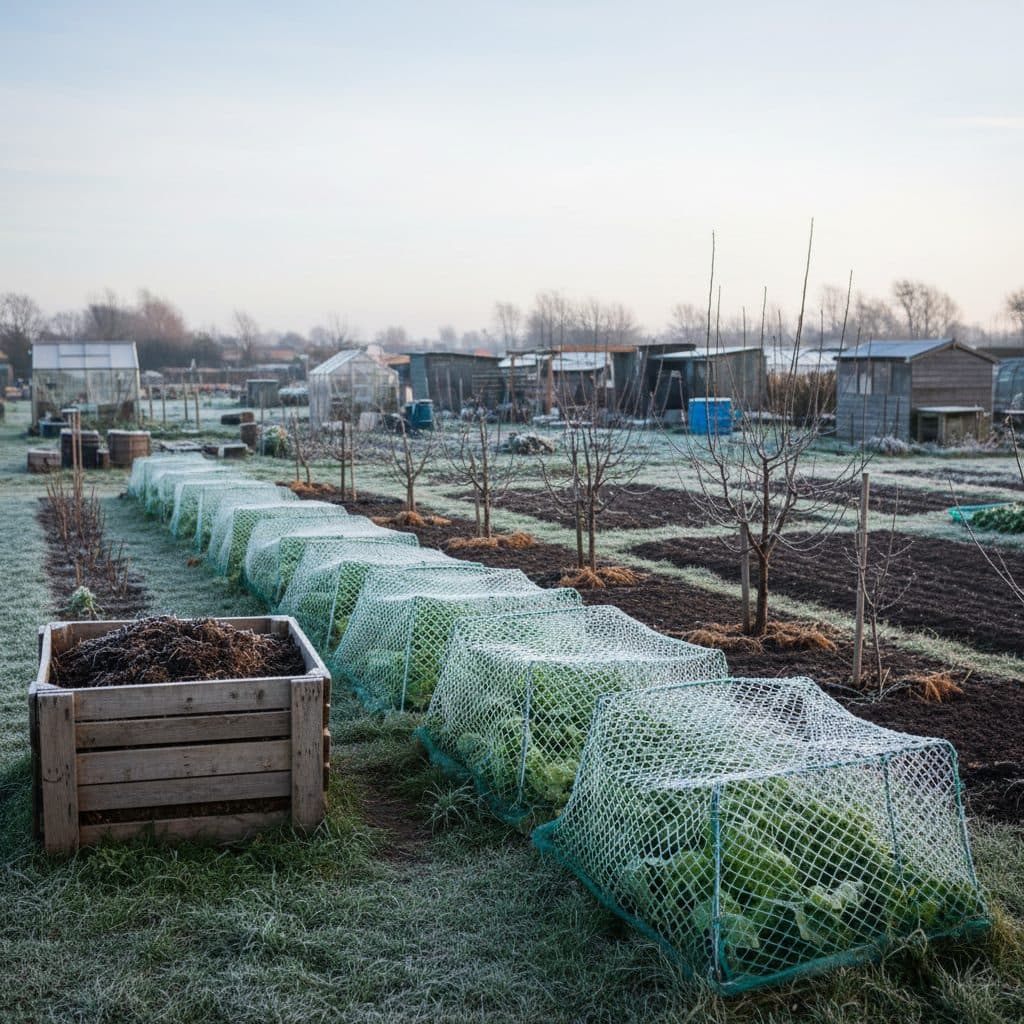
|  3. Inspect brassica netting: Clear heavy snow from nets    |
|  4. Protect root crops: Mulch parsnips and leeks in ground  |
|  5. Maintain paths: Lay fresh wood chips on access routes   |
+-------------------------------------------------------------+
Apply a 5 cm blanket of well-rotted farmyard manure or garden compost across cleared beds. Earthworms and soil organisms will draw organic matter down into the soil over winter, creating a friable, weed-free seedbed for spring without requiring double-digging.
Check your compost system to ensure decomposition continues smoothly. Applying methods from our guide on small space composting or adjusting ratios using rebalancing problem compost pile keeps organic matter cycling efficiently through the cold months.
Allotment planning and infrastructure maintenance
Quiet winter afternoons provide time to maintain plot infrastructure and design crop rotations for the upcoming season.
- Path maintenance: Suppress encroaching couch grass and winter mud by laying cardboard topped with thick wood chips along your walkways. Reviewing allotment paths provides practical surface ideas that comply with local council and association tenancy rules.
- Crop rotation design: Map out four-year crop rotation blocks (legumes, brassicas, roots, and alliums/solanums) to slow the buildup of soil-borne clubroot and white rot. Once clubroot or white rot is present, rotation alone will not clear it—the resting bodies survive 15 to 20 years; use resistant cultivars and raised, limed beds for clubroot, and keep alliums off infected ground.
- Tool reconditioning: Clean spades, hoes, and secateurs with wire brushes, sharpening cutting edges with a whetstone and rubbing metal parts with boiled linseed oil to prevent winter rust. Spread linseed-oil rags flat outdoors to dry, or seal them in a metal tin of water, before disposal—bunched oily rags can catch fire on their own.
- Seed ordering: Review seed catalogues early in December to secure desired heritage varieties before popular seed stocks sell out.
By taking advantage of bare-root planting windows, indoor microgreens, and structural maintenance, you turn December into a highly productive month. At agripure, honest, practical advice helps British growers make the most of their allotments in every season.