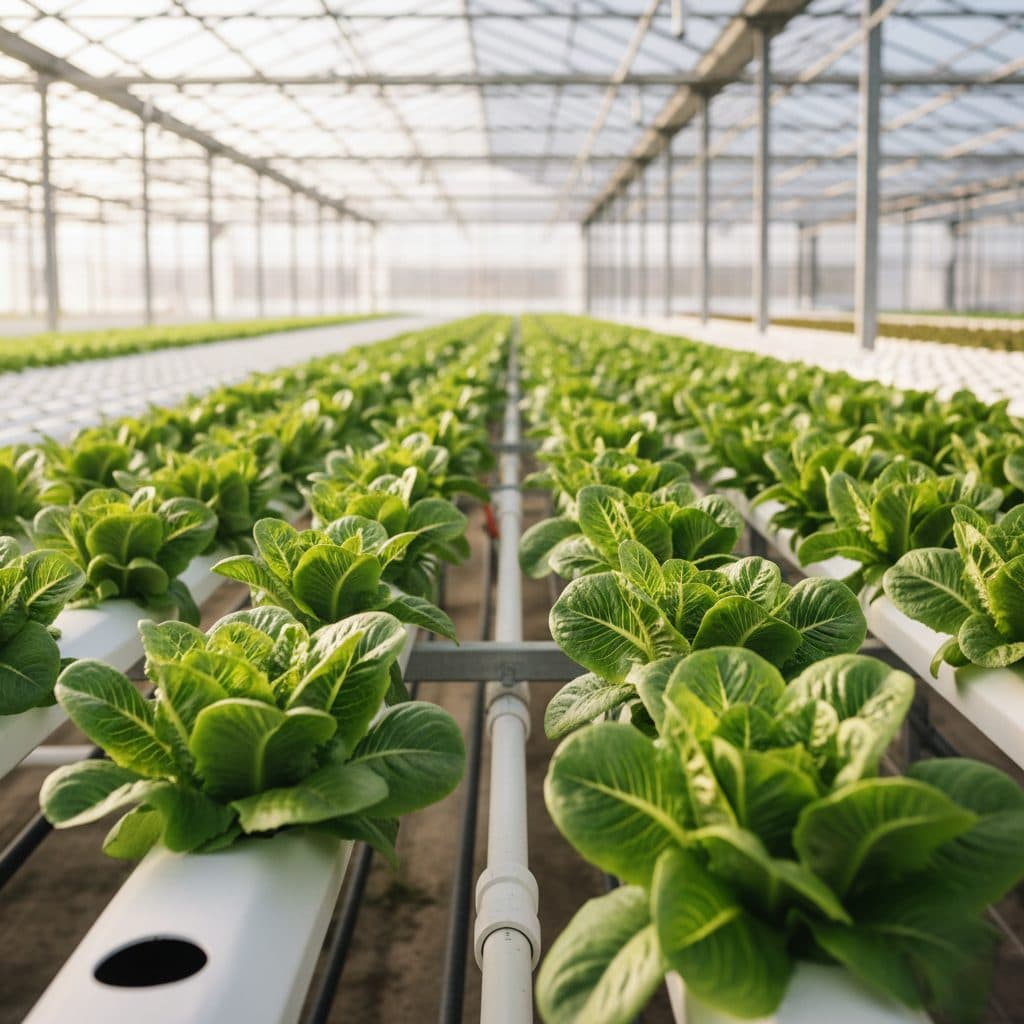
Key takeaways
- Whole-head harvesting typically offers a single, larger yield per plant, often reaching 150-200 grams per head.
- Harvest-and-come-again provides multiple smaller harvests from a single plant, extending the plant’s productive life by several weeks.
- Labor efficiency varies; whole-head is a one-time task per plant, while cut-and-come-again requires more frequent, but less intensive, handling.
- Cut-and-come-again can increase total biomass yield by 20-30% over a longer period compared to a single whole-head harvest.
- Nutrient solution management is critical for sustained growth in cut-and-come-again systems, requiring consistent EC levels around 1.4-1.8 mS/cm.
- Choosing a method depends on your market, labor availability, and desired harvest frequency, with 6-8 week cycles common for whole-head.
Quick answer: Hydroponic lettuce can be harvested using either whole-head or cut-and-come-again methods. Whole-head offers a single, larger yield per plant, while cut-and-come-again provides multiple smaller harvests, potentially increasing total biomass yield by 20-30% over a longer period.
In the world of controlled environment agriculture, especially for growers in places like southern California or USDA zone 9, lettuce is a staple crop, and how you harvest it makes a big difference to your bottom line. We're talking about more than just snipping leaves: two distinct strategies, harvest-and-come-again (sometimes called cut-and-come-again) and whole-head harvesting, each with its own rhythm and reward. For instance, a well-managed hydroponic setup can produce a significant amount of lettuce per square foot annually, and that number shifts based on your chosen harvest method.
Understanding these methods isn’t just academic; it’s about optimizing your system for maximum output and efficiency. Whether you’re running a small indoor grow tent or a commercial facility covering 2,000 square feet, the decisions you make at harvest time impact everything from labor costs to market appeal. Let’s dig into the details and see which approach might best serve your growing goals, aiming for an optimal yield increase where possible.
Understanding whole-head harvesting
Whole-head harvesting is straightforward: you grow a lettuce plant to its full maturity, then cut the entire head at the base, usually just above the root crown. This method is common for varieties like Romaine, Butterhead, or Iceberg lettuce, which typically reach a marketable size in 30 to 45 days in a hydroponic system. For instance, a mature Butterhead lettuce might weigh 150 to 200 grams at harvest, providing a substantial, single-serving product for consumers. This approach simplifies packaging and distribution, as each unit is a complete, visually appealing head of lettuce.
the single-pass approach
This method mirrors what some large-scale agricultural operations do, like the single-pass corn harvesting systems mentioned in research from 2023 [2]. You plant, you grow, you harvest all at once, then you replant. This cycle is efficient for high-volume production where consistent product size and rapid turnover matter most. A typical hydroponic farm might aim for 10 to 12 cycles per year using this method, yielding a predictable volume of produce. The primary benefit is the reduced handling per plant during the harvest phase, as each plant is only touched once. However, it also means a shorter period of active growth for each individual plant, which can impact overall system productivity if not managed with tight planting schedules.
- Predictable yield: Each plant yields one full head, often 150-200 grams.
- Market appeal: Whole heads are preferred by many consumers and restaurants.
- Simplified logistics: Easier to pack and ship uniform units.
- Faster turnover: Plants are harvested and replaced within 5-7 weeks.
- Lower individual plant labor: Each plant is handled only once at harvest.
Exploring harvest-and-come-again
The harvest-and-come-again method, sometimes referred to as cut-and-regrow, involves taking only the outer leaves of the lettuce plant, allowing the inner leaves to continue growing for subsequent harvests. This technique is particularly effective for loose-leaf varieties like Buttercrunch, or certain types of lettuce and spinach. You might start harvesting as early as 21 days after transplanting, taking about 30% of the plant’s biomass at each cut. This method extends the productive life of a single plant by several weeks, potentially yielding three to five harvests over a 60 to 90-day period.
the multiple-pass approach
This strategy is akin to multiple-pass harvesting systems, where a single ‘plant’ or field is revisited for successive yields. For hydroponic lettuce, this means you get a steady supply of fresh greens from fewer plants over a longer duration. For instance, a single plant might yield 50 grams of leaves every 10-14 days, accumulating a total biomass of 150-250 grams over its lifespan. This method can lead to a higher total yield per square foot over time, as the plant continues to photosynthesize and grow. It’s a great option for home growers or local markets that value continuous fresh produce over large, single batches. Maintaining optimal nutrient solution strength, around 1.4-1.8 mS/cm, matters for plant recovery and regrowth.
- Continuous supply: Provides fresh leaves every 10-14 days.
- Higher total biomass: Can increase overall yield by 20-30% per plant.
- Reduced replanting: Fewer seedlings needed, saving on propagation costs.
- Extended plant life: Plants can produce for 60-90 days or longer.
- Freshness on demand: Harvest only what’s needed, reducing waste.
Yield and labor considerations
When comparing yield, it’s not always a simple grams-per-plant calculation. With whole-head harvesting, you get one substantial yield of, say, 180 grams per plant, in a relatively short 35-day cycle. If you plant 100 heads, you harvest 100 heads. For harvest-and-come-again, that same plant might give you three harvests of 60 grams each over 70 days, totaling 180 grams. However, because the plant occupies the space for a longer period, the yield per unit of time or yield per square foot per year can differ significantly. For some leafy greens, cut-and-come-again can increase total biomass yield over a longer period compared to a single whole-head harvest.
labor efficiency and market demand
Labor is a major factor for any grower, especially in operations with 500 or more plants. Whole-head harvesting involves a single, more intensive harvest event per plant. You might spend 2 hours harvesting 100 heads, then another 1 hour cleaning and replanting. In contrast, harvest-and-come-again requires more frequent, but less intensive, trips to the plants. You might spend 30 minutes harvesting 100 plants every 10 days for 60 days, totaling 3 hours of harvest time over the plant’s life, plus less frequent replanting. The choice often comes down to your market: do your customers prefer full heads for salads, or are they looking for a continuous supply of fresh, loose leaves? Many farmers markets in the Pacific Northwest, for example, see strong demand for both types of product, often at different price points per pound.
- Whole-head labor: One intensive harvest per plant, then replant.
- Cut-and-come-again labor: Multiple, less intensive harvests per plant.
- Market preference: Whole heads for retail, loose leaves for continuous home use.
- Yield per square foot: Cut-and-come-again can offer a 20-30% higher total biomass over time [1].
- Replanting frequency: Whole-head requires more frequent replanting cycles, perhaps 10-12 times a year.
Optimizing for your system
The best harvesting method for your hydroponic or aquaponic system depends on several factors, including your specific lettuce variety, available space, labor resources, and target market. For instance, if you’re growing in a small, vertical farm in a dense urban area like New York City, where space is at a premium, optimizing for yield per square foot with harvest-and-come-again might make more sense. You can continuously produce fresh greens from a smaller footprint, potentially generating 25% more usable product over a 90-day period compared to a single whole-head crop.
variety selection and plant health
Certain lettuce varieties are better suited for one method over the other. Loose-leaf types like Black Seeded Simpson or Grand Rapids are excellent for cut-and-come-again, as they readily regrow new leaves from their central meristem. For these, maintaining a consistent nutrient solution pH between 5.8 and 6.2 matters for good regrowth. On the other hand, compact head-forming varieties like Parris Island Cos Romaine or Bibb are ideal for whole-head harvesting, yielding a dense, uniform product. Regardless of the method, plant health is paramount. Regular monitoring for pests and diseases, and ensuring adequate light (at least 12-14 hours per day), will maximize your success. Consider using a system that allows for easy access to plants, perhaps a deep water culture (DWC) setup where plants float on nutrient-rich water, making harvesting simpler.
- Loose-leaf varieties: Best for cut-and-come-again (e.g., Black Seeded Simpson).
- Head-forming varieties: Best for whole-head (e.g., Parris Island Cos Romaine).
- Nutrient pH: Maintain 5.8-6.2 for optimal growth and regrowth.
- Light duration: Provide 12-14 hours of light daily.
- System design: Choose systems like DWC for easy access and harvesting.
Making the right choice for your operation
Deciding between harvest-and-come-again and whole-head harvesting ultimately boils down to aligning your cultivation practices with your specific goals. If you’re a small-scale grower, perhaps in a community garden in a USDA zone 6 region, supplying a local farm stand with fresh greens daily, the continuous supply of cut-and-come-again might be ideal. It allows you to offer a steady stream of product without the need for large, synchronized planting and harvesting events. This method also reduces the number of seedlings you need to start each week, potentially saving on seed costs over a year.
balancing efficiency and market needs
For larger commercial operations, especially those serving grocery stores or restaurants that require uniform, full heads of lettuce, whole-head harvesting often proves more efficient. The ability to harvest a large batch of 500-1000 plants at once, process them quickly, and ship them out simplifies logistics and ensures consistency. This matters for maintaining contracts that specify product size and weight, often requiring heads to be within a specific weight variance. While the labor for whole-head harvesting is concentrated, it can be streamlined with specialized tools and efficient workflows, minimizing the per-unit cost. The USDA Natural Resources Conservation Service (2024) emphasizes the importance of resource management, and this extends to how we manage our harvest cycles [6].
- Small-scale growers: Benefit from continuous supply and reduced seed costs (15-20% savings).
- Large-scale operations: Prioritize uniformity and batch processing for market contracts.
- Logistics: Whole-head simplifies shipping of large, uniform orders.
- Labor costs: Can be streamlined to about $0.15 per head for whole-head.
- Resource management: Align harvest methods with overall resource efficiency [6].
Comparison of Hydroponic Lettuce Harvesting Methods
Feature | Whole-Head Harvesting | Harvest-and-Come-Again |
|---|---|---|
Harvest Frequency | One-time per plant (30-45 days) | Multiple times per plant (every 10-14 days) |
Product Type | Full, intact head (e.g., 180 grams) | Loose leaves, individual cuts (e.g., 50 grams per cut) |
Total Yield per Plant | Lower over time (e.g., 180 grams) | Potentially 20-30% higher total biomass (e.g., 250 grams) |
Labor Intensity | High per event, low frequency | Low per event, high frequency |
Market Suitability | Retail grocery, restaurants (uniformity) | Farmers markets, home use, continuous supply |
Plant Life | Short (30-45 days) | Extended (60-90 days) |
Replanting Needs | Frequent, after each harvest | Less frequent, after multiple cuts |
Yield Potential: Harvest-and-come-again can increase total biomass yield over a plant’s extended lifespan compared to a single whole-head harvest.
Harvest Cycle: Whole-head lettuce typically matures for harvest in 30-45 days in hydroponic systems, allowing for 10-12 cycles annually.
Labor Cost: For commercial whole-head operations, labor can be streamlined with efficient workflows.
Frequently asked questions
Which lettuce varieties are best for harvest-and-come-again?
Loose-leaf varieties like Black Seeded Simpson, Grand Rapids, and Romaine are excellent choices for cut-and-come-again harvesting. These types readily regrow new leaves from their central meristem, allowing for multiple harvests over a 60-90 day period.
How often can I harvest using the cut-and-come-again method?
With optimal growing conditions, you can typically harvest outer leaves every 10-14 days using the cut-and-come-again method. This allows the plant sufficient time to regrow, often yielding 3-5 cuts from a single plant.
Does whole-head harvesting yield more per plant?
While a single whole-head harvest provides a larger, one-time yield (e.g., 180 grams), the harvest-and-come-again method can result in a 20-30% higher total biomass yield from a single plant over its extended lifespan of 60-90 days [1].
What are the main labor differences between the two methods?
Whole-head harvesting involves a single, more intensive labor event per plant, typically taking 2-3 hours for 100 heads, followed by replanting. Harvest-and-come-again requires more frequent, but less intensive, labor, perhaps 30 minutes for 100 plants every 10 days, reducing replanting frequency.
Is one method better for commercial operations?
For large commercial operations serving grocery stores, whole-head harvesting is often preferred due to its uniformity and simplified logistics for batch processing of 500-1000 plants. Smaller operations or those serving farmers markets might prefer cut-and-come-again for continuous fresh supply and reduced seed costs.
What nutrient levels are best for regrowing lettuce?
For optimal regrowth in cut-and-come-again systems, maintain your hydroponic nutrient solution’s electrical conductivity (EC) between 1.4-1.8 mS/cm and the pH level between 5.8 and 6.2. Consistent nutrient availability is crucial for plant recovery and subsequent leaf development.
References
- HARVEST (2023). HARVEST.
- WHOLE-PLANT CORN HARVESTING FOR BIOMASS: COMPARISON OF SINGLE-PASS AND ULTIPLE-PASS HARVEST SYSTEMS (2023). WHOLE-PLANT CORN HARVESTING FOR BIOMASS: COMPARISON OF SINGLE-PASS AND ULTIPLE-PASS HARVEST SYSTEMS.
- again-come, v..
- BORN AGAIN.
- [\Grab] Come Break My Heart Again.
- USDA Natural Resources Conservation Service (2024). USDA Natural Resources Conservation Service.