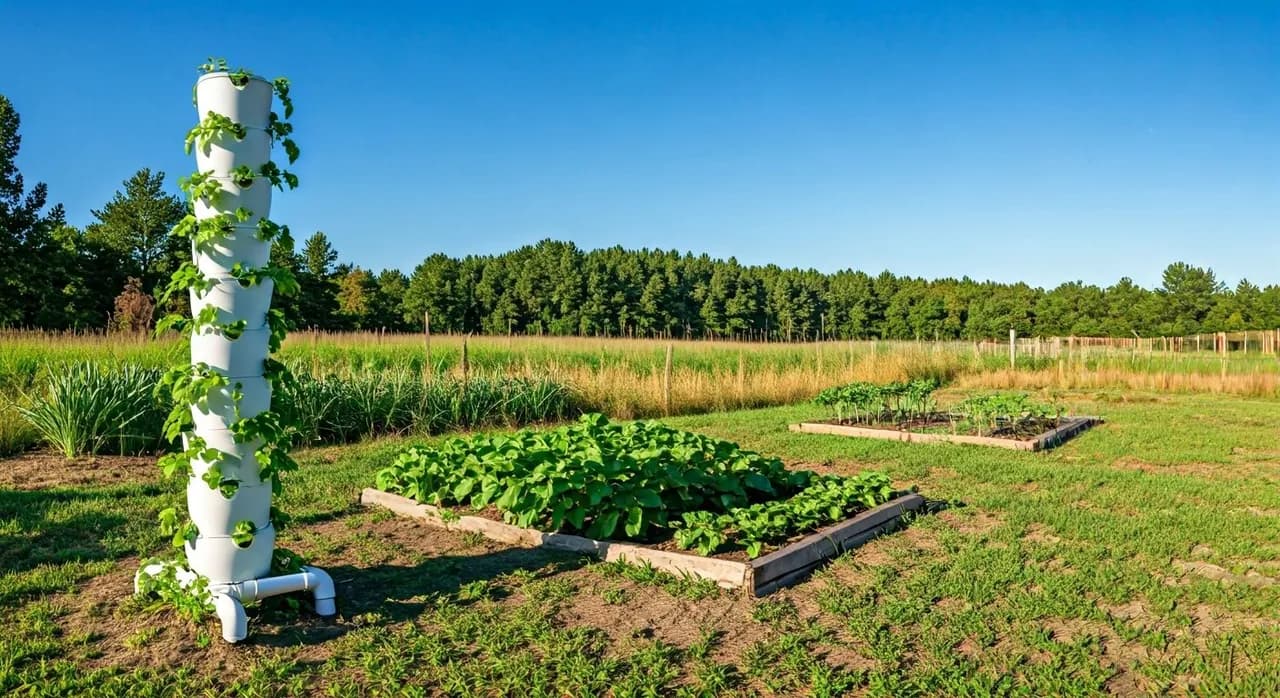
Key takeaways
- DIY PVC vertical towers offer a significantly lower upfront cost, often under a couple hundred dollars, compared to commercial Tower Gardens which can cost over seven hundred dollars.
- Commercial Tower Gardens typically provide around 20 to 28 plant sites, while DIY setups can be built to hold a similar number, often ranging from 10 to 20 sites.
- Hydroponic vertical farming systems can use 70% to 90% less water than traditional soil gardening methods.
- Plants in vertical hydroponic systems can grow significantly faster due to optimized nutrient delivery.
- DIY systems require more planning, construction time, and ongoing maintenance adjustments, but offer customization.
- Commercial systems provide convenience, support, and often better aesthetics, but at a higher price point.
Quick answer: DIY PVC vertical towers offer a lower upfront cost ($100-$200) and customization, while commercial Tower Gardens ($700-$1000) provide convenience, support, and often better aesthetics, both offering significant yield in less space.
In the arid regions of the American Southwest, where water conservation is paramount, or in dense urban areas like New York City, vertical gardening offers a compelling solution for growing fresh produce. Many growers in USDA zone 7, for example, are looking for ways to extend their growing season and maximize space. Two popular approaches stand out: building a DIY vertical tower from PVC pipe or investing in a commercial system like the Tower Garden.
This article will break down the costs, potential yields, and practical considerations for both options, providing real numbers and practical advice. We will compare the initial investment, ongoing operational expenses, and the expected harvest from each system, helping you decide which path best suits your gardening goals and budget, whether you are aiming for a small herb garden or a more substantial vegetable yield.
The appeal of vertical hydroponic gardening
Vertical hydroponic gardening has gained considerable traction across the United States, from backyard enthusiasts in Florida to commercial operations in California. This method allows growers to produce more food in a smaller footprint, often using significantly less land than traditional farming methods. For instance, a vertical tower occupying just 3 square feet can support 20 or more plants, a density unachievable in a conventional garden plot.
Beyond space efficiency, hydroponics offers significant water savings. Studies suggest that these systems can reduce water consumption by 70% to 90% compared to soil-based agriculture, a critical advantage in states like Arizona where water resources are scarce. Plants also tend to grow significantly faster in hydroponic setups, reaching maturity sooner and allowing for more harvest cycles per year. This accelerated growth is due to the direct delivery of nutrient-rich water to the roots, bypassing soil-borne pests and diseases. Many growers are finding success with a variety of crops, from leafy greens like lettuce and spinach to herbs such as basil and garden sage, even strawberries.
Why vertical growing makes sense for many
- Space efficiency: Grow 10-28 plants in less than 3 square feet.
- Water conservation: Can use 70% to 90% less water than traditional gardening.
- Faster growth: Plants can mature 30% to 50% quicker, yielding more harvests.
- Pest reduction: Minimize soil-borne pests and diseases, reducing crop loss.
- Year-round growing: Possible indoors with supplemental lighting, even in USDA zone 4 winters.
Building a DIY PVC vertical tower: cost and considerations
For the hands-on grower, constructing a DIY PVC vertical tower can be a rewarding and cost-effective project. The core components include a 4-inch or 6-inch diameter PVC pipe, a submersible pump, a reservoir, and net cups. A 10-foot section of 4-inch PVC pipe typically costs around $30 to $50 at hardware stores in states like Ohio. You will need to cut holes for net cups, which can be done with a 2-inch hole saw for about $15.
A small submersible pump, suitable for recirculating water, can be purchased for $20 to $50. For the reservoir, a 5- to 10-gallon plastic tote works well and costs $10 to $30. Net cups and growing media, such as rockwool or coco coir, might add another $10 to $20. Total material costs for a basic DIY system often fall between $100 and $200. This estimate does not include the cost of nutrients, which can be $30 to $60 for a starter kit, or supplemental lighting if growing indoors, which could add $50 to $200 for an LED grow light, especially if you’re setting up a reflective indoor grow tent.
Essential components for a DIY system
- PVC pipe: One 10-foot section of 4-inch or 6-inch diameter pipe for $30-$50.
- Submersible pump: A 200-400 GPH pump for $20-$50.
- Reservoir: A 5-10 gallon plastic tote for $10-$30.
- Net cups and media: 10-20 net cups and growing media for $10-$20.
- Nutrients: A hydroponic nutrient starter kit for $30-$60.
Investing in a commercial Tower Garden: features and expense
For those seeking convenience and a polished aesthetic, a commercial system like the Tower Garden offers an all-in-one solution. These systems, often seen in urban farms in places like Chicago or educational settings in Texas, are designed for ease of assembly and use. A basic Tower Garden HOME model typically costs between $700 and $1000, which includes the tower, pump, reservoir, initial nutrients, and seed starting supplies. This price point is significantly higher than a DIY setup but includes proprietary aeroponic technology, which delivers nutrients as a fine mist to plant roots, as noted in research on aeroponic systems [1].
The Tower Garden Classic, for example, comes with 20 plant sites, allowing for a substantial harvest of leafy greens, herbs, or even small fruiting plants like garden peas. The system’s design often includes a 20-gallon reservoir, reducing the frequency of water top-offs compared to smaller DIY reservoirs. While the initial investment is higher, commercial systems often come with detailed instructions, customer support, and a warranty, providing peace of mind for new growers. They are also generally more compact and visually appealing for indoor use, fitting well in a sunroom or on a patio in USDA zone 8.
Advantages of commercial systems
- Ease of setup: Pre-engineered components mean quick assembly, often in under an hour.
- Integrated design: All parts are designed to work together seamlessly, including the pump and nutrient delivery.
- Customer support: Access to troubleshooting guides and direct assistance from the manufacturer.
- Aesthetics: Often more visually appealing for home or public display, with a smaller footprint of about 2.5 square feet.
- Aeroponic efficiency: Advanced nutrient delivery can lead to optimized growth, with some claiming 30% faster growth.
Comparing yield, maintenance, and long-term value
When comparing yield, a commercial Tower Garden typically offers 20 to 28 plant sites, allowing for a consistent harvest of popular crops like lettuce, kale, or herbs. A well-managed Tower Garden can produce several pounds of leafy greens per month, or a steady supply of herbs for a family of four. DIY PVC towers, depending on their design and height, usually support 10 to 20 plant sites. While this means a slightly lower potential yield per tower, a DIY system can be scaled by building multiple towers, perhaps three towers for a total of 45 plants, for less than the cost of one commercial unit.
Maintenance is another key differentiator. Commercial systems often feature robust pumps and integrated timers, simplifying the daily routine. Nutrient solution changes are recommended every two to three weeks, requiring about 15 minutes of effort. DIY systems, while functional, might require more frequent checks on water levels, pump performance, and nutrient balance, especially if using less expensive components. For example, a 1/4-inch garden PE irrigation hose may need more frequent inspection for clogs than a commercial system’s tubing. Long-term, the durability of commercial-grade plastics and components often surpasses that of standard PVC, though a well-built DIY system can last for many years with proper care, especially in a sheltered environment like a small greenhouse kit.
Key comparison points
- Plant capacity: Commercial systems (20-28 sites) generally offer more sites than DIY (10-20 sites) per unit.
- Yield potential: Commercial can yield 6-8 pounds of greens monthly; DIY can achieve similar with multiple units.
- Maintenance effort: Commercial systems often require less hands-on adjustment due to integrated design.
- Durability: Commercial systems typically use higher-grade, UV-resistant plastics for longer life.
- Customization: DIY offers complete control over design, plant spacing, and component choices.
DIY PVC Tower vs. Commercial Tower Garden: A Quick Comparison
Feature | DIY PVC Vertical Tower | Commercial Tower Garden |
|---|---|---|
Initial Cost | $100 – $200 | $700 – $1000 |
Plant Sites | 10 – 20 | 20 – 28 |
Assembly Time | 4 – 8 hours | 0.5 – 1 hour |
Customization | High | Low |
Maintenance | Moderate, more hands-on | Low, automated |
Durability | Moderate (PVC, standard pump) | High (UV-resistant plastic, quality pump) |
Support | Community forums, self-reliance | Manufacturer support, warranty |
DIY Cost Savings: Building a DIY PVC tower can save you $500 to $800 on initial investment compared to buying a commercial Tower Garden.
Water Efficiency: Vertical hydroponic systems, whether DIY or commercial, can save 70% to 90% of the water used in traditional soil gardening.
Frequently asked questions
How much space does a vertical tower garden require?
Most vertical tower gardens, both DIY and commercial, require a footprint of only 2.5 to 3 square feet. This compact design allows them to fit on small patios, balconies, or even indoors with supplemental lighting, making them ideal for urban environments or small yards in places like Portland, Oregon.
What kind of plants grow best in vertical hydroponic towers?
Leafy greens like lettuce, kale, spinach, and Swiss chard thrive in vertical towers, as do most herbs such as basil, mint, and cilantro. Small fruiting plants like strawberries and <a href=”https://agripure.org/plants/pisum-sativum”>garden peas</a> also perform well, often yielding a consistent harvest over several months.
Is it cheaper to build a DIY tower or buy a commercial one?
Building a DIY PVC vertical tower is significantly cheaper, with material costs typically ranging from $100 to $200. A commercial Tower Garden, on the other hand, usually costs between $700 and $1000 for a complete starter system, representing a 3x to 10x higher initial investment.
How often do I need to change the water and nutrients?
For both DIY and commercial hydroponic systems, it is generally recommended to change the nutrient solution every two to three weeks. This ensures plants receive fresh, balanced nutrients and prevents the buildup of unwanted salts, contributing to healthier growth and better yields, often increasing the harvest.
Can vertical tower gardens be used indoors during winter?
Yes, vertical tower gardens can be used indoors year-round, even in cold climates like USDA zone 4, with the addition of proper grow lights. Many growers utilize <a href=”https://agripure.org/shop/beylsion-grow-tent-growbox-plant-tent-indoor-hydroponics-grow-room-tent-growing-tent-for-indoor-greenhouse-growing-plants-mylar”>grow tents</a> and LED lighting to provide the 12-16 hours of light plants need daily, ensuring continuous harvests regardless of outdoor temperatures.
References
- Aeroponic tower garden solar powered vertical farm (2023). Aeroponic tower garden solar powered vertical farm.
- 13. The Old church tower and Garden wall (2023). 13. The Old church tower and Garden wall.
- From ivory tower to walled garden (2019). From ivory tower to walled garden.
- From ivory tower to walled garden (2019). From ivory tower to walled garden.
- The One World Observatory: Caught between Vertical and Horizontal Gigantism (2020). The One World Observatory: Caught between Vertical and Horizontal Gigantism.
- USDA Natural Resources Conservation Service (2024). USDA Natural Resources Conservation Service.