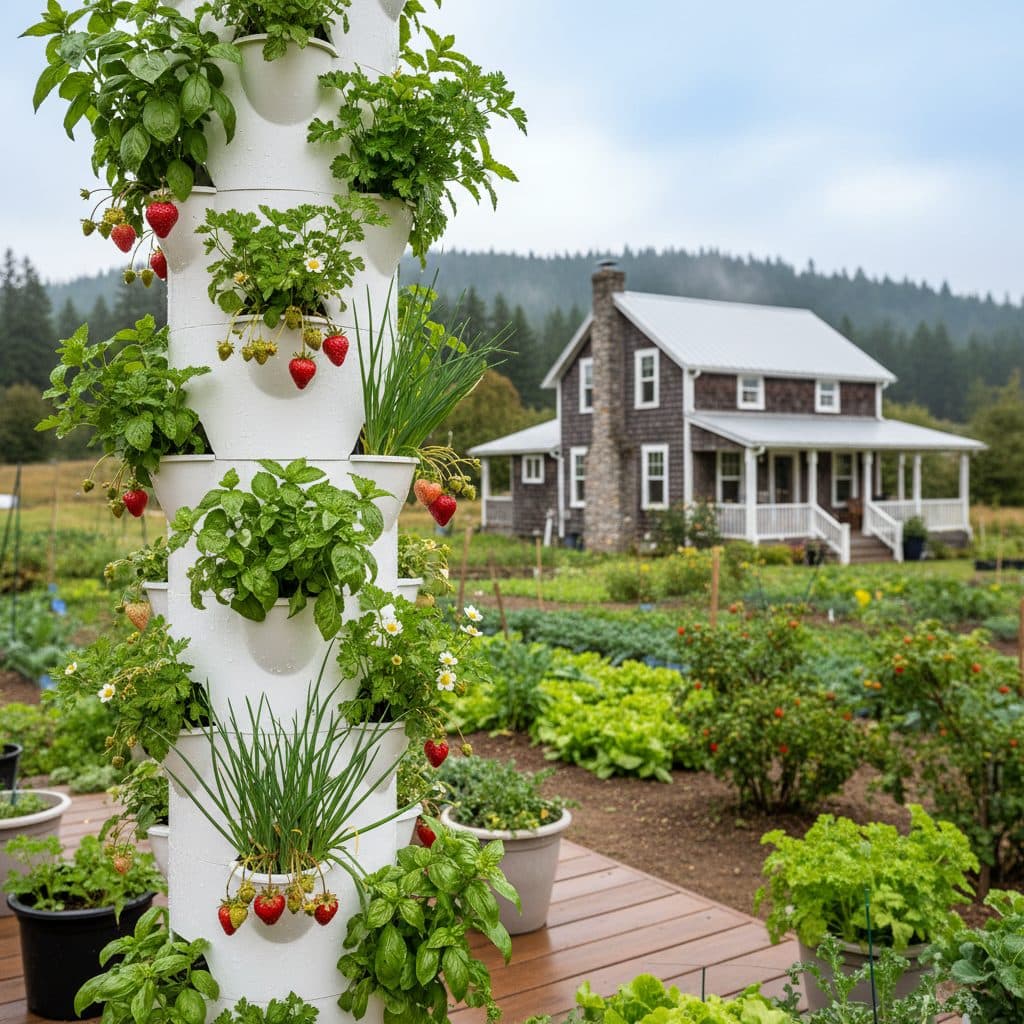
Key takeaways
- Vertical systems increase herb and strawberry yields by up to ten times per square foot.
- Hydroponics and aquaponics significantly reduce water use, often by 70% to 95% compared to traditional farming.
- Proper lighting, typically 12-16 hours daily, is crucial for optimal growth in vertical setups.
- Nutrient Film Technique (NFT) and Deep Water Culture (DWC) are effective systems for these crops.
- Maintaining specific nutrient solution parameters, like EC 1.2-1.8 mS/cm for strawberries, is vital.
- Year-round production is achievable, allowing for multiple harvests annually, even in colder USDA zones.
Quick answer: Vertical farming can increase herb and strawberry yields by up to ten times per square foot in controlled environments, significantly reducing water usage by 70% to 95% compared to traditional farming methods.
In regions like the arid Southwest, where water is a precious resource, growers are constantly seeking methods to produce more with less. Traditional field farming in areas such as Arizona’s Yuma Valley consumes vast amounts of water, often relying on irrigation from distant sources. Vertical farming offers a compelling alternative, allowing for substantial crop production in a fraction of the space and with significantly reduced water usage, making it an attractive option for both urban and rural settings.
This approach is particularly effective for high-value crops like herbs and strawberries, which can thrive in controlled environments. Vertical systems can increase crop yield per square foot by up to ten times compared to traditional field farming methods, making efficient use of limited space [3]. By understanding the specific needs of these plants and the various soilless growing techniques, US growers can cultivate fresh produce year-round, regardless of local climate challenges, from the humid Southeast to the colder climates of USDA zone 5.
The vertical advantage for herbs and strawberries
Embracing vertical farming for herbs and strawberries offers several distinct advantages over traditional horizontal cultivation. This method allows growers to maximize production in minimal square footage, making it ideal for urban settings or properties with limited outdoor space, such as a small backyard in Portland, Oregon. Vertical systems can increase crop yield per square foot by up to ten times compared to traditional field farming methods, enabling continuous harvests throughout the year, even in USDA zone 4 where outdoor growing seasons are short [3].
Why go vertical?
Beyond space efficiency, vertical growing significantly reduces water consumption, often by 70% to 95%, compared to conventional agriculture, which is a critical benefit in drought-prone areas like California’s Central Valley. Controlled environments also minimize exposure to pests and diseases, potentially reducing the need for chemical treatments and leading to healthier plants and produce. This control also allows for precise climate management, ensuring optimal growing conditions for specific varieties of herbs and strawberries, resulting in consistent quality and faster growth cycles, sometimes reducing time to harvest compared to field-grown crops.
- Yield per square foot: Up to ten times more produce than traditional farming.
- Water savings: Reduces water use by 70% to 95%.
- Climate control: Year-round production, up to 15 harvests annually for some herbs.
- Pest reduction: Significantly lowers pest and disease pressure in enclosed systems.
- Resource efficiency: Less land and fewer external inputs required for high output.
Hydroponic systems for vertical growth
Hydroponics, a method of growing plants without soil, is foundational to most vertical farming operations. It delivers nutrient-rich water directly to plant roots, leading to efficient nutrient uptake and faster growth. In a typical indoor setup in a grow tent, like those found at agripure.org/shop/beylsion-grow-tent-growbox-plant-tent-indoor-hydroponics-grow-room-tent-growing-tent-for-indoor-greenhouse-growing-plants-mylar, water use can be reduced by 90% or more compared to traditional soil gardening [6]. This efficiency is particularly valuable for growing thirsty crops like strawberries.
Popular vertical hydroponic methods
The Nutrient Film Technique (NFT) is highly effective for herbs and strawberries, circulating a shallow stream of nutrient-rich water past the roots, allowing for excellent oxygenation. Deep Water Culture (DWC) systems, while simpler, submerge roots in a constantly aerated nutrient solution, often in 15-20 gallon reservoirs, and are well-suited for larger, more established plants. Aeroponics, which mists roots with nutrient solution every few minutes, offers even greater oxygenation and can lead to faster growth rates, though it requires more technical precision and can require a higher initial investment than some other systems.
- Nutrient Film Technique (NFT): Ideal for leafy greens and strawberries, uses a thin film of water.
- Deep Water Culture (DWC): Roots are submerged in aerated nutrient solution, good for robust plants.
- Aeroponics: Roots are misted with nutrients, offering superior oxygenation and growth.
- Wick Systems: Simple, passive systems suitable for smaller herbs with minimal power needs.
- Drip Systems: Delivers nutrient solution directly to the base of each plant, common in larger setups.
Aquaponics: combining fish and plants
Aquaponics integrates aquaculture (raising fish) with hydroponics, creating a symbiotic ecosystem where fish waste provides nutrients for the plants, and the plants filter the water for the fish. This method can be incredibly efficient, often achieving a 30:1 fish-to-plant ratio in terms of biomass production, and it reduces the need for external nutrient inputs by 50% or more compared to hydroponics [3]. Setting up a small system in a garage or basement can start with a 20-gallon fish tank, as explored in more detail at agripure.org/articles/aquaponics-fish-tank.
Designing an aquaponics system
A successful aquaponics system relies on a balanced nitrogen cycle. Fish, such as tilapia or trout, produce ammonia, which beneficial bacteria convert first to nitrites and then to nitrates. These nitrates are then absorbed by the plants as a primary nutrient source. Maintaining water parameters is crucial; fish typically thrive in temperatures between 70-80°F, while plants prefer a pH range of 6.0-7.0. A biofilter, often integrated into the grow beds, provides a surface area for these beneficial bacteria to colonize, processing waste from approximately one to two pounds of fish per ten gallons of water.
- Fish Tank: Houses the fish, typically 20 gallons or larger for a small system.
- Grow Beds: Where plants are grown, often using media like expanded clay pebbles.
- Biofilter: Provides a surface for nitrifying bacteria to convert ammonia to nitrates.
- Water Pump: Circulates water from the fish tank to the grow beds and back.
- Air Pump/Airstone: Ensures adequate oxygenation for both fish and beneficial bacteria.
Soilless substrates and nutrient management
In soilless growing, the substrate provides physical support for the plants, while all essential nutrients are delivered through the water. Unlike traditional soil, these inert media do not contribute nutrients, giving the grower complete control over the plant’s diet. For instance, in a vertical herb garden, consistent nutrient delivery can lead to a 30% increase in aromatic oils compared to soil-grown counterparts [1]. Understanding nutrient requirements is paramount for success, especially for demanding crops like strawberries.
Specific nutrient needs
Herbs generally prefer a slightly acidic pH range of 5.5-6.5, while strawberries thrive with a specific Electrical Conductivity (EC), typically between 1.2 and 1.8 mS/cm, indicating the concentration of dissolved salts in the nutrient solution. A balanced nutrient solution will include macronutrients like nitrogen, phosphorus, and potassium, as well as micronutrients such as iron, zinc, and manganese. Regularly monitoring and adjusting both pH and EC—typically every 3-7 days—is crucial for preventing nutrient deficiencies or toxicities. For a 10-gallon system, a complete nutrient change every two weeks is often recommended to maintain optimal levels and prevent nutrient lockout.
- Coco Coir: Excellent water retention and aeration, often used in a 70:30 mix with perlite.
- Rockwool: Inert, sterile, and offers good water-holding capacity, commonly used for starting seedlings.
- Perlite: Lightweight volcanic glass that improves drainage and aeration, often mixed with other substrates.
- Vermiculite: Hydrated mineral that retains water and nutrients, suitable for seed starting.
- Clay Pebbles (Hydroton): Porous, lightweight, and reusable, providing good support and drainage.
Lighting, climate control, and pest considerations
Achieving optimal growth in a vertical system hinges on providing the right environmental conditions, with lighting being a primary factor. LED grow lights are the standard, offering energy efficiency—up to 75% less energy than traditional HPS lights—and tunable spectrums to meet specific plant needs. For both herbs and strawberries, a daily light cycle of 12 to 16 hours is generally recommended to support vigorous vegetative growth and fruit production [1]. The intensity of light, measured by Daily Light Integral (DLI), should be adjusted based on the plant’s stage of development, with fruiting strawberries often requiring a DLI of 18-25 mol/m²/day.
Optimal environmental conditions
Beyond light, maintaining consistent temperature and humidity is crucial. Most herbs and strawberries prefer ambient temperatures between 65-75°F (18-24°C) during the day and slightly cooler at night, perhaps a 5-10°F drop. Humidity levels should typically be in the 60-70% range for vegetative growth, dropping to 50-60% during flowering and fruiting to prevent fungal issues. Proper airflow, often achieved with small oscillating fans, is essential to prevent stagnant air pockets and strengthen plant stems. Integrated Pest Management (IPM) strategies, including regular scouting, sticky traps, and beneficial insects, are critical for preventing outbreaks in enclosed environments, where a single pest can multiply rapidly, potentially affecting 100% of the crop if not addressed within a few days.
- Light Duration: 12 to 16 hours of light per day for most herbs and strawberries.
- Temperature: Maintain 65-75°F (18-24°C) during the day, slightly cooler at night.
- Humidity: Target 60-70% for vegetative growth, 50-60% for flowering/fruiting.
- Airflow: Use fans to ensure good air circulation and prevent fungal diseases.
- CO2 Enrichment: Consider supplementing CO2 to 500-1000 ppm for enhanced growth.
Comparison of vertical growing methods for herbs and strawberries
Feature | Hydroponics | Aquaponics | Soilless (Container) |
|---|---|---|---|
Water Use | Very Low (70-95% less) | Low (60-80% less) | Moderate (20-40% less) |
Nutrient Source | Synthetic solutions | Fish waste | Organic/synthetic amendments |
Complexity | Moderate | High | Low |
Initial Cost | Moderate | High | Low |
Pest Control | Easier in closed systems | More delicate due to fish | Similar to traditional |
Typical Yield Increase | Up to 10x | Up to 8x | Up to 3x |
Water Efficiency: Vertical hydroponics can reduce water use by up to 95% compared to traditional field farming methods, a significant benefit in arid regions.
Yield Boost: Expect up to ten times the crop yield per square foot in vertical systems compared to conventional methods, maximizing production in limited space [3].
Frequently asked questions
How much space do I need for a vertical herb and strawberry garden?
A vertical garden can fit into surprisingly small spaces. A tower system might only require one to two square feet of floor space, yet it can hold 20-40 plants. For example, a 2×2 ft footprint can yield as much as a 20 sq ft traditional garden.
What are the best herbs and strawberries for vertical growing?
For herbs, basil, mint, chives, and lettuce varieties are excellent choices due to their compact growth and consistent harvests. For strawberries, everbearing varieties like ‘Albion’ or ‘Seascape’ perform well, producing fruit over several months, often yielding a good harvest per plant per season.
How often do I need to change the nutrient solution?
In hydroponic systems, it’s generally recommended to change the nutrient solution every one to two weeks, especially for smaller reservoirs (under 20 gallons). This prevents nutrient imbalances and buildup of unwanted salts, ensuring plants receive a fresh, balanced diet.
Can I use tap water for my vertical system?
Tap water can often be used, but it’s important to test its pH and EC levels first. If your tap water has high chlorine or mineral content, or an unsuitable pH (above 7.5 or below 5.0), filtering or using reverse osmosis water might be necessary to avoid issues with nutrient uptake and plant health.
What kind of lighting is best for vertical herbs and strawberries?
LED grow lights are highly recommended for vertical gardens. They are energy-efficient, produce less heat, and allow for spectrum tuning. Herbs and strawberries typically need 12-16 hours of light per day, with specific light spectrums promoting vegetative growth or fruiting, and consume about 30-50 watts per square foot.
How do I prevent pests in a vertical garden?
Pest prevention in vertical gardens relies on vigilance and proactive measures. Regularly inspect plants, use sticky traps, and maintain good hygiene. If pests appear, introduce beneficial insects or use organic treatments like neem oil, typically applied every 7-10 days, to control infestations without harsh chemicals.
References
- Herbs (2024). Herbs.
- Maximizing the Current Output in Self-Aligned GrapheneInAsMetal Vertical Transistors (2023). Maximizing the Current Output in Self-Aligned GrapheneInAsMetal Vertical Transistors.
- A New Approach for Vertical Plant Cultivation Maximizing Crop Efficiency (2024). A New Approach for Vertical Plant Cultivation Maximizing Crop Efficiency.
- Modeling Vertical Migrations of Zooplankton Based on Maximizing Fitness (2021). Modeling Vertical Migrations of Zooplankton Based on Maximizing Fitness.
- USDA Natural Resources Conservation Service (2024). USDA Natural Resources Conservation Service.
- EPA — Soak Up the Rain (2024). EPA — Soak Up the Rain.