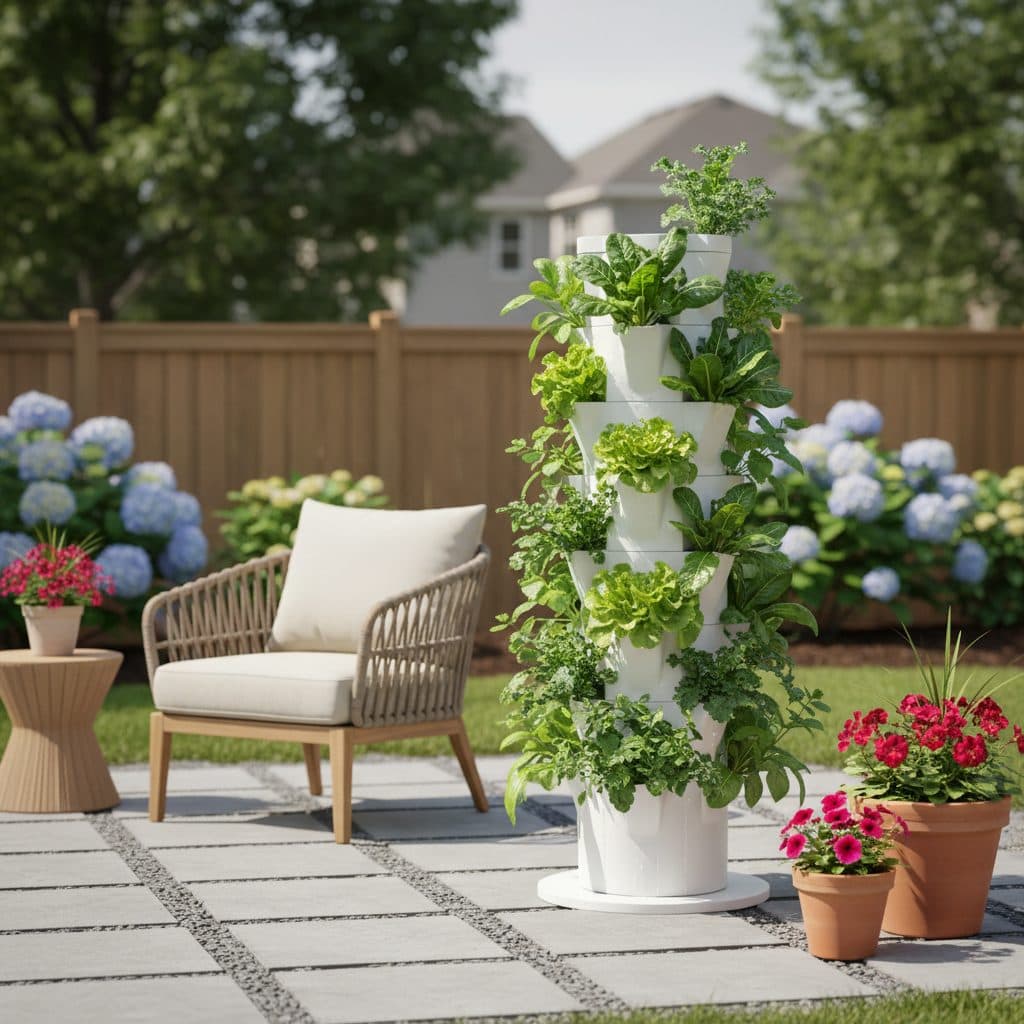
Key takeaways
- Vertical tower systems can grow 20-30 plants in one square foot, ideal for small patios in urban areas like New York City.
- Hydroponics uses up to 90% less water than traditional soil gardening, a significant advantage in drought-prone regions such as California.
- Plants often grow faster and produce more over a season, because nutrient delivery never stops.
- Initial setup costs can range from $300 to $1,000 for a basic system, requiring a notable upfront investment.
- Maintenance includes regular pH and EC monitoring, along with nutrient solution replenishment every one to two weeks.
- Best suited for leafy greens, herbs, and some fruiting plants like strawberries, rather than root vegetables.
Quick answer: Hydroponic vertical tower systems are often worth it for patio gardening, offering higher yields and much lower water use in minimal space.
In densely populated areas like USDA zone 7b in Raleigh, North Carolina, or the compact patios of San Francisco, every square foot of outdoor space is valuable. Traditional gardening can feel limiting when you dream of fresh produce but only have a small concrete slab. This is where hydroponic vertical tower systems enter the picture, promising a bounty of vegetables and herbs in a footprint no larger than a small trash can. Many growers wonder if these systems truly deliver on their promises, especially when faced with an initial investment that can be several hundred dollars.
Vertical hydroponics offers compelling advantages for urban and suburban gardeners, particularly its ability to produce substantial yields in minimal space. But it also comes with its own set of challenges, from technical learning curves to the ongoing cost of nutrients. Let’s dig into whether these systems are a worthwhile addition to your patio garden, considering factors like yield, water usage, and overall effort.
Understanding hydroponic vertical tower systems
A hydroponic vertical tower system is essentially a stacked series of growing pods, often standing five to six feet tall, where plants are grown without soil. Instead, a nutrient-rich water solution is continuously or intermittently pumped from a reservoir at the base to the top of the tower, then trickles down through the plant roots. This recirculating system means plants get a consistent supply of water and dissolved minerals, leading to efficient growth. Most towers are designed to hold between 10 and 30 individual plants, all within a compact footprint of about one square foot.
how tower systems work
These systems operate on a simple principle: deliver water and nutrients directly to the plant roots. A small submersible pump, typically consuming 10 to 20 watts of power, pushes the nutrient solution up a central pipe. The solution then flows out through emitters at each planting pocket, bathing the roots before returning to the reservoir. This method significantly reduces water waste, using up to 90% less water than conventional soil gardening, which is a major benefit in arid regions like Arizona or parts of California where water conservation is critical. The entire cycle can be automated with a simple timer, often set to run for 15 minutes every hour during daylight hours.
- Reservoir: Holds 10 to 20 gallons of nutrient solution.
- Pump: Circulates water from the reservoir to the top.
- Tower sections: Stackable units with planting pockets.
- Net pots: Small mesh cups to hold seedlings and growing media.
- Growing media: Inert materials like rockwool or coco coir to support plants.
The real benefits for patio growers
For anyone with limited outdoor space, like those in a USDA zone 6 apartment building in Chicago, the primary benefit of vertical towers is undeniable space efficiency. A single tower, typically 5 feet tall and 1 foot in diameter, can accommodate 20 to 30 plants, which would require at least 10 square feet of traditional garden bed space. This compact design makes fresh produce accessible even on the smallest balconies or patios. The ability to grow so much in such a small area is a significant draw for urban gardeners.
yields and resource efficiency
Beyond space, hydroponic systems offer impressive gains in yield and resource conservation. Plants grown hydroponically often mature faster than their soil-grown counterparts because their roots have constant access to water, oxygen, and nutrients without needing to search for them. This accelerated growth translates to more frequent harvests over a season than the same space in pots would give. Furthermore, these systems use up to 90% less water compared to traditional in-ground gardening, making them an excellent choice for regions facing water restrictions, such as the southwestern United States. This water efficiency is a major environmental and economic advantage for growers. You can learn more about efficient gardening methods at agripure.org/articles/beginner-vegetable-gardening-faqs.
- Space Savings: Grow 20-30 plants in one square foot.
- Water Conservation: Uses up to 90% less water.
- Faster Growth: Plants mature quicker than the same crops in soil.
- Higher Yields: Expect more produce over a season.
- Reduced Pests: Fewer soil-borne pests, though a warm reservoir invites root-zone pathogens like Pythium.
Drawbacks and practical considerations
While the benefits are compelling, vertical hydroponic systems are not without their challenges. The initial investment can be substantial, with basic starter kits ranging from $300 to $1,000, depending on the number of plant sites and included accessories. This cost is notably higher than setting up a few traditional container pots, which might only run $50 to $100. For a gardener in a USDA zone 8 climate like Houston, Texas, where outdoor growing is possible for much of the year, this upfront expense needs careful consideration against the long-term savings and convenience.
technical learning curve and maintenance
Hydroponics requires a different skill set than soil gardening. Growers need to monitor and adjust the pH of the nutrient solution, ideally keeping it between 5.5 and 6.5 for most vegetables. They also need to measure the Electrical Conductivity (EC) or Total Dissolved Solids (TDS) to ensure nutrient levels are appropriate, keeping leafy greens toward the low end of the range printed on your nutrient label — pushed too strong, lettuce tipburns and turns bitter. This involves purchasing a pH meter and an EC meter, which add another $50 to $100 to the setup cost. The system’s reliance on electricity for the pump means a power outage, even for a few hours, can stress or kill plants, particularly in hot climates where roots can quickly dry out. Furthermore, while many plants thrive, root vegetables like carrots or potatoes are generally not suitable for these systems due to their growth habits. You can explore building simpler systems at agripure.org/articles/diy-hydroponic-system.
- Initial Cost: $300-$1,000 for a starter system.
- Technical Skills: Requires monitoring pH and EC levels.
- Power Dependency: Vulnerable to electricity outages.
- Limited Plant Types: Not suitable for root crops or large vining plants.
- Nutrient Management: Requires precise mixing and replenishment every 1-2 weeks.
Setup, maintenance, and what to grow
Setting up a hydroponic vertical tower system on your patio, whether in a sunny spot in Florida or a protected corner in Oregon, is a straightforward process that typically takes a few hours. Most systems come with clear instructions for assembly, which involves stacking the tower sections, installing the pump in the reservoir, and connecting the tubing. Once assembled, the reservoir is filled with 10 to 20 gallons of water, and the appropriate hydroponic nutrients are added according to manufacturer guidelines, usually a two-part or three-part solution. After mixing, the pH is adjusted to the target range of 5.5 to 6.5, and young seedlings, often started in rockwool cubes, are placed into the net pots in each planting site.
Ongoing maintenance and choosing plants
For ongoing maintenance, checking the pH and EC levels every two to three days is crucial. The nutrient solution in the reservoir should be completely changed every one to two weeks to prevent nutrient imbalances and pathogen buildup. This usually involves draining the old solution, cleaning the reservoir, and refilling with fresh water and nutrients. For plant selection, leafy greens like various types of lettuce, spinach, and Swiss chard are excellent choices, often ready for harvest in as little as 30 days [3]. Herbs such as basil, mint, oregano, and cilantro also thrive in these systems [2]. Small fruiting plants like strawberries and cherry tomatoes can be successful, though tomatoes may require additional support as they grow. Aim for 20-24 plants in a 5-foot tower, focusing on quick-growing greens for a continuous harvest throughout the season.
- Leafy Greens: Lettuce, spinach, kale, Swiss chard are fast growers [3].
- Herbs: Basil, mint, oregano, cilantro, and chives do exceptionally well [2].
- Strawberries: Produce abundant fruit in a vertical setup.
- Bush Beans: Compact varieties can yield well.
- Cherry Tomatoes: Can be grown with proper pruning and support.
Cost analysis and long-term value
When considering the long-term value of a hydroponic vertical tower system, it’s essential to look beyond the initial purchase price. While a basic system might cost $300 to $500, a more advanced setup with integrated lighting for indoor use or automated pH dosing could easily reach $800 to $1,500. For a gardener in a cooler USDA zone 5 region like Denver, Colorado, where the outdoor growing season is shorter, the ability to extend the season indoors with supplemental lighting can justify a higher initial cost. However, ongoing expenses also factor into the equation, including electricity for the pump and lights, and the recurring cost of hydroponic nutrients.
weighing the investment
A typical 15-watt pump running 15 minutes an hour draws only a few kilowatt-hours a month, which comes to well under a dollar at average US residential rates. If supplemental grow lights are used, especially high-efficiency LED lights consuming 100 to 200 watts, this cost could increase to $20 to $40 per month, depending on local electricity rates. Hydroponic nutrients, purchased in concentrated form, might cost $50 to $100 per year for a single tower, depending on the number and type of plants grown. A tower offsets part of a produce bill rather than replacing it. Herbs and specialty greens are where the value per port is highest, but payback depends on your electricity rate, what nutrients cost you, and how continuously you keep every port planted. The value derived from fresh, homegrown produce, free from pesticides, also adds an intangible benefit that many growers find priceless.
- Initial Tower: $300-$1,500, depending on features.
- Nutrients: $50-$100 per year for a single tower.
- Electricity: well under a dollar a month for the pump alone; $20-$40 if you add grow lights.
- pH/EC Meters: $50-$100 one-time purchase.
- Seedlings/Seeds: $20-$50 per year, depending on variety.
Vertical Hydroponics vs. Traditional Container Gardening
Feature | Vertical Hydroponics | Traditional Container |
|---|---|---|
Space Efficiency | High (20-30 plants in 1 sq ft) | Moderate (1-3 plants per sq ft) |
Water Usage | Very Low (up to 90% less) | High (daily watering often required) |
Growth Rate | Fast | Standard |
Yield Potential | High | Moderate |
Initial Cost | High ($300-$1,000) | Low ($50-$100) |
Maintenance Complexity | Moderate (pH/EC monitoring) | Low (watering, occasional feeding) |
Pest Issues | Reduced soil-borne pests, though root-zone pathogens like Pythium thrive in a sun-warmed reservoir | Common (soil-borne pests, fungus gnats) |
Space Saver: A typical 5-foot vertical tower can grow 20-30 plants in a footprint of just one square foot, ideal for small urban patios.
Water Efficient: A recirculating tower reuses its solution instead of losing it to the ground, so it gets through far less water than the same number of plants in pots.
Higher Yields: Leafy greens and herbs mature faster in a tower than in soil, which means more cuttings over a season.
Frequently asked questions
How much space does a vertical hydroponic tower system require?
A typical vertical tower system, often 5 to 6 feet tall, requires a minimal footprint of approximately one square foot. This allows you to grow 20 to 30 plants in a very compact area, making it ideal for small patios or balconies.
What kind of plants grow best in these systems?
Leafy greens like lettuce, spinach, and kale thrive, often ready for harvest in 30 days. Herbs such as basil, mint, and oregano also do exceptionally well, as do strawberries and some compact pepper varieties [1, 2].
How much water do vertical hydroponic towers use?
These systems are highly water-efficient, using up to 90% less water compared to traditional soil gardening methods. This is because the water recirculates, and evaporation is significantly reduced.
What is the typical initial cost for a vertical tower system?
The initial cost for a basic hydroponic vertical tower system can range from $300 to $1,000. This includes the tower structure, pump, reservoir, and initial growing media, but not necessarily nutrients or monitoring equipment.
How often do I need to change the nutrient solution?
For optimal plant health and to prevent nutrient imbalances, the entire nutrient solution in the reservoir should be completely changed every one to two weeks. This ensures plants receive a fresh, balanced supply of minerals.
References
- Succulents (2024). Succulents.
- Herbs (2024). Herbs.
- Vegetables (2024). Vegetables.
- Perennials (2024). Perennials.
- USDA Natural Resources Conservation Service (2024). USDA Natural Resources Conservation Service.