Key takeaways
- Integrated Pest Management (IPM) focuses on prevention, monitoring, and targeted control to manage weeds effectively.
- Proper lawn care, including mowing at 2-3 inches and deep, infrequent watering, significantly reduces weed pressure.
- Crabgrass and dandelion are annual and perennial weeds, respectively, often controlled by cultural practices and hand-weeding.
- Bindweed, a persistent perennial, requires consistent mechanical removal and competitive planting for long-term control.
- Purslane, a succulent annual, is often managed by improving soil drainage and reducing surface moisture.
- Soil testing and understanding your specific USDA zone conditions are foundational for successful weed management.
Quick answer: Integrated Pest Management (IPM) for weeds focuses on prevention, monitoring, and targeted organic control methods to reduce weed populations and foster a healthier garden ecosystem. This includes practices like proper mulching, high mowing, and deep, infrequent watering to create conditions that favor desired plants.
In many parts of the United States, from the humid summers of USDA zone 7 in the Southeast to the arid climates of USDA zone 5 in the Mountain West, gardeners face a consistent challenge: weeds. These persistent plants compete with desired vegetation for water, nutrients, and sunlight, often reducing crop yields by 10% to 80% in agricultural settings, and similarly impacting home gardens. Understanding the specific weeds you’re dealing with is the first step toward effective management, saving countless hours of effort and frustration.
Four common weeds cause regular problems in US gardens: crabgrass, bindweed, purslane, and dandelion. Understanding their life cycles and applying organic Integrated Pest Management (IPM) practices helps control them without relying on synthetic herbicides.
Understanding integrated pest management for weed control
Integrated Pest Management (IPM) is a holistic approach to managing pests, including weeds, that prioritizes prevention and observation over reactive treatments. For weed control, this means understanding the weed’s biology, its preferred growing conditions, and how it interacts with your garden environment. In a typical US garden, an IPM plan can reduce weed populations by 50% or more within two to three seasons. The core idea is to create conditions that favor your desired plants, making it harder for weeds to establish and thrive.
Regular monitoring is central to IPM. Walking through your garden for just 15 minutes each week, especially during spring and early summer in USDA zones 4 through 8, allows you to catch new weed seedlings before they become established. Early intervention, such as hand-pulling small weeds or spot-treating with organic herbicides, is far more effective and less labor-intensive than addressing mature infestations. For instance, a small dandelion seedling is easy to remove with a wooden-handle garden fork, while a mature plant with a 10-inch taproot requires more effort and leaves a larger soil disturbance.
Preventative strategies for a healthier garden
Prevention is the cornerstone of organic weed management. This includes practices like proper mulching, which can suppress up to 90% of annual weeds by blocking sunlight. Applying a 2-4 inch layer of organic mulch, such as wood chips or straw, around garden beds is highly effective. Additionally, ensuring your lawn is mowed at a height of 2-3 inches helps shade out weed seeds and promotes stronger turf growth, especially for cool-season grasses in USDA zones 3-7. Over-watering can also encourage specific weeds like nutsedge, so deep, infrequent watering (about 1 inch per week) is generally recommended for most garden plants. Drip irrigation or soaker hoses deliver water where needed, reducing waste and discouraging weeds.
- Mulch deeply: Apply 2-4 inches of organic mulch to suppress weed germination.
- Water wisely: Provide deep, infrequent watering, about 1 inch per week, to encourage deep root growth.
- Mow high: Maintain a lawn height of 2-3 inches to shade out weed seeds.
- Clean tools: Prevent seed spread by cleaning tools after working in weedy areas.
- Plant densely: Reduce open soil for weeds by planting desired species closely.
Identifying and managing crabgrass and dandelion
Crabgrass (Digitaria spp.) is a common annual grassy weed across all USDA zones, particularly problematic in lawns from zone 4 to 9. It germinates when soil temperatures consistently reach 55-60°F, typically in late spring or early summer. Its leaves are broad and coarse, often growing in a star-like pattern from a central root. A single crabgrass plant can produce up to 150,000 seeds in a single growing season, which makes early prevention essential [3]. Once established, it spreads rapidly, especially in thin, stressed turf. The best defense is a thick, healthy lawn that outcompetes it for resources.
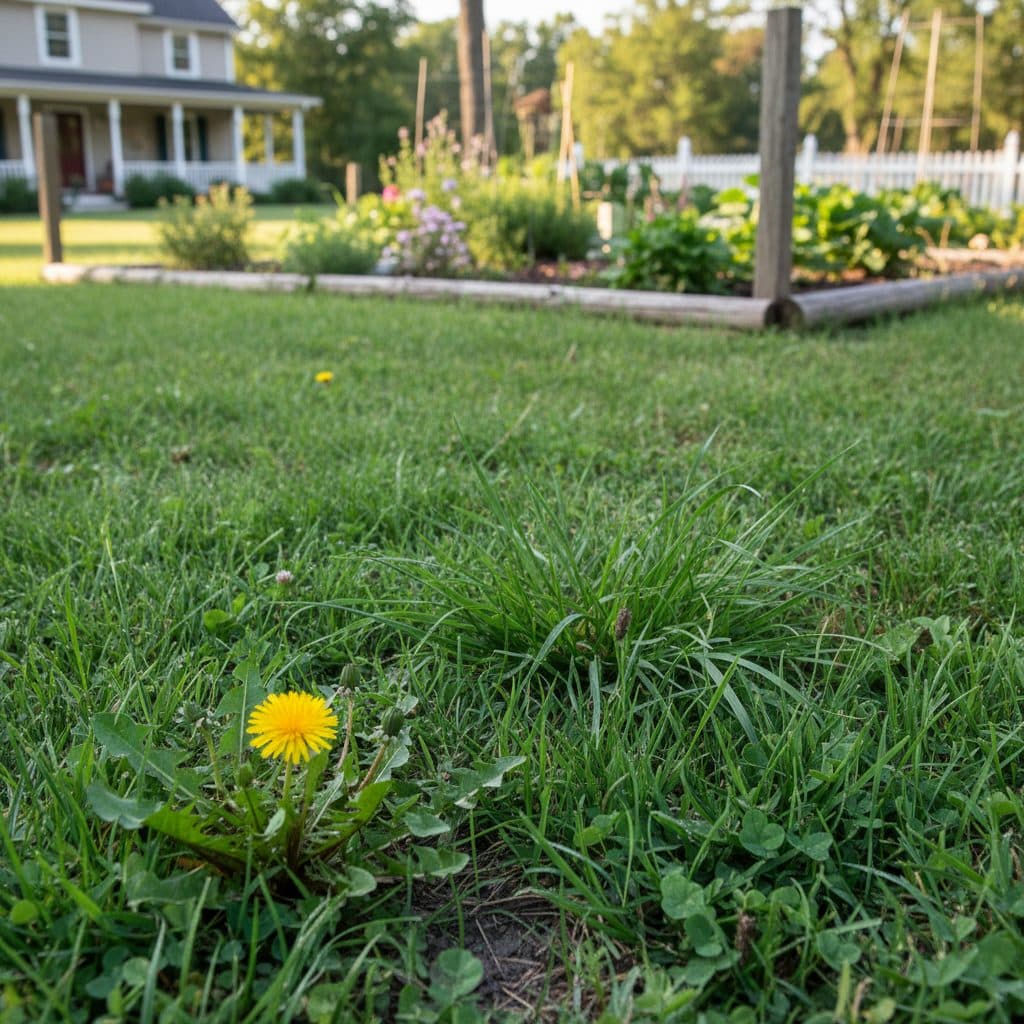
Dandelion (Taraxacum officinale) is a familiar perennial broadleaf weed, recognizable by its bright yellow flowers and distinctive puffball seed heads. It thrives in disturbed soils and compacted lawns across nearly all US regions, from USDA zone 2 to 10. Dandelions have a deep taproot, sometimes extending 10-15 inches into the soil, which makes them resilient to pulling unless the entire root is removed [4]. Each plant can produce over 20,000 seeds annually, which are easily dispersed by wind over many miles.
Effective organic strategies for these common weeds
For crabgrass, cultural practices are the most effective defense. Maintaining a lawn height of 2-3 inches and watering deeply and infrequently encourages strong turf that shades out crabgrass seedlings. Applying organic corn gluten meal in early spring, before soil temperatures reach 55°F, can act as a pre-emergent, inhibiting seed germination by about 60% without harming established turf. For dandelions, hand-weeding is highly effective if the entire taproot is removed; a specialized weeding tool can help extract roots up to 10 inches deep. Improving soil aeration through core cultivation in fall can also reduce dandelion prevalence by alleviating compaction, a condition they favor. Young dandelion greens can also be harvested for culinary use.
- Crabgrass prevention: Apply corn gluten meal in early spring, before soil hits 55°F.
- Dandelion removal: Use a specialized tool to extract the entire 10-15 inch taproot.
- Mow high: Keep lawn grass at 2-3 inches to shade out weed seeds.
- Improve soil: Aerate compacted areas to deter dandelion growth.
- Water deeply: Provide 1 inch of water weekly to encourage strong root systems.
Managing bindweed and purslane
Field Bindweed (Convolvulus arvensis) is one of the most challenging perennial weeds, prevalent across the US, especially in agricultural fields and gardens in USDA zones 3 through 9. It’s characterized by arrow-shaped leaves and small, trumpet-shaped white or pink flowers. Its extensive root system can penetrate 10-20 feet deep, with lateral roots spreading 10-15 feet horizontally [6]. This makes it extremely difficult to eradicate, as even small root fragments can regenerate new plants. Consistent effort over several years is typically required for control.
Common Purslane (Portulaca oleracea) is a succulent annual weed that thrives in warm, disturbed soils, particularly in vegetable gardens across USDA zones 5 to 11. It has reddish stems and thick, fleshy leaves, often forming a dense mat 4-6 inches high. Purslane is remarkably resilient; even detached stems can reroot and grow, and its seeds can remain viable in the soil for 20 years or more [3]. It prefers moist, rich soils and is often an indicator of good soil fertility, though it can outcompete young vegetable seedlings. It is also an edible green, rich in Omega-3 fatty acids.
Organic control methods for persistent weeds
For bindweed, consistent mechanical removal is necessary. Repeatedly cutting the plant at the soil line, every 7-10 days, depletes its root reserves over time. This process often needs to be maintained for two to three growing seasons to significantly reduce the infestation. Solarization, covering infested areas with clear plastic for 6-8 weeks during the hottest part of summer, can heat the soil to 120-140°F, killing seeds and shallow roots. For purslane, improving drainage and reducing surface moisture can help. Hand-pulling or hoeing is effective, but ensure all plant fragments are removed from the soil surface to prevent rerooting. A 2-3 inch layer of mulch also suppresses purslane germination effectively.
- Bindweed persistence: Cut bindweed every 7-10 days for 2-3 years to deplete root reserves.
- Purslane removal: Hand-pull or hoe, ensuring all succulent fragments are removed from soil.
- Solarization: Use clear plastic for 6-8 weeks in summer to kill bindweed roots and seeds.
- Mulch heavily: Apply 2-3 inches of mulch to suppress purslane and other annuals.
- Improve drainage: Reduce surface moisture to make conditions less favorable for purslane.
Diagnostic tools and long-term prevention
Effective weed management relies heavily on understanding your soil. A soil test, typically conducted every 3-5 years, provides necessary data on pH, nutrient levels, and organic matter content. For instance, dandelions often thrive in compacted, low-calcium soils, while purslane prefers rich, moist conditions. Addressing soil imbalances, such as adjusting pH from 5.0 to a more neutral 6.5-7.0 for most garden plants, can make your desired plants more vigorous and less susceptible to weed competition.
Beyond soil amendments, long-term prevention involves strategic planting and crop rotation. Planting cover crops in off-seasons, such as clover or annual rye in fall in USDA zones 4-8, can suppress winter annual weeds and improve soil structure. In vegetable gardens, rotating crops annually helps break weed cycles and prevents the buildup of weed seeds specific to certain crops. For example, following a heavy feeder like corn with a legume can improve soil nitrogen, reducing the need for fertilizers that can sometimes encourage weed growth.
Maintaining a resilient garden ecosystem
Building a resilient garden ecosystem is a continuous process that reduces weed pressure over time. This includes encouraging beneficial insects and microorganisms, which contribute to overall plant health and soil vitality. For example, a diverse planting of native species can attract predatory insects that help manage other garden pests, indirectly strengthening your desired plants against weed competition. In areas like the Pacific Northwest (USDA zone 8-9), consistent application of 1-2 inches of compost annually can significantly improve soil structure and microbial activity, leading to a 30% reduction in weed germination over five years. Remember, a healthy garden is your best defense against weeds, requiring less intervention and providing more enjoyment.
- Test soil: Conduct soil tests every 3-5 years to understand nutrient and pH levels.
- Amend soil: Adjust pH to 6.5-7.0 and add organic matter based on test results.
- Use cover crops: Plant clover or annual rye in fall to suppress winter weeds.
- Rotate crops: Change crop locations annually to break weed and pest cycles.
- Add compost: Apply 1-2 inches of compost annually to improve soil health and suppress weeds.
Common US lawn and garden weeds: identification and characteristics
Weed | Life Cycle | Key Identification | Primary Challenge |
|---|---|---|---|
Crabgrass | Annual | Broad, coarse leaves; star-like growth; light green color | Rapid spread (up to 150,000 seeds/plant); thrives in thin lawns |
Dandelion | Perennial | Yellow flowers, puffball seeds; deeply lobed leaves; deep taproot (10-15 in) | Deep taproot; prolific seed production (20,000+ seeds/plant); wind-dispersed |
Field Bindweed | Perennial | Arrow-shaped leaves; trumpet-shaped white/pink flowers; vining habit | Extensive, deep root system (10-20 ft); regenerates from root fragments |
Common Purslane | Annual | Reddish stems; thick, fleshy leaves; mat-forming | Resilient; rerooting from fragments; long-lived seeds (20+ years) |
Crabgrass Seeds: A single crabgrass plant can produce up to 150,000 seeds in one growing season, making early prevention essential.
Bindweed Roots: Field bindweed’s root system can extend 10-20 feet deep, making consistent mechanical removal over 2-3 years essential for control.
Frequently asked questions
What is the most effective organic method for controlling crabgrass in a lawn?
The most effective organic method involves a combination of strategies. In early spring, before soil temperatures reach 55°F, apply corn gluten meal as a pre-emergent. Additionally, maintain a lawn height of 2-3 inches and water deeply but infrequently, about 1 inch per week, to encourage a thick turf that outcompetes crabgrass.
How can I permanently get rid of field bindweed in my garden?
Permanently eradicating field bindweed is challenging due to its deep root system, which can extend 10-20 feet. The most effective organic approach requires consistent effort over 2-3 years. Repeatedly cut the plant at the soil line every 7-10 days to deplete its root reserves. Solarization during summer for 6-8 weeks can also help by heating the soil to 120-140°F.
Why do dandelions keep coming back even after I pull them?
Dandelions are perennial weeds with a deep taproot, often reaching 10-15 inches into the soil. If even a small portion of this taproot remains in the ground after pulling, the plant can regenerate. For effective removal, use a specialized weeding tool to ensure the entire taproot is extracted, preventing regrowth from root fragments.
Is common purslane always a weed, or does it have benefits?
While common purslane often acts as a weed, competing with desired plants, it is also a highly nutritious edible. It’s rich in Omega-3 fatty acids and various vitamins and minerals. Many gardeners in USDA zones 5-11 choose to harvest young purslane for culinary use, turning a weed problem into a food source, while still managing its spread through mulching.
How often should I test my garden soil for optimal weed management?
Conducting a soil test every 3-5 years provides essential data on soil pH, nutrient levels, and organic matter. This allows you to make informed amendments that favor desired plants over weeds, potentially reducing weed pressure by 30%.
References
- Tree Weeds (1945). Tree Weeds.
- Illustrations and Descriptions of Weeds (1945). Illustrations and Descriptions of Weeds.
- Garden and Lawn Weeds (1977). Garden and Lawn Weeds.
- Weeds of Lawn and Garden (1945). Weeds of Lawn and Garden.
- Introduction (1945). Introduction.
- USDA Natural Resources Conservation Service (2024). USDA Natural Resources Conservation Service.