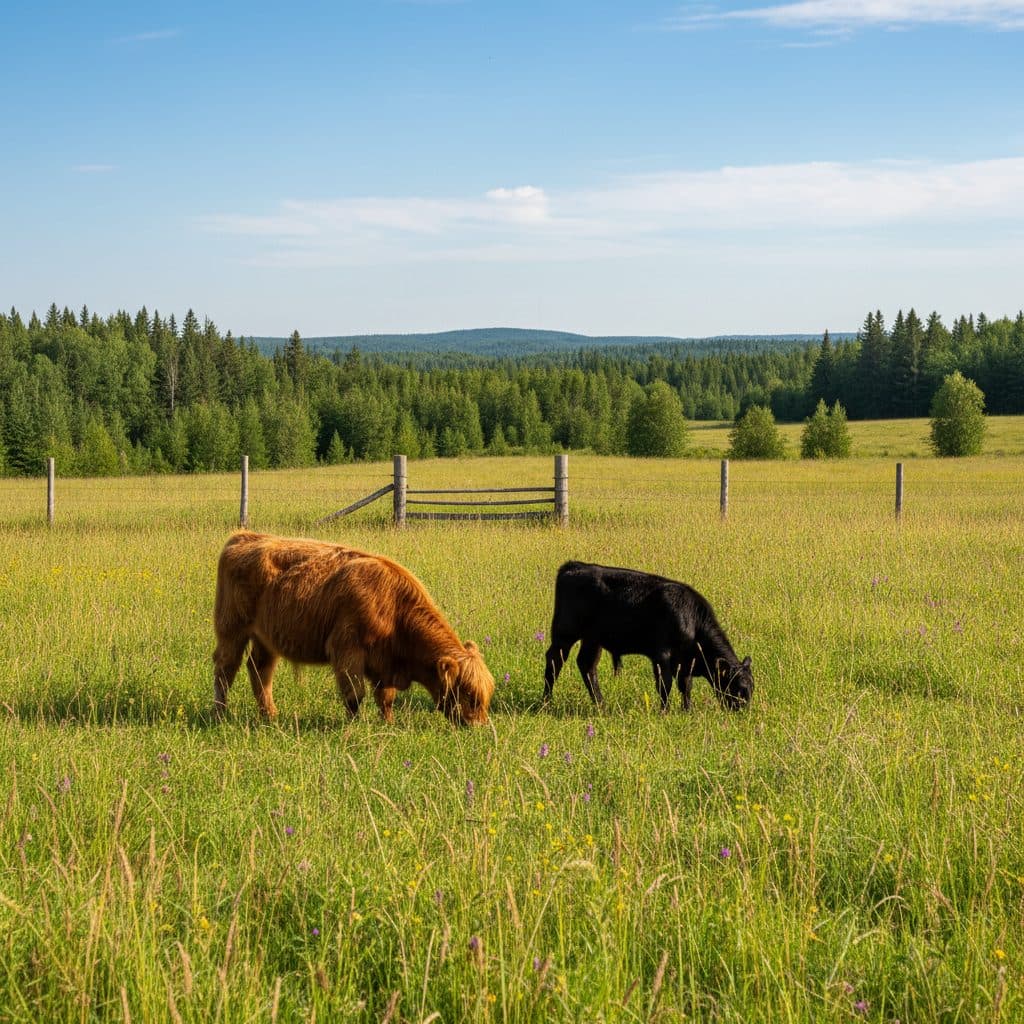
Key takeaways
- Miniature cattle breeds consume roughly one-third to one-half the daily forage of standard commercial beef breeds, reducing hay costs.
- Dexter, Miniature Highland, and Lowline Angus cattle adapt well to Canadian winter conditions when provided with windbreaks and clean bedding.
- Stocking rates on productive Canadian pastures average 0.5 to 1.0 acre per head as a starting estimate (carrying capacity varies severalfold across regions).
- Lighter body weights (250 kg to 450 kg) significantly reduce soil compaction and pasture poaching during wet spring thaws.
- Perimeter fencing requires five-strand high-tensile electric wire or heavy woven field fence with bottom wires positioned close to ground level.
Quick answer: Miniature cattle are compact bovines standing between 90 cm and 120 cm at the hip, weighing between 250 kg and 450 kg (550 lbs to 1,000 lbs). Well-suited for Canadian smallholders and acreage owners, breeds such as Dexter, Miniature Highland, and Australian Lowline produce high-quality grass-fed beef and rich family milk while requiring less feed, lower fencing infrastructure, and smaller acreage than standard commercial cattle.
Managing commercial 650 kg (1,400 lbs) cattle on a small Canadian acreage can quickly overwhelm limited pasture, damage soil structure during wet spring thaws, and require heavy handling equipment. For homesteaders seeking household milk, grass-fed beef, or pasture-mowing livestock on two to ten acres, miniature cattle offer an accessible and manageable alternative.
These compact breeds convert pasture grass and hay into meat and milk with high feed efficiency. Their gentle temperament and smaller size make them easier to handle for family members without industrial livestock chutes or heavy squeeze gates.
Choosing the right breed, planning winter forage for the Canadian climate, and building adequate handling facilities keeps a small-scale cattle enterprise healthy and productive year-round.
Popular miniature cattle breeds in Canada
Several heritage and purpose-bred miniature lines thrive across Canadian provinces, from coastal British Columbia to the prairie provinces and eastern Canada.
+------------------------+-------------------+-------------------+-------------------------------+
| Breed                  | Height at Hip     | Mature Weight     | Primary Homestead Purpose     |
+------------------------+-------------------+-------------------+-------------------------------+
| Dexter                 | 95 to 110 cm      | 300 to 450 kg     | Dual-purpose (milk & beef)    |
| Miniature Highland     | 90 to 105 cm      | 250 to 400 kg     | Hardy beef, brush management  |
| Australian Lowline     | 95 to 115 cm      | 320 to 450 kg     | Premium marbled beef          |
| Miniature Jersey       | 100 to 115 cm     | 270 to 380 kg     | High-butterfat family dairy   |
| Miniature Hereford     | 100 to 115 cm     | 350 to 480 kg     | Docile beef, easy keeping     |
+------------------------+-------------------+-------------------+-------------------------------+
Dexter Cattle
Originating in Ireland, Dexters are the classic dual-purpose homestead cow. They produce roughly 6 to 9 litres a day at peak lactation for a well-managed cow, and appreciably less through the rest of lactation, while finishing efficiently on grass for lean beef. Before breeding any Dexter, have both animals DNA-tested for chondrodysplasia and PHA (pulmonary hypoplasia with anasarca) through the breed association. Never mate a carrier to a carrier: chondrodysplasia carrier x carrier gives about one lethal 'bulldog' calf in four, and PHA carrier x carrier produces a grossly oedematous calf that cannot be delivered normally.
Miniature Scottish Highlands
With a double coat of dense insulating hair, Miniature Highlands are exceptionally suited to severe sub-zero temperatures across Alberta, Saskatchewan, and Manitoba. Note that Miniature Highlands are small-framed Highland cattle registered through miniature-cattle registries rather than a recognised separate breed — check what registry the stock is actually recorded in before paying a premium. They forage coarse brush that other cattle reject, and their placid nature makes them popular on family acreages.
Australian Lowline Angus
Developed from pure Aberdeen Angus bloodlines selected for compact frame size without dwarfism genes, Lowlines produce well-marbled beef on pasture alone. They are naturally polled (hornless), possess calm temperaments, and finish out at a carcass size that fits a home freezer. Slaughter and processing rules differ by province, and any meat you sell must be processed at an inspected abattoir — confirm the requirements with your provincial authority before you plan a kill date.
Acreage, pasture management and stocking rates
Carrying capacity varies severalfold across Canadian soil and precipitation zones. Treat stocking numbers as a starting point only, and check against your provincial forage or range guidance before setting stocking numbers. In lush maritime or southern Ontario pastures, two acres may support two miniature head during summer, whereas dry prairie rangeland requires considerably more acreage.
+-------------------------------------------------------------------+
|               ESTIMATING PASTURE AND FORAGE NEEDS                 |
+-------------------------------------------------------------------+
| Summer Grazing: 0.5 to 1.0 acre/head (starting regional estimate) |
| Daily Dry Matter Intake: 2.0% to 2.5% of body weight in dry forage|
| Winter Hay Supply: 1.8 to 2.5 tonnes/cow (incl. 15-20% waste)     |
| Clean Water Access: 25 to 50 L/head/day (60-70 L lactating in sum)|
+-------------------------------------------------------------------+
Rotational grazing on small plots
Divide your pasture into small paddocks using portable electric step-in posts and poly-braid wire. Move cattle every three to five days to allow grazed forage to recover for three to four weeks before regrazing. This rotation breaks parasite life cycles, prevents overgrazing, and distributes manure evenly across the field.
Because miniature cattle weigh significantly less than commercial breeds, their hooves cause far less damage to wet pasture during early spring snowmelt. Integrating miniature cows alongside smaller livestock as described in raising pastured chickens or managing multi-species grazing with raising dairy goats maximizes forage utilization across mixed pastures.
Canadian winter care, shelter and water
Canadian winters present sub-zero temperatures, freezing rain, and heavy snowpack that require careful cold-weather management.
+------------------------+-----------------------------------+-----------------------------------+
| Winter Element         | Key Management Requirement        | Failure Risk                      |
+------------------------+-----------------------------------+-----------------------------------+
| Wind Protection        | 3-sided shed or 2.4 m slab fence  | Severe hypothermia from wind chill|
| Deep Bedding Pack      | 20 cm clean dry straw or woodchip | Frozen teats, energy depletion    |
| Water Delivery         | Heated stock tank / continuous flow| Dehydration, rumen impaction     |
| Nutritional Energy     | Free-choice grass-alfalfa hay mix | Rapid body condition loss         |
+------------------------+-----------------------------------+-----------------------------------+
Three-sided run-in sheds
Miniature cattle do not require heated barns. A well-constructed three-sided timber run-in shed oriented away from prevailing winter winds provides sufficient shelter. The structure should allow at least 5 square metres of dry floor space per animal. Ensure proper roof pitch to shed heavy snow loads, and maintain a dry straw bedding pack throughout January and February to prevent ground chill from drawing away body heat.
Winter hydration and feed management
Cattle cannot maintain body temperature or digest dry hay without adequate water intake. When water troughs freeze solid, cattle stop eating dry forage, leading to rapid weight loss, rumen impaction and dehydration. Submerged stock tank heaters or freeze-proof thermal drinkers are essential infrastructure on Canadian farms. Learn about remote freeze-protection options in our guide on solar livestock water heaters.
Provide a balanced grass-alfalfa hay mix with 12 to 14 percent crude protein during the coldest months. Rumen fermentation of fibrous hay acts as an internal heater, helping small cattle generate body warmth naturally in sub-zero weather.
Fencing, handling facilities and herd health
While miniature cattle do not exert the massive physical force of full-sized commercial breeds, secure fencing and handling pens remain critical for veterinary care, herd health, and regulatory compliance. All cattle in Canada must carry an approved Canadian Cattle Identification Agency (CCIA) radio-frequency tag before leaving their farm of origin; consult CCIA or CFIA guidelines for current requirements.
+-------------------------------------------------------------------+
|                 MINIATURE CATTLE HANDLING LAYOUT                  |
+-------------------------------------------------------------------+
| [Pasture Paddock] ====> [Gathering Pen] ====> [Funnel Sweep Tub]  |
|                                                      |            |
|                                              [Adjustable Chute]   |
|                                                      |            |
|                                              [Small Head Gate]    |
+-------------------------------------------------------------------+
Perimeter and interior fencing
- Perimeter Boundaries: 120 cm high woven wire field fence with a single top strand of barbed or electric wire, or a 5-strand high-tensile electric fence reading at least 2,000 to 3,000 volts at the point furthest from the energiser. Ensure bottom wires sit within 15 cm of the ground to prevent smaller calves from slipping beneath.
- Cross-Fencing: Two strands of high-visibility electric poly-wire at 40 cm and 80 cm above ground level.
Routine health and veterinary management
- Hoof Trimming: Check hooves annually, especially on soft or damp pastures where natural wear is minimal.
- Parasite Control: Conduct routine fecal egg counts before administering targeted anthelmintic dewormers, rotating pasture paddocks to keep parasite loads low.
- Mineral Supplementation: Provide free-choice loose cattle minerals containing salt, selenium, copper, and cobalt formulated specifically for your geographic region. Canadian soils in many areas are naturally low in selenium, making supplemental loose minerals vital for preventing white muscle disease in young calves. Match the mineral formulation to your region on veterinary or provincial forage-test advice, and do not stack multiple selenium sources (mineral, bolus, and injectable) at the same time.
Review foundational small-scale farm setup in what is homesteading to build a sustainable livestock operation on your land.