Key takeaways
- Ontario's climate requires sturdy winter housing, dependable frozen-water prevention, and 150 to 180 days of stored winter forage per ewe.
- Recommended breeds for Ontario include prolific Canadian-developed Rideau Arcotts, commercial terminal Suffolks, hardy Dorsets, and low-maintenance Katahdin hair sheep.
- Rotational pasture management supports typical stocking rates of 4 to 6 adult ewes per acre on prime, well-drained agricultural land.
- Predator pressure from coyotes and feral canines demands permanent perimeter woven-wire fencing paired with livestock guardian dogs or electrified offset wires.
- All Ontario sheep must be tagged with Canadian Sheep Identification Program (CSIP) radio-frequency ear tags prior to leaving their farm of origin.
Quick answer: Starting sheep farming in Ontario requires selecting cold-hardy breeds like Rideau Arcott, Dorset, or Katahdin, budgeting 4 to 6 ewes per acre on rotational pasture, and constructing well-ventilated winter pole barns. Operations must secure livestock against coyotes with guardian dogs or electric fencing and comply with the national CSIP tagging requirements.
Small-scale livestock producers and homesteaders across rural Ontario increasingly turn to sheep for meat, wool, and targeted grazing. With steady consumer demand across the Greater Toronto Area and strong provincial livestock infrastructure, sheep farming in ontario offers a viable, scalable enterprise on acreage that may be unsuitable for intensive row cropping.
However, operating a sheep farm in Central and Eastern Canada requires adapting to severe seasonal swings. Ontario temperatures range from hot, humid summer highs above 30°C (86°F) to sub-zero winter lows dropping below -25°C (-13°F), accompanied by heavy snow accumulation.
Success requires matching your flock genetics to local conditions, building winter barns that maximize ventilation without creating drafts, implementing rotational grazing, and establishing reliable predator defenses.
+-------------------------------------------------------------+
|              ONTARIO SHEEP FARMING CALENDAR                 |
|                                                             |
|   SEASON         MONTHS         OPERATIONAL FOCUS           |
|   ------         ------         -----------------           |
|   Spring         April - May    Lambing, turn out to pasture|
|   Summer         June - August  Rotational grazing, haying  |
|   Autumn         Sept - Oct     Breeding season, flush feed |
|   Winter         Nov - March    Barn feeding, snow shelter  |
+-------------------------------------------------------------+
Which sheep breeds perform best in Ontario climates?
Selecting the right breed depends on your primary production goal: commercial meat lambs, fleeces, or pasture maintenance.
1. Rideau Arcott
Developed by Agriculture and Agri-Food Canada in Ottawa, the Rideau Arcott is a primary maternal breed in Ontario. Known for exceptional prolificacy, Rideau ewes regularly produce twins and triplets and have heavy milk yields to sustain fast lamb growth.
2. Dorset (polled and horned)
Dorsets are known for their ability to breed out-of-season, allowing producers to implement accelerated lambing systems (three lamb crops in two years). They possess dense, warm fleeces and handle Ontario winter conditions easily.
3. Katahdin (hair sheep)
Katahdin sheep shed their winter coats naturally in spring, eliminating the expense and labour of annual shearing. They demonstrate strong natural parasite tolerance during warm, humid Ontario summers and produce lean, mild-flavoured meat.
4. Suffolk and Canadian Arcott
Suffolks and Canadian Arcotts are heavy, fast-growing meat breeds commonly used as "terminal sires." Crossing a Suffolk ram with Rideau Arcott or Dorset ewes produces vigorous market lambs with rapid daily weight gains.
+-----------------------------------------------------------------+
|              BREED PERFORMANCE COMPARISON                       |
|                                                                 |
|   BREED          PRIMARY TRAIT             IDEAL MANAGEMENT     |
|   -----          -------------             ----------------     |
|   Rideau Arcott  High prolificacy / milk   Intensive lambing    |
|   Dorset         Out-of-season breeding    Pasture or drylot    |
|   Katahdin       No shearing / parasite resLow-input pasture    |
|   Suffolk        Rapid lamb meat growth    Terminal cross sire  |
+-----------------------------------------------------------------+
How many sheep can you graze per acre in Ontario?
Pasture carrying capacity varies considerably between prime agricultural counties in Southwestern Ontario and rocky, shallow soils across the Canadian Shield.
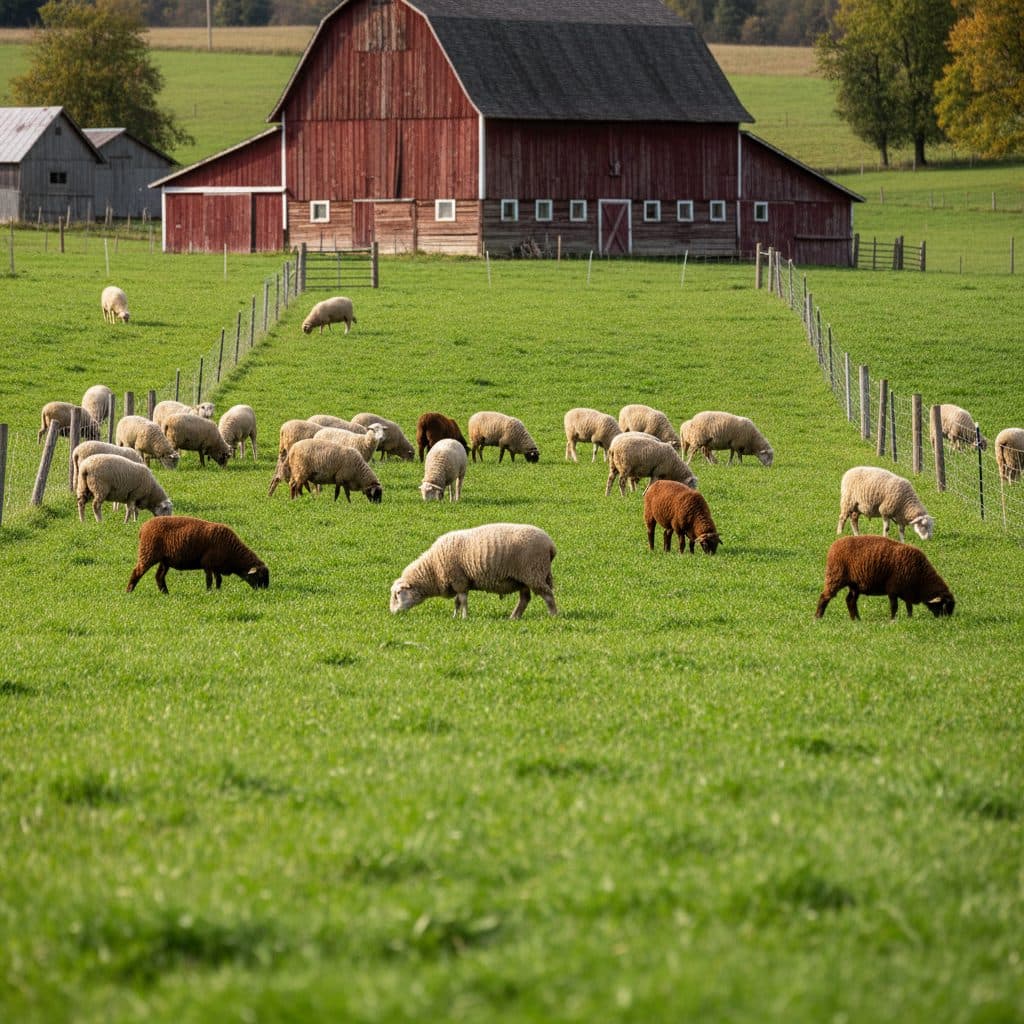
- Rotational grazing on quality pasture: On well-managed, fertile pastures seeded with orchard grass, timothy, brome, and white clover, you can support 4 to 6 adult ewes with their lambs per acre (10 to 15 ewes per hectare) during the active 5 to 6-month grazing season (May to October).
- Marginal or unimproved pasture: On rough, brushy, or dry upland acreage, reduce stocking rates to 2 to 3 ewes per acre to prevent overgrazing.
- Rotational paddock design: Divide your pasture into small paddocks using temporary electric polywire. Move sheep to a fresh paddock every 3 to 5 days and rest grazed paddocks as long as the season allows. A 21 to 30-day rest suits grass regrowth but will not clear infective larvae: 60 days or more in summer is needed to meaningfully lower barber's pole worm (Haemonchus contortus) burdens, and larvae can overwinter. Pair rotation with FAMACHA scoring and targeted selective deworming under your vet's direction rather than relying on rotation alone. For integrating livestock with tree canopies, explore our guide on silvopasture.
+-------------------------------------------------------------+
|              ROTATIONAL GRAZING CELL DESIGN                 |
|                                                             |
|   [ Paddock 1 ] ---> [ Paddock 2 ] ---> [ Paddock 3 ]       |
|   (Active 3-5 days)  (Resting 12 days)  (Resting 24 days)   |
|         ^                                     |             |
|         |                                     v             |
|   [ Paddock 6 ] <--- [ Paddock 5 ] <--- [ Paddock 4 ]       |
|   (Resting 60 days)  (Resting 48 days)  (Resting 36 days)   |
+-------------------------------------------------------------+
To plan whole-property fencing and lane access, consult our guide to farm layout and planning.
What infrastructure and winter housing do sheep need in Ontario?
While adult sheep with full wool coats tolerate dry, freezing temperatures well, they cannot tolerate wet bedding combined with cold winter drafts.
Barn ventilation and bedding
- Housing style: A three-sided pole barn or open-front shed facing south or east provides adequate shelter. Ensure the open front is shielded from prevailing northwesterly winter winds.
- Continuous airflow: Moisture and ammonia buildup causes fatal respiratory pneumonia in lambs. Maintain continuous ridge vents or eave openings to exhaust warm, humid air.
- Deep pack bedding: Spread clean, dry wheat or oat straw regularly over the floor. The decaying lower layers generate gentle heat, insulating bedded ewes from freezing subsoil.
Winter water and feeding
- Heated watering systems: In sub-zero Ontario winters, water buckets freeze solid within hours. Install electrically heated automatic waterers or submersible de-icers in insulated stock tanks. Sheep consume 4 to 8 litres (1 to 2 gallons) of water daily; cold-induced dehydration causes metabolic toxemia in pregnant ewes. Consider renewable options in our guide on solar livestock water heaters.
- Hay budgeting: Plan for 150 to 180 days of stored winter forage per ewe. A 70 kg (155 lb) ewe consumes approximately 2.0 to 2.5 kg (4.5 to 5.5 lbs) of good-quality legume-grass mixed hay daily.
To review construction blueprints and load ratings, consult our principles on farm infrastructure design.
+-------------------------------------------------------------+
|              WINTER BARN CHECKLIST                          |
|                                                             |
|   - Draft-free solid walls up to 1.2 m; open ridge vents    |
|   - Deep, dry straw pack cleaned out annually               |
|   - Thermostatically controlled heated water troughs        |
|   - 1.5 to 2.0 square metres barn floor space per ewe       |
|   - Hay feeders elevated to prevent wool contamination      |
+-------------------------------------------------------------+
How do you protect flocks from Ontario predators?
Coyotes (Canis latrans) are the primary predator threat to sheep in Ontario, alongside domestic dogs and occasional black bears in northern districts.
Physical fencing
- Perimeter fencing: Install woven-wire (page wire) fencing at least 1.2 metres (48 inches) tall with a single electrified offset wire running 15 to 20 cm above the ground on the exterior to prevent coyotes from digging beneath.
- Electric high-tensile: A 7 to 9-strand high-tensile electric fence charged to at least 5,000 to 7,000 volts provides an effective perimeter deterrent.
Livestock guardian animals
Relying solely on wire fences is rarely enough in heavy coyote territory. Integrating guardian animals provides active, around-the-clock flock protection:
- Livestock Guardian Dogs (LGDs): Breeds such as the Great Pyrenees, Maremma, Anatolian Shepherd, and Akbash live permanently with the flock, bonding with sheep and deterring predator packs through barking and aggressive territorial marking.
- Guard donkeys and llamas: A single jenny (female) donkey or gelded llama will naturally challenge and strike at canines that enter pasture boundaries.
What regulations govern sheep farming in Ontario?
Starting an agricultural livestock enterprise requires adhering to provincial and national livestock tracking standards:
- Ontario Sheep Farmers (OSF): The producer-led provincial organisation that represents sheep farmers, oversees licensing, and administers research and marketing initiatives.
- Canadian Sheep Identification Program (CSIP): All sheep and lambs must bear an approved CSIP radio-frequency identification (RFID) ear tag before leaving the farm of origin for auction, processing, or transfer.
- Premises Identification (PID): Ontario requires a Provincial Premises ID for properties keeping livestock. The OMAFA program is delivered by Agricorp; confirm current registration requirements with them before you buy stock or move animals, as programme delivery and thresholds change.
- Veterinary-Client-Patient Relationship (VCPR): Establish a working relationship with a local large-animal veterinarian for prescription parasiticides, vaccines (such as 8-way Clostridial / tetanus protection), and herd health protocols.
Before purchasing rural acreage or fencing your boundaries, explore our checklist for assessing land for homesteading.