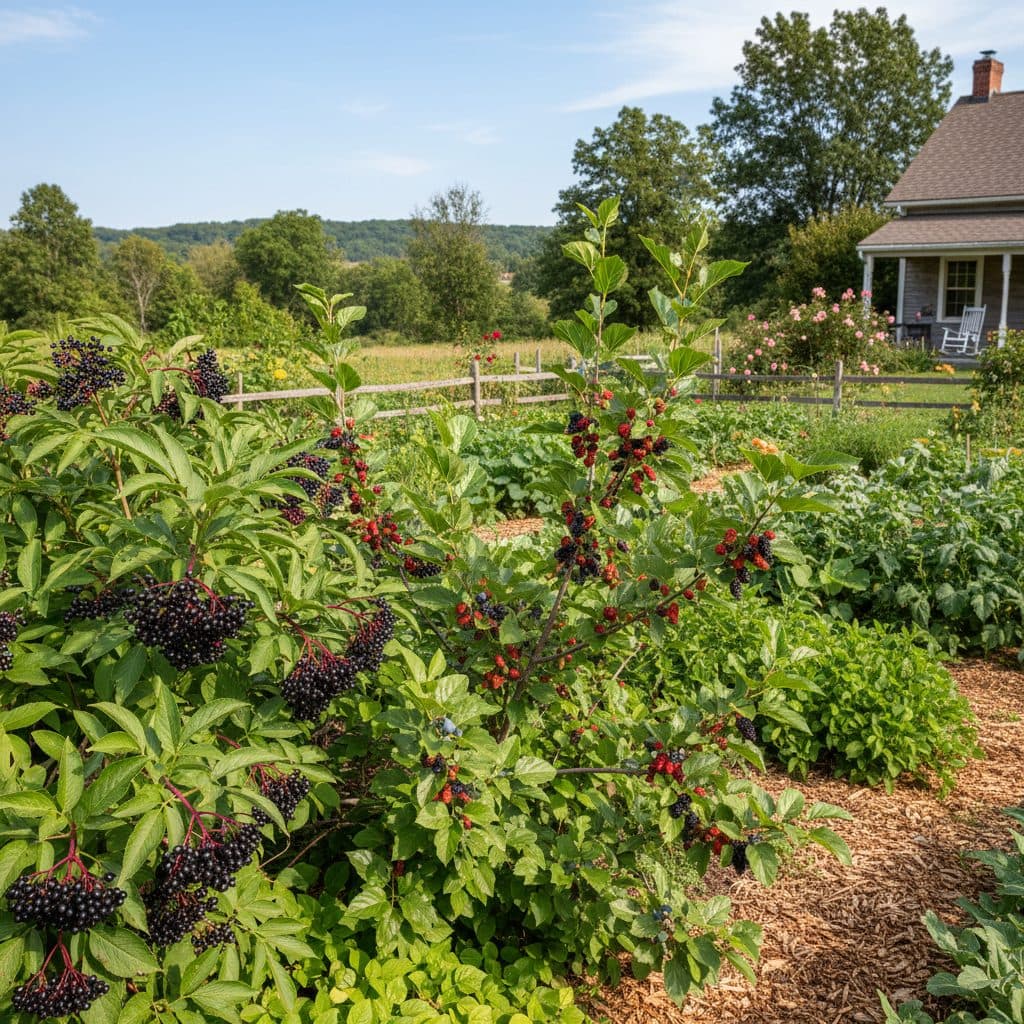
Key takeaways
- Native elderberry, serviceberry, and mulberry are well-adapted to US climates, thriving in USDA zones 3-9 with minimal care.
- Elderberries (Sambucus canadensis) are fast-growing shrubs, producing 10-15 pounds of berries per plant in late summer.
- Serviceberries (Amelanchier spp.) are small trees or large shrubs, offering 5-10 pounds of fruit in late spring and early summer.
- Mulberries (Morus rubra) are robust trees yielding 20-50 pounds of fruit, though they can be messy when ripe.
- All three prefer full sun (6+ hours daily) and well-drained soil, generally requiring about 1 inch of water per week during establishment.
- Regular pruning, especially for elderberries, helps maintain plant health and maximize fruit production.
Quick answer: Elderberry, serviceberry, and mulberry are easy native US berries to grow in zones 3-9 due to their adaptability to local climates, natural pest resistance, and reliable yields with minimal care.
Across the United States, from USDA zone 3 in northern Minnesota down to zone 9 in central Florida, many home growers are looking for fruit options that require less fuss and integrate well with local conditions. Native berries offer a compelling solution, often demonstrating better resilience to regional pests and diseases than non-native species. For instance, a typical 0.25-acre backyard orchard can host several productive native berry plants, yielding dozens of pounds of fruit annually with less effort than more demanding crops.
Among the easiest and most rewarding native berries to cultivate are elderberry, serviceberry, and mulberry. These plants adapt to a wide range of US climates and provide substantial harvests for jams, pies, and, for serviceberry and mulberry, fresh eating. Elderberry is the exception: it must be cooked before use. With proper planning and a few hours of care each season, you can establish a thriving berry patch that consistently produces fruit for many years, often for 20 years or more for well-maintained plants.
Why choose native berries for your home orchard?
Opting for native berry plants like elderberry, serviceberry, and mulberry brings several advantages to the home grower. These species have evolved over thousands of years within North American ecosystems, making them naturally suited to local soil types, rainfall patterns, and temperature fluctuations. For example, a native elderberry in USDA zone 5 in Ohio will likely require less supplemental watering and fewer pest interventions than a non-native fruit tree struggling to adapt. This inherent resilience translates directly into less work for you, the grower.
Beyond their ease of care, native berries often exhibit a natural resistance to common regional pests and diseases. While no plant is entirely immune, a native species is generally less susceptible to widespread outbreaks that can devastate non-native crops. For instance, the red mulberry (Morus rubra) is generally more resistant to local leaf spot fungi than some cultivated non-native mulberries. This means fewer chemical treatments, if any, are needed to maintain a healthy harvest. Furthermore, these plants contribute to local biodiversity by giving native wildlife, such as birds and beneficial insects, food and habitat, which can aid in natural pest control within your garden. A mature serviceberry tree, for example, can support dozens of bird species with its early summer fruit.
The benefits of growing native US berries
- Reduced maintenance: Native plants are adapted to local conditions, often requiring less water and fertilizer.
- Pest and disease resistance: They have natural defenses against common local threats, minimizing intervention.
- Ecological support: Provide food and habitat for native wildlife, improving garden biodiversity.
- Reliable yields: Consistent fruit production with less effort once established, often for 15-30 years.
- Adaptability: Thrive across a broad range of USDA zones, from 3 to 9 for many species.
Elderberry: a versatile and prolific shrub
The American elderberry (Sambucus canadensis) is a sturdy, fast-growing shrub that offers both ornamental beauty and abundant harvests. Typically reaching 5-12 feet tall and wide, it can produce significant quantities of berries, often 10-15 pounds per plant, once established. These plants are incredibly adaptable, thriving in USDA zones 3-9, and prefer moist, well-drained soil with a pH between 5.5 and 6.5. While they tolerate partial shade, a location with at least six hours of direct sunlight daily will result in the heaviest fruit production.
Planting elderberries is straightforward. Dig a hole twice as wide as the root ball and just as deep to ensure the crown of the plant is level with the soil surface. Space individual plants 6-10 feet apart to allow for mature growth and good air circulation. After planting, water thoroughly, providing about 1 inch of water per week for the first growing season. Elderberries are relatively pest and disease-free, though they can be affected by Elderberry Carlavirus, which causes yellowing and stunting [1]. Regular observation can help catch issues early. For optimal fruit, plant at least two different cultivars. American elderberry is partially self-fertile but sets noticeably heavier crops with a second cultivar flowering nearby.
Essential elderberry care practices
- Pruning: Annually remove dead, damaged, or older canes (over three years old) to encourage new growth and fruit production. Learn more about pruning techniques here.
- Watering: Maintain consistent soil moisture, especially during dry spells and fruit development, aiming for 1 inch of water weekly.
- Fertilization: A balanced granular fertilizer (e.g., 10-10-10) applied in early spring can boost growth, but often isn’t strictly necessary in fertile soils.
- Pest monitoring: Watch for aphids or spider mites, which can be managed with a strong spray of water if populations are small.
- Weed control: Keep the area around the base of the plant free of weeds to reduce competition for water and nutrients.
Serviceberry: early season sweetness and beauty
That work on elderberry sets up what follows here.
Serviceberry, also known as Juneberry or Saskatoon berry, encompasses several species of the Amelanchier genus, all native to North America. These small trees or large shrubs are celebrated for their early spring blossoms, attractive fall foliage, and delicious, blueberry-like fruits. Amelanchier arborea, or downy serviceberry, is a common species found in the eastern US, often growing 15-25 feet tall [5]. They are remarkably hardy, thriving in USDA zones 3-9, and can adapt to a range of soil conditions, from sandy to clay, as long as drainage is adequate. Full sun to partial shade is acceptable, but like elderberries, more sun means more fruit.
Serviceberries are typically planted in early spring or fall. When selecting a site, ensure it has good air circulation to help prevent fungal diseases. Dig a planting hole that is 1.5 times wider than the root ball and deep enough so the root flare is at ground level. Water newly planted trees with 5 gallons of water immediately after planting, then maintain consistent moisture, especially during dry periods, providing about 1 inch of water per week. Serviceberries are generally trouble-free but can be susceptible to rust, powdery mildew, and fire blight, particularly in humid climates. Regular pruning to improve air flow and removing infected branches can mitigate these issues. Birds are often the biggest challenge and can take most of the ripe berries if they are not deterred.
Popular serviceberry species and their characteristics
- *Amelanchier canadensis* **(Shadblow Serviceberry): Grows 10-20 feet, often multi-stemmed, good for wet sites in USDA zones 4-8.
- *Amelanchier arborea* **(Downy Serviceberry): Reaches 15-25 feet, known for its fuzzy new leaves, widespread in eastern US [5].
- *Amelanchier laevis* **(Allegheny Serviceberry): Up to 25 feet, smooth leaves, purplish new growth, hardy in zones 4-8.
- *Amelanchier alnifolia* **(Saskatoon Serviceberry): Shrubby, 6-15 feet, very cold hardy (zones 2-7), popular for fruit production.
- *Amelanchier grandiflora* **(Apple Serviceberry): A hybrid, 20-30 feet, larger flowers and fruit, zones 4-8.
Mulberry: a fast-growing, heavy producer
This builds directly on serviceberry.
The red mulberry (Morus rubra) is the only mulberry species truly native to the eastern and central United States, growing naturally from USDA zone 4 to 9. White mulberry (Morus alba), introduced from Asia, is listed as invasive across much of the US and hybridizes with red mulberry, which is one reason native Morus rubra populations are declining. Morus rubra belongs in local ecosystems and is well adapted to local conditions. These trees can grow quite large, reaching 30-60 feet tall with a similar spread, and are known for their rapid growth rate, often adding 2-3 feet of height per year when young. A single mature tree can produce an astonishing 20-50 pounds of fruit annually, making it one of the most prolific berry producers for the home orchard.
Mulberries are remarkably unfussy about soil type, tolerating a wide range from clay to sandy, provided it drains well. They absolutely thrive in full sun, requiring at least eight hours of direct sunlight daily for optimal fruit production. While established trees are quite drought-tolerant, young trees need consistent moisture, about 1 inch of water per week, for their first 2-3 years. Mulberries have alternate branching and simple leaves that are often variably lobed, especially on young growth. The biggest challenge with mulberries is the mess created by falling ripe fruit, which can stain patios or walkways. Consider planting them away from high-traffic areas or over a ground cover that can handle the fruit drop. Pruning is mainly for shaping and removing dead or crossing branches, typically done in late winter.
Tips for successful mulberry cultivation
- Site selection: Choose a location with full sun (8+ hours) and good drainage, preferably away from paved surfaces due to fruit drop.
- Watering: Provide 1 inch of water per week for young trees; established trees are drought-tolerant but benefit from supplemental water during prolonged dry spells.
- Pruning: Minimal pruning is needed, primarily for structural integrity and removing any dead or diseased wood in late winter.
- Pest and disease: Mulberries are generally resistant; watch for occasional cankers or bacterial blight, but serious issues are rare.
- Harvesting: Berries ripen over several weeks in early to mid-summer; place tarps under the tree and shake branches for easy collection.
General orchard care for native berries
Those mulberry habits matter here as well.
While elderberry, serviceberry, and mulberry are considered low-maintenance, a few general orchard care practices will ensure their long-term health and productivity. All three species benefit from well-drained soil. If your soil is heavy clay, consider amending it with 2-3 inches of compost before planting to improve drainage and aeration. A lab soil test through your county extension office will give you reliable pH and nutrient readings so you can tailor any amendments. An inexpensive 3-in-1 pH, moisture and light meter is handy for spot checks of moisture, but it does not measure nutrients and its pH readings are not dependable.
Consistent watering is essential during the establishment phase, typically the first 1-2 years after planting. Aim for about 1 inch of water per week, either from rainfall or supplemental irrigation. For mature plants, especially in regions with regular summer rainfall, supplemental watering might only be necessary during prolonged dry spells lasting more than two weeks. Mulching around the base of your plants with 2-4 inches of organic material like wood chips or straw helps retain soil moisture, suppress weeds, and regulate soil temperature. Ensure the mulch doesn’t touch the stem or trunk to prevent rot. Regularly inspect your plants for any signs of stress, pests, or disease; early detection keeps minor issues from becoming major ones.
Key considerations for a healthy berry patch
- Soil health: Amend heavy soils with compost and maintain a pH between 6.0 and 7.0 for most berries.
- Watering strategy: Use a soil moisture meter to guide watering, aiming for consistent moisture without waterlogging.
- Mulching: Apply 2-4 inches of organic mulch to conserve moisture and control weeds.
- Integrated pest management: Monitor for pests and diseases, using cultural controls or organic sprays if necessary, rather than broad-spectrum chemicals.
- Winter protection: In colder USDA zones (e.g., zone 3), ensure young plants have adequate mulch at their base for root insulation.
Harvesting and enjoying your native berry bounty
These orchard care lessons apply to the steps below, too.
The reward for your efforts comes during harvest season, which varies slightly for each native berry. Serviceberries are typically ready first, often in late May or June in USDA zone 6, providing a sweet, early summer treat. Elderberries follow in late July through September, offering clusters of dark purple berries. Mulberries ripen over an extended period from early June to late July, making them a continuous source of fresh fruit. Knowing the optimal ripeness indicators for each berry ensures you get the best flavor and yield. For instance, serviceberries should be deep blue-purple and soft to the touch, while elderberries are best when plump and dark, easily detaching from their stems.
Harvesting techniques vary. Serviceberries are usually hand-picked, similar to blueberries. Elderberries are harvested by cutting entire clusters, then stripping the berries from the stems later. Remove every piece of stem and any green, unripe berries before cooking, since both carry cyanogenic glycosides. Mulberries can be picked by hand, but for large quantities, spreading a tarp under the tree and gently shaking the branches collects the ripe fruit quickly. Once harvested, these berries have a relatively short shelf life, typically 3-5 days in the refrigerator. For longer storage, freezing is an excellent option; berries can be spread in a single layer on a baking sheet, frozen solid, then transferred to freezer bags for up to 12 months. This allows you to enjoy your harvest throughout the year in jams, pies, and cooked syrups and cordials.
Creative ways to use your berry harvest
- Jams and jellies: Classic preparations for all three berries, often requiring added pectin due to low natural levels.
- Pies and crumbles: Mulberries and serviceberries shine in baked goods. Elderberries must always be cooked. The leaves, stems, bark and unripe fruit of Sambucus canadensis contain cyanogenic glycosides, and even raw ripe berries can cause nausea, vomiting and diarrhea, so strip the berries fully from their stems and cook them before eating or preserving.
- Wines and cordials: Elderberries are particularly popular for homemade wines and liqueurs, often yielding 1-2 gallons per batch.
- Sauces and syrups: Excellent for topping pancakes, ice cream, or savory dishes, providing a unique flavor profile.
- Freezing: A simple method to preserve berries for up to 12 months, allowing for year-round enjoyment.
Comparison of Native US Berries for Home Growers
Feature | Elderberry | Serviceberry | Mulberry |
|---|---|---|---|
Botanical Name | Sambucus canadensis | Amelanchier spp. | Morus rubra |
Typical Size | 5-12 ft shrub | 15-25 ft small tree/shrub | 30-60 ft tree |
USDA Zones | 3-9 | 3-9 | 4-9 |
Sun Requirement | Full sun to partial shade (6+ hrs) | Full sun to partial shade (6+ hrs) | Full sun (8+ hrs) |
Estimated Yield (per plant/tree) | 10-15 lbs | 5-10 lbs | 20-50 lbs |
Harvest Season | Late July – Sept | Late May – June | Early June – Late July |
Key Challenge | Virus susceptibility [1] | Bird competition | Messy fruit drop |
High Yield Potential: A single mature red mulberry tree (Morus rubra
) can produce an impressive 20-50 pounds of fruit annually, making it one of the most prolific berry producers.
Wide Adaptability: Many native berries, including elderberry and serviceberry, thrive across a broad range of USDA zones, from zone 3 to zone 9, adapting to diverse US climates.
Frequently asked questions
What USDA zones are best for these native berries?
Elderberry and serviceberry are highly adaptable, thriving across USDA zones 3-9. Red mulberry (Morus rubra) prefers zones 4-9. This wide range means most US growers can successfully cultivate at least one of these species.
How much sun do elderberry, serviceberry, and mulberry need?
For optimal fruit production, elderberry and serviceberry require at least six hours of direct sunlight daily. Mulberries are even more sun-loving, needing a minimum of eight hours of full sun to produce their best yields, often 20-50 pounds per tree.
Are these native berries susceptible to many pests or diseases?
Generally, these native berries are quite resistant. Elderberries can sometimes get Elderberry Carlavirus [1], and serviceberries might face rust or powdery mildew. Mulberries are largely trouble-free, though birds can take a large share of both serviceberry and mulberry crops if not deterred.
How much fruit can I expect from these plants?
Yields vary: a mature elderberry shrub can produce 10-15 pounds of berries. A serviceberry tree typically yields 5-10 pounds. A large mulberry tree can be the most prolific, offering 20-50 pounds of fruit annually.
What’s the best way to prune these native berry plants?
Pruning varies by species. For elderberries, annually remove dead, damaged and older canes (over three years old) in late winter. Serviceberries require minimal pruning, mainly for shaping and removing dead wood. Mulberries also need light pruning for structure, typically in late winter or early spring.
Can I grow these berries in containers?
While possible for young plants or smaller varieties, container growing is generally not ideal long-term due to their mature size. Elderberries can be grown in large 15-20 gallon containers for a few years, but serviceberries and mulberries will eventually outgrow most pots, needing transplanting to the ground.
References
- Elderberry Disease = Elderberry Carlavirus, Elderberry Latent CarmovirusDisease = Elderberry Carlavirus, Elderberry Latent Carmovirus (2023). Elderberry Disease = Elderberry Carlavirus, Elderberry Latent CarmovirusDisease = Elderberry Carlavirus, Elderberry Latent Carmovirus.
- Alternate branching, simple leaves: (2011). Alternate branching, simple leaves:.
- Fermentation Characteristics of Mulberry Concentrate by Lactic Acid Bacteria Isolated from Mulberry and Elderberry (2018). Fermentation Characteristics of Mulberry Concentrate by Lactic Acid Bacteria Isolated from Mulberry and Elderberry.
- AMELANCHIER (Serviceberry, Juneberry) (2023). AMELANCHIER (Serviceberry, Juneberry).
- Downy Serviceberry Amelanchier arborea (Michx. f.) Fern. (2020). Downy Serviceberry Amelanchier arborea (Michx. f.) Fern..