Key takeaways
- Musa basjoo, the Japanese fiber banana, is the most cold-hardy variety, capable of surviving down to 0°F with proper winter protection.
- Permaculture principles like microclimate identification, swales, and plant guilds improve banana and plantain success in marginal zones.
- Deep mulching (12-24 inches) and cutting back pseudostems are essential winterizing steps for rhizome survival in zones 6 and 7.
- Bananas are heavy feeders, requiring consistent moisture and nutrient-rich soil with a pH between 6.0 and 7.0 for optimal growth.
- While fruit production is possible, the primary benefit in colder zones is often the tropical aesthetic and biomass generation for the food forest.
- Careful site selection, focusing on south-facing slopes and wind protection, can buy a meaningful margin of warmth on a cold night, though it is not a substitute for winter mulching.
Quick answer: Cold-hardy bananas like Musa basjoo can be grown in USDA zones 6 and 7 by selecting appropriate varieties, utilizing permaculture principles, and providing deep mulching for winter rhizome protection.
In parts of the United States, from the Appalachian foothills of North Carolina up to the coastal regions of New England, gardeners in USDA zones 6 and 7 are discovering the surprising possibility of growing bananas and plantains. While true tropical climates offer year-round warmth, specific cold-hardy varieties, particularly Musa basjoo, can thrive and even produce fruit with thoughtful permaculture design and winter preparation. Understanding plant resilience and leveraging microclimates extends the range of these varieties.
Successfully cultivating bananas in marginal zones requires a shift in perspective from traditional annual gardening. It involves selecting the right species, understanding their specific needs, and employing strategies like deep mulching, strategic planting, and plant guilds to create a supportive environment. With an average of 150-200 frost-free days in many zone 6 and 7 locations, there’s ample time for these fast-growing plants to establish and potentially yield a harvest, offering a unique addition to the temperate food forest.
Understanding cold hardiness in banana and plantain varieties
When we talk about cold-hardy bananas, we’re primarily discussing the survival of the rhizome, the underground stem from which the plant grows. Musa basjoo, often called the Japanese fiber banana, is the undisputed champion in this regard, with its rhizomes capable of surviving temperatures as low as 0°F, or even slightly below, when adequately protected. This resilience is key for growers in USDA zones 6 and 7, where winter temperatures can regularly dip into the single digits or even negative numbers for short periods. Other varieties, like Musa sikkimensis, offer slightly less hardiness, typically surviving down to 10°F to 15°F with protection, making them better suited for zone 7 and warmer parts of zone 6. It’s important to distinguish between the pseudostem, the above-ground trunk-like structure, and the rhizome; while the pseudostem will almost certainly die back in freezing temperatures, the plant’s ability to regrow from the rootstock is what defines its hardiness.
the difference between pseudostem and rhizome survival
Most banana and plantain varieties, including those grown for fruit like Cavendish or plantain cultivars, are generally hardy only to USDA zone 9 or 10, where temperatures rarely fall below 25°F. These varieties are highly susceptible to frost damage, and their pseudostems will be killed by even a light freeze. In contrast, Musa basjoo, while its pseudostem will also succumb to temperatures below 20°F, possesses a robust rhizome system that can endure much colder conditions. This underground survival mechanism allows the plant to send up new shoots, or ‘pups,’ in the spring, often growing 10-15 feet in a single season. The goal for growers in marginal zones is to protect this vital underground structure to ensure its long-term viability and subsequent regrowth.
- Rhizome survival: The plant’s ability to regrow from its underground rootstock.
- Pseudostem dieback: The above-ground stem freezing and dying in winter.
- Hardiness ratings: Often refer to rhizome survival, not pseudostem.
- Musa basjoo: Rhizomes can tolerate down to 0°F with protection.
- Musa sikkimensis: Rhizomes can tolerate down to 10-15°F with protection.
Selecting the right varieties for your permaculture design
For anyone in USDA zones 6 or 7 aiming to integrate bananas into their food forest, variety selection is paramount. Musa basjoo, the Japanese fiber banana, is the most reliable choice due to its exceptional cold tolerance. Its fruit is packed with hard seeds and carries almost no pulp, so treat it as inedible rather than as a crop; the plant earns its place through a striking tropical aesthetic and significant biomass. For those in warmer pockets of zone 7 or zone 8, Musa sikkimensis, the Darjeeling banana, offers a similar hardiness profile to Musa basjoo but with the potential for more palatable fruit, though still seedy. Its leaves also have a distinctive red variegation, adding ornamental value. When considering plantains, which are cooking bananas, most common varieties like ‘Orinoco’ or ‘Mysore’ are only reliably hardy in zone 9 or 10. However, with extreme winter protection, some growers in zone 8 might attempt them, but it’s a significant gamble for fruit production.
considering fruit quality and plant function
The primary function of cold-hardy bananas in a permaculture system in marginal zones often shifts from direct fruit production to other benefits. Musa basjoo, for example, excels as a biomass accumulator, producing large leaves that can be chopped and dropped to enrich soil organic matter and supporting a healthy soil food web. Its rapid growth, often 10-15 feet in a single season, also makes it an excellent privacy screen or a windbreak for more delicate plants. When designing your permaculture garden plan, consider the microclimates you can create. A south-facing wall or a sheltered corner runs warmer than open ground, which is worth exploiting, though it is not a licence to skip winter protection. For more on planning, see our article on A permaculture garden plan: zones, guilds, and a first-year layout.
- Musa basjoo: Most cold-hardy, rhizomes to 0°F, seedy fruit, excellent biomass.
- Musa sikkimensis: Hardier than most, rhizomes to 10-15°F, ornamental, seedy fruit.
- Plantain cultivars: Generally zone 9-10 hardy, require significant protection in zone 8.
- Primary function: Biomass, aesthetic, windbreak, instead of edible fruit in colder zones.
- Microclimate impact: South-facing walls hold warmth into the night and take the edge off a cold snap.
Permaculture design for banana success: microclimates, swales, and guilds
Integrating cold-hardy bananas into a permaculture system goes beyond simply planting them; it involves thoughtful design that mimics natural ecosystems. The first step is identifying and improving microclimates on your property. A south-facing slope or a spot sheltered by evergreen trees or a building runs measurably warmer on cold nights, which helps rhizome survival and early spring growth. Bananas are heavy feeders and drinkers, requiring consistent moisture and nutrient-rich soil with a pH between 6.0 and 7.0. To address their water needs, consider implementing swales on contour lines. These shallow ditches capture and slowly infiltrate rainwater, directing moisture to the banana root zone and reducing the need for supplemental irrigation, especially during dry spells that can last 2-3 weeks in summer. For more on site analysis, refer to Permaculture design: how to read a site before you plant it.
building a banana plant guild
Plant guilds are a cornerstone of permaculture, creating mutually beneficial relationships between plants. For bananas, which are nutrient hogs, a guild should include nitrogen fixers and dynamic accumulators. Nitrogen fixers like various clovers or bush beans can provide nitrogen to the soil, reducing the need for synthetic fertilizers. Siberian pea shrub (Caragana arborescens) is sometimes used for the same job in cold zones, but it seeds heavily and has escaped cultivation across parts of the upper Midwest and the northern prairies — check whether it is listed in your state before planting it, and cut the pods off before they split if you do. Sterile Bocking 14 comfrey (Symphytum x uplandicum ‘Bocking 14’) is an excellent chop-and-drop mulch plant, producing heavy leaf bulk without setting seed the way common comfrey does. Use it as mulch only; comfrey's pyrrolizidine alkaloids are hepatotoxic, so it is neither food nor fodder. This ‘chop and drop’ method builds soil organic matter, suppresses weeds, and maintains soil moisture, which is vital for plants that can consume 1-2 inches of water per week during peak growth. These guilds create a self-sustaining system, reducing external inputs and supporting a resilient plant community.
- Microclimate creation: Use south-facing aspects, walls, or windbreaks to gain warmth.
- Swales: Capture and infiltrate rainwater, providing consistent moisture to roots.
- Nitrogen fixers: Legumes such as clover or bush beans supply nitrogen. Siberian pea shrub (see Cold-Hardy Nitrogen Fixers for Zones 2-6) fixes nitrogen too, but it self-seeds heavily and has escaped in parts of the upper Midwest; check your state list first.
- Dynamic accumulators: Bocking 14 comfrey (the sterile, seedless cultivar) produces heavy leaf mulch that enriches the topsoil. Mulch only: do not eat it or feed it to animals.
- Chop and drop: Builds organic matter, suppresses weeds, retains soil moisture.
Planting, care, and winterizing strategies
When planting cold-hardy bananas, timing is important. Plant in late spring after all danger of frost has passed, typically in May or early June in zones 6 and 7, when soil temperatures are consistently above 60°F. Dig a hole twice as wide as the root ball and just as deep to ensure good drainage. Bananas prefer rich, well-drained soil, so amend heavy clay soils with 20-30% organic matter like compost. Space plants 8-10 feet apart to allow for mature growth and suckering. During the growing season, bananas are heavy feeders, benefiting from an organic fertilizer with a nitrogen-forward analysis every 4-6 weeks, or a continuous supply of compost tea. Consistent moisture is non-negotiable; monitor soil moisture regularly, especially during dry periods to ensure the top 6 inches of soil remain damp. A soil moisture meter can be a valuable tool for this, such as the Soil Moisture Meter available in our shop.
preparing for winter’s chill
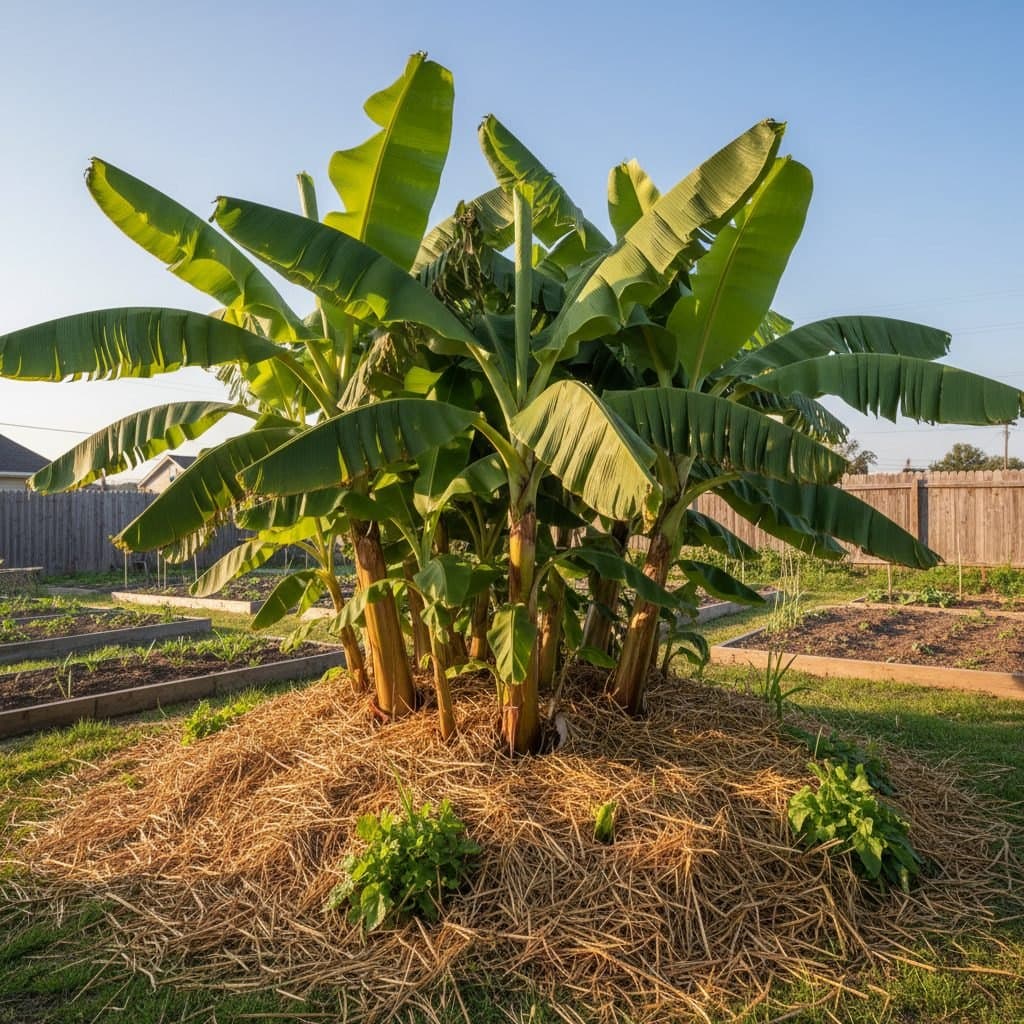
Winterizing is the most critical step for perennial banana survival in marginal zones. In late fall, after the first hard frost has killed back the leaves and pseudostems, cut the pseudostems down to 12-24 inches above the ground. This stub will protect the crown and rhizome. Then, apply a thick layer of mulch (12-24 inches of straw, wood chips, or shredded leaves) over the entire root zone. This insulation helps maintain a more stable soil temperature, preventing deep freezes that can damage the rhizome. In regions with heavy winter rainfall or snow, consider placing a waterproof cover, like a tarp or plastic sheeting, over the mulch to shed rain; weight the edges but leave the sides open, since a sealed cover traps condensation against the crown and causes the rot it was meant to prevent. Remove this cover in early spring when temperatures begin to rise, typically in April, to allow the soil to warm up and new shoots to emerge. With proper protection, banana plants can return year after year in temperate gardens.
- Planting time: Late spring (May-June) when soil is above 60°F.
- Soil amendment: Incorporate 20-30% organic matter for drainage and fertility.
- Fertilization: Apply a nitrogen-forward organic fertilizer every 4-6 weeks.
- Winter cutback: Reduce pseudostems to 12-24 inches after first hard frost.
- Deep mulching: Apply 12-24 inches of insulating material over the root zone.
Comparison of Cold-Hardy Banana and Plantain Varieties
Variety | USDA Zone (Rhizome) | Fruit Edibility | Primary Use in Cold Zones |
|---|---|---|---|
Musa basjoo (Japanese Fiber Banana) | 6-10 (0°F with protection) | Seedy, not typically eaten fresh | Biomass, ornamental, windbreak |
Musa sikkimensis (Darjeeling Banana) | 7-10 (10-15°F with protection) | Seedy, can be cooked when ripe | Ornamental, biomass, potential for cooked fruit |
Generic Plantain Cultivar | 9-10 (25°F without protection) | Starchy, cooked when green or ripe | Highly challenging, usually not viable for fruit |
Rhizome Hardiness: <i>Musa basjoo</i> rhizomes can survive temperatures as low as 0°F when protected by 12-24 inches of mulch.
Growth Rate: Cold-hardy bananas can grow 10-15 feet in a single growing season from their protected rhizome.
Water Needs: Mature banana plants require 1-2 inches of water per week during peak growth periods for optimal health.
Frequently asked questions
Can I really get edible bananas from cold-hardy varieties in zones 6-7?
While it is possible to get fruit from cold-hardy varieties like <i>Musa basjoo</i>, it is not guaranteed in zones 6-7. The growing season of 150-200 days might be just long enough for fruit to develop, but it often won’t fully ripen or will be seedy. The primary benefit in these zones is usually the plant’s tropical aesthetic and biomass production.
What is the best way to protect banana rhizomes in winter?
The most effective method for winter protection involves cutting the pseudostems down to 12-24 inches after the first hard frost. Then, apply a substantial layer of mulch, 12-24 inches deep, over the entire root zone. This insulation helps keep the soil temperature stable and prevents the rhizome from freezing solid, allowing it to regrow in spring.
How much sun do cold-hardy bananas need?
Cold-hardy bananas, like all bananas, are sun-loving plants. They require at least 8-10 hours of direct sunlight per day for optimal growth and potential fruit production. Planting them in a full-sun location, especially one with a south-facing exposure, can significantly improve their performance in marginal zones.
What kind of soil do cold-hardy bananas prefer?
Bananas thrive in rich, well-drained soil with a slightly acidic to neutral pH, ideally between 6.0 and 7.0. They are heavy feeders and benefit greatly from high organic matter content, so amending your soil with 20-30% compost or well-rotted manure before planting is highly recommended for vigorous growth.
How often should I fertilize my banana plants?
During the active growing season, from late spring through early fall, established banana plants are heavy feeders and benefit from fertilization every 4-6 weeks. Use an organic fertilizer with a nitrogen-forward analysis, or consistently apply compost tea to provide the nutrients for their rapid growth.
Can I grow plantains in USDA zone 7 with extra protection?
Attempting to grow plantains in USDA zone 7 is extremely challenging for fruit production. Most plantain cultivars are reliably hardy only in zones 9-10, where temperatures rarely drop below 25°F. While you might keep the rhizome alive with exceptional winter protection, the growing season in zone 7, typically 150-200 days, is usually insufficient for the plant to mature and produce edible fruit.