Key takeaways
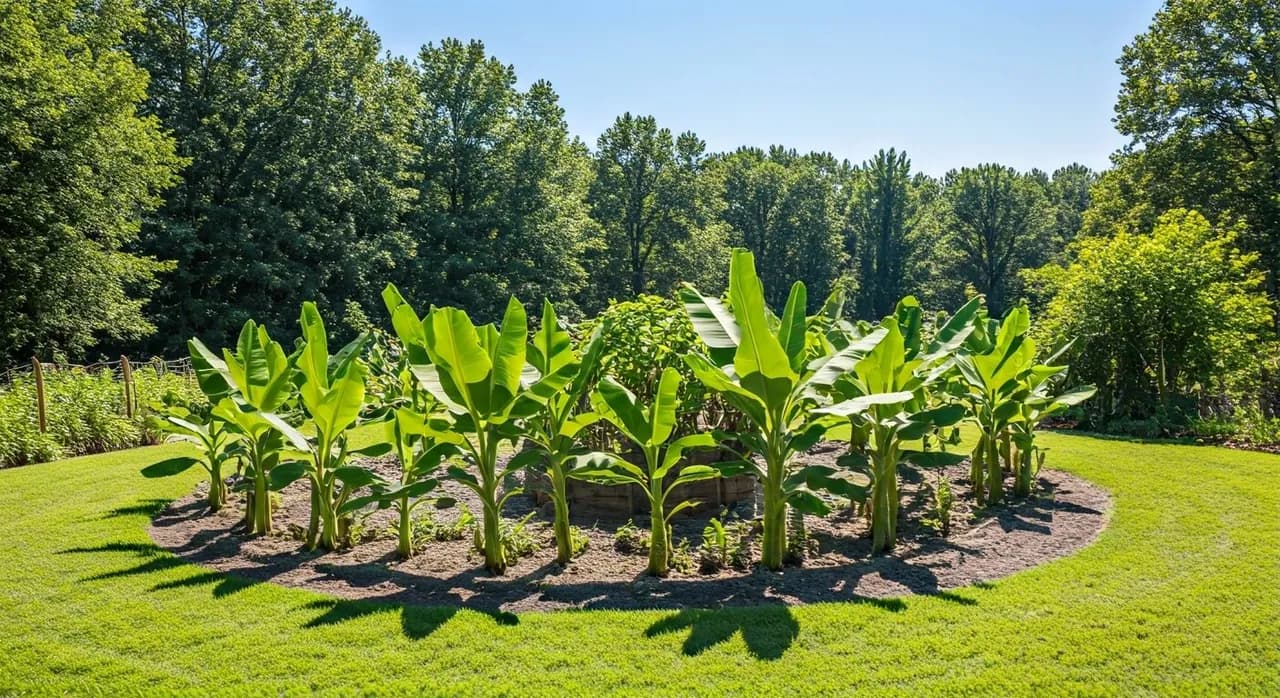
- A banana circle is a permaculture design feature, typically 10-15 feet in diameter, centered around a 4-6 foot wide compost pit, designed to grow bananas and other moisture-loving plants.
- These systems are particularly well-suited for US hardiness zones 8-11 including regions like Florida, the Gulf Coast, Texas, Southern California, and Hawaii, where frost is minimal or manageable.
- The central compost pit acts as a continuous nutrient and water source, so the circle needs less supplemental irrigation than conventionally spaced plantings.
- Plant guilds, incorporating nitrogen fixers, dynamic accumulators, and groundcovers, support the banana circle’s productivity and resilience, mimicking natural forest systems.
- Careful site selection, with at least six hours of direct sunlight daily and well-draining soil, helps establish a healthy, productive banana circle.
- Ongoing maintenance involves regularly feeding the compost pit with organic materials and managing banana suckers to maintain plant vigor and fruit production.
Quick answer: A banana circle is a permaculture design feature, typically 10-15 feet in diameter with a central compost pit, that thrives in US hardiness zones 8-11, including Florida, the Gulf Coast, Texas, Southern California, and Hawaii.
In humid Florida, where average annual temperatures often exceed 70°F, or along coastal Southern California, the banana circle offers a water-wise approach to growing food. Centered around a continuously fed compost pit, this system creates a microclimate supporting bananas alongside other useful plants. For US growers in USDA hardiness zones 8 through 11, including regions like the Gulf Coast, parts of Texas, and Hawaii, the banana circle can be a highly efficient way to cultivate tropical and subtropical edibles.
A well-designed banana circle maximizes nutrient cycling and water retention, making it a resilient addition to a food forest or backyard garden. As climate patterns shift, potentially extending warmer growing seasons into areas previously considered marginal for tropical plants [1], understanding these systems becomes even more valuable. Understanding the mechanics of a banana circle and its suitability for specific US zones provides practical guidance for establishing one.
What is a banana circle?
A banana circle is a circular planting system, a core component of permaculture design, that typically spans 10 to 15 feet in overall diameter. In the center lies a compost pit, usually 4 to 6 feet wide and 2 to 3 feet deep, which acts as a water reservoir and nutrient source. This pit is filled with organic matter (kitchen scraps, garden trimmings, wood chips, and leaves) that slowly breaks down to feed the surrounding plants.
How a banana circle works
The primary function of the central pit is to collect and retain water, mimicking a small swale or rain garden. When it rains, water flows into the pit, percolating slowly into the surrounding soil. This consistent moisture, combined with the rich nutrients from decomposition, creates an ideal environment for bananas and other moisture-loving plants to thrive. Around the pit’s perimeter, typically six to eight banana plants are positioned, benefiting directly from the enriched soil and steady water supply. This design holds water in the root zone longer than traditional row planting, so it needs less supplemental irrigation, especially in drier periods.
- Water harvesting: The central pit collects rainwater and runoff, directing it to plant roots.
- Nutrient cycling: Organic matter in the pit breaks down, providing a steady supply of nutrients.
- Microclimate creation: The dense planting and moisture create a humid, sheltered environment.
- Waste reduction: Utilizes garden and kitchen waste for composting in place.
- Soil improvement: Continuously enriches and aerates the soil around the circle.
Why zones 8-11 are ideal for bananas
Bananas (Musa spp.) are tropical plants that thrive in warm, humid conditions and are highly sensitive to frost. The USDA Plant Hardiness Zone Map categorizes regions based on their average annual extreme minimum winter temperature. Zones 8 through 11 provide the necessary warmth for bananas to grow and fruit reliably, with zone 10 and 11 being optimal.
Understanding banana cold tolerance
In USDA zone 8, which includes parts of the Gulf Coast states like Louisiana and Alabama, as well as northern Florida and central Texas, winter temperatures can dip to 10°F to 20°F. Cold-hardy varieties like ‘Orinoco’ or ‘Raja Puri’ can come back from the rhizome after a zone 8 winter, but only where the rhizome is insulated under a deep mulch. A hard freeze kills the top growth outright, so the plant restarts from the ground in spring and fruiting is delayed or lost for the season. In contrast, zones 9 (20°F to 30°F), 10 (30°F to 40°F), and 11 (above 40°F) offer progressively milder winters, allowing banana pseudostems to overwinter and produce fruit more quickly, often within 9-12 months of planting. Hawaii spans a wide range of USDA zones with elevation, from 12 and 13 in the warm lowlands down to zone 9 and below on the upper slopes, and its lowland areas support close to continuous banana production.
- Zone 8: Minimum temperatures of 10°F to 20°F; requires cold-hardy varieties and winter protection.
- Zone 9: Minimum temperatures of 20°F to 30°F; good for many varieties with occasional protection.
- Zone 10: Minimum temperatures of 30°F to 40°F; excellent for most banana types, minimal protection needed.
- Zone 11: Minimum temperatures above 40°F; ideal for continuous, year-round banana growth and fruiting.
- Microclimates: Urban heat islands and sheltered garden spots run warmer than open ground on a cold night, which can be the difference between dieback and survival.
Designing your banana circle: plant guilds and water management
Beyond the bananas themselves, a banana circle incorporates supporting plants, forming a guild that supports overall health and productivity. These plant guilds work together to provide nutrients, deter pests, suppress weeds, and improve soil structure, reducing the need for external inputs. This approach follows permaculture design principles, focusing on integrated polycultures (Permaculture design: how to read a site before you plant it).
Strategic plant selection for guilds
Around the banana plants, consider layering with species that offer various benefits. For instance, nitrogen-fixing plants like pigeon pea (Cajanus cajan) can enrich the soil, while sterile Bocking 14 comfrey (Symphytum x uplandicum ‘Bocking 14’) produces bulky leaf mulch that can be chopped and dropped. Use the sterile cultivar instead of common comfrey, which sets seed and self-sows, and treat comfrey as mulch only (its pyrrolizidine alkaloids are hepatotoxic, so it is not food and not fodder). Groundcovers like sweet potato (Ipomoea batatas) help suppress weeds and retain soil moisture while yielding an edible crop. Taro (Colocasia esculenta) does the same job in the wettest ground, though its corms and leaves contain calcium oxalate and must be cooked thoroughly before eating, and it has escaped into wetlands across the warm South, so check your state list before planting it. Lemongrass (Cymbopogon citratus) can act as a pest deterrent and its dense growth helps define the circle’s edge. The goal is to create a multi-layered, self-sustaining ecosystem that supports the bananas and provides additional harvests, often yielding 20-30 pounds of diverse produce per year from a single circle.
- Nitrogen fixers: Pigeon pea, perennial peanut (Arachis glabrata), or specific clovers add nitrogen to the soil.
- Dynamic accumulators: Bocking 14 comfrey (sterile, does not set seed), yarrow (Achillea millefolium), or borage (Borago officinalis) produce heavy leaf mulch. Comfrey is mulch only; do not eat it or feed it to livestock.
- Groundcovers/mulchers: Sweet potato, taro, or perennial basil suppress weeds and conserve moisture.
- Pest deterrents: Lemongrass, marigolds (Tagetes spp.), or garlic chives (Allium tuberosum) can help manage insect pressure.
- Support plants: Small shrubs or trellises for climbing beans can add vertical layers and additional yields.
Site selection and maintenance for success
Establishing a productive banana circle requires careful consideration of its location and ongoing management. The success of your circle, particularly in zones like USDA zone 8 where conditions can be borderline for some banana varieties, hinges on maximizing sunlight exposure and maintaining rich, moist soil. A properly sited and maintained circle can yield 50-100 pounds of bananas annually from its primary plants.
Optimizing for growth and yield
Choose a site that receives at least six to eight hours of direct sunlight per day. While bananas tolerate some shade, full sun promotes faster growth and better fruit production. The soil around the pit should be well-draining but rich in organic matter, with an ideal pH range of 6.0 to 7.0. Before planting, consider a soil test to understand existing conditions and amend as needed. Once established, regular maintenance involves continuously feeding the central compost pit with fresh organic materials. This ensures a steady supply of nutrients and helps maintain soil moisture. Pruning involves removing dead leaves and managing suckers; allow one or two strong suckers to grow alongside the main plant to ensure continuous production after the main stalk fruits and dies. For more general permaculture maintenance, see Permaculture gardening: no-dig beds, guilds, and zones.
- Sunlight: Ensure a minimum of six hours of direct sun daily for optimal growth and fruiting.
- Soil pH: Aim for a slightly acidic to neutral range, typically 6.0 to 7.0, for nutrient availability.
- Compost replenishment: Add fresh organic materials to the central pit weekly or bi-weekly to sustain fertility.
- Sucker management: Allow one or two strong suckers to mature for future fruit production, removing excess ones.
- Mulching: Maintain a 4-6 inch layer of mulch around the plants to conserve moisture and suppress weeds.
Expanding your permaculture vision
A banana circle is just one component of a larger permaculture system, but its principles of water conservation, nutrient cycling, and plant guilds can be applied throughout your garden. By observing how these elements interact, you can design more resilient and productive gardens. Consider how other perennial food systems, like a diverse food forest, could integrate with your banana circle, providing year-round harvests and ecological benefits.
Integrating with other systems
For example, the water-retention capabilities of a banana circle can be mirrored by implementing swales or rain gardens in other parts of your property, further reducing how much you need to irrigate. The concept of plant guilds can be extended to fruit trees, where beneficial understory plants support the main crop, as detailed in resources like A permaculture garden plan: zones, guilds, and a first-year layout. Even in zones where bananas are not viable, the underlying principles of creating self-sustaining plant communities remain relevant. For instance, while you might not grow bananas in USDA zone 6, you can still apply guild principles to apple trees or berry bushes, using sterile Bocking 14 comfrey and clover to support their productivity and health. The goal is to create a garden that works with nature, minimizing inputs and maximizing outputs over the long term.
- Food forests: Integrate banana circles into larger multi-layered food forests for diverse yields.
- Swales and earthworks: Use contour planting and water-harvesting earthworks to spread water retention throughout the property.
- Perennial vegetables: Incorporate other long-lived edible plants that require less annual disturbance.
- Pollinator habitats: Plant flowering species that attract beneficial insects, improving overall garden health.
- Biomass production: Grow plants specifically for chop-and-drop mulching to feed the soil continuously.
Banana Circle vs. Traditional Row Planting
Feature | Banana Circle | Traditional Row Planting |
|---|---|---|
Water Use | Low; central pit collects and retains water, cutting supplemental irrigation | High; requires consistent external irrigation, often 1-2 inches per week |
Nutrient Cycling | High; continuous decomposition in central pit provides steady nutrients | Moderate; relies on external fertilizers, often applied monthly or quarterly |
Plant Diversity | High; supports bananas, groundcovers, nitrogen fixers, and other guild plants | Low; typically monoculture of bananas or limited companion plants |
Weed Suppression | High; dense planting and groundcovers naturally suppress weeds | Low; requires manual weeding or herbicides, often weekly or bi-weekly |
Soil Health | Excellent; builds organic matter and improves soil structure over time | Variable; can degrade soil structure without regular organic amendments |
Labor Input | Moderate; initial setup, then mostly feeding compost and harvesting | High; regular tilling, fertilizing, weeding, and pest management |
Water Savings: A banana circle concentrates rain and runoff in the root zone, so it needs less supplemental irrigation than conventional planting.
Yield Potential: A single mature banana circle can produce between 50 and 100 pounds of bananas annually, in addition to yields from guild plants.
Soil pH: Bananas thrive in slightly acidic to neutral soil, with an optimal pH range of 6.0 to 7.0 for nutrient uptake.
Frequently asked questions
How much space does a banana circle require?
A typical banana circle, including the central compost pit and surrounding plants, generally requires an area 10 to 15 feet in diameter. The central pit itself is usually 4 to 6 feet wide and 2 to 3 feet deep.
What kind of bananas can I grow in a banana circle in zone 8?
In USDA zone 8, you’ll need to select cold-hardy banana varieties such as ‘Orinoco’, ‘Raja Puri’, or ‘Ice Cream’ (Blue Java). With the rhizome insulated under a deep mulch, these varieties can come back after lows of 10°F to 20°F, though the top growth dies to the ground and regrows in spring.
How often do I need to add material to the compost pit?
For optimal nutrient cycling and moisture retention, you should aim to add organic materials to the central compost pit weekly or bi-weekly. This continuous feeding ensures a steady supply of nutrients for the surrounding banana plants and guild members, supporting up to 100 pounds of fruit per year.
Can I grow other fruits or vegetables in a banana circle?
Yes, a banana circle is designed to support a diverse plant guild. You can grow moisture-loving plants like sweet potato, taro, ginger, turmeric, and various herbs and leafy greens in the outer rings. These plants benefit from the enriched soil and consistent moisture, often adding 20-30 pounds of additional produce.
What are the main benefits of a banana circle?
The main benefits include water conservation, efficient nutrient cycling through in-situ composting, improved soil health, and increased biodiversity in the garden. It also provides a high yield of bananas and other edible crops from a relatively small footprint.
References
- Climate change is shifting the zones where plants grow – here’s what that could mean for your garden (2024). Climate change is shifting the zones where plants grow – here’s what that could mean for your garden.