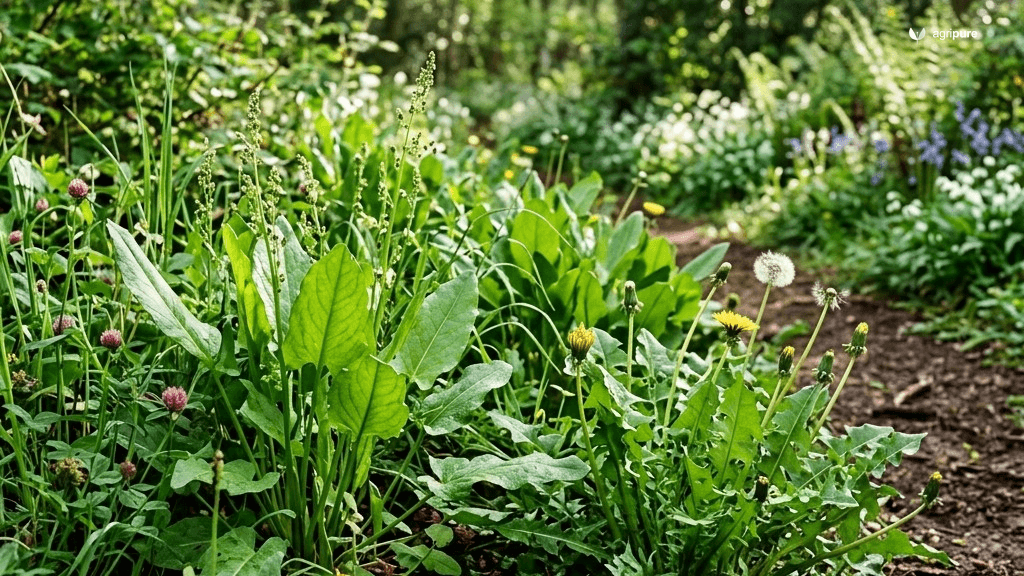
Most leafy-green advice assumes a tidy annual bed: sow lettuce in spring, harvest, repeat. But the most resilient greens a regenerative grower can plant are the ones that come back on their own: true perennials, self-seeding pioneers, and the so-called weeds that colonise bare ground whether you invite them or not. They feed you in the lean months when sown crops have bolted or died back, and most double as living mulch that rebuilds tired soil.
This guide covers cultivated and naturalised greens for garden planting. Every plant here can be deliberately grown or encouraged in a bed, a food forest understorey, or a pond edge, chosen by your climate so that there is a reliable perennial green for almost every zone on Earth. We have keyed each one to USDA hardiness zones, the UK’s RHS H-rating, and Australian climate zones so the list works wherever you garden.
How to read “perennial” across hardiness systems

Foraged perennial leafy greens offering high mineral content from early spring regrowth.
The word perennial is slippery, and hardiness ratings are the reason. A plant that lives for years in a frost-free climate often behaves as an annual where winters are hard. Several greens on this list cheat the rules entirely by self-seeding so prolifically that the patch is effectively permanent even when each individual plant dies.
Three scales describe the same thing (cold tolerance) from different angles:
- USDA zones (1–13): based on average annual minimum temperature; the lower the number, the colder-hardy the plant.
- RHS H-rating (H1a–H7): the UK and European scale running the other way: H7 is the toughest, surviving below −20°C, while H1c plants need warmth and tolerate no frost.
- Australian climate zones: descriptive bands (cool-temperate, warm-temperate, Mediterranean, subtropical, arid, tropical) that map roughly onto the same gradient.
Read across all three and you can place any green on this list. A cold-zone gardener in USDA 4 looks to the H6–H7 plants; a grower in tropical Queensland or coastal Kerala wants the H1c end of the range.
Cold zones: USDA 3–6 (RHS H7–H5, cool-temperate)
The greens that survive a genuine freeze are the deep-rooted survivors of the temperate world, and two of the best are usually pulled up as weeds.
Dandelion (Taraxacum officinale)
The dandelion is the cold-zone anchor of any forager’s planting list. Rated to USDA 3 (RHS H7), it is a genuine herbaceous perennial that shrugs off winters down to roughly −40°C and returns from its taproot every spring. Young leaves are a bitter, mineral-rich salad green; the roots are roasted as a coffee substitute and used medicinally.
As a regenerative pioneer it is hard to beat. The fleshy taproot drives 25–40 cm or more into compacted ground, opening channels for air and water and mining potassium, calcium and phosphorus from the subsoil. When the leaves and root die back, those minerals return to the topsoil for shallower-rooted neighbours: classic dynamic-accumulator behaviour. Plant it where you want to break up a hardpan, not where you want a manicured lawn.
Bathua / lamb’s quarters (Chenopodium album)
Known as bathua across South Asia and lamb’s quarters or fat-hen in the West, Chenopodium album is a self-seeding annual that behaves as a perennial: one plant sets enormous quantities of seed, so once it is established the patch returns reliably each year. It is rated USDA 3–10 (RHS H5) and grows across cool-temperate to arid and subtropical zones.
Nutritionally it rivals spinach (a close relative of both spinach and quinoa) with tender leaves for saag and curries and grain-like seeds. Ecologically it is a textbook pioneer of disturbed ground, one of the first colonisers of bare or broken soil, where it stabilises the surface, accumulates nitrogen and minerals, and feeds them back when it decomposes. Let a few plants stand at the edge of a new bed and you get both greens and a free cover crop.
Other reliable cold-zone perennial greens to interplant include sorrel, Good King Henry and perennial kale; but dandelion and bathua ask nothing of you and give the most back to the soil.
Temperate and Mediterranean zones: USDA 7–9 (RHS H4–H2)
This is the broadest band, and the one where annual-versus-perennial behaviour shifts most. Many warm-season greens that die at the first frost in USDA 6 overwinter or self-seed indefinitely here.
Purslane (Portulaca oleracea)
Purslane is the standout for warm-temperate, Mediterranean and arid gardens. Rated USDA 9–11 (RHS H2), this low, succulent groundcover thrives in heat and poor, dry soil where most greens fail, self-seeding so freely that it returns year after year. Its claim to fame is nutritional: wild purslane carries the highest level of the omega-3 fatty acid alpha-linolenic acid (ALA) of any leafy green vegetable measured (several times that of spinach) alongside good potassium, magnesium and vitamin C.
As a pioneer it forms a dense, moisture-holding mat over bare ground, shading the soil surface, cutting evaporation and suppressing erosion on the disturbed, sun-baked sites it favours. Use it as a fast living mulch between slower perennials in a dry-climate bed.
For Mediterranean and warm-temperate growers, this band also suits perennial rocket, tree spinach and watercress in damp spots, but purslane is the one that turns a hot, neglected corner into a harvest.
Subtropical and tropical zones: USDA 9–12 (RHS H2–H1c)
In the tropics the problem is reversed: temperate spinaches and lettuces bolt and collapse in the heat. The answer is a set of heat-loving perennial greens that shine when the thermometer climbs.
Chaulai / amaranth greens (Amaranthus tricolor)
Vegetable amaranth (chaulai in India, callaloo in the Caribbean) is the summer green that takes over when others wilt. Rated USDA 10–11 (RHS H2), it is frost-tender but exceptionally heat-, drought- and poor-soil-tolerant, and as one of the few C4 leafy crops it is remarkably water-efficient. The protein-rich leaves carry vitamin C, carotenoids and the amino acids lysine and methionine. Grown as a fast self-seeding pioneer, it produces edible greens within weeks and reseeds itself for the next flush.
Malabar spinach (Basella alba)
Where regular spinach surrenders to summer, Basella alba takes over. Rated USDA 10–12 (RHS H1c), this twining, semi-succulent vine is a tender perennial in the tropics (grown as a summer annual elsewhere) that thrives above 32°C and produces glossy, mild, mucilaginous leaves used like spinach in soups, stir-fries and curries. As a vigorous climber it provides quick vertical ground cover, shading soil and structures while it crops.
Water spinach (Ipomoea aquatica)
For wet ground, ponds and the margins of paddy and aquaculture systems, water spinach is the tropical workhorse. Rated USDA 9–11 (RHS H1c), it is a fast-growing perennial in frost-free climates, used both as a tender leafy vegetable and as fodder. It is a pioneer of waterlogged and nutrient-rich water, where its rapid growth takes up surplus nutrients (useful in integrated pond systems), though it must be contained: in the United States it is listed as a federal noxious weed, and importing or moving it across state lines without a permit is prohibited.
Gotu kola (Centella asiatica)
For the damp, shaded understorey of a tropical or subtropical food forest, Centella asiatica is the perennial ground cover of choice. Rated USDA 9–12 (RHS H2), this low, creeping plant spreads by stolons that root at each node, knitting bare soil into a living carpet within a season. The kidney-shaped leaves are eaten fresh in salads and leaf drinks and prized medicinally. It is happiest in moist soil and partial shade: the niche under taller plantings that bare-soil annuals never fill.
A zone-keyed quick-reference list
Plant | USDA | RHS | Best zones | Pioneer role |
|---|---|---|---|---|
Dandelion | 3–9 | H7 | Cool-temperate | Deep taproot breaks compaction; mines subsoil minerals |
Bathua / lamb’s quarters | 3–10 | H5 | Cool-temperate to arid | Colonises disturbed soil; accumulates N and minerals |
Purslane | 9–11 | H2 | Warm-temperate, Mediterranean, arid | Succulent living mulch; cuts evaporation on bare ground |
Amaranth (chaulai) | 10–11 | H2 | Subtropical, tropical | Fast self-seeding cover for hot, poor soils |
Malabar spinach | 10–12 | H1c | Tropical, subtropical | Vigorous climber; quick vertical shade cover |
Water spinach | 9–11 | H1c | Tropical, subtropical (wet) | Takes up surplus nutrients in water systems |
Gotu kola | 9–12 | H2 | Tropical, subtropical (shade) | Stoloniferous carpet for damp, shaded understorey |
Why these greens rebuild soil and provide food
Every plant on this list is classed in our database as a pioneer: the ecological role that colonises bare or degraded ground and prepares it for what follows. This ecological role explains why they are so easy to grow. Pioneers earn their keep three ways: deep roots like the dandelion’s break compaction and lift minerals from the subsoil; sprawling growers like purslane and gotu kola shade the surface so it holds moisture and resists erosion; and fast, leafy species like bathua and amaranth pull nutrients into their tissue and release them when chopped back as mulch or left to decompose.
The method is the same in every zone: let a few plants of the right pioneer establish on your worst ground, harvest the leaves you want, and return the rest to the soil as mulch. Over a season or two the patch shifts from bare and compacted toward crumbly, covered and alive, providing greens along the way.
Frequently asked questions
Are these plants invasive if I deliberately grow them?
Some can be. Pioneers spread by design, which is what makes them useful and what makes them weeds. Bathua and amaranth self-seed heavily, and water spinach is a federal noxious weed in the United States (banned from import and interstate movement without a permit, and regulated in some sixteen states). Grow them where you can manage spread: harvest before they set all their seed, contain water spinach to a defined pond, and check your local regulations before planting anything naturalised.
Can I grow the tropical greens in a cold climate?
Yes, as warm-season annuals. Malabar spinach, amaranth and water spinach are frost-tender, but in a cool-temperate summer they will crop happily from a spring sowing until the first autumn frost. You simply replant each year because they do not overwinter.
Which of these is the single best soil-builder to start with?
For compacted or poor soil in a temperate garden, start with dandelion: its taproot does the deepest work and it survives almost any winter. In a hot or tropical garden, purslane (dry ground) or gotu kola (damp shade) will cover and protect bare soil fastest.
Sources
- Purslane Weed (Portulaca oleracea): A Prospective Plant Source of Nutrition, Omega-3 Fatty Acid, and Antioxidant Attributes — PMC
- A Compiled Update on Nutrition, Phytochemicals and Health Effects of Chenopodium album — PMC
- Malabar spinach, Basella alba — University of Wisconsin Horticulture Extension
- Centella asiatica (Gotu Kola) — NC State Extension Gardener Plant Toolbox
- Dandelions — University of Minnesota Extension
- Amaranthus tricolor — NC State Extension Gardener Plant Toolbox
- Water Spinach (Ipomoea aquatica) — USDA National Invasive Species Information Center