Key takeaways
- Select persimmon varieties (Diospyros virginiana or Diospyros kaki) based on your USDA hardiness zone, typically 4 through 10.
- Understand the difference: astringent varieties like ‘Hachiya’ must be fully soft to eat, while non-astringent ‘Fuyu’ can be enjoyed firm.
- Plant persimmons in well-drained soil with a pH between 6.0 and 7.0 to ensure at least 6 hours of direct sunlight daily.
- Provide consistent moisture, especially during the first two years, aiming for 1 inch of water per week.
- Prune young trees to establish a strong central leader or open vase shape, removing dead or crossing branches annually in late winter.
- Ripen astringent persimmons by placing them in a paper bag with an apple or banana for 3 to 7 days to accelerate ethylene gas exposure.
Quick answer: To care for persimmons in USDA zone 6, select cold-hardy American varieties or specific Asian types to ensure well-drained soil, 6+ hours of sun, and consistent watering. Differentiate between astringent varieties, eaten when fully soft, and non-astringent types, which can be enjoyed firm.
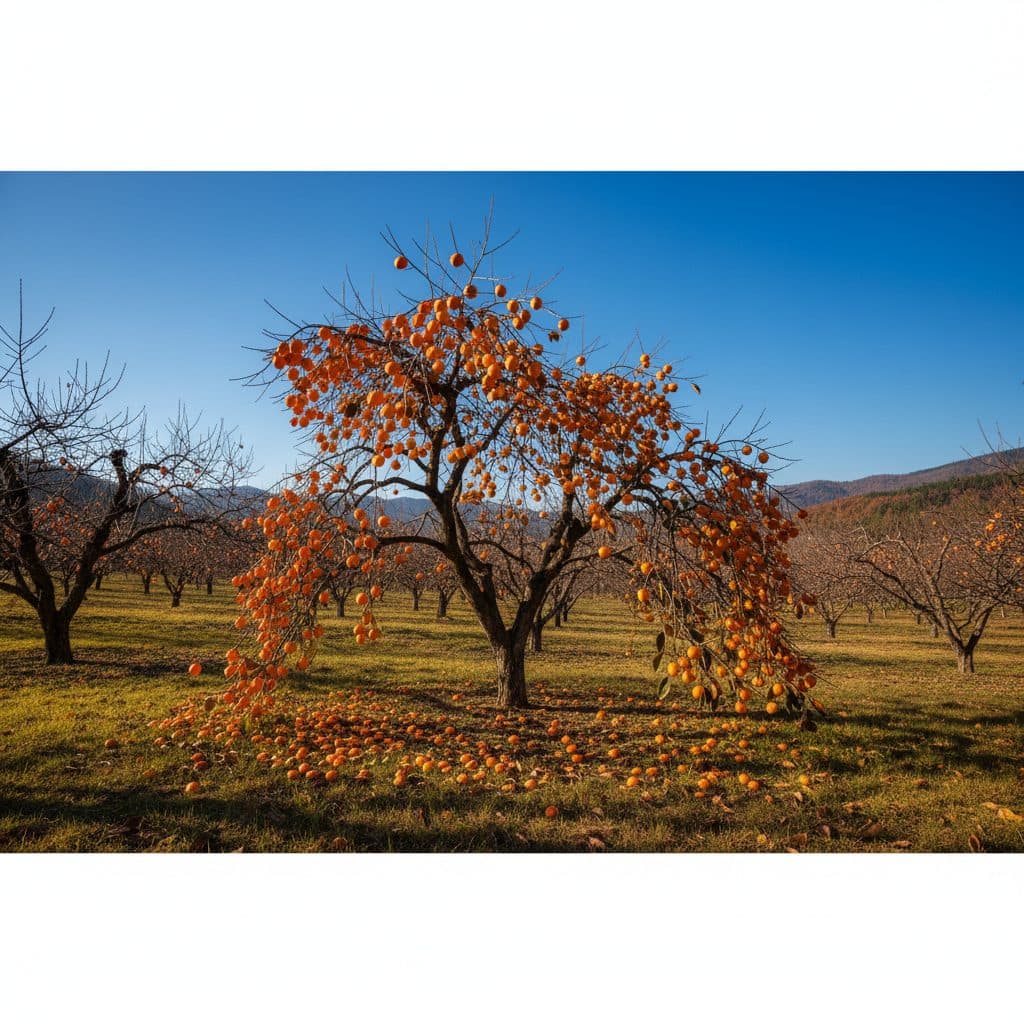
For many home growers across the United States, from USDA zone 4 to 10, persimmon trees offer a rewarding harvest of sweet, flavorful fruit in the late fall. These deciduous trees represent two main species, the American persimmon (Diospyros virginiana) and the Asian persimmon (Diospyros kaki), growing 20 to 60 feet tall. Understanding the specific needs of these trees, particularly the distinction between astringent and non-astringent varieties, helps ensure a productive orchard.
In 1925, Sherwood Persimmon and Walnut Nurseries offered a range of persimmon varieties, indicating a long history of cultivation in the US [1]. Today, home growers continue this tradition, often seeking to produce fruit that can be eaten fresh or preserved. Managing persimmon care involves matching varieties to regional hardiness, establishing planting depth and irrigation, and timing harvest according to astringency type.
Choosing the right persimmon for your climate and taste
Selecting the appropriate persimmon variety is the first critical step for any home grower. American persimmons (Diospyros virginiana) are generally more cold-hardy, thriving in USDA zones 4 through 9, and can tolerate temperatures down to -25°F. American persimmons are dioecious (a tree is either male or female), so a male within pollination range is usually needed for seeded fruit, though several named female cultivars set seedless fruit parthenocarpically without one. Asian persimmons (Diospyros kaki), on the other hand, prefer warmer climates, typically USDA zones 7 through 10, and are sensitive to temperatures below 0°F. Many Asian varieties are parthenocarpic, meaning they can produce seedless fruit without pollination, which simplifies orchard planning. For those in colder regions, exploring cold-hardy fruit and nut trees is essential.
Astringent versus non-astringent varieties
The primary distinction between persimmon types lies in their astringency. Astringent varieties, such as ‘Hachiya’ (Asian) or most American persimmons, contain high levels of tannins when unripe, causing a puckering sensation if eaten before fully soft. These fruits are typically bell-shaped or conical. Non-astringent varieties, like ‘Fuyu’ (Asian), have lower tannin levels and can be eaten firm, similar to an apple, without the unpleasant taste. These are often squat and tomato-shaped. Understanding this difference dictates how and when to harvest the fruit.
- Astringent examples: ‘Hachiya’, ‘Saijo’, ‘Eureka’, most Diospyros virginiana cultivars.
- Non-astringent examples: ‘Fuyu’, ‘Jiro’, ‘Izu’, ‘Suruga’.
- Hardiness considerations: American persimmons down to USDA zone 4; Asian persimmons typically USDA zone 7.
- Fruit shape: Astringent often conical; non-astringent often squat.
Planting and initial care for young persimmon trees
Once you have selected your persimmon variety, proper planting is essential for establishing a healthy tree. Persimmons prefer full sun, meaning at least 6 hours of direct sunlight per day, and well-drained soil. A soil pH between 6.0 and 7.0 is ideal for optimal growth, which can be monitored with a soil pH test. Dig a hole twice as wide as the root ball and just as deep to ensure the tree is planted at the same depth it was in the nursery container. Backfill with native soil, avoiding excessive amendments that can create drainage issues. Young trees, especially those under two years old, benefit from a 2-inch layer of mulch around the base, keeping it 3 inches away from the trunk to prevent pest issues.
Watering and early pruning techniques
Newly planted persimmon trees require consistent watering. Provide 1 inch of water per week, either through rainfall or irrigation, for the first two growing seasons. A soil moisture meter can help determine when to water, keeping the top 6 inches of soil moist but not waterlogged. Drip irrigation delivers water efficiently to the root zone. Pruning young trees focuses on establishing a strong structure. In the first year, select a central leader and 3 to 5 well-spaced scaffold branches. Remove any branches growing at narrow angles or below 18 inches from the ground to establish the framework for future fruit production.
- Sunlight requirement: At least 6 hours of direct sun daily.
- Ideal soil pH: Between 6.0 and 7.0.
- Watering for young trees: 1 inch per week for the first two years.
- Mulch depth: 2 inches, kept 3 inches from trunk.
Ongoing care: fertilizing, pruning mature trees, and pest management
As your persimmon tree matures, its care routine shifts to maintenance and pest prevention. Fertilize established trees annually in early spring, before new growth begins. A balanced fertilizer, such as a 10-10-10 granular formula, applied at a rate of 1 pound per inch of trunk diameter (measured 1 foot above ground) is generally sufficient. Avoid over-fertilizing, which can promote excessive vegetative growth at the expense of fruit production. In regions like California’s Central Valley, where persimmons are widely grown, a mature tree might require 5 to 10 pounds of fertilizer per year. Monitor soil nutrient levels every 2 to 3 years to adjust your fertilization program.
Pruning for fruit production and health
Pruning mature persimmon trees, typically done in late winter while the tree is dormant, focuses on maintaining tree health and maximizing fruit yield. Remove any dead, diseased, or damaged branches to limit wood-rot fungi and cankers. Thin out crowded branches to improve air circulation and sunlight penetration into the canopy, which can increase fruit quality and reduce fungal problems. For American persimmons, which can reach 60 feet tall, annual pruning helps manage size for easier harvesting. Aim to remove no more than 20% of the canopy in any given year. Persimmons fruit on the current season’s shoots, which grow from last year’s wood, so head those one-year-old shoots back sparingly; cutting them off removes the buds that would have carried this year’s crop.
- Fertilizer type: Balanced 10-10-10 granular formula.
- Application rate: 1 pound per inch of trunk diameter.
- Pruning season: Late winter, during dormancy.
- Canopy removal limit: No more than 20% annually.
Harvesting and ripening persimmon fruit
The harvest season for persimmons typically runs from September through December, depending on the variety and your specific USDA zone. Astringent varieties, such as ‘Hachiya’, must be fully ripe and soft to the touch before eating. They will have a deep orange or reddish color and feel like a water balloon. Picking them too early will result in an unpleasant, mouth-puckering experience due to high tannin content. Non-astringent varieties, like ‘Fuyu’, can be harvested when they achieve a good orange color and are firm. They can be eaten immediately or stored for several weeks at room temperature or up to 2 months in refrigeration at 32°F.
Accelerating ripening for astringent fruit
If you have harvested astringent persimmons that are still firm, there are several methods to accelerate their ripening. One common technique is to place the fruit in a paper bag with an apple or banana. These fruits naturally release ethylene gas, which triggers the ripening process in persimmons. This method typically takes 3 to 7 days, depending on the initial ripeness of the persimmon. Another method is alcohol de-astringency: seal the fruit in an airtight container with a splash of spirits on a cloth. This removes the pucker over roughly one to two weeks, and the fruit stays firm rather than going soft. Once ripened, astringent persimmons are highly perishable and should be consumed within a few days or preserved. For preserving, consider methods outlined in a home canning guide, such as making jams or drying the fruit.
- Harvest season: September through December.
- Astringent ripeness: Fully soft, deep orange color.
- Non-astringent ripeness: Firm, good orange color.
- Ethylene ripening time: 3 to 7 days in a paper bag.
Astringent vs. non-astringent persimmons
Characteristic | Astringent Varieties (e.g., ‘Hachiya’) | Non-Astringent Varieties (e.g., ‘Fuyu’) |
|---|---|---|
Tannin Content (Unripe) | High, causes puckering | Low, no puckering |
Eating Stage | Must be fully soft and jelly-like | Can be eaten firm or soft |
Typical Shape | Conical or heart-shaped | Squat, tomato-shaped |
Primary Species | Most <em>Diospyros virginiana</em>, some <em>Diospyros kaki</em> | Most popular <em>Diospyros kaki</em> cultivars |
Cold Hardiness (Asian) | USDA zones 7-10 | USDA zones 7-10 |
American Persimmon Hardiness: American persimmons (Diospyros virginiana) are hardy to USDA zone 4, tolerating temperatures as low as -25°F.
Optimal Soil pH: Persimmon trees thrive in well-drained soil with a pH range of 6.0 to 7.0, which can be maintained with annual testing.
Watering Young Trees: Newly planted persimmons require 1 inch of water per week for their first two growing seasons to establish a strong root system.
Frequently asked questions
What is the main difference between astringent and non-astringent persimmons?
Astringent persimmons, like ‘Hachiya’, contain high levels of tannins when unripe, causing a bitter, puckering sensation if eaten before they are fully soft. Non-astringent varieties, such as ‘Fuyu’, have low tannin levels and can be eaten firm like an apple, or when soft, providing versatility in consumption. Most American persimmon varieties are astringent.
How often should I water a newly planted persimmon tree?
Newly planted persimmon trees require consistent moisture for the first two years to establish their root system. Provide approximately 1 inch of water per week, either from rainfall or supplemental irrigation. This ensures the top 6 inches of soil remains moist, but not waterlogged.
When is the best time to prune a mature persimmon tree?
The best time to prune a mature persimmon tree is in late winter, while the tree is dormant and before new growth begins. This timing minimizes stress on the tree and allows for clear visibility of the branch structure. Aim to remove no more than 20% of the canopy annually for optimal health and fruit production.
Can I grow persimmons in a cold climate like USDA zone 5?
Yes, you can grow persimmons in USDA zone 5, but you should choose cold-hardy American persimmon varieties (Diospyros virginiana). These trees are typically hardy down to -25°F. Asian persimmons (Diospyros kaki) are generally less cold-tolerant, usually suited for USDA zones 7-10.
How do I know when an astringent persimmon is ready to eat?
An astringent persimmon is ready to eat when it is fully soft to the touch, almost jelly-like, and has developed a deep orange or reddish color. It should feel like a water balloon when gently squeezed. Eating it before this stage will result in a very unpleasant, tart taste due to the high tannin content.
References
- Retail price list Sherwood Persimmon and Walnut Nurseries / (1925). Retail price list Sherwood Persimmon and Walnut Nurseries /.
- River Ebony, Gaub Persimmon or Indian Persimmon (2019). River Ebony, Gaub Persimmon or Indian Persimmon.
- Persimmon (2023). Persimmon.
- Persimmon cryptic virus (2021). Persimmon cryptic virus.